

This article was automatically translated from the original Turkish version.
+2 More
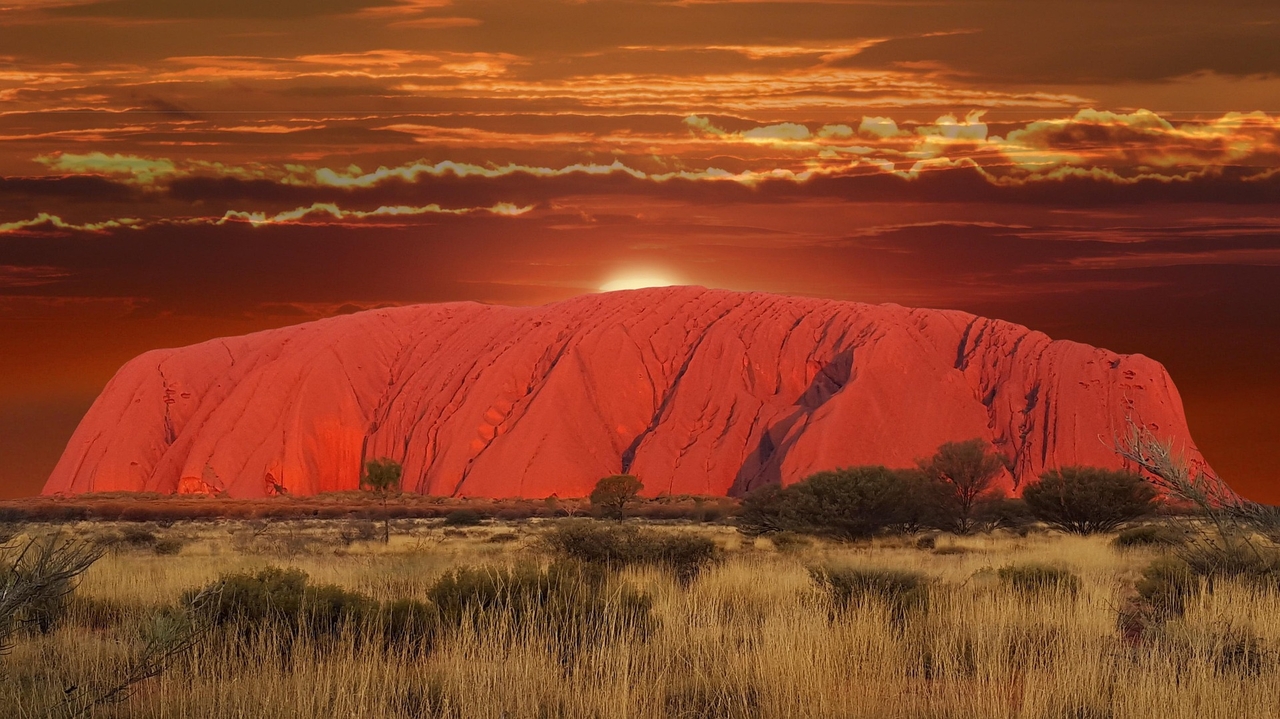
Uluru is a large sandstone monolith located within the boundaries of Uluru-Kata Tjuta National Park in the Northern Territory of Australia. The cracks, hollows and small caves on the rock are the result of prolonged geological erosion processes. For the Pitjantjatjara Anangu people, Uluru is considered sacred and is characterized by its geological structure, vegetation and rock formations. The vegetation observed in the region consists of species adapted to desert conditions.
The recording of Uluru by European explorers began in the 19th century. In 1873, William Christie Gosse became the first European to visit the area and named the rock Ayers Rock in honor of Sir Henry Ayers, Secretary of State for South Australia. Earlier, in 1872, William Ernest Giles had seen the region but did not reach the rock. The Horn Expedition (1894) provided scientific knowledge about the region’s geology, vegetation, animal life and Indigenous cultures. In 1920, Uluru and its surroundings were declared the South West Reserve under Australia’s conservation system, which limited access to a small number of European visitors. In the mid-20th century tourism activities increased and the first tourist facilities were established around Uluru in 1958.【1】

Uluru (Pixabay)
The recognition of Anangu land rights began in the 1970s. In 1976, the Northern Territory Land Rights Act came into effect and in 1985 the title deeds to Uluru-Kata Tjuta National Park were handed over to the Anangu people. Anangu leased the lands to the Australian National Parks and Wildlife Service and a shared management model for the park was established. In 1993 the park officially changed its name to Uluru-Kata Tjuta National Park to recognize Anangu traditional names. Uluru and its surroundings were inscribed on the World Heritage List in 1987 and 1994 for their natural and cultural significance.【2】
Uluru is located within the boundaries of Uluru-Kata Tjuta National Park in the Northern Territory of Australia, in the interior of the country. This rock formation rises above a vast and flat landscape in the heart of Australia’s arid desert belt. The region exhibits semi-arid to arid climatic conditions and its vegetation consists of species adapted to desert environments. Around Uluru, local plant species such as desert oaks and spinifex are found; different topographic surfaces are observed to the south and north of the area. Nearby modern tourism settlements include Yulara and the Mutitjulu community where the Anangu people live. Uluru is evaluated together with the Kata Tjuta formations within the same national park boundaries as a geographical and administrative unit.
Uluru is a large, rounded sandstone monolith rising above the surrounding flat desert plain. The sandstone on the rock is rich in the mineral feldspar and classified as arkose. This rock formed from the accumulation of sand and gravel eroded from ancient granite mountains. Uluru’s height reaches approximately 340 meters and creates a prominent elevation above its surrounding plain.【3】 The cracks, hollows and small caves on the rock are the result of long-term mechanical and chemical erosion processes. Rainwater and groundwater shape depressions and gullies on the rock while the surface’s reddish color results from the oxidation of iron minerals.
Kata Tjuta consists of 36 domed rock formations located approximately 32 kilometers west of Uluru and covers an area of 3,500 hectares. These rocks are conglomerates formed by the binding of pebbles and boulders with sand and clay. Mount Olga, the highest point in the region, exceeds 500 meters in elevation.【4】 Uluru and Kata Tjuta were shaped by millions of years of sedimentation in the Amadeus Basin followed by tectonic movements. The sand dunes in the area have remained in the same location for over 30,000 years, with only surface sand being slightly moved by wind.【5】 This geological structure and physical characteristics present a landscape integrated with both the rock formation and the ecological and cultural context of the region.
Uluru is a culturally significant site for the Pitjantjatjara Anangu and other Indigenous communities in the region. The cracks, hollows and caves on the rock contain spatial records of Tjukurpa, the Anangu laws and creation stories. These areas are used for ceremonies and rituals and enable community members to continue education and traditional practices.
Uluru and its surroundings hold historical and cultural centrality for the Pitjantjatjara Anangu community. Tjukurpa encompasses Anangu laws, creation stories and cultural principles that govern community life. The cracks, caves and specific rock formations on the site are recognized as spatial records of Tjukurpa stories. These areas are used for ceremonies, rituals and the education of younger generations. Tjukurpa shapes both cultural knowledge transmission and the relationship between community members and the natural environment.
The Anangu community continues its traditional responsibilities in the areas around Uluru. These responsibilities include the protection of sacred sites and the continuation of cultural practices. Tjukurpa guides both individual behavior and community decision-making processes. The region is not merely a natural formation but a living cultural landscape that holds deep significance for the Anangu as a convergence of history, belief and social order.
The caves and rock surfaces around Uluru reflect the cultural expressions of the Anangu community. Rock paintings, carvings and other artistic elements found here exhibit continuity over thousands of years. Ceremonies and rituals conducted in these areas reinforce the social and cultural identity of community members. Anangu ritual practices are connected to creation stories and Tjukurpa; the markings and symbols on the rock form spatial and visual representations of these narratives. The monuments in the region make visible both the spiritual experiences of community members and their historical and cultural continuity. This art and these monuments enable the preservation of cultural heritage and its transmission to future generations while also providing visitors with insight into the Anangu community’s history and belief system.
Uluru and its surroundings are accessible to visitors through designated pathways; most visitors reach the area via the town of Yulara. The Uluru-Kata Tjuta Cultural Centre, opened in 1996, conveys the Anangu community’s cultural heritage and Tjukurpa stories to visitors. Designed architecturally to harmonize with the environment, the center offers both educational and experiential spaces. Activities such as photography and climbing are restricted to specific areas; these measures are implemented to respect cultural sensitivities and regulate visitor movement.

Uluru (Pixabay)
Visitor density necessitates planned management of the region’s cultural and natural resources. Walking trails, interpretive signage and guided tours enable visitors to experience the area in a more informed and respectful manner. The Anangu community participates directly in the tourism process; cultural narratives and traditional knowledge are shared with visitors, making the community’s heritage visible. This structure supports both the sustainability of tourism and the protection of cultural heritage.
Uluru and its surroundings are subject to a strict conservation and management system due to their natural and cultural values. The area is managed as Uluru-Kata Tjuta National Park under a collaborative management model based on cooperation between the Anangu community and Australian federal and regional authorities. Rock surfaces, caves and natural landscape elements are protected from visitor impacts and access is restricted in certain zones. Management practices aim to ensure both the sustainability of the ecosystem and the preservation of Anangu’s Tjukurpa and cultural heritage. Educational programs, guided tours and learning materials for visitors encourage behavior consistent with the environmental and cultural sensitivities of the area. The park’s conservation strategies include management of underground water sources, erosion control and protection of natural habitats; these practices support the maintenance of Uluru and its surroundings’ ecological integrity.
[1]
Uluru‑Kata Tjuṯa National Park, “History of Uluṟu Kata‑Tjuṯa Fact Sheet,” Uluru.gov.au, 2023, Last Access: 26 February 2026, https://uluru.gov.au/static/fd377185930a78d02e7087dce2c7bb18/fs-history2309.pdf
[2]
A.e.,
[3]
Department of Climate Change, Energy, the Environment and Water, “World Heritage Places – Uluru‑Kata Tjuṯa National Park,” Department of Climate Change, Energy, the Environment and Water, 2024, Last Access: 26 February 2026, https://www.dcceew.gov.au/parks-heritage/heritage/places/world/uluru
[4]
A.e.,
[5]
Uluru‑Kata Tjuṯa National Park, “Geology,” Uluru.gov.au, September 2023, Last Access: 26 February 2026, https://uluru.gov.au/static/cb2d9a32e0ee507fca49cc3642552d8d/uktnp-a4factsheet-geology_23-sept.pdf

Historical Process
Location and Geographic Features
Geological Structure and Physical Characteristics
Cultural Significance
Aboriginal Communities and Tjukurpa
Rituals, Art and Monuments
Tourism and Visitor Experience
Conservation and Management