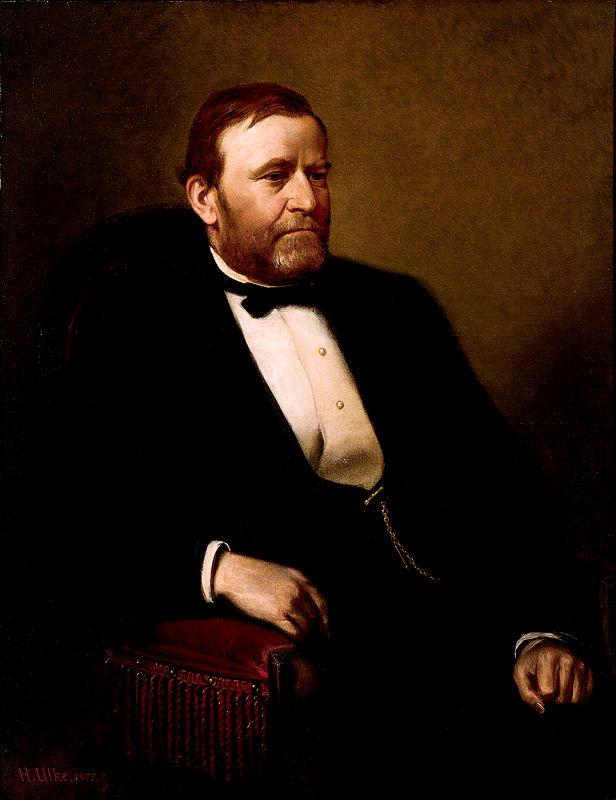
Doğum tarihi | 1822-04-27 | ||||||||
|---|---|---|---|---|---|---|---|---|---|
Eş | Julia Dent Grant (m. 1848 – d. 1902) | ||||||||
Place of Birth | Point Pleasant, Ohio – USA | ||||||||
Ölüm tarihi | 1885-07-23 | ||||||||
Place of Death | Wilton, New York – USA | ||||||||
Parents | Jesse Root Grant, Hannah Simpson Grant | ||||||||
Presidential Order | 18th President of the United States (1869–1877) | ||||||||
Ulysses S. Grant was born on April 27, 1822, in the town of Point Pleasant, Ohio. His original name was Hiram Ulysses Grant, but due to a clerical error on his appointment document from Congress, he became known as Ulysses S. Grant. His father, Jesse Grant, was a tradesman involved in tanning; his mother, Hannah Grant, came from a family of Pennsylvania origin. During his childhood, Grant did not enjoy working in his family’s tannery and instead showed interest in farm work, particularly in horse care. In 1839, he was admitted to the United States Military Academy at West Point and graduated in 1843. During his studies, he excelled especially in mathematics.
Grant began his military career by participating in the Mexican-American War, where he served as a quartermaster and received two honorary promotions (brevets) for his bravery. After the war, he served at various garrisons. In 1854, while stationed at Fort Humboldt in California, he resigned from the army following investigations into his alcohol use. The subsequent period of civilian life was marked by financial hardship and failed business ventures. In 1860, he began working in his family’s tanning business in Galena, Illinois.
With the outbreak of the American Civil War in 1861, Grant joined the Union Army and was appointed by the Governor of Illinois to lead a volunteer regiment. He quickly achieved military success, gaining attention for his victories at Fort Henry and Fort Donelson. In particular, his demand for “unconditional surrender” from the enemy at Fort Donelson earned him the nickname “Unconditional Surrender Grant” in public opinion. In April 1862, the Battle of Shiloh resulted in heavy casualties, but Grant’s counterattack on the second day turned the battle in favor of the Union.
In 1863, the siege of Vicksburg ended Confederate control over the Mississippi River, and the victory at Chattanooga marked the peak of Grant’s military career. Following these developments, Abraham Lincoln appointed him commanding general of all Union Armies. Beginning in 1864, Grant led direct campaigns against General Robert E. Lee, culminating in the Siege of Petersburg and Lee’s surrender at Appomattox Court House on April 9, 1865. This event is widely regarded as the effective end of the American Civil War. In the same year, Congress awarded him the rank of General of the Army of the United States.
Grant was elected president in the 1868 election as the Republican Party candidate and served two terms as the 18th President of the United States from 1869 to 1877. During his presidency, he implemented Reconstruction policies aimed at integrating the Southern states back into the Union. In this context, he supported the Fifteenth Amendment to the Constitution, established the Department of Justice to lead federal efforts against racist organizations such as the Ku Klux Klan, and pursued a “peace policy” toward Native Americans, appointing Ely S. Parker as head of the Bureau of Indian Affairs. In 1872, he approved the creation of Yellowstone National Park, taking legal steps in the field of environmental conservation.
Grant’s presidency is also remembered for numerous corruption scandals. Although no evidence directly links Grant to corruption, his trust in associates, lack of oversight, and failure to ensure competence drew criticism. After leaving office, he embarked on a world tour and attempted to run for president again in 1880 but was unsuccessful. In 1884, he lost his entire fortune due to financial fraud. That same year, he was diagnosed with throat cancer and wrote his memoirs, Personal Memoirs of U.S. Grant, to secure his family’s financial future. The memoirs were completed shortly before his death and received widespread acclaim for their literary and historical value. Grant died on July 23, 1885, in New York, and his remains were interred at General Grant National Memorial (Grant’s Tomb).
American Battlefield Trust. “Ulysses S. Grant.” American Battlefield Trust. Accessed July 20, 2025. https://www.battlefields.org/learn/biographies/ulysses-s-grant
Biden White House Archives. “Ulysses S. Grant.” The White House. Accessed July 20, 2025. https://bidenwhitehouse.archives.gov/about-the-white-house/presidents/ulysses-s-grant/
Miller Center. “Ulysses S. Grant: Life Before the Presidency.” *Miller Center, University of Virginia*. Accessed July 20, 2025. https://millercenter.org/president/grant/life-before-the-presidency
National Museum of the United States Army. “Ulysses S. Grant.” The National Museum of the United States Army. Accessed July 20, 2025. https://www.thenmusa.org/biographies/ulysses-s-grant/
National Park Service. “Ulysses S. Grant.” *U.S. National Park Service*. Accessed July 20, 2025. https://www.nps.gov/people/ulysses-s-grant.htm
Ulysses S. Grant Presidential Library. "Military Service." Ulysses S. Grant Presidential Library. Accessed July 20, 2025. https://www.usgrantlibrary.org/usgrant/military
Ulysses S. Grant Presidential Library. “A Brief Life of Ulysses S. Grant.” Ulysses S. Grant Presidential Library. Accessed July 20, 2025. https://www.usgrantlibrary.org/usgrant/bio

Doğum tarihi | 1822-04-27 | ||||||||
|---|---|---|---|---|---|---|---|---|---|
Eş | Julia Dent Grant (m. 1848 – d. 1902) | ||||||||
Place of Birth | Point Pleasant, Ohio – USA | ||||||||
Ölüm tarihi | 1885-07-23 | ||||||||
Place of Death | Wilton, New York – USA | ||||||||
Parents | Jesse Root Grant, Hannah Simpson Grant | ||||||||
Presidential Order | 18th President of the United States (1869–1877) | ||||||||
Civil War and Rise to Command
Presidency and Final Years