
 Recently Added:
This article was automatically translated from the original Turkish version.
The United Nations Security Council Gaza Session (16–17 July 2025) was an extraordinary diplomatic meeting held at the UN Headquarters in New York on 16–17 July 2025 to assess the severe humanitarian crisis resulting from Israel’s military operations in the Gaza Strip.
The session was convened at the joint request of the United Kingdom, France, Denmark, Greece and Slovenia. Issues such as the obstruction of humanitarian access, rising child mortality, collapse of healthcare infrastructure and civilian casualties during aid distribution were brought to the Security Council’s agenda. During the session, UN officials and representatives of member states delivered individual statements, presenting assessments of the humanitarian situation in Gaza and proposing solutions.

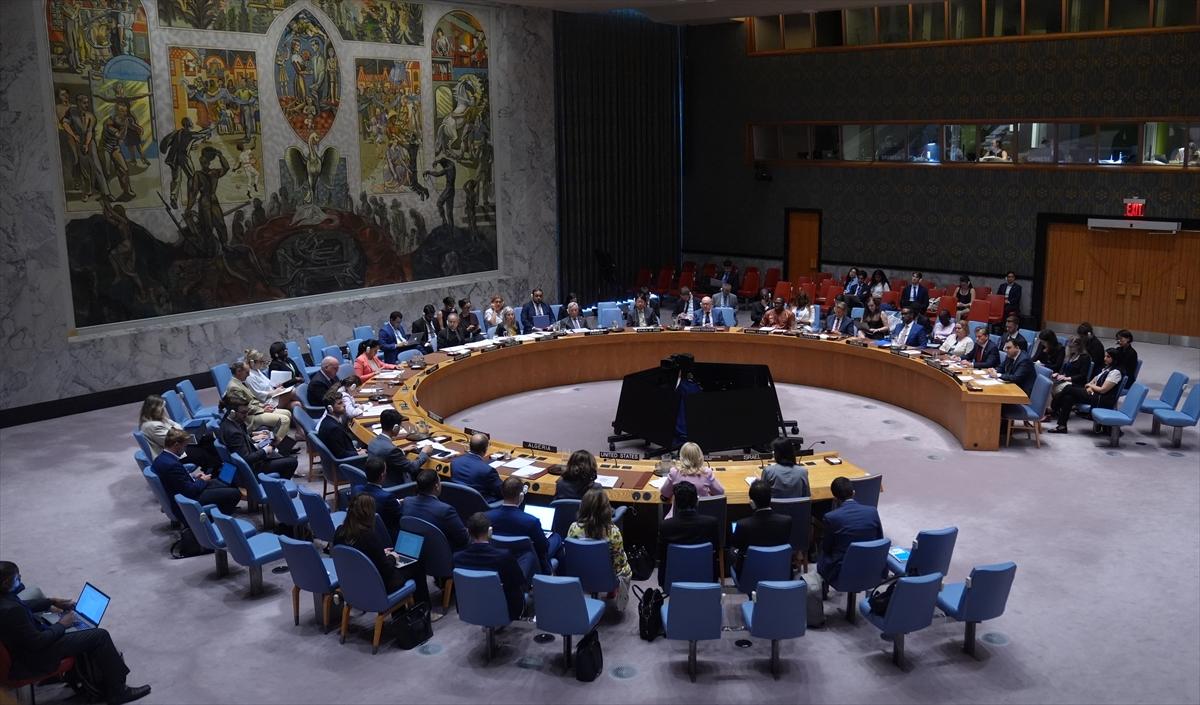
United Nations Security Council (UNSC) Gaza session, 17 July 2025 – (Anadolu Agency)
Tom Fletcher (UN Emergency Relief Coordinator) reported that the basic healthcare infrastructure in Gaza was on the verge of collapse. Fletcher stated that malnutrition rates among children reached their highest levels in June, with only 17 of 36 hospitals and 63 of 170 primary healthcare centers operating partially. He noted that some hospitals had five babies in a single incubator and that 70 percent of essential medicines had been exhausted. He emphasized that while limited numbers of fuel trucks were permitted entry into Gaza weekly, this was insufficient to sustain life-saving services.
Catherine Russell (UNICEF Director), stated that over 17,000 children had died in the past 21 months, averaging 28 child deaths per day. She reported that in just the past week, nine children and four women were killed while waiting in aid queues. Russell stressed the urgent need for safe and sustainable humanitarian access to Gaza.
Hakan Fidan, Minister of Foreign Affairs of Türkiye, speaking on behalf of Türkiye at the United Nations Security Council session, stated that Israel did not seek peace or stability. Fidan described how over two million people in Gaza were living under conditions of mass displacement, infrastructure destruction and lack of access to basic necessities such as food and water.

Minister of Foreign Affairs Hakan Fidan at the UN Security Council emergency session on “The Situation in the Middle East, Palestine”,17 July 2025 – (Anadolu Agency)
Minister Fidan highlighted that aid delivery was being systematically obstructed, civilians were being targeted at aid distribution points and hunger was being used as a weapon of war. He emphasized that humanitarian aid could only be delivered in accordance with the principles of neutrality, impartiality, humanity and independence if coordinated by the United Nations. He warned that current alternative models were undermining the fundamental characteristics of humanitarian assistance.
Fidan also drew attention to Israel’s aggressive strategy beyond Gaza, particularly its operations in Syria, Lebanon and Iran, which he said were fueling regional instability and deepening ethnic fault lines. He warned that failure to halt this aggression would create a widespread security risk.
Fidan recalled Türkiye’s long-standing support for Palestine’s full membership in the United Nations and called for the recognition of the State of Palestine and the immediate initiation of a two-state solution process. Türkiye, he stated, was determined to contribute to regional stability through progress on this process.
Hakan Fidan described the current humanitarian crisis in Gaza not merely as a regional issue but as a collective test of human dignity and stressed that the Security Council must assume responsibility in this moment. He called for an immediate ceasefire, unhindered delivery of humanitarian aid and urgent political commitments toward a solution. He also emphasized the need to end the culture of impunity.
Reut Shapir Ben-Naftaly, Political Coordinator of Israel’s Permanent Mission, stated in her remarks that her country was engaged in high-level cooperation with various UN bodies including UNICEF. She disclosed that over 66 million meals, 7,500 tons of flour and 100 tons of infant formula delivered by UNICEF had been transported into Gaza. She clarified that these aid items were distributed through the Gaza Humanitarian Foundation (GHF) and were directed solely to civilians, not to Hamas.
Ben-Naftaly reported that Israeli Prime Minister Benjamin Netanyahu had held talks with President Trump and other U.S. officials during his visit to Washington regarding hostage agreements and confirmed that Israel would continue coordinating with the United States, Egypt and Qatar. She asserted that Israel remained committed to supporting civilians in Gaza, adhering to its belief that aid must not be politicized.
Majed Bamya, Deputy Permanent Representative of Palestine to the UN, stated in his address that living conditions in Gaza had become equivalent to death. He emphasized that each day, especially for children, carried a risk of death, saying, “For a generation, death has become more familiar than life.” He addressed the total collapse of Gaza’s life-sustaining infrastructure and the forced risk to life as people searched for food, water and shelter.

Palestine’s Deputy Permanent Representative to the United Nations Majed Bamya,17 July 2025 – (Anadolu Agency)
Bamya criticized the international community for “counting calories” in an environment where babies were dying from malnutrition, insisting that aid must not be subject to negotiation. He stated that Israel did not recognize Palestinians as individuals entitled to equal rights and that this approach was combined with policies of forced displacement. He also noted that attacks on aid workers and UN personnel had created a world order requiring urgent scrutiny.
France’s Permanent Representative to the UN, Jérôme Bonnafont, argued that the humanitarian aid blockade in Gaza must be lifted. He stated that the distribution system operated by the Gaza Humanitarian Foundation (GHF) violated humanitarian principles of neutrality, impartiality and independence, and that hundreds of civilians had lost their lives at GHF distribution centers.
The French representative called for implementation of the aid agreement signed between the European Union and Israel on 10 July 2025, insisting that humanitarian assistance must be delivered exclusively through the UN and its partners. He emphasized that the UN was the only actor capable of delivering humanitarian aid safely and effectively. He stressed that the UNSC must continue calling for an immediate ceasefire and exert pressure for the release of hostages. Bonnafont affirmed that the two-state solution was the only realistic path forward and pointed to a conference scheduled for the end of the month in New York.
United Kingdom’s Permanent Representative Barbara Woodward stated that the humanitarian situation was deteriorating daily and called on all parties to immediately begin negotiations for a ceasefire. She noted that the lack of access to fuel, water, medicine and food in Gaza was directly causing civilian deaths. She underscored the UN’s unique capacity in humanitarian assistance and urged Israel to accept these aid deliveries without obstruction.
Woodward said her country opposed the expansion of Israel’s military operations and stated that civilian casualties had reached unacceptable levels. She declared that Israel’s forced displacement of Palestinians violated international law and affirmed the UK’s support for a conference on the two-state solution co-chaired by France and Saudi Arabia.
China’s Permanent Representative to the UN, Fu Cong, stated that the militarized aid mechanism established by the United States and Israel was both inadequate and responsible for numerous civilian casualties. Fu affirmed that the systems previously established by the UN and related humanitarian organizations were superior in experience and capacity, and insisted that aid must be delivered exclusively through these structures and in accordance with humanitarian principles. Fu emphasized that both Gaza and the West Bank were the homeland of the Palestinian people and could not be subject to political bargaining.
Diplomatic representative Sangjin Kim, speaking on behalf of the Republic of Korea, reported that testimonies regarding incidents at GHF distribution centers came not only from Palestinians but also from Israeli security personnel and IDF soldiers. He called for an independent and transparent investigation into these incidents. He stressed that access for international media to Gaza must not be obstructed.
Stavros Lambrinidis, speaking on behalf of the European Union, noted that the initial effects of the aid agreement between the EU and Israel were already visible: fuel deliveries had resumed, routes through Jordan and Egypt had reopened, and a new crossing point had been activated in northern Gaza. He affirmed that aid must be delivered in accordance with humanitarian principles and without being channeled to Hamas. Evangelos Sekeris added that these developments could only be sustainable with the expertise of the UN and emphasized the indispensable role of UNRWA.
Denmark’s Permanent Representative Christina Markus Lassen stated that the frequency and severity of civilian deaths at aid distribution centers were unacceptable. She insisted that humanitarian aid must not be turned into a subject of political bargaining and called for avoidance of the dangerous precedent created by the GHF system. She affirmed Denmark’s support for a humanitarian aid distribution plan led by the UN and stressed the need to ensure that relevant institutions, including UNRWA, could carry out their work safely.
The Gaza Humanitarian Foundation (GHF) is a humanitarian aid distribution mechanism coordinated by Israel. Israeli representative Reut Shapir Ben-Naftaly stated that hundreds of millions of meals and thousands of tons of flour had been delivered through this structure. She emphasized that these aid items were directed directly to civilians, not to Hamas.
In contrast, France’s Permanent Representative to the UN, Jérôme Bonnafont, stated that the GHF system violated international law and that hundreds of civilians had died at its distribution centers. He asserted that GHF failed to meet the criteria of neutral, independent and impartial aid delivery and declared the system unacceptable.
South Korea’s representative Sangjin Kim noted that testimonies regarding civilian deaths at GHF distribution points came not only from Palestinians but also from foreign security personnel and Israeli soldiers, and stressed the need for a full and transparent investigation.
China’s representative Fu Cong pointed out that the system had become a military structure that increased civilian losses and argued that aid delivery must be conducted exclusively under UN leadership and coordination by international humanitarian organizations.
United Kingdom’s representative Barbara Woodward stated that GHF was insufficient and that aid must be reorganized under UN leadership. Denmark’s representative Christina Markus Lassen said the mechanism had turned humanitarian aid into a political or military tool and warned that this constituted a dangerous precedent for international humanitarian practice.

Palestine’s Deputy Permanent Representative to the United Nations Majed Bamya,17 July 2025 – (Anadolu Agency)
One of the session’s common calls was for a lasting ceasefire and the unconditional release of hostages. It was noted that Israel, the United States, Egypt and Qatar were continuing mediation efforts in this regard. The unconditional release of hostages was demanded.
Palestinian representative Majed Bamya stated that the situation in Gaza had become a daily choice between life and death, insisting that aid must be removed from the realm of negotiation and that its delivery was a matter of saving lives. He emphasized that an immediate ceasefire could not be delayed in an environment where child deaths were rising and infrastructure had completely collapsed. The Palestinian side affirmed its support for mediation efforts by Egypt, Qatar and the United States.
France’s representative Jérôme Bonnafont called for implementation of the EU-Israel aid agreement and delivery of aid to Gaza through the UN. He also highlighted the importance of the two-state solution conference scheduled for the end of the month in New York, stating that concrete steps toward this solution would be defined during the conference.
The United Kingdom affirmed that the two-state solution must be the diplomatic priority and announced its support for the conference co-chaired by France and Saudi Arabia. Türkiye’s Minister of Foreign Affairs Hakan Fidan stated that the international community must support Palestine’s full membership in the United Nations.
Al Jazeera English. "UN Holds Security Council Meeting on Middle East, with Focus on Latest Developments in Palestine." YouTube video, Accessed July 17, 2025. https://www.youtube.com/watch?v=Jd26iTyUfyw
Anadolu Ajansı. "Fransa, İsrail'den Gazze'de İnsani Yardıma Yönelik Uyguladığı Ablukaya Son Vermesini İstedi." Accessed July 17, 2025. https://www.aa.com.tr/tr/ayrimcilikhatti/ayrimcilik/fransa-israilden-gazzede-insani-yardima-yonelik-uyguladigi-ablukaya-son-vermesini-istedi/1826214
Anadolu Ajansı. “Dışişleri Bakanı Fidan: İsrail Barış İstemiyor, İsrail İstikrar İstemiyor.” Accessed July 17, 2025. https://www.aa.com.tr/tr/ayrimcilikhatti/ayrimcilik/disisleri-bakani-fidan-israil-baris-istemiyor-israil-istikrar-istemiyor/1826211
Anadolu Ajansı. “İsrail Gıda, İlaç ve Kritik Malzemelerin Gazze'ye Girişini Desteklemeye Devam Edecek.” Accessed July 17, 2025. https://www.aa.com.tr/tr/ayrimcilikhatti/ayrimcilik/israil-gida-ilac-ve-kritik-malzemelerin-gazzeye-girisini-desteklemeye-devam-edecek/1826209
UK Government. “With Each Day That Passes, the Suffering Increases: We Urge the Parties to Secure an Immediate Ceasefire – UK Statement at the UN Security Council.” GOV.UK, Accessed July 17, 2025. https://www.gov.uk/government/speeches/with-each-day-that-passes-the-suffering-increases-we-urge-the-parties-to-secure-an-immediate-ceasefire-uk-statement-at-the-un-security-council
United Nations Department of Political and Peacebuilding Affairs. “Security Council Live: Aid Must Go Where Needs Are Greatest in Gaza, Urges UN Relief Chief.” United Nations, Accessed July 17, 2025. https://dppa.un.org/en/security-council-live-aid-must-go-where-needs-are-greatest-gaza-urges-un-relief-chief
United Nations News. “Security Council Live: Aid Must Go Where Needs Are Greatest in Gaza, Urges UN Relief Chief.’, UN Relief Chief Warns.” UN News, Accessed July 17, 2025. https://news.un.org/en/story/2025/07/1165409

The United Nations Security Council convened an emergency session on 16 July 2025 at the UN Headquarters in New York to discuss the severe humanitarian situation in the Gaza Strip. The meeting, called for by the United Kingdom, France, Denmark, Greece and Slovenia, addressed issues including access to humanitarian aid, civilian casualties, child deaths and the collapse of the health system. Türkiye argued that aid must be delivered under UN coordination; Israel reported that it was providing assistance through the GFH; UN representatives stated that infrastructure had collapsed and child deaths had increased. The Palestinian side called for an immediate ceasefire and international accountability, stating that all paths led to death.
No Discussion Added Yet
Start discussion for "United Nations Security Council Gaza Session (July 2025)" article
July 17, 2025
United Nations Officials’ Briefings
July 17, 2025
Member State Representatives’ Statements
July 17, 2025
Debates on the Gaza Humanitarian Foundation (GHF)
July 17, 2025
Calls for Ceasefire, Release of Hostages and Two-State Solution