


This article was automatically translated from the original Turkish version.
+2 More
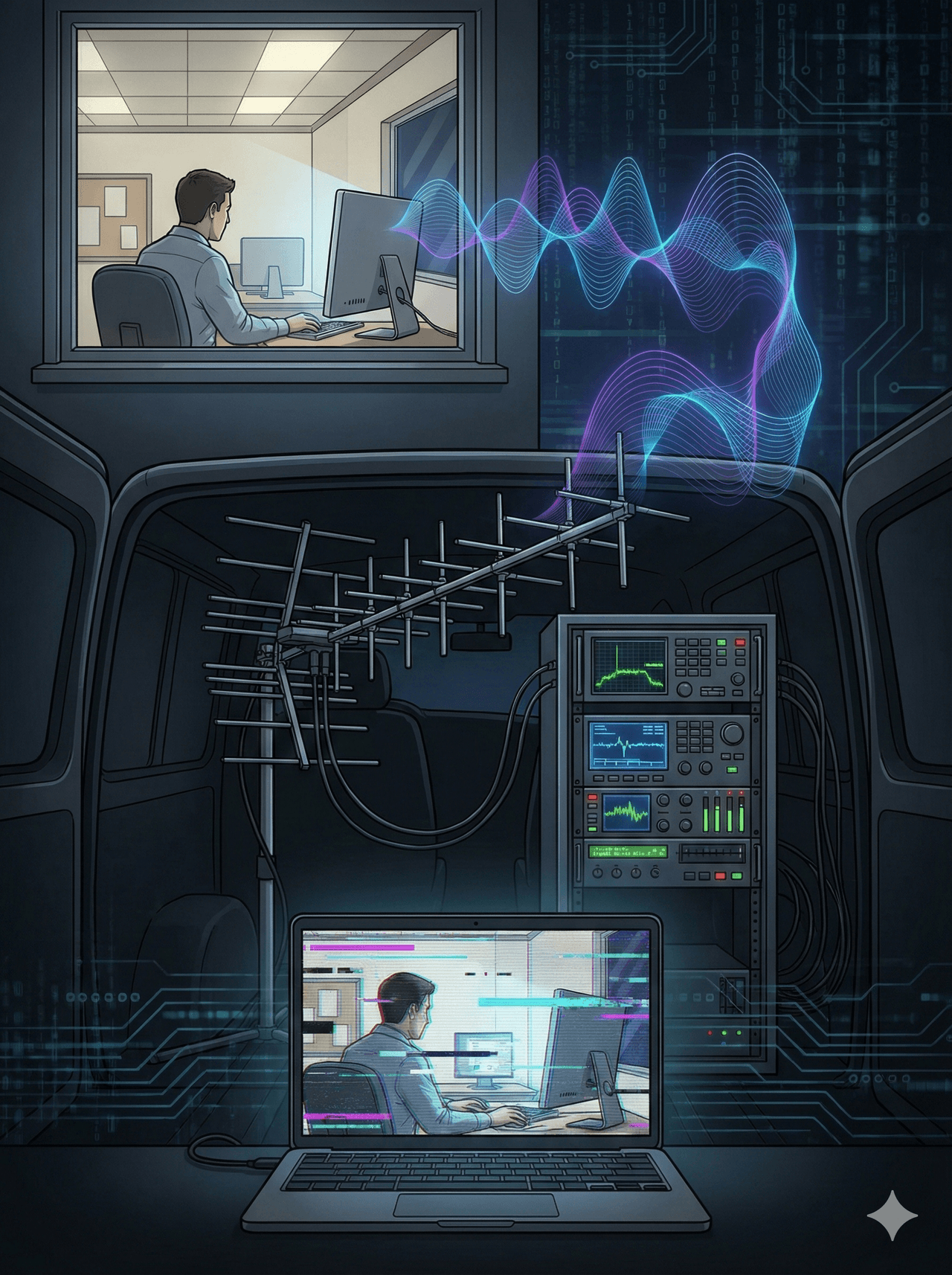
Van Eck Phreaking (Yapay zeka ile oluşturulmuştur)
Van Eck Phreaking (Van Eck Radiation) is an eavesdropping technique that enables the remote reconstruction of displayed information by capturing and processing unintentional electromagnetic waves emitted by electronic devices, particularly computer monitors. The term is named after Wim van Eck, who in 1985 brought this security vulnerability to public attention by demonstrating that the content of cathode ray tube (CRT) displays could be remotely observed using a modified standard television receiver with altered synchronization pulses. The method relies on exploiting side channels emitted during the operation of electronic hardware and is also classified in information security literature as an electromagnetic analysis attack.

Representative illustration of a Van Eck Phreaking attack (generated by Artificial Intelligence)
The fact that electronic devices emit signals carrying information has been known since the 19th century, but the threat of using these emissions for espionage was made concrete through Wim van Eck’s work in 1985. The fundamental principle of the attack is based on the observation that repetitive video signals driving display screens can leak into the environment even through shielded cables.
These signals can be captured using directional antennas and wideband receivers. Because the signals have a periodic structure, periodic averaging techniques can be applied to separate the image from background noise and render it readable. Initially considered a risk only for CRT monitors, advances in technology have revealed that flat panel displays (FPDs) also exhibit similar, and in some cases more severe, security vulnerabilities.
Flat panel display technologies such as liquid crystal displays (LCDs), which have replaced CRT technology, produce a different electromagnetic signature due to their distinct methods of processing video signals. Modern flat panel displays receive video data through digital interfaces operating at gigabit speeds (e.g. DVI or FPD-Link). The high-frequency serial transmission formats used in these interfaces can modulate the signal in ways that make it more susceptible to remote interception compared to analog systems.
Experimental studies have observed that the primary source of leakage in flat panel displays is not the display module itself but rather the cables connecting the graphics card to the display panel. The strength and remote readability of the signal vary depending on the digital transmission standard used (e.g. LVDS or TMDS) and the color combinations of the displayed text. The readability of the emitted signal can be enhanced by using specific test patterns and color contrasts.
The concept of Van Eck Phreaking has been adapted as a theoretical threat model for quantum cryptographic devices beyond classical electronics. In this scenario, termed "Quantum Van Eck Phreaking," it is proposed that the environment functions as an information-carrying channel during quantum measurement processes.
According to the theory of quantum Darwinism, the measurement of a quantum system and its transition into classical data (quantum-to-classical transition) requires interaction between the system and its environment, leading to the proliferation of multiple copies of the information within the environment (einselection). This contradicts the assumption that quantum devices operate in "perfectly shielded laboratories," because information leakage (decoherence) is unavoidable for any measurement to occur.
In this context, a relationship has been established between the probability that an adversary (Eve) can guess the device’s outcome by observing part of the environment () and the collective decoherence factor of the system (). This relationship is expressed by the formula , indicating that the adversary’s chance of success increases as measurement occurs (i.e. as decoherence increases).
Defensive methods developed against Van Eck Phreaking and similar electromagnetic leakage attacks are collectively referred to as Emission Security (EMSEC). Some governments have developed TEMPEST standards that mandate the use of specially shielded equipment to protect against such leaks.
In addition to hardware-based protection, software-based countermeasures are also available. Soft TEMPEST techniques developed for flat panel displays aim to mask the signals emitted by displayed content. For example, adding random data to the least significant bits (LSB) of the video signal can disrupt its periodic structure and render the eavesdropper’s averaging technique ineffective.
Kuhn, Markus G. "Electromagnetic Eavesdropping Risks of Flat-Panel Displays." *4th Workshop on Privacy Enhancing Technologies*, May 26–28, 2004, Toronto, Canada. https://www.cl.cam.ac.uk/~mgk25/pet2004-fpd.pdf
Mironowicz, P. "Quantum security and theory of decoherence." New Journal of Physics 24, no. 113054 (2022). https://iopscience.iop.org/article/10.1088/1367-2630/aca558/pdf

Van Eck Phreaking (Yapay zeka ile oluşturulmuştur)
Historical Development and Technical Foundations
Eavesdropping Risks with Flat Panel Displays (FPD)
Quantum Van Eck Phreaking
Defenses and Countermeasures