
This article was automatically translated from the original Turkish version.
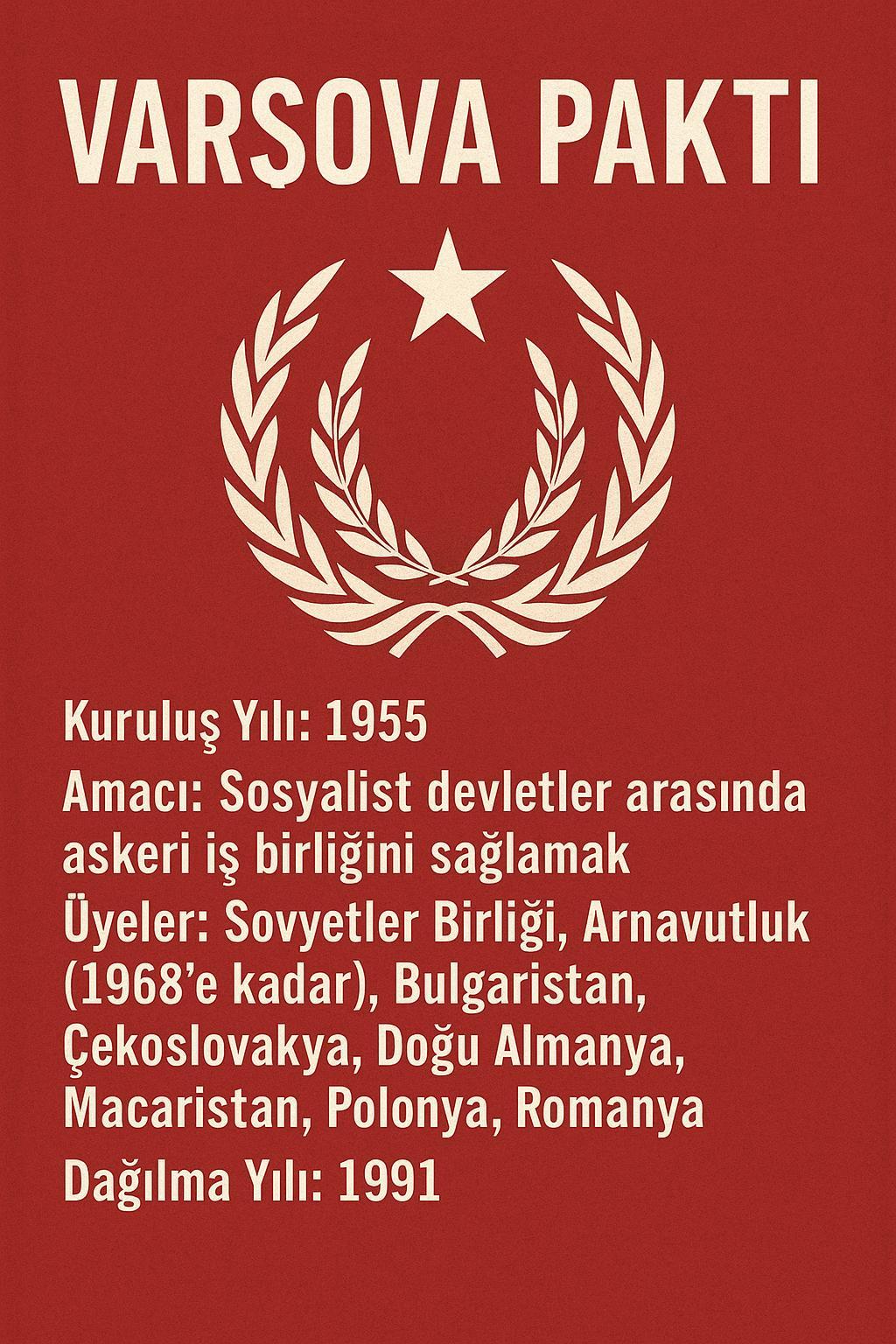
Official Name | Friendship Agreement on Cooperation and Mutual Assistance | ||||||||
|---|---|---|---|---|---|---|---|---|---|
Founding Date | 14 May 1955 | ||||||||
Place of Founding | Warsaw, Poland | ||||||||
Founding Countries | Soviet Union, Albania (until 1968), Poland, Romania, Bulgaria, Hungary, Czechoslovakia, East Germany | ||||||||
Purpose | To unite Eastern Bloc countries under a common defense To maintain military balance against NATO | ||||||||
Governing Country | Soviet Union | ||||||||
Main Military Organ | Joint Military Command (managed by Soviet generals) | ||||||||
Political Organ | Political Consultative Committee (decision-making centered in the USSR) | ||||||||
Important Interventions | Hungary 1956, Czechoslovakia 1968, Poland 1981 | ||||||||
Dissolution Date | 1 July 1991 | ||||||||
Historical Position | During the Cold War, it served as the military alliance of the Eastern Bloc, countering NATO. | ||||||||
Warsaw Pact, one of the most important military and political blocs of the Cold War era, was established by a treaty signed on 14 May 1955 in Poland’s capital, Warsaw. Officially known as the Warsaw Treaty Organization (Warsaw Treaty Organization – WTO), it was a collective defense system formed by Eastern Bloc countries in opposition to the West’s NATO.
The founding members were the Soviet Union, Albania, Bulgaria, Czechoslovakia, East Germany, Hungary, Poland and Romania. The formation of the Warsaw Pact occurred in response to NATO’s decision to rearm Germany, particularly West Germany, and its subsequent accession of the Federal Republic of Germany into NATO in 1955. This development reinforced the Soviet Union’s perception of the West as an aggressive power.
The Pact was established under Soviet leadership, with its primary objective being to ensure collective defense against military attacks among member states. However, this defensive concept gradually acquired an aggressive character, paving the way for direct intervention in the internal affairs of member states. NATO, viewed as the direct counterpart of the Warsaw Pact, had been founded in 1949 with the aim of strengthening military solidarity among Western allies. In this context, the Soviet Union perceived NATO’s eastward expansion as a direct threat to its own security. This perception of threat intensified especially after Germany’s division. NATO’s rearmament of West Germany and its incorporation into the collective defense mechanism was regarded by the Soviets as an unacceptable step. Under these conditions, the Warsaw Pact was presented as a necessity and institutionalized Soviet influence over its member states.
According to its founding document, the primary goal of the Warsaw Pact was “to ensure the peaceful coexistence of nations” and “to carry out joint defense against any aggressive threat.” However, the real purpose was to consolidate Soviet control over Eastern Europe. This structure functioned as a mechanism of both military and political pressure over other socialist countries dependent on the USSR. The command structure of the organization was designed to confirm this centralization. The highest decision-making body, the Political Consultative Committee, consisted of leaders of member states and their ruling parties, but in practice, directives from Soviet leaders were decisive. The military structure was unified under Soviet army control. The Supreme Command of the Warsaw Pact was always held by a Soviet general. This situation demonstrates that the USSR held authority over all processes, from military doctrine to operational command.
In the years following its establishment, the Pact’s military capacity was steadily expanded, Soviet military bases were established in Eastern Bloc countries, joint exercises were organized, and intelligence cooperation was intensified. Member states were compelled to restructure their national armies according to Soviet military standards, and their armament programs were shaped along Soviet models. This situation significantly limited the sovereignty of these countries and resulted in their foreign policies being determined in accordance with Moscow’s interests.

A Soviet tank passing through a barricade in Budapest (Flickr)
The events that erupted in Hungary in 1956 constituted the first major test of the Warsaw Pact. A popular uprising began against the rigid policies of the communist regime, and a reformist government was established under Prime Minister Imre Nagy, who declared Hungary’s withdrawal from the Warsaw Pact. This development was deemed unacceptable by the Soviet Union, and the Moscow leadership swiftly decided to intervene. In November 1956, Soviet tanks entered Budapest and crushed the uprising in a bloody operation. Thousands of civilians lost their lives in this intervention, which clearly demonstrated that the Warsaw Pact was being used not for defense but to maintain political control.

Construction of the Berlin Wall - 1961 (Flickr)
In 1961, the Berlin Crisis occurred. Unable to prevent mass migration from East Germany to the West, the Soviet-backed East German regime constructed the Berlin Wall. Although this crisis did not directly trigger the military deployment of the Warsaw Pact, it was regarded as a development closely linked to the Pact’s political presence in East Germany.

Street incidents during the Soviet occupation in Czechoslovakia (Flickr)
The “Prague Spring” in Czechoslovakia in 1968 brought about the Warsaw Pact’s second major intervention. Initiated by Alexander Dubček, leader of the Communist Party of Czechoslovakia, the reform movement aimed to increase political freedoms and move away from the Soviet model under the banner of “humanistic socialism.” These reforms were viewed by the Soviet Union as a dangerous deviation, and on 20 August 1968, Warsaw Pact forces under Soviet leadership (excluding Romania and Albania) invaded Czechoslovakia. This operation once again demonstrated the reality that member states of the Pact could militarily intervene in each other’s internal affairs. Albania, which opposed this intervention, fully withdrew from the Pact in subsequent years and developed closer cooperation with China.
The 1970s brought a partial relaxation in the Pact’s foreign policy. Within the framework of détente policies, agreements were signed between the Eastern and Western blocs, and consensus was reached on issues of security, human rights and cooperation in Europe through documents such as the Helsinki Final Act. However, this process did not eliminate the Pact’s military nature. The Soviet Union continued its military spending, supported the arms race among Warsaw Pact countries, and did not abandon its goal of maintaining a balance with NATO.
In 1979, the Soviet Union’s intervention in Afghanistan became an operation in which the Warsaw Pact did not officially participate but whose members provided political support. This contributed to renewed tensions with the West.
By the 1980s, economic crises in the countries within the Pact had deepened, and public dissatisfaction with the regimes had grown. Particularly, the Solidarity movement that emerged in Poland seriously undermined the authority of the Warsaw Pact through its demands for trade union rights and political reform. In 1981, martial law was declared in Poland, and direct military intervention by the Warsaw Pact became a topic on the agenda. However, Soviet leadership refrained from this option due to international pressure and risks posed by domestic public opinion.
With Mikhail Gorbachev’s rise to the position of General Secretary of the Communist Party of the Soviet Union in 1985, significant changes occurred in the political doctrines that defined the nature of the Warsaw Pact. Gorbachev’s policies of glasnost (openness) and perestroika (restructuring) led to questioning of Soviet hegemony and increased calls for reform within Warsaw Pact countries. During this period, the Brezhnev Doctrine, which justified foreign intervention if socialism in a socialist country was under threat, was abandoned. Instead, the Soviet Union signaled that it would no longer interfere in the internal affairs of other socialist countries. This marked a period in which the political power of the Warsaw Pact effectively came to an end.
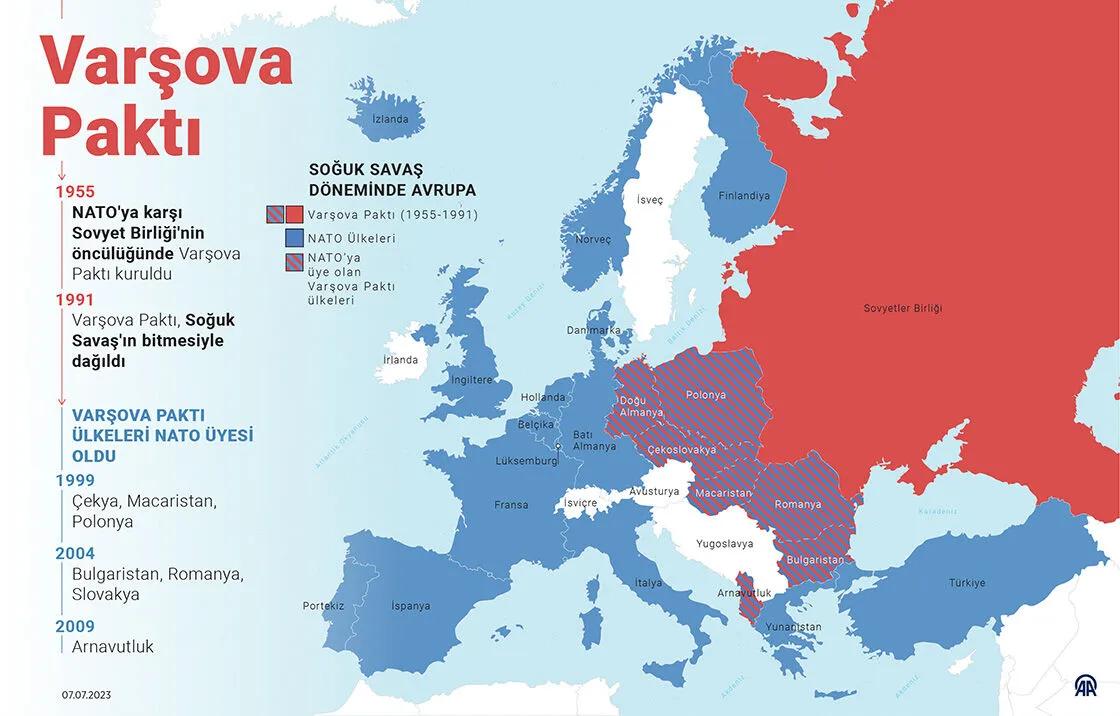
Warsaw Pact Map (AA)
In 1989, socialist regimes across Eastern Europe began to collapse one after another, as popular uprisings, free elections and changes in power took place. Pro-Soviet governments in countries such as Hungary, Poland, East Germany, Bulgaria and Czechoslovakia were overthrown, and the public’s desire for integration with the West was clearly expressed. These developments revealed that the Warsaw Pact’s capacity for military intervention had ended and that the USSR had lost its political control over Eastern Europe. On 3 July 1991, the Warsaw Pact was formally dissolved. This decision was announced at its final meeting in Prague, and member states were granted the right to independently determine their own defense policies.
The military strength of the Warsaw Pact was based on the Soviet Union’s vast army and nuclear capabilities. The armed forces of member states were structured according to the Soviet model, equipped with Soviet weapons systems and trained according to Soviet military doctrines. Particularly in terms of tank power, artillery systems and air forces, the Warsaw Pact was comparable to NATO. However, it lagged behind the West in technological advancements. Its political power was shaped by the Soviet Union’s international influence and ideological alliances. The dissolution of the Warsaw Pact was not merely the end of a military alliance but also a symbol of the conclusion of the Cold War. Member states soon turned toward Western-oriented structures such as NATO and the European Union, and the Soviet Union itself dissolved shortly afterward in December 1991. This process represented one of the most comprehensive geopolitical transformations of the 20th century.
Anadolu Ajansı. "Varşova Paktı." Infographic. Accessed July 7, 2026.https://www.aa.com.tr/tr/info/infografik/34750.
Flickr, Soviet tank cleaning up barricades on streets in Hungary, 1956, CIA archive, Accessed July 8, 2025,https://www.flickr.com/photos/ciagov/8113980088/in/photostream/
Flickr, street events during the Soviet Union's invasion of Czechoslovakia, 1968, CIA archives, Accessed July 8, 2025,https://www.flickr.com/photos/ciagov/8113976317/in/photostream/
Flickr.Berlin Duvarı construction, dividing East and West Germany, 1961, CIA archives. Accessed July 8, 2025.https://www.flickr.com/photos/ciagov/8054617573/in/photostream/
History Today. "The Warsaw Pact." History Today. Accessed May 13, 2025.https://www.historytoday.com/archive/months-past/warsaw-pact.
History.com Editors. “The Warsaw Pact Is Formed.” History.com. Accessed May 13, 2025.https://www.history.com/this-day-in-history/may-14/the-warsaw-pact-is-formed.
NATO. “The Warsaw Pact.” North Atlantic Treaty Organization. Accessed May 13, 2025.https://www.nato.int/cps/en/natohq/declassified_138294.htm.
Secopedia. "Varşova Paktı." Secopedia. Accessed May 13, 2025.https://www.secopedia.org/kavramlar/bolgesel-guvenlik/varsova-pakti/.
U.S. Department of State. “The Warsaw Treaty Organization (Warsaw Pact), 1955.” Office of the Historian. Accessed May 13, 2025.https://history.state.gov/milestones/1953-1960/warsaw-treaty.


Official Name | Friendship Agreement on Cooperation and Mutual Assistance | ||||||||
|---|---|---|---|---|---|---|---|---|---|
Founding Date | 14 May 1955 | ||||||||
Place of Founding | Warsaw, Poland | ||||||||
Founding Countries | Soviet Union, Albania (until 1968), Poland, Romania, Bulgaria, Hungary, Czechoslovakia, East Germany | ||||||||
Purpose | To unite Eastern Bloc countries under a common defense To maintain military balance against NATO | ||||||||
Governing Country | Soviet Union | ||||||||
Main Military Organ | Joint Military Command (managed by Soviet generals) | ||||||||
Political Organ | Political Consultative Committee (decision-making centered in the USSR) | ||||||||
Important Interventions | Hungary 1956, Czechoslovakia 1968, Poland 1981 | ||||||||
Dissolution Date | 1 July 1991 | ||||||||
Historical Position | During the Cold War, it served as the military alliance of the Eastern Bloc, countering NATO. | ||||||||
Reasons and Objectives for the Establishment of the Warsaw Pact
Soviet Hegemony
Military Organization
Soviet Union’s Interventions
Collapse of Socialist Regimes
The End of the Warsaw Pact