


This article was automatically translated from the original Turkish version.
Pluto was met with great excitement upon its discovery in 1930 and was accepted as the ninth planet of the Solar System. Despite its small size, it was regarded as a “planet” in school textbooks, scientific studies, and public perception for approximately 76 years. However, in 2006, the International Astronomical Union (IAU) made a decisive change to Pluto’s status: Pluto was no longer classified as a planet but as a “dwarf planet.”
Until that time, the general definition of a planet was quite vague. Planets were typically described as objects orbiting their own paths, possessing a certain mass, and revolving around a star. However, beginning in the 1990s, numerous celestial bodies similar to Pluto began to be discovered in the Kuiper Belt region of the Solar System.
The discovery in 2005 of Eris, a dwarf planet even larger than Pluto, exposed the inadequacy of the existing definition. If Pluto qualified as a planet, then Eris must also be considered one. But if that were the case, would dozens or even hundreds of other small celestial bodies also need to be classified as planets?
To resolve this confusion, the IAU clarified the definition of a planet during its general assembly in Prague in 2006. According to the new definition, a celestial body must meet three criteria to be classified as a planet.
A celestial body must satisfy the following three conditions to be considered a planet:
1. It must orbit the Sun,

Solar System (pixabay)
2. It must be massive enough for its own gravity to pull it into a nearly round shape,

Pluto (Generated by Artificial Intelligence)
3. It must have cleared its orbital path of other debris.

Mercury Example (Generated by Artificial Intelligence)
Pluto orbits the Sun and is not a satellite of another celestial body. Additionally, its gravity is sufficient to give it a nearly spherical shape. These characteristics mean Pluto satisfies two of the three classical criteria for planetary status.
Pluto resides in the outer regions of the Solar System, within the Kuiper Belt—a region filled with frozen celestial bodies. The Kuiper Belt is analogous to the asteroid belt but much larger and composed primarily of icy objects. In Pluto’s immediate vicinity:
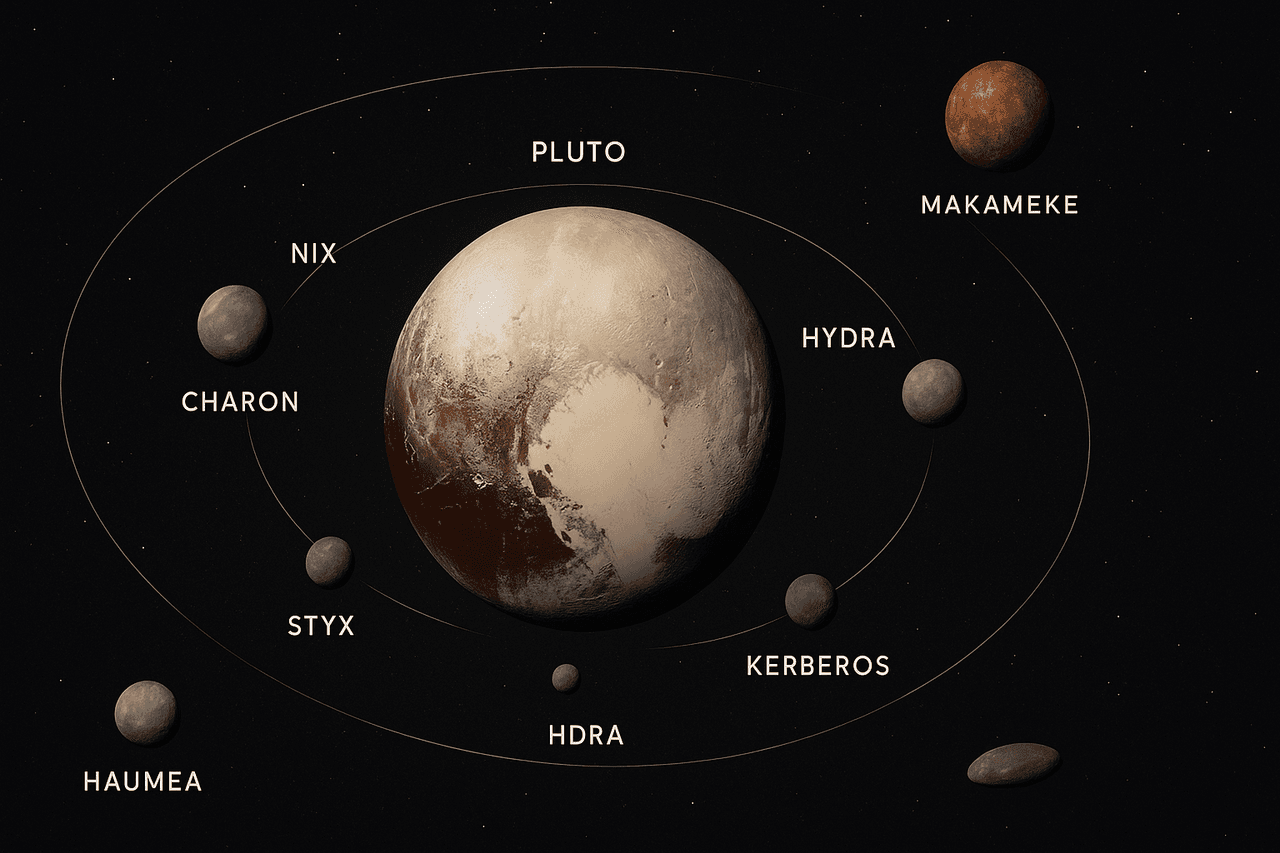
Pluto’s immediate surroundings (Photograph generated by Artificial Intelligence)
Therefore, the primary reason Pluto is not classified as a planet is its inability to clear its orbital path of other celestial bodies using its own gravitational influence. This failure means it does not meet the third criterion of orbital dominance. As a result, Pluto is classified not as a planet but as a dwarf planet.
Why was this decision made? What had changed?
Three Criteria for a Celestial Body to Be Classified as a Planet
Key Characteristics of Pluto
Lack of Orbital Dominance