

This article was automatically translated from the original Turkish version.
Discovery Date | 5 January 2005 | ||||||||
|---|---|---|---|---|---|---|---|---|---|
Satellite | Dysnomia | ||||||||
Mass | ~1.66 × 10^22 kg | ||||||||
Diameter | ~2.400 km | ||||||||
Observation Data | 21 October 2003, Palomar Observatory | ||||||||
Eris is one of the largest known dwarf planets in the Solar System. It was discovered on 5 January 2005 by Mike Brown from the California Institute of Technology, Chad Trujillo from the Gemini Observatory, and David Rabinowitz from Yale University during observations of the outer Solar System at the Palomar Observatory. The data used for its discovery were obtained from observations dated 21 October 2003. Initially named 2003 UB313, this celestial body was popularly referred to by the name of the television character Xena. On 14 September 2006, the International Astronomical Union (IAU) officially named the dwarf planet Eris, after the Greek goddess of discord. Its moon was named Dysnomia, after the goddess of lawlessness and daughter of Eris.
The discovery of Eris reignited debates over Pluto’s planetary status, leading the IAU in 2006 to reclassify Pluto as a dwarf planet. As a result, the number of planets in the Solar System was reduced to eight, with Pluto, Ceres, and Eris now categorized as dwarf planets.

Image of Eris (NASA)
Eris has an equatorial diameter of approximately 2,400 kilometres, which is about one-fifth the diameter of Earth and slightly smaller than Pluto. Its mass is estimated at 1.66 × 10²² kg, making it about 27 percent more massive than Pluto. Surface temperatures range from -217 °C (-359 °F) to -243 °C (-405 °F), and the surface is likely composed of rocky and icy material.
Very little is known about its internal structure, but surface and atmospheric observations suggest similarities to Pluto. Due to its great distance from the Sun, Eris’s atmosphere largely collapses and freezes onto the surface as snow. When it reaches its closest point to the Sun in its orbit, the atmosphere sublimates again. No current information is available regarding its magnetosphere.
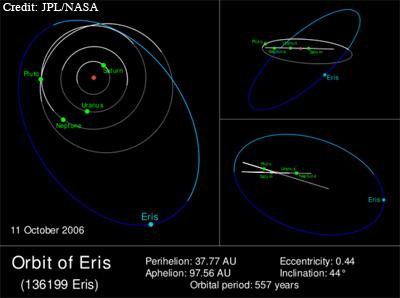
Eris takes approximately 557 Earth years to complete one orbit around the Sun. Its orbit is highly inclined, at an angle of 44 degrees relative to the ecliptic, and extends beyond the Kuiper Belt into the scattered disc region. Its day length is approximately 25.9 hours, similar to that of Earth.
Eris has one known satellite, Dysnomia. Dysnomia’s diameter is estimated to be less than 150 kilometres, and it orbits Eris at a distance of approximately 37,370 kilometres. It completes one orbit in 15 to 16 days. It is believed to have formed from material ejected by a collision, similar to the process thought to have created Earth’s Moon.
Due to its extremely cold surface conditions, the possibility of life existing on Eris is considered very low.
Eris is one of the dwarf planets in the Solar System, along with Pluto and Ceres.
Eris resides beyond the Kuiper Belt in a region known as the scattered disc. This distant region contains thousands of icy and rocky bodies left over from the early Solar System and is home to trans-Neptunian objects or plutoids.
The discovery of Eris prompted a reevaluation of the structure of the Solar System and the definition of a planet, marking a significant milestone in modern astronomy.
Dwarf Planet Eris (Pixabay)
Depositphotos. “Eris Dwarf Planet JPG.” Accessed August 16, 2025. https://depositphotos.com/tr/photos/eris-dwarf-planet.html?qview=285035996
Dumas, C., F. Merlin, M. A. Barucci, C. de Bergh, O. Hainault, A. Guilbert, P. Vernazza, and A. Doressoundiram. “Surface composition of the largest dwarf planet 136199 Eris (2003 UB).” *Astronomy & Astrophysics* 1, no. 471 (2007): 331–334. Accessed August 16, 2025. https://www.aanda.org/articles/aa/abs/2007/31/aa6665-06/aa6665-06.html
LASP. “Kuiper Belt Objects and Dwarf Planets.” Laboratory for Atmospheric and Space Physics, University of Colorado. Accessed August 16, 2025. https://lasp.colorado.edu/outerplanets/kbos_dwarfplanets.php
NASA. “Eris.” *NASA Science*. Accessed August 16, 2025. https://science.nasa.gov/dwarf-planets/eris/
Pixabay. "Eris Cüce Gezegen Video." Accessed August 16, 2025. https://pixabay.com/tr/videos/eris-c%C3%BCce-gezegen-asteroit-evren-130699/

Discovery Date | 5 January 2005 | ||||||||
|---|---|---|---|---|---|---|---|---|---|
Satellite | Dysnomia | ||||||||
Mass | ~1.66 × 10^22 kg | ||||||||
Diameter | ~2.400 km | ||||||||
Observation Data | 21 October 2003, Palomar Observatory | ||||||||
Physical Properties and Structure
Orbit and Rotation
Satellites
Potential for Life
Dwarf Planets in the Solar System and Comparison
Formation and Location