
This article was automatically translated from the original Turkish version.
+2 More
Manufacturer(s) | LHV Linke-Hofmann-Werke Breslau (Germany) | ||||||||
|---|---|---|---|---|---|---|---|---|---|
Year of Production | 1935 | ||||||||
Number of Cars | 9 | ||||||||
Notable Car | Atatürk's private coach with sleeping and meeting rooms | ||||||||
Museum Designation Date | 1964 (Ankara Station); 1991 (Yenice Station) | ||||||||
Protection Status | Cultural Heritage (1991 Ministry of Culture) | ||||||||
The White Train is a special train used by Mustafa Kemal Atatürk, the founder of the Republic of Türkiye, for official and private journeys across the country from 1935 until his death. It is a historical transportation vehicle reflecting the importance placed on railway transport and modernization policies during the Republican era. Noted for its technical design, security measures, and diplomatic function, the most renowned component of the train—the Atatürk Carriage—is currently exhibited as a museum at Ankara Station.

Image Taken on the White Train (TCDD)
The process of allocating a special train for Mustafa Kemal Atatürk’s domestic travels began in 1924, when contact was established with Wegmann & Co. of Kassel, Germany. The first special carriage, delivered in 1927, comprised sections such as a salon, meeting room, bedroom, bathroom, and toilet. Heated by steam and illuminated by dynamos, this carriage became an example of early Republican-era state protocol based on rail transport. The carriage was later stored at İzmir Basmane Station and underwent restoration in 1990.
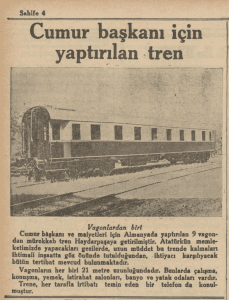
In response to increasing protocol needs during the 1930s, a more comprehensive train project was developed and ordered from the Linke-Hofmann-Werke (Breslau) company in Germany. A decree dated 25 December 1934 authorized the duty-free import of furnishings for the train’s interior. A technical delegation from Türkiye was sent to Germany to oversee inspection and furnishing operations. Upon arrival at Haydarpaşa on 19 July 1935, the train—whose lower section was dark navy and upper section white—became known to the public as the White Train.
The White Train consists of nine carriages, each averaging 21 meters in length. The interior of the Presidential Carriage was crafted with walnut and ebony wood paneling, enriched with leather upholstery and bronze details. A telephone system was installed on the train, enabling communication between carriages using Siemens equipment. Atatürk’s carriage included a sitting room, bedroom, bathroom, a small private room, and a meeting hall. It also featured a system for playing music.

Interior Design (TCDD)
The White Train was preferentially used by Atatürk for a limited number of domestic journeys, particularly during his travels in Central Anatolia, Southeastern Anatolia, and the Mediterranean region in 1937 and 1938. Security during train journeys was maintained at the highest level: sealed envelopes containing special codes were sent to each station, and only personnel aware of these codes were permitted to approach the train. The train also carried portable telegraph and telephone equipment.
The White Train was not only used by Atatürk but also for hosting official guests from abroad. It was specifically assigned for protocol purposes during visits by figures such as King Edward VIII of England and Emir Abdullah of the Emirate of Jordan. After Atatürk’s death, his body was transported from Dolmabahçe Palace to Ankara via the White Train on 19 November 1938, departing from Haydarpaşa. In this sense, the train served as both a political and symbolic journey.
İsmet İnönü continued to use the White Train for official travels during his presidency (1938–1950). The meeting between İnönü and British Prime Minister Winston Churchill in Yenice on 30 January 1943 was held aboard the train. However, criticisms that the White Train had become a symbol of “luxury” and “extravagance,” particularly raised by the Democratic Party opposition, led to a decline in its usage frequency after 1950.
The most prominent component of the train, the Atatürk Carriage, has been open to the public at Ankara Station since 1964. In 1991, it was officially registered as a cultural heritage item requiring protection. The original manufacturer’s plate, still bearing the inscription “LHV Linke-Hofmann-Werke, Breslau, 1935,” remains intact. Sections such as Atatürk’s bedroom, meeting hall, and private bathroom have been preserved in their original state. Meanwhile, the carriage where Churchill’s meeting took place has been exhibited at Yenice Station since 1991.
Malkoç, Eminalp. “Beyaz Tren.” *Atatürk Ansiklopedisi*, September 1, 2021. Accessed July 10, 2025. https://ataturkansiklopedisi.gov.tr/detay/718/Beyaz-Tren
TCDD Resmî Website. "Atatürk Vagonu." Accessed July 10, 2025. https://www.tcdd.gov.tr/sayfa/ataturk-vagonu
TRT Haber. “Atatürk'ün Hatıralarına Tanıklık Eden ‘Beyaz Tren’.” Accessed July 10, 2025.

Manufacturer(s) | LHV Linke-Hofmann-Werke Breslau (Germany) | ||||||||
|---|---|---|---|---|---|---|---|---|---|
Year of Production | 1935 | ||||||||
Number of Cars | 9 | ||||||||
Notable Car | Atatürk's private coach with sleeping and meeting rooms | ||||||||
Museum Designation Date | 1964 (Ankara Station); 1991 (Yenice Station) | ||||||||
Protection Status | Cultural Heritage (1991 Ministry of Culture) | ||||||||
The Initial Phase of Special Carriages (1924–1935)
Construction and Delivery of the White Train (1934–1935)
Technical Specifications and Interior Furnishings
Usage and Security Measures
Hosting State Guests
Usage During the İnönü Era and Controversies
Remaining Components and Museum Status