This article was automatically translated from the original Turkish version.
History | 5 December | ||||||||
|---|---|---|---|---|---|---|---|---|---|
First Celebrated Year | 1985 | ||||||||
Initiating Organization | United Nations (UN) | ||||||||
Volunteering refers to activities undertaken by individuals out of their own free will, without any expectation of material gain, for the benefit of society. Individuals engaged in volunteering expend their time, skills, or labor without seeking financial reward such as salary or payment, and without coercion, pressure, or obligatory duty. This definition positions volunteering as a form of “altruism,” social contribution, and solidarity, both from the individual and societal perspectives.
Volunteering does not arise solely within the context of aid or social services; it can also emerge in technology, education, health, environment, civil society, disaster response, culture, sports, and many other fields. Thus, volunteering is a social phenomenon that transforms individual intention into social benefit, redefining the relationship between the individual and society through the axes of solidarity, participation, and responsibility.
In order to raise visibility and support for international volunteering, the United Nations General Assembly (UNGA) decided in 1985 to designate December 5 each year as “International Volunteers Day.” This decision aims to raise awareness among the international community about the importance of volunteer work, increase public understanding, and encourage volunteer participation. Furthermore, the UN declared 2001 the “International Year of Volunteers” to support efforts to promote volunteering on a global scale. As a result, volunteering has transcended its status as merely individual goodwill or local community activity to become an integral part of the international vision of social responsibility, development, and solidarity.
This historical background has established a normative framework that reinterprets volunteering—whether at the local or global level—in terms of sustainable development, social solidarity, and civic consciousness.
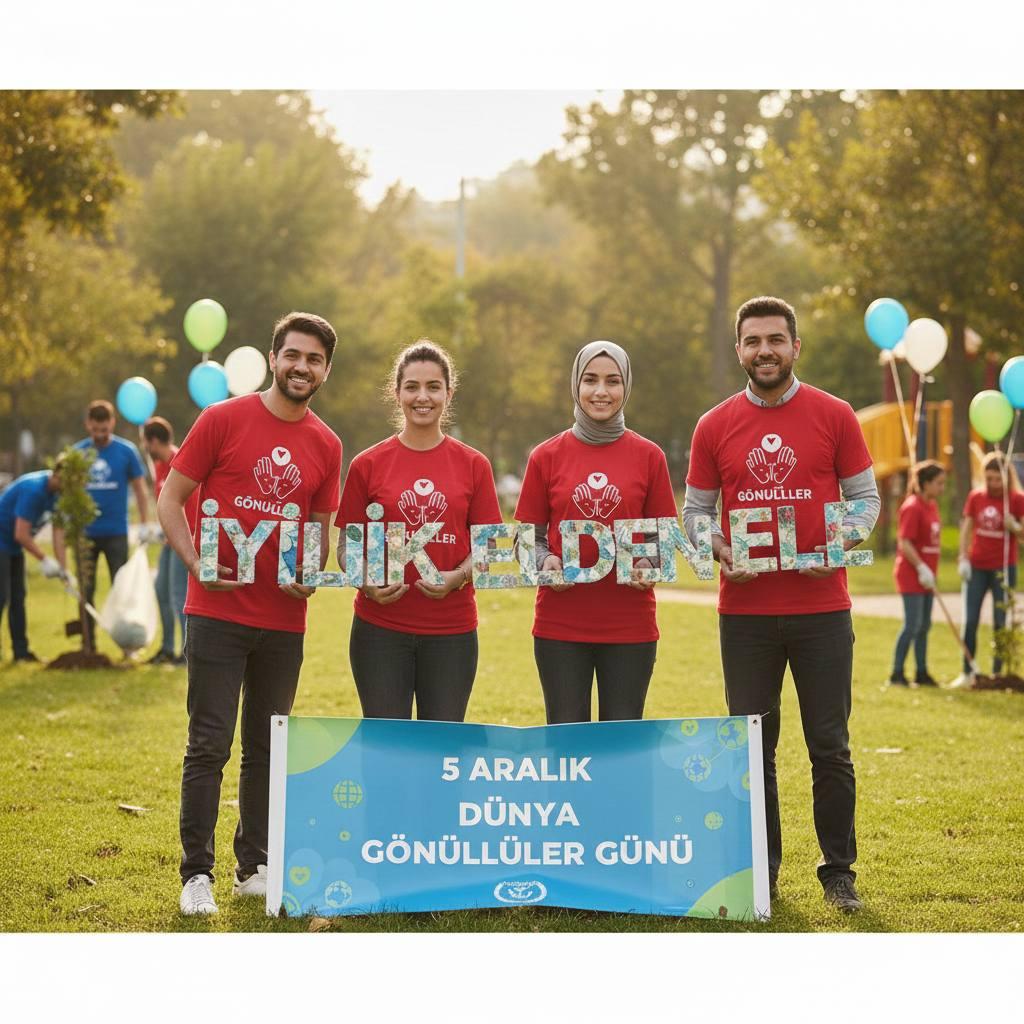
Generated by Artificial Intelligence.
One of the most distinguishing features of volunteering is that it is carried out “of one’s own free will,” without coercion or external pressure. Moreover, financial gain or compensation is not expected in volunteer activities. In this sense, volunteering emerges as an intrinsic expression of mutual aid, solidarity, and social responsibility.
Volunteer activities are not grounded solely in individual satisfaction or charitable intent; they are elevated by the principles of social benefit, public service, and responsiveness to community needs. In this context, volunteering is regarded as a mechanism through which civil society steps in to enhance social welfare in areas where the state or official institutions are unable to reach or are insufficient.
While volunteering offers individuals psychosocial, cultural, and skill-based gains, it also contributes to the formation of social values such as social capital, solidarity, community sense, and social cohesion. For instance, volunteering strengthens social relationships; develops individuals’ communication, leadership, responsibility, and teamwork skills; provides new experiences; and increases social awareness and empathy. In this regard, volunteering is seen as a strategic tool for both individual development and social progress. This dual benefit enables volunteering to be understood not merely as an act of assistance but as a process of building social solidarity and civic consciousness.
Understanding why volunteering is chosen requires examining the motivations and theoretical frameworks underlying it. Some individuals are motivated by internal factors such as altruism, compassion, and empathy, while others are driven by external factors such as a sense of social responsibility, belonging, social acceptance, or the desire to build social relationships.
Theoretically, volunteer practices can also be analyzed through various social theories. For example, studies have examined volunteering through perspectives such as “social change theory,” “role theory,” and “symbolic interactionism.”
This diversity demonstrates that generalizing volunteering through a single motivation or cause is inadequate; each act of volunteering must be evaluated in light of its specific context, individual intentions, and social conditions.
International Volunteers Day is not merely a symbolic celebration; it serves as a platform for reflection, dialogue, and policy guidance on the value, diversity, and social contributions of volunteering. Key functions of this day include:
In particular, within the global agenda, volunteering can serve goals such as peace, social cohesion, societal responses to crises, and combating social exclusion.
The phenomenon of volunteering is multidimensional and an interdisciplinary field of study. On one hand, it is examined within the contexts of sociology, social psychology, social participation, civil society, and civic organization; on the other hand, educational, cultural, ethical, and development perspectives are also integral to this analysis.
In academic literature, issues such as the sustainability of volunteering, its motivations, the production of social capital, state–NGO relations, youth and volunteering, and the social and economic impacts of volunteering are explored in depth.
These analyses contribute to understanding volunteering not merely as individual sacrifice but as a systematic, planned, and evaluated component of social structure, social fabric, civic participation, and civil society.
Individuals participating in volunteer activities gain opportunities to develop skills such as social competence, teamwork, organizational ability, empathy, and a sense of responsibility. Moreover, volunteering fosters a sense of social belonging and cultivates awareness of being an active and responsible citizen within society.
Volunteers expand their social networks by interacting with people of different ages, social backgrounds, and cultural histories, which holds value both personally and in terms of social capital.
Volunteering enhances society’s capacity to generate civil solutions to social problems and supports assistance, support, and social service processes in areas where state institutions fall short.
It increases social solidarity, empathy, mutual aid, community awareness, and civic participation, thereby strengthening social capital and social cohesion.
Especially when young people develop sensitivity to social issues through volunteering, participate in processes of social transformation, and become part of social change, volunteering becomes a strategic tool.
NGOs gain both human resources and community support through volunteers. This enhances the impact, reach, and sustainability of NGOs.
Additionally, volunteering increases public participation in civil society–state relations, contributing to institutionalization in areas such as democratic participation, social oversight, public awareness, and social responsibility.
Although volunteering provides benefits in many respects, a number of criticisms and challenges have been raised in both academic and practical contexts:
These limitations indicate that volunteer policies must be restructured not merely on the basis of individual intentions but within a broader institutional, legal, organizational, and social framework.
Today, social problems span numerous domains including climate change, refugee crises, economic inequality, access to healthcare, and social exclusion. In this context, volunteering is a vital instrument for both individual and collective responses and solutions.
In particular, through youth, civil society, community-based solidarity mechanisms, and citizen participation, volunteering is a strategic tool with the potential to transform societies, enhance resilience, and strengthen social justice.
International Volunteers Day serves as a vehicle to recall, make visible, and reach broad audiences with this potential. This day provides a platform to honor volunteers, normalize volunteering, and encourage new participants.
At the same time, volunteering bridges formal institutions, civil society, the private sector, and individuals, offering a perspective for developing multi-actor and participatory solutions to social problems.
To ensure that volunteer practices are ethical, respectful, and sustainable, several core principles are emphasized:
These principles underscore that volunteering is not merely an emotional or individual act but an ethical, responsible, and socially accountable practice.
The future of volunteering is directly linked to active youth participation, strengthening civil society, public policies that support volunteering, and the development of institutional structures.
Developing policies and programs that view volunteering not merely as charity or aid but as a dimension of social participation, democratic citizenship, social solidarity, and development will ensure its sustainability.
Simultaneously, the institutionalization of volunteering—through establishing volunteer rights, volunteer management, coordination, education, and monitoring-evaluation mechanisms; recognizing volunteering in civil society–state cooperation; and integrating it into public policy—is critical to its future.
International Volunteers Day contributes to the recognition of volunteering as a social value, responsibility, and mode of participation, rather than merely an individual behavior. This day makes volunteering visible and promotes social solidarity, civic participation, civic consciousness, and social responsibility.
Volunteering empowers individuals with personal development, social skills, and a sense of belonging, while enriching society, civil society organizations, and the public with values such as social services, solidarity, mutual aid, inclusivity, and resilience. In this sense, volunteering plays a vital role in enabling modern societies—particularly through the lenses of youth, civic participation, and development—to build a sustainable, just, and participatory future.
However, for volunteering to realize this potential, it must be properly understood, respected, supported, and organized effectively, ethically, and sustainably.
Therefore, International Volunteers Day is not merely a symbolic celebration but a critical occasion that lays the groundwork for rethinking, expanding, and institutionalizing volunteering as a social, cultural, and political value.
Volunteering strengthens the bridge of solidarity between the individual and society; enhances the collective capacity to generate solutions to social problems; and transforms individual sacrifice into collective responsibility. For this reason, volunteering deserves the recognition, time, effort, and respect it merits—both today and in the future.
Akiş, Mehmet Selim. “Sivil Toplum Kuruluşlarında (STK) Gönüllü Motivasyon Kaynaklarının Sosyo Demografik Değişkenler Açısından İncelenmesi.” *Marmara Sosyal Araştırmalar Dergisi* 15 (June 2019). Accessed November 27, 2025. https://dergipark.org.tr/tr/pub/marusad/issue/69134/1094839
Gülbak, Okan, and Edanur Ayyıldız. “Gönüllülük Çalışmaları Kapsamında İnsan Doğasını Sorgulamak: Farkındalık Topluluğu Örneği.” *İstanbul Ticaret Üniversitesi Sosyal Bilimler Dergisi* 22, no. 46 (2023): 97–114. Accessed November 27, 2025. https://dergipark.org.tr/tr/pub/iticusbe/article/1162684
Yönten Balaban, Aslı, and İnci Çoban İnce. “Gençlerin Sivil Toplum Kuruluşlarındaki Gönüllülük Faaliyetleri ve Gönüllülük Algısı: Türkiye Eğitim Gönüllüleri Vakfı (TEGV) Örneği.” Dokuz Eylül Üniversitesi İktisadi ve İdari Bilimler Fakültesi Dergisi 30, no. 2 (2015): 149–169. Accessed November 27, 2025. https://dergipark.org.tr/tr/pub/deuiibfd/issue/22713/242424

History | 5 December | ||||||||
|---|---|---|---|---|---|---|---|---|---|
First Celebrated Year | 1985 | ||||||||
Initiating Organization | United Nations (UN) | ||||||||
No Discussion Added Yet
Start discussion for "World Volunteers Day" article
Origins and Historical Background of International Volunteers Day
Core Characteristics and Conceptual Framework of Volunteering
Free Will and Non-Remunerated Participation
Social Benefit and Public Service
Individual and Social Benefit: The Dual Role of Volunteering
Motivation and Theoretical Approaches
Purpose and Function of International Volunteers Day
Academic and Theoretical Analysis of Volunteering
Benefits and Impacts of Volunteering
Impacts on the Individual
Impacts on Society
Impacts on Civil Society and Institutional Structures
Challenges, Criticisms, and Limitations of Volunteering
Contemporary Significance of International Volunteers Day
Core Principles and Ethical Values
The Future of Volunteering: Sustainability, Youth, and Institutionalization