

This article was automatically translated from the original Turkish version.
+2 More
Yelbegen (or Celbegen) is a mythical creature in Turkic mythology and folk narratives, possessing the characteristics of giants and dragons, and typically depicted as malevolent in nature. One of the indigenous terms used in Turkic dialects for giants is Yelbegen or Celbegen. In Kaşgarlı Mahmut’s Divanü Lûgat-it-Türk, the dragon is referred to as Yilbüke. In Mongol legends, all nine sons of Buka Noyon, the father of giants, are described as Yelbüke, a type of giant with a dragon-like appearance.
In Turkic dialects, this entity is commonly known by native names such as Yelbegen, Celbegen, and Delbegen. In Azerbaijani Turkish, it is called div or dev; in Uyghur Turkish, it is expressed as deva. The word “dev” is noted to have been borrowed from Indo-Iranian languages, while in Northern Turkic epics, names such as yel-moos and kara-moos are also recorded for this being.

Representative Image of Yelbegen (Generated by Artificial Intelligence)
In the belief of the Altai Turks, Yelbegen is depicted as a seven-headed, massive, malevolent dragon. It is generally portrayed as a seven-headed giant across all Turkic communities; some accounts describe it as having three, seven, or twelve heads. Physically, it possesses an enormous stature, wings, and a long tail. Its skin is covered in armor-like scales and it spews fire from its mouth. Various types exist with large ears, large teeth, and wide mouths. It is most often encountered as black or yellow in color. Giants may be tall like minarets, strong, and possess long arms capable of carrying millstones. Their mouths are extremely large; the lower lip can sweep the ground while the upper lip can reach the sky. When giants approach, thunder first rumbles, then lightning strikes and the earth trembles; sometimes they emerge from a dark cloud.

Representative Image of Yelbegen (Generated by Artificial Intelligence)
Yelbegen is one of the most powerful mythical beings in Turkic mythology and stands among the primary malevolent figures that heroes must defeat to restore order after chaos. In Altai Turkic belief, it is sent by Erlik Han, the god of evil and the underworld. When Erlik Han observes humans straying from the righteous path, he dispatches Yelbegen to capture them and bring them to the underworld. Yelbegen is said to feast on humans, horses, and sheep, and is believed to swallow the Sun and the Moon, causing solar and lunar eclipses. Giants are also interpreted as embodied forms of powerful natural forces with divine qualities; the struggle between human and giant symbolizes the broader conflict between humanity and nature. The mythological origin of Yelbegen is thought to stem from the dragon; its multi-headed, horned, furred form, ability to spew flame, and capacity to fly indicate its descent from predatory animals or dragons.
In folktales, giants are seen as chaotic entities that play a critical role in the hero’s transformation. Evil giants are portrayed as cruel, tyrannical, and man-eating; they immediately sense human scent, become aggressive, and kidnap young girls, hanging them by their hair in castles or caves. Benign or conditionally benevolent giants, on the other hand, are used to assist, protect, or even guide the hero. The motif of the giant mother or wife represents the archetypal nurturing mother, shielding the hero from her own offspring and guiding him on his path. Despite their imposing appearance, giants are mentally depicted as possessing low intelligence; in tales, they are portrayed as foolish and easily deceived by the hero’s words. This trait allows heroes to overcome them through cunning rather than brute force.
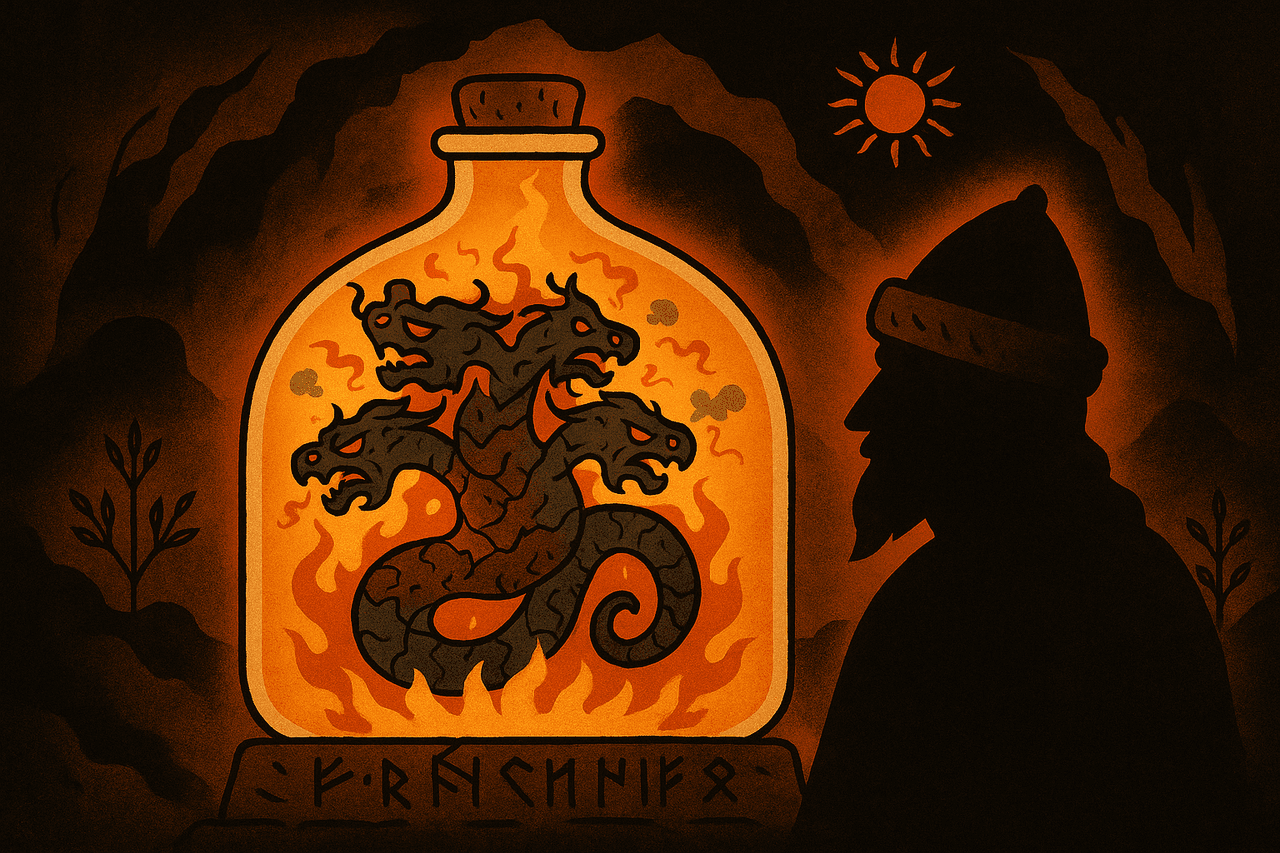
Representative Image of Yelbegen (Generated by Artificial Intelligence)
The soul (life force) of Yelbegen is typically stored outside its body, hidden within a bottle or chest; this external soul motif grants it immortality. To kill Yelbegen, the hero must locate and destroy its external soul. Giants are described as powerful sorcerers who guard or wield magical objects such as enchanted clubs, razors, pomegranates, water, and salt. To escape dire situations, they frequently use shape-shifting abilities, transforming into natural phenomena such as dust, clouds, smoke, or storms, and rarely into animals or humans such as monkeys, old women, or men. Giants dwell in inaccessible realms, typically in the Zulmet world—a domain of the underworld and chaos where humans fear to tread. Caves, wells, and dungeons are their common habitats. Mythological mountains such as Kafdağı and Kühgaf are also places where giants guard or hide.
The motif of defeating Yelbegen and the giants it represents symbolizes the hero’s maturation and the restoration of order after chaos. The most common method involves the destruction of the external soul—the object in which the giant’s life force is concealed.
Heros kill giants using iron weapons such as swords, daggers, maces, or arrows. Iron is regarded in Turkic culture as a purifying material with ritual significance. Some heroes defeat giants without any weapon, merely by overpowering them with sheer strength in wrestling. Due to their low intelligence, heroes can easily trick giants into drowning in water or being crushed under millstones. Giants can also be neutralized when heroes seize their magical objects or enter sacred places.
Accessed November 26, 2025.
Duman, Harun. "Türk Mitolojisinde Ejderha." *Uluslararası Beşeri Bilimler ve Eğitim Dergisi* 5, no. 11 (2019): 482-493. Accessed October 20, 2025. https://dergipark.org.tr/en/download/article-file/784315.
Karagöz, Neslihan and Ömer Faruk Ateş. "Altay Masalı "İyt Le Börü"de Kötülük Sembolü Celbegen ve Karşısındakiler." Bürküt Türk Dünyası Dergisi 1, no. 1 (2022): 56-71. Accessed October 20, 2025.
Özden, Melike. *Türk Kültüründen Seçilen Demonik Varlıkların İncelenmesi ve Seramik Yorumları*. Master's thesis, Dokuz Eylül Üniversitesi, 2022. Accessed October 20, 2025. https://tez.yok.gov.tr/UlusalTezMerkezi/TezGoster?key=CG8WvdvvxJP04Unr7Yecf8LKEKPJK5x1wisNYOtqX_YAwz8l4L6_TCvP4X9sXC-_

Physical Characteristics and Appearance
Mythological Role and Origin
Supernatural Powers, External Soul Motif, and Habitats