

This article was automatically translated from the original Turkish version.
+2 More
Cizre Dragons
Name(s) | Cizre Dragons | ||||||||
|---|---|---|---|---|---|---|---|---|---|
Producer(s) | Abul-Iz Ismail ibn al-Razzaz al-Jazari | ||||||||
Production Date | 12th Century | ||||||||
Location | Cizre Grand Mosque (Door Knockers) | ||||||||
Material(s) | Bronze | ||||||||
Technique | Engraving Technique | ||||||||
Current Condition | one is exhibited at the Istanbul Museum of Turkish and Islamic Arts one was smuggled to Denmark in 1969 Number: 2 pieces (originally) | ||||||||
Artistic Features | Cultural origin: Chinese mythology — Sham — Islamic art (Seljuk and Artuqid) — Mesopotamianism Rumi motif: Animalistic origin — compatible with dragon and lion | ||||||||
Similar Work | Door knocker from Tbilisi (Berlin Museum of Islamic Art, Inventory No: 1.2242); similar bronze craftsmanship, minor stylistic differences (round-eyed lion, dense scales) | ||||||||
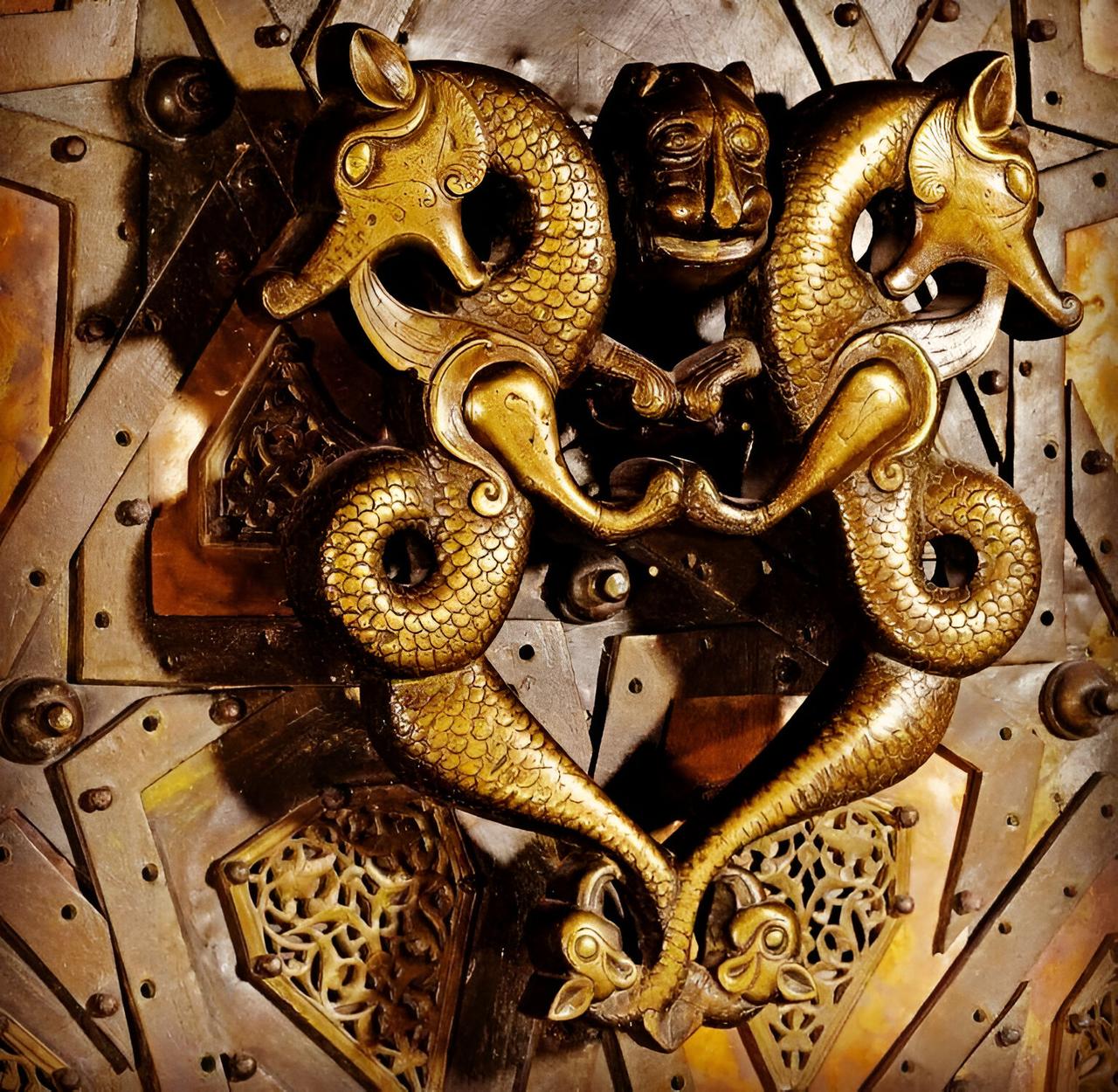
The Cizre Door Knockers are bronze door knockers crafted in the 12th century by the physicist and mechanical inventor Abu al-Iz Ismail ibn al-Razzaz al-Jazari for the inner door of Cizre Ulu Camii. These works, executed using the engraving technique, are identified as dragons and resemble creatures with almond-shaped eyes, pointed ears, and wings. The dragons are stylized biting each other’s wings, while their bodies are designed to evoke the texture of snake skin. One of these figures represents the Tigris River, the other the Euphrates River, while the stylized lion head in the center symbolizes the people of Cizre, and the eagles at the lower section represents the power of war.
Of the two dragon figures found on either side of the door of Cizre Ulu Camii, one was smuggled to Denmark in 1969, while the other is currently on display at the Istanbul Turkish Museum of Islamic Art. At the center of the dragons, the lion head motif in the complete area measures 9 x 6 cm and features almond-shaped eyes, a broad flat nose merging with the brow line, full cheeks, and pointed ears. The lion’s mane is rendered with engraving techniques to suggest texture. The nail connecting the door knocker to the lion head, forming a unified fork appearance, is 23 cm in length.
The patterns on the door panels prominently feature the rumi motif, generally accepted as having animal origins, designed to harmonize with the dragon and lion head figures. The rumi motif is a common decorative element in Anatolia architecture and crafts, and is considered to have animal origins due to its resemblance to stylized animals rather than plant forms. In Gülsen Start’s doctoral thesis, it is stated that the rumi motif is based on bird beaks, half-palmettes, or dragon prototypes.
The dragon figure is typically stylized as a winged creature with lion paws and a serpent-like tail, and its origins are presumed to lie in Chinese mythology. The dragon carries various meanings across different cultures: it was called “Lung” by the Chinese, “Tannin” by the Arabs, “Dragon” by the Persians, and “Universe” by the Turks. In the Shamanist beliefs of the Central Asia Turks, the dragon was thought to symbolize not only mastery over air and water but also a princess guarding a treasure. In ancient Mesopotamia, it was regarded as a symbol of sovereignty, and in other traditions, as a symbol of moon and darkness. In Islamic art, particularly in Seljuk and Artuqid art, the dragon figure occupied a important place and was used on coins and door knockers by Artuqids. According to some beliefs, stylized dragons were intended to frighten evil spirits and prevent them from crossing the threshold.
The lion figure generally carries a protective symbolism. In ancient Mesopotamia, the lion was seen as a symbol of power and guardian of the gate, a meaning it retained during the Islamic period. The Anatolian Seljuks frequently employed the lion in architecture as a protective element against hostile forces, placing it on exterior facades or entrance doors. According to Şenay Alsan, in the door knockers of Cizre Ulu Camii, the lion was used as a symbol of identity, power, light and the sun, while the dragons represented the moon and darkness, thus expressing opposing principles together.
A door knocker similar to the Cizre Dragons was discovered in Tbilisi and is now exhibited at the Berlin Museum of Islamic Art under inventory number 1.2242 inventory. This bronze piece shows strong similarities to the Cizre example and is believed to be a product of Artuqid mineral art from the 12th–13th centuries. Differences between these works, despite their identical Technical composition, are evident in the dragon’s scale work (more frequent and point headed scales), the more pronounced relief shapes of the wings, and the lion head’s round eyes, slender cheeks, and closed mouth design. Aside from these small differences, no significant distinction exists between the two pieces.
Caca, Şeyhmus. “Cizre Ulu Camii Kapı Tokmakları.” *İslam Medeniyeti Araştırmaları Dergisi*, 2012. Accessed April 6, 2025. chrome-extension://efaidnbmnnnibpcajpcglclefindmkaj/https://isamveri.org/pdfdrg/D208678/2012/2012_CACAS.pdf
Şırnak Kültür and Tourism Ministry. "Cizre Ejderleri." Accessed April 6, 2025. https://sirnak.ktb.gov.tr/TR-371721/cizre-ejderleri.html#:~:text=Sfenks%20ejderler%20badem%20g%C3%B6zl%C3%BC%20sivri,kartallar%20ise%20sava%C5%9F%20g%C3%BCc%C3%BCn%C3%BC%20simgeler


Cizre Dragons
Name(s) | Cizre Dragons | ||||||||
|---|---|---|---|---|---|---|---|---|---|
Producer(s) | Abul-Iz Ismail ibn al-Razzaz al-Jazari | ||||||||
Production Date | 12th Century | ||||||||
Location | Cizre Grand Mosque (Door Knockers) | ||||||||
Material(s) | Bronze | ||||||||
Technique | Engraving Technique | ||||||||
Current Condition | one is exhibited at the Istanbul Museum of Turkish and Islamic Arts one was smuggled to Denmark in 1969 Number: 2 pieces (originally) | ||||||||
Artistic Features | Cultural origin: Chinese mythology — Sham — Islamic art (Seljuk and Artuqid) — Mesopotamianism Rumi motif: Animalistic origin — compatible with dragon and lion | ||||||||
Similar Work | Door knocker from Tbilisi (Berlin Museum of Islamic Art, Inventory No: 1.2242); similar bronze craftsmanship, minor stylistic differences (round-eyed lion, dense scales) | ||||||||
Current Status and Features
Decoration and Rumi Motif
Origin and Meanings of the Dragon Figure
Symbols of the Lion Figure
Similar Examples Worldwide