This article was automatically translated from the original Turkish version.
+1 More
Control Mechanism | Controlled by horizontal stabilizer-linked elevators. Elevators typically move together (up and down). | ||||||||
|---|---|---|---|---|---|---|---|---|---|
Application Area(s) | Trim (balance) adjustment Altitude control Loops and aerobatic maneuvers Climb and descent | ||||||||
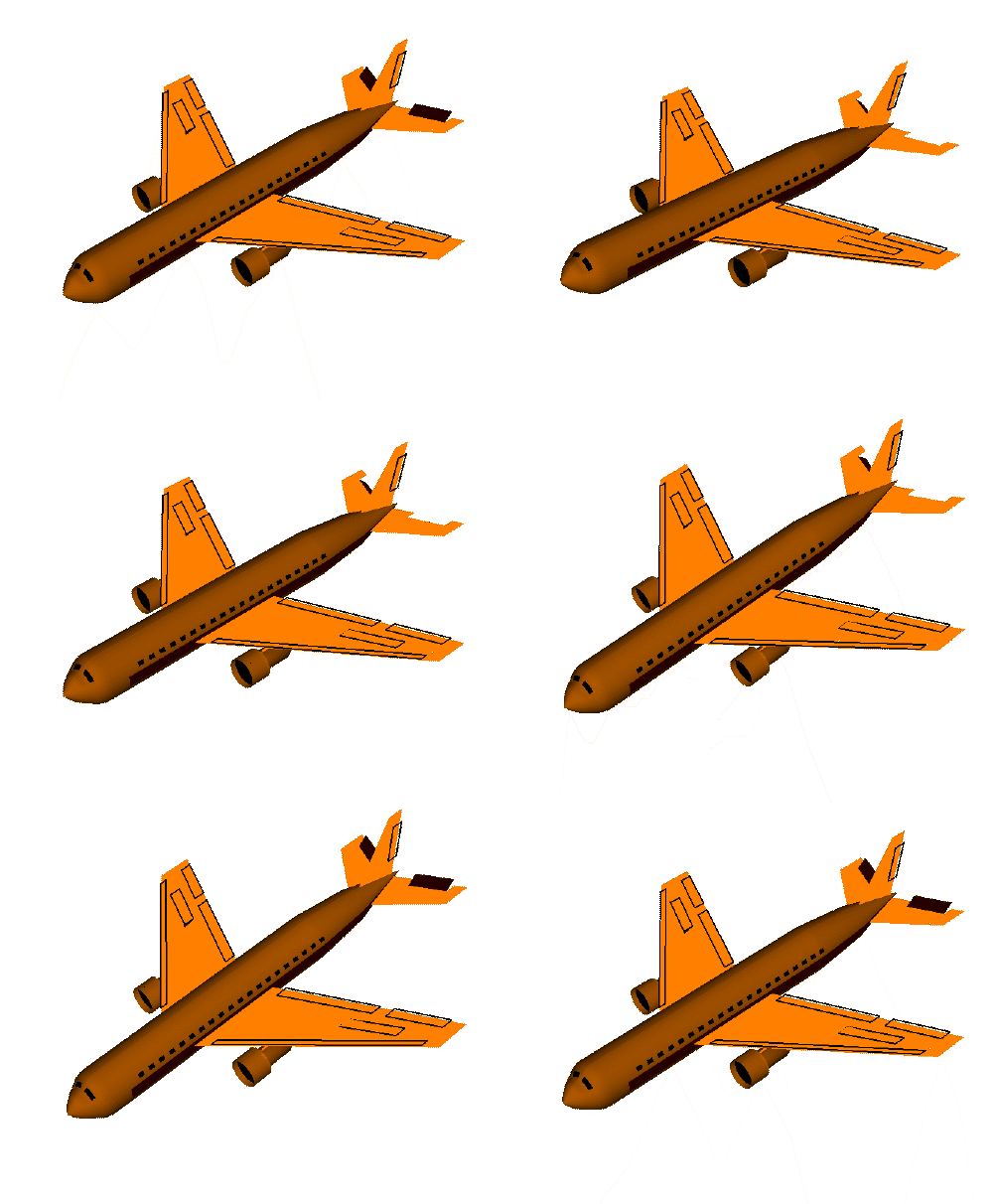
In aviation, pitch is the rotational movement of an aircraft around its horizontal axis passing through its center of gravity. This axis is perpendicular to the aircraft’s longitudinal axis (fuselage axis) and lies within the plane of the wings. Pitch motion is defined by the upward or downward movement of the aircraft’s nose.
Pitch motion is typically controlled by elevators, which are hinged surfaces attached to the horizontal stabilizer. These elevators are symmetrical surfaces positioned on either side of the vertical stabilizer and usually move together either upward or downward. When the elevator is deflected upward, it generates a downward-directed lift force on the airflow, causing the aircraft’s nose to rise. Conversely, when the elevator is deflected downward, an upward-directed force is produced, causing the nose to lower. This difference in force creates a moment that rotates the aircraft around its center of gravity.
Pilots use pitch motion to control the aircraft’s altitude, enabling climbs, descents, or maneuvers such as loops. Some aircraft are structurally prone to natural nose-up or nose-down tendencies; in such cases, the elevator is also used to trim or balance the aircraft.
In many aircraft, the horizontal stabilizer and elevator have symmetrical airfoil profiles. This configuration produces no net lift force when the elevator is in its neutral position; however, deflection of the elevator generates either positive or negative lift forces. In fighter aircraft requiring high maneuverability, the horizontal stabilizer and elevator are combined into a single movable surface known as the stabilator. In this system, control is achieved by changing the angle of the entire surface.
Airplane control - Roll, Pitch, Yaw (SoftwarePole)
ITÜ. "Aerodinamik Kuvvet ve Momentler." Accessed July 19, 2025. https://web.itu.edu.tr/~yukselen/Uck351/02-%20Aerodinamik%20kuvvet%20ve%20momentler.pdf
NASA Glenn Research Center. "Aircraft Pitch Motion." NASA. Accessed July 19, 2025. https://www.grc.nasa.gov/www/k-12/VirtualAero/BottleRocket/airplane/pitch.html
SoftwarePole. "Airplane control - Roll, Pitch, Yaw." YouTube. Accessed July 19, 2025. https://youtu.be/pQ24NtnaLl8

Control Mechanism | Controlled by horizontal stabilizer-linked elevators. Elevators typically move together (up and down). | ||||||||
|---|---|---|---|---|---|---|---|---|---|
Application Area(s) | Trim (balance) adjustment Altitude control Loops and aerobatic maneuvers Climb and descent | ||||||||
No Discussion Added Yet
Start discussion for "Yunuslama (Aviation)" article
Formation of Pitch Motion