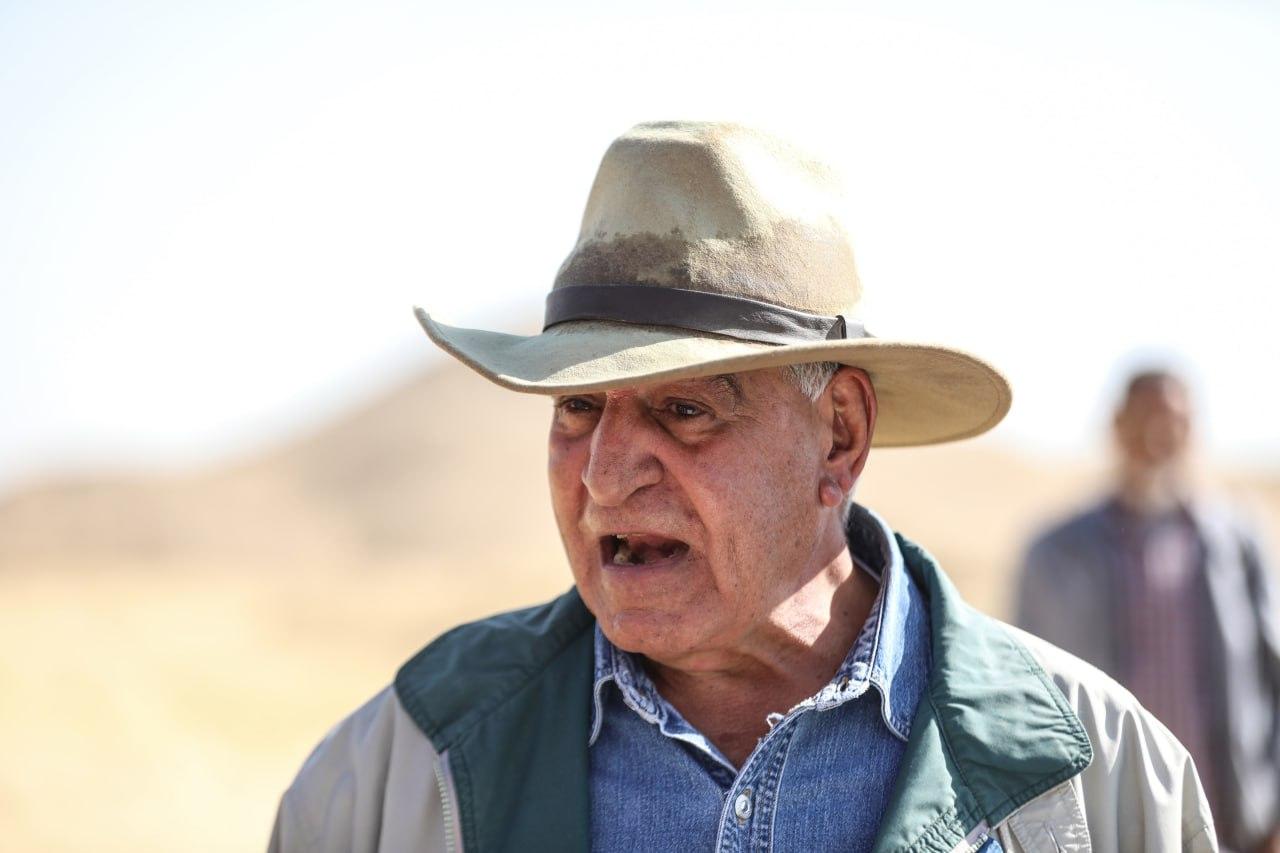
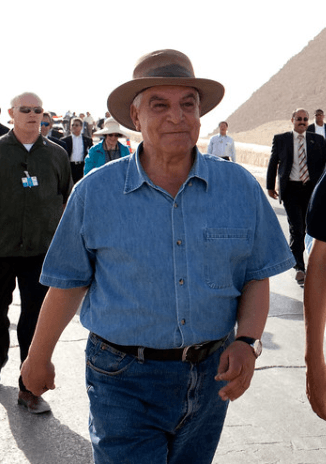
Dr. Zahi Hawass (b. 1947, Abeedya, near Damietta, Egypt) is one of the most renowned and prolific figures in modern Egyptology. He is known for his work as an archaeologist, antiquities administrator, author, and public cultural ambassador through education, fieldwork, institutional reforms, publishing, media engagement, and campaigns for the repatriation of cultural heritage.
Early Life, Education, and Professional Beginnings (1947–1990)
Zahi Hawass was born in 1947 in the small village of Abeedya near Damietta. In his youth, he planned to become a lawyer and began legal studies at age 15, but soon turned to archaeology after finding law uninteresting. In 1967, at age 20, he earned his bachelor’s degree from the Department of Archaeology at Alexandria University, specializing in Greek and Roman Archaeology.
After graduation, he was assigned through a state-run “employment for graduates” program to the Antiquities Service, where he began work as an Inspector of Antiquities. Following brief stints in the Ministry of Culture’s Cinema Department and the Ministry of Tourism, he returned to fieldwork and gained experience in excavation and restoration.
From 1969 to 1974, he served as an inspector in regions including Tuna el-Gebel, Minya (Sikh Abada), Edfu-Esna, Abydos, and the western Delta of Alexandria. In 1970, he oversaw the Western Delta region; from 1972 to 1974, he supervised the Embaba and Giza areas; in 1973–1974, he was inspector for Abu Simbel; in 1974, he oversaw the Pennsylvania expedition at Malkata (Luxor); and from 1974 to 1975, he served as inspector for the Boston Museum of Fine Arts’ Giza project.
From 1974 to 1979, he served as First Inspector of the Giza Pyramids, Embaba, and the Bahariya Oasis. In 1979, he received his diploma in Egyptology from Cairo University and became Chief Inspector of the Giza Pyramids. That same year, he won a Fulbright scholarship and was admitted to the University of Pennsylvania. He completed his master’s degree in 1983 and earned his doctorate in 1987 under the supervision of Professor David O’Connor with his thesis titled The Funerary Establishments of Khufu, Khafra, and Menkaura During the Old Kingdom.
In 1987, Hawass returned to Egypt and was appointed Director General of Giza, Saqqara, and the Bahariya Oasis. During this period, he initiated restoration projects for the Khafre Pyramid (Giza) and the Djoser Pyramid (Saqqara), and in 1989 took charge of the Sphinx Restoration Project.
Key Discoveries and Fieldwork (1990s–Present)
Hawass’s fieldwork spans a wide range of discoveries. Below are the major finds and projects listed chronologically:
- 1990: Discovery of the “pyramid builders” tombs at Giza. This work provided concrete evidence of the community of artisans and laborers involved in pyramid construction.
- 1991: Discovery of Khufu’s (Cheops) satellite pyramid; also the identification of the Osiris shaft between the Khafre Pyramid and the Sphinx.
- 1993: Reporting of original finds inside the Khufu Pyramid, including a door with copper handles.
- 1996: Discovery of the “Valley of the Golden Mummies” in the Bahariya Oasis; uncovering tombs of local governors, their spouses, and family members.
- 1997: Leadership of the preservation and restoration of the Menkaure Pyramid.
- 1998: Work at Giza encompassing Khufu and the royal necropolises; same year promoted to Undersecretary for the Giza Monuments within the state administration.
- 2000s: In early 2002, Hawass became Secretary General of the Supreme Council of Antiquities (SCA). In 2005, he launched the Egyptian Mummy Project (EMP), employing modern forensic techniques (CT scans, DNA analysis) to identify royal mummies and determine causes of death. Under EMP:The mummy of Hatshepsut and members of Tutankhamun’s family were identified.Evidence regarding the cause of death of Ramses III (assassination/“harem conspiracy”) was obtained.
- Robotic research at Giza: Under Hawass’s leadership, a scientific team used robotic equipment to investigate “hidden doors” within Khufu’s Great Pyramid; he also chaired the scientific committee of the Scan Pyramids project.
- Valley of the Kings: Hawass organized the first Egyptian-led excavation in the Valley of the Kings, contributing to the rediscovery of “lost” tombs such as KV 53; he clarified the labyrinthine tunnel mystery in the tomb of Seti I.
- New pyramids, tumuli, and monument discoveries: Identification of previously unknown or reidentified structures such as Khufu’s satellite pyramid and the pyramid of Teti’s mother; also, the reidentification of pyramids belonging to queens of the 5th and 6th Dynasties at Saqqara.
- 2021: Discovery of the “Dazzling Aten / Lost Golden City” in Luxor (associated with Amenhotep III); also, new findings around the Teti Pyramid and restoration work at the tomb of Ramses II.
- 2023–2025: In 2023, a 25th Dynasty female tomb was discovered in Luxor, a lost pyramid at Gisr el-Mudir, and a temple of Thutmose I were uncovered; in 2024–2025, field reports and catalogues for the Grand Egyptian Museum (GEM) and other exhibitions were published. Ongoing surveys in the West Valley and the “Valley of the Monkeys” continue to investigate royal workshops and potential new tombs in the West Valley.
Hawass has also led underwater excavations in the Nile in search of ancient obelisks and statues, uncovered the northern entrances of the Kavalye and other temples, and overseen numerous smaller but chronologically significant archaeological discoveries.
Scientific Methods: Mummies and Modern Forensic Applications
One of the key scientific initiatives during Hawass’s tenure was the Egyptian Mummy Project (EMP). This project aimed to identify royal mummies and determine causes of death through computerized tomography (CT) scans, paleoradiological examinations, DNA analysis, and anthropological-pathological assessments.
Research under EMP led to significant findings, including confirmation of Hatshepsut’s identity, genetic identification of members of Tutankhamun’s family, and the forensic determination of Ramses III’s cause of death. These results were published in scientific journals such as the Journal of the American Medical Association (JAMA), British Medical Journal (BMJ), Frontiers in Medicine, and the Journal of Computer Assisted Tomography, generating broad impact in archaeology, genetics, and forensic science.
Institutional Roles, Conservation Programs, and Heritage Management
Throughout his administrative career, Hawass played an active role in shaping Egypt’s heritage protection policies. Key initiatives include:
- Introduction of site management practices: Dividing ancient sites into zones, establishing protected areas, and regulating visitor flow.
- Construction of visitor centers: Building visitor centers that balance tourism infrastructure with conservation needs.
- Repatriation of antiquities: Recovery of over 6,000 artifacts and active efforts against looting.
- Training of Egyptian archaeologists: Educating over a thousand young archaeologists in museum curation and excavation techniques.
- Legal protection: Strengthening legal frameworks for the protection of antiquities.
- Major conservation projects: Restoration and preservation programs for monuments including the Sphinx, the Khufu and Khafre Pyramids, the Djoser Pyramid (Step Pyramid), the Serapeum, the Abusir blocks, and the Queens’ Pyramids.
- Museum construction and modern museology: Launching and managing large-scale museum initiatives such as the Grand Egyptian Museum (GEM) and the National Museum of Egyptian Civilization (NMEC).
Publications — Books, Academic Articles, and Editorial Work
Selected English Books and Edited Volumes
Since 1987, Hawass has published numerous articles and book chapters, primarily focused on Giza, Saqqara, Abusir, the Bahariya Oasis, the Valley of the Kings, and royal tombs. His publications cover the identification of archaeological finds, architectural analysis of structures, statue groups, Old Kingdom programs, site management, and paleoradiological and CT-DNA studies.
- Hawass, Zahi 1990. The pyramids of ancient Egypt. The Carnegie Series on Egypt. Pittsburgh: Carnegie Museum of Natural History.
- Hawass, Zahi 1998. Silent images: women in pharaonic Egypt. New York: Abrams.
- Hawass, Zahi 1998. The secrets of the Sphinx: restoration past and present. Cairo: The American University in Cairo Press.
- Hawass, Zahi 2000. Valley of the golden mummies. New York: Harry Abrams.
- Hawass, Zahi 2000. The mysteries of Abu Simbel: Ramesses II and the temples of the rising sun. Cairo; New York: American University in Cairo Press.
- Hawass, Zahi 2002. Hidden treasures of the Egyptian Museum: one hundred masterpieces from the centennial exhibition. Photographs by Kenneth Garrett. Cairo: American University in Cairo Press.
- Hawass, Zahi (ed.) 2002. Bibliotheca Alexandrina: the Archaeology Museum. Photographs by Christoph Gerigk. Cairo: Supreme Council of Antiquities.
- Hawass, Zahi and Lyla Pinch Brock (eds) 2003. Egyptology at the dawn of the twenty-first century: proceedings of the Eighth International Congress of Egyptologists, Cairo, 2000, 3 vols. Cairo; New York: American University in Cairo Press.
- Hawass, Zahi 2003. Secrets from the sand: my search for Egypt's past. London: Thames & Hudson.
- Hawass, Zahi (ed.) 2003. The treasures of the pyramids. Cairo: American University in Cairo Press.
- Hawass, Zahi 2004. Hidden treasures of ancient Egypt: unearthing the masterpieces of Egyptian history. Photographs by Kenneth Garrett. Washington, DC: National Geographic.
- Hawass, Zahi 2004. The golden age of Tutankhamun: divine might and splendor in the New Kingdom. Cairo; New York: American University in Cairo Press.
- Hawass, Zahi 2004. The island of Kalabsha. Cairo: Supreme Council of Antiquities Press.
- Hawass, Zahi 2005. Tutankhamun and the golden age of the pharaohs. Photographs by Kenneth Garrett. Washington, DC: National Geographic Society.
- Hawass, Zahi 2006. Mountains of the pharaohs: the untold story of the pyramid builders. Cairo: American University in Cairo Press.
- Hawass, Zahi 2006. The realm of the pharaohs. Vercelli: White Star.
- Hawass, Zahi 2006. The royal tombs of Egypt: the art of Thebes revealed. London: Thames & Hudson.
- Hawass, Zahi A. and Janet E. Richards (eds) 2007. The archaeology and art of ancient Egypt: essays in honor of David B. O'Connor, 2 vols. Supplément aux Annales du Service des Antiquités de l'Egypte 36. Le Caire: Conseil Suprême des Antiquités de l'Egypte.
- Hawass, Zahi 2007. King Tutankhamun: the treasures of the tomb. Photographs by Sandro Vannini. London: Thames & Hudson.
- Hawass, Zahi and Ashraf Senussi 2008. Old Kingdom pottery from Giza. Cairo: Supreme Council of Antiquities.
- Hawass, Zahi A., Khaled A. Daoud, and Sawsan Abd El-Fattah (eds) 2008. The realm of the pharaohs: essays in honor of Tohfa Handoussa, 2 vols. Supplément aux Annales du Service des Antiquités de l'Egypte 37. Cairo: General Organisation for Government Printing Offices.
- Hawass, Zahi 2008. Tutankhamun: the golden king and the great pharaohs. Photographs by Sandro Vannini. Washington, D.C.: National Geographic.
- Hawass, Zahi 2009. The lost tombs of Thebes: life in paradise. Photographs by Sandro Vannini. London: Thames & Hudson.
- Hawass, Zahi and Franck Goddio 2010. Cleopatra: the search for the last queen of Egypt. Washington D.C.: National Geographic.
- Hawass, Zahi 2010. Highlights of the Egyptian Museum. Photographs by Sandro Vannini. Cairo: American University in Cairo Press.
- Hawass, Zahi and Jennifer Houser Wegner (eds) 2010. Millions of jubilees: studies in honor of David P. Silverman, 2 vols. Supplément aux Annales du Service des Antiquités de l'Egypte 39. Le Caire: Conseil Suprême des Antiquités.
- Hawass, Zahi and Salima Ikram (eds) 2010. Thebes and beyond: studies in honour of Kent R. Weeks. Supplément aux Annales du Service des Antiquités de l'Egypte 41. Le Caire: Conseil Suprême des Antiquités.
- Hawass, Zahi A., Peter Der Manuelian, and Ramadan B. Hussein (eds) 2010. Perspectives on ancient Egypt: studies in honor of Edward Brovarski. Supplément aux Annales du Service des Antiquités de l'Egypte 40. Cairo: Conseil Suprême des Antiquités de l'Égypte.
- Hawass, Zahi 2010. Wonders of the Horus temple: the sound and light of Edfu. Photographs by Sherif Sonbol. Cairo: Misr Company for Sound, Light & Cinema.
- Hawass, Zahi A., Khaled A. Daoud, and Ramadan B. Hussein (eds) 2011. Scribe of justice: Egyptological studies in honour of Shafik Allam. Supplément aux Annales du Service des Antiquités de l'Egypte 42. Le Caire: Ministry of State for Antiquities.
- Hawass, Zahi 2011. Newly-discovered statues from Giza: 1990–2009. Cairo: Ministry of State for Antiquities.
- Hawass, Zahi, Tamás A. Bács, and Gábor Schreiber (eds) 2011. Proceedings of the colloquium on Theban archaeology at the Supreme Council of Antiquities, November 5, 2009. Le Caire: Conseil Suprême des antiquités de l'Égypte.
- Hawass, Zahi 2013. Discovering Tutankhamun: from Howard Carter to DNA. Cairo: The American University in Cairo Press.
- Hawass, Zahi and Sahar N. Saleem 2016. Scanning the pharaohs: CT imaging of the New Kingdom royal mummies. Cairo; New York: The American University in Cairo Press.
- Lehner, Mark and Zahi Hawass 2017. Giza and the pyramids: the definitive history. London: Thames & Hudson.
- Hawass, Zahi (ed.) 2018. Tutankhamun: treasures of the golden pharaoh. The centennial celebration. New York: Melcher Media.
- Hawass, Zahi 2021. Ramses the Great: And the Gold of the Pharaohs. Viterbo, Italy: Laboratoriorosso.
- Hawass, Zahi 2022. The Pyramids: Magic and Mystery. High Quality with limited edition. Photographs by Sandro Vanini. Italy: Laboratorio rosso.
- Hawass, Zahi 2022. Zahi Hawass’ Secret Egypt. Photographs by Sandro Vanini. Italy: Laboratorio rosso.
- Hawass, Zahi 2024. NMEC Catalogue (Arabic Edition). Cairo: Nahdet Misr. (Note: Primarily Arabic, but included per list context.)
- Hawass, Zahi, et al. 2024. Pyramids: Treasures, mysteries, and new discoveries in Egypt. Milan: Whitestar.
- Hawass, Zahi 2025. Grand Egyptian museum Tutankhamun. Viterbo, Italy: Laboratoriorosso. (Note: June 2025 publication.)
- Hawass, Zahi 2025. L’Uomo con il Cappello. FAS editore.
Selected English Academic Articles and Book Chapters
- Hawass, Zahi 1985. The Khufu statuette: is it an Old Kingdom sculpture? In Posener-Kriéger, Paule (ed.), Mélanges Gamal eddin Mokhtar 1, 379-394. Le Caire: Institut français d'archéologie orientale.
- Hawass, Zahi Abass 1987. The funerary establishments of Khufu, Khafra and Menkaura during the Old Kingdom. Ann Arbor: UMI.
- Hawass, Zahi 1991. The statue of the dwarf Pr-n(j)-anx(w) recently discovered at Giza. Mitteilungen des Deutschen Archäologischen Instituts, Abteilung Kairo 47, 157-162.
- Hawass, Zahi 1991. Recent work in Egypt. Newsletter of the American Research Center in Egypt 154, 12-13.
- Hawass, Zahi 1992. Nazlet el-Samman, 1991: Old Kingdom pottery types. Bulletin de liaison de la céramique égyptienne 16, 10-13.
- Hawass, Zahi 1992. Recent discoveries at Giza plateau. In Anonymous (ed.), Sesto Congresso internazionale di egittologia: atti 1, 241-242. Torino: International Association of Egyptologists.
- Hawass, Zahi A. 1992. A burial with an unusual plaster mask in the western cemetery of Khufu's pyramid. In Friedman, Renée and Barbara Adams (eds), The followers of Horus: studies dedicated to Michael Allen Hoffman, 327-336. Oxford: Oxbow Books.
- Hawass, Zahi 1992. History of the Sphinx conservation. In Esmael, Feisal A. (ed.), The First International Symposium on the Great Sphinx: book of proceedings, 165-214. Cairo: Egyptian Antiquities Organization Press.
- Hawass, Zahi 1992. Nazlet el-Samman, 1991. Old Kingdom pottery types. Bulletin de liaison du groupe international d'étude de la céramique égyptienne 16, 10-13.
- Hawass, Zahi 1993. The great Sphinx at Giza: date and function. In Anonymous (ed.), Sesto Congresso internazionale di egittologia: atti 2, 177-195. Torino: International Association of Egyptologists.
- Hawass, Zahi and Peter Grossmann 1993. Recent discoveries in al-Haiz (Bahria Oasis). Bulletin de la Société d'Archéologie Copte 32, 89-110.
- Hawass, Zahi 1994. A fragmentary monument of Djoser from Saqqara. Journal of Egyptian Archaeology 80, 45-56.
- Hawass, Zahi and Mark Lehner 1994. Remnant of a lost civilization? Archaeology 47 (5), 44-47.
- Hawass, Zahi A. 1994. Can the sphinx be saved? Archaeology 47 (5), 42-43.
- Hawass, Zahi 1995. The Egyptian monuments: problems and solutions. International Journal of Cultural Property 1 (4), 105-117.
- Hawass, Zahi 1995. Saving the monuments of Egypt: now and forever. Minerva 6 (5), 6-11.
- Hawass, Zahi 1995. The programs of the royal funerary complexes of the Fourth Dynasty. In O'Connor, David and David P. Silverman (eds), Ancient Egyptian kingship, 221-262. Leiden: E. J. Brill.
- Hawass, Zahi 1995. A group of unique statues discovered at Giza 2: an unfinished reserve head and a statuette of an overseer. In Anonymous (ed.), Kunst des Alten Reiches: Symposium im Deutschen Archäologischen Institut Kairo am 29. und 30. Oktober 1991, 97-101. Mainz: Zabern.
- Hawass, Zahi 1995. A group of unique statues discovered at Giza 1: statues of the overseers of the pyramid builders. In Anonymous (ed.), Kunst des Alten Reiches: Symposium im Deutschen Archäologischen Institut Kairo am 29. und 30. Oktober 1991, 91-95. Mainz: Zabern.
- Hawass, Zahi 1996. The workmen's community at Giza. In Bietak, Manfred (ed.), Haus und Palast im Alten Ägypten / House and palace in ancient Egypt, 53-67. Wien: Verlag der Österreichischen Akademie der Wissenschaften.
- Hawass, Zahi 1996. The discovery of the satellite pyramid of Khufu (GI-d). In Manuelian, Peter Der (ed.), Studies in honor of William Kelly Simpson 1, 379-398. Boston: Dept. of Ancient Egyptian, Nubian and Near Eastern Art, Museum of Fine Arts.
- Hawass, Zahi and Miroslav Verner 1996. Newly discovered blocks from the causeway of Sahure (archaeological report). Mitteilungen des Deutschen Archäologischen Instituts, Abteilung Kairo 52, 177-186.
- Hawass, Zahi 1997. The discovery of the harbors of Khufu and Khafre at Gîza. In Berger, Catherine and Bernard Mathieu (eds), Études sur l'Ancien Empire et la nécropole de Saqqâra dédiées à Jean-Philippe Lauer 1, 245-256. Montpellier: Université Paul Valéry-Montpellier III.
- Hawass, Zahi 1997. The discovery of a pair-statue near the pyramid of Menkaure at Giza. Mitteilungen des Deutschen Archäologischen Instituts, Abteilung Kairo 53, 289-293.
- Hawass, Zahi 1997. A statue of Caracalla found in the Nile by a fisherman. In Phillips, Jacke (ed.), Ancient Egypt, the Aegean, and the Near East: studies in honour of Martha Rhoads Bell 1, 227-233. San Antonio: Van Siclen Books.
- Hawass, Zahi 1998. Antiquities reports from Egypt: the Giza monuments. KMT 9 (3), 22-25.
- Hawass, Zahi 1998. The splendour of the Old Kingdom: from the Fourth Dynasty to the Sixth Dynasty. In Tiradritti, Francesco (ed.), Egyptian treasures: from the Egyptian Museum in Cairo, 50-59. Vercelli: White Star.
- Hawass, Zahi 1998. Pyramid construction: new evidence discovered at Giza. In Guksch, Heike and Daniel Polz (eds), Stationen: Beiträge zur Kulturgeschichte Ägyptens, Rainer Stadelmann gewidmet, 53-62. Mainz: Philipp von Zabern.
- Hawass, Zahi 1998. A unique Old Kingdom headrest and offering tablet of seven sacred oils found at Saqqara. Memnonia 9, 155-160.
- Hawass, Zahi 1998. A group of unique statues discovered at Giza III: the statues of Jnty-5dw from Tomb GSE 1915. In Grimal, Nicolas, Les critères de datation stylistiques à l'ancien empire, 187-208. Le Caire: Institut français d'archéologie orientale.
- Hawass, Zahi 1998. Abusir tomb: Egyptian priest's undisturbed burial discovered. Photographs by Kenneth Garrett. National Geographic 194 (5), 102-113.
- Hawass, Zahi 1997. The pyramids. In Silverman, David P. (ed.), Ancient Egypt, 168-191. New York, London: Oxford University Press.
- Hawass, Zahi 1999. Excavating the Old Kingdom: the Egyptian archaeologists. In Anonymous (ed.), Egyptian art in the age of the pyramids, 154-165. New York: Metropolitan Museum of Art.
- Hawass, Zahi 1999. Oasis of the dead: Roman-era tombs southwest of Cairo yield scores of gilded mummies. Archaeology 52 (5), 38-43.
- Hawass, Zahi 1999. Fragmentary quartzite female hand found in Abou-Rawash. In Teeter, Emily and John A. Larson (eds), Gold of praise: studies on ancient Egypt in honor of Edward F. Wente, 175-178. Chicago: Oriental Institute of the University of Chicago.
- Hawass, Zahi 1999. The "Pyramid Builders": A group of unique statues discovered at Giza IV. The statue of an overseer of the craftsmen and his wife. In Ziegler, Christiane and Nadine Palayret (eds), L'art de l'Ancien Empire égyptien: actes du colloque organisé au musée du Louvre par le Service culturel les 3 et 4 avril 1998, 79-98. Paris: Documentation française.
- Hawass, Zahi 1999-2000. A personal account of the discovery of the Valley of the Gilded Mummies. KMT 10 (4), 72-85.
- Hawass, Zahi 1999. Tombs of the pyramid builders. Archaeology 50 (1), 39-43.
- Hawass, Zahi and Mark Lehner 1999. Builders of the pyramids: excavations at Giza yield the settlements and workshops of three generations of laborers. Archaeology 50 (1), 30-38.
- Hawass, Zahi 2000. Recent discoveries in the pyramid complex of Teti at Saqqara. In Bárta, Miroslav and Jaromír Krejčí (eds), Abusir and Saqqara in the year 2000, 413-444. Praha: Academy of Sciences of the Czech Republic, Oriental Institute.
- Hawass, Zahi 2000. Roman mummies discovered at Bahria Oasis. In Stager, Lawrence E., Joseph A. Greene, and Michael D. Coogan (eds), The archaeology of Jordan and beyond: essays in honor of James A. Sauer, 157-166. Winona Lake, Indiana: Eisenbrauns.
- Hawass, Zahi 2001. Solving the puzzles of Giza. Egypt revealed: archaeology, travel and adventure 2001 (March/April), 38-45.
- Hawass, Zahi 2001. New discoveries from the valley of the golden mummies. Egypt revealed: archaeology, travel and adventure 2001 (June), 46-53.
- Hawass, Zahi 2002. An inscribed lintel in the tomb of the vizier Mehu at Saqqara. Lingua Aegyptia 10, 219-224.
- Hawass, Zahi 2002. Old Kingdom wooden statues from Saqqara recently arrived at the Egyptian Museum. In Eldamaty, Mamdouh and May Trad (eds), Egyptian museum collections around the world 1, 523-532. Cairo: Supreme Council of Antiquities.
- Hawass, Zahi 2002. The glory of Ancient Egypt: the pharaonic period. In Hawass, Zahi (ed.), Bibliotheca Alexandrina: the Archaeology Museum, 13-41. Cairo: Supreme Council of Antiquities.
- Hawass, Zahi 2001-2002. The legend of the pharaoh's lost tomb: a tale from the Valley of the Golden Mummies. The Massachusetts Review 42 (4), 475-488.
- Hawass, Zahi 2003. The Old Kingdom pyramidion: did it exist and was it cased in gold? In Grimal, Nicolas, Amr Kamel, and Cynthia May-Sheikholeslami (eds), Hommages à Fayza Haikal, 111-124. Le Caire: Institut français d'archéologie .
- Hawass, Zahi 2003. Site management and conservation. In Hawass, Zahi and Lyla Pinch Brock (eds), Egyptology at the dawn of the twenty-first century: proceedings of the Eighth International Congress of Egyptologists, Cairo, 2000 3, 48-61. Cairo; New York: American University in Cairo Press.
- Hawass, Zahi 2003. The pyramids. In Hawass, Zahi (ed.), The treasures of the pyramids, 12-17. Cairo: American University in Cairo Press.
- Hawass, Zahi 2003. The architectural development of the Egyptian royal tomb. In Hawass, Zahi (ed.), The treasures of the pyramids, 46-49. Cairo: American University in Cairo Press.
- Hawass, Zahi 2003. The architectural components of the pyramid complex. In Hawass, Zahi (ed.), The treasures of the pyramids, 50-53. Cairo: American University in Cairo Press
- Hawass, Zahi 2003. The queens' pyramids of the Fourth Dynasty at Giza. In Hawass, Zahi (ed.), The treasures of the pyramids, 138-149. Cairo: American University in Cairo Press.
- Hawass, Zahi 2003. The satellite pyramid of Khufu. In Hawass, Zahi (ed.), The treasures of the pyramids, 150-151. Cairo: American University in Cairo Press.
- Hawass, Zahi 2003. The mystery of Hetepheres. In Hawass, Zahi (ed.), The treasures of the pyramids, 152-155. Cairo: American University in Cairo Press.
- Hawass, Zahi 2003. The secret doors inside the Great Pyramid. In Hawass, Zahi (ed.), The treasures of the pyramids, 156-159. Cairo: American University in Cairo Press.
- Hawass, Zahi 2003. The pyramidion. In Hawass, Zahi (ed.), The treasures of the pyramids, 160-163. Cairo: American University in Cairo Press.
- Hawass, Zahi 2003. The royal boats at Giza. In Hawass, Zahi (ed.), The treasures of the pyramids, 164-171. Cairo: American University in Cairo Press.
- Hawass, Zahi and Miroslav Verner 2003. The surprising Abusir blocks. In Hawass, Zahi (ed.), The treasures of the pyramids, 260-263. Cairo: American University in Cairo Press.
- Hawass, Zahi 2003. The decorative program of the Old Kingdom pyramid complexes. In Hawass, Zahi (ed.), The treasures of the pyramids, 282-285. Cairo: American University in Cairo Press.
- Hawass, Zahi 2004. The tombs of the pyramid builders: the tomb of the artisan Petety and his curse. In Knoppers, Gary N. and Antoine Hirsch (eds), Egypt, Israel, and the ancient Mediterranean world: studies in honor of Donald B. Redford, 21-39. Leiden; Boston: Brill.
- Hawass, Zahi 2004. Luxor addition heralds a new era for museums in Egypt. KMT 15 (3), 20-32.
- Hawass, Zahi 2004. The EMP: Egyptian Mummy Project. KMT 15 (4), 29-38.
- Hawass, Zahi 2005. Khufu's national project: the Great Pyramid of Giza in the year 2528 B.C. In Jánosi, Peter (ed.), Structure and significance: thoughts on ancient Egyptian architecture, 305-334. Wien: Verlag der Österreichischen Akademie der Wissenschaften.
- Hawass, Zahi 2005. The tomb of Merer-nisut at Giza. Bulletin of the Egyptian Museum 2, 79-88.
- Hawass, Zahi 2005. Facing Tutankhamun. Bulletin of the American Research Center in Egypt 188, 1, 3-5.
- Hawass, Zahi 2005. The riddle of the pyramids. Ancient Egypt: the history, people and culture of the Nile valley 29 (5/5), 19-25.
- Hawass, Zahi 2005. Unique statues from Giza V: the exceptional statue of the priest Kai and his family. In Daoud, Khaled, Shafia Bedier, and Sawsan Abd El-Fattah (eds), Studies in honor of Ali Radwan 2, 25-37. Le Caire: Conseil Suprême des Antiquités.
- Hawass, Zahi 2005. Recent discoveries at Akhmim. KMT 16 (1), 18-23.
- Hawass, Zahi 2005. King Tut returns: Tutankhamun and the golden age of the pharaohs. Photographs by Andreas Voegelin. KMT 16 (2), 20-37.
- Hawass, Zahi 2006. A new colossal seated statue of Ramses II from Akhmim. In Czerny, Ernst, Irmgard Hein, Hermann Hunger, Dagmar Melman, and Angela Schwab (eds), Timelines: studies in honour of Manfred Bietak 1, 129-139. Leuven: Peeters; Departement Oosterse Studies.
- Hawass, Zahi 2006. The excavation at Kafr el Gebel: season 1987 - 1988. In Daoud, Khaled and Sawsan Abd el-Fatah (eds), The world of ancient Egypt: essays in honor of Ahmed Abd el-Qader el-Sawi, 121-145. Le Caire: General Organisation for Government Printing Offices.
- Hawass, Zahi 2006. Unique statues found at Giza VIII: the tomb and the statue of Wenen-em-niut. Annales du Service des Antiquités de l'Égypte 80, 229-255.
- Hawass, Zahi 2006. Dancing with pharaohs: the new royal mummies halls at the Egyptian Museum, Cairo. KMT 17 (1), 20-28.
- Hawass, Zahi 2006. Quest for the mummy of Hatshepsut: could she be the lady in the attic of the Egyptian Museum, Cairo? KMT 17 (2), 40-43.
- Hawass, Zahi 2007. A note on the discovery of an unfinished double statue found in the cemetery of the pyramid builders. Bulletin of the Egyptian Museum 4, 57-70.
- Hawass, Zahi 2007. Meeting Tutankhamun. Ancient Egypt: the history, people and culture of the Nile valley 44 (8/2), 29-35.
- Hawass, Zahi A. 2007. The discovery of the Osiris shaft at Giza. In Hawass, Zahi A. and Janet E. Richards (eds), The archaeology and art of ancient Egypt: essays in honor of David B. O'Connor 1, 379-397. Le Caire: Conseil Suprême des Antiquités de l'Egypte.
- Hawass, Zahi 2007. Sakkara's new Imhotep Museum. KMT 18 (1), 26-35, 47.
- Hawass, Zahi 2007. The scientific search for Hatshepsut's mummy. KMT 18 (3), 20-25.
- Hawass, Zahi 2007. New revelations from the pyramids of Giza. In Fagan, Brian M. (ed.), Discovery! Unearthing the new treasures of archaeology, 46-49. London: Thames & Hudson.
- Hawass, Zahi 2007. The tomb of Tutankhamun's mother? An 18th Dynasty chamber in the Valley of the Kings. In Fagan, Brian M. (ed.), Discovery! Unearthing the new treasures of archaeology, 50-55. London: Thames & Hudson.
- Hawass, Zahi 2007. The Valley of the Golden Mummies, Egypt. In Fagan, Brian M. (ed.), Discovery! Unearthing the new treasures of archaeology, 72-77. London: Thames & Hudson.
- Hawass, Zahi 2007. Royal figures found in Petrie's so-called workmen's barracks at Giza. Bulletin of the Egyptological Seminar 17, 97-100.
- Hawass, Zahi, M[ervat] Shafik, F[rank] J. Rühli, A[shraf] Selim, E[ssam] el-Sheikh, S[herief] Abdel Fatah, H. Amer, F[awzi] Gaballa, A[ly] Gamal Eldin, E. Egarter-Vigl, and P. Gostner 2007. Computed tomographic evaluation of Pharao Tutankhamun, ca. 1300 BC. Annales du Service des Antiquités de l'Égypte 81, 159-174.
- Hawass, Zahi 2008. Unique statues found at Giza VI: two unknown statues found in the western field and near the causeway of Khafre. In Thompson, Stephen E. and Peter Der Manuelian (eds), Egypt and beyond: essays presented to Leonard H. Lesko upon his retirement from the Wilbour chair of Egyptology at Brown University June 2005, 155-161. Providence, RI: Brown Univ., Dep. of Egyptology and Ancient Western Asian Studies.
- Hawass, Zahi 2008. Giza GSE 1937: a seated statue of an unknown man and an unfinished double statue (uniques statues discovered at Giza VII). In Gabolde, Luc (ed.), Hommages à Jean-Claude Goyon: offerts pour son 70e anniversaire, 247-260. Le Caire: Institut Français d'Archéologie Orientale.
- Hawass, Zahi 2008. Mother, wife, or daughter of the king: queenship in Egypt. In Ziegler, Christiane (ed.), Queens of Egypt: from Hetepheres to Cleopatra, 46-59. Monaco, Paris: Grimaldi Forum.
- Hawass, Zahi 2008. A statue of Menkaure found in Luxor. In Engel, Eva-Maria, Vera Müller, and Ulrich Hartung (eds), Zeichen aus dem Sand: Streiflichter aus Ägyptens Geschichte zu Ehren von Günter Dreyer, 211-218. Wiesbaden: Harrassowitz.
- Hawass, Zahi 2008. A statue of Thutmose II and the god Amun: genuine or fake? In Hawass, Zahi A., Khaled A. Daoud, and Sawsan Abd El-Fattah (eds), The realm of the pharaohs: essays in honor of Tohfa Handoussa 1, 269-282. Kairo: General Organisation for Government Printing Offices.
- Hawass, Zahi 2009. The glory of the pyramids: the Old Kingdom at the Egyptian Museum. The 3rd to the 8th Dynasty. In Radwan, Ali (ed.), Ancient Egypt at the Cairo Museum, 67-105. Cairo: Supreme Council of Antiquities.
- Hawass, Zahi 2009. King Tutankhamun. In Radwan, Ali (ed.), Ancient Egypt at the Cairo Museum, 173-191. Cairo: Supreme Council of Antiquities.
- Hawass, Zahi 2009. The unfinished obelisk quarry at Aswan. In Ikram, Salima and Aidan Dodson (eds), Beyond the horizon: studies in Egyptian art, archaeology and history in honour of Barry J. Kemp 1, 143-164. Cairo: Supreme Council of Antiquities.
- Hawass, Zahi 2009. The tomb of Keki: the pyramid builder. In Rössler-Köhler, Ursula and Tarek Tawfik (eds), Die ihr vorbeigehen werdet … Wenn Gräber, Tempel und Statuen sprechen: Gedenkschrift für Prof. Dr. Sayed Tawfik Ahmed, 125-135. Berlin; New York: de Gruyter.
- Hawass, Zahi 2010. Lost tombs of Thebes: life in paradise. Current World Archaeology 39 (4.3), 28-38.
- Hawass, Zahi, Shaun Whitehead, Robert Richardson, Andrew Pickering, Stephen Rhodes, Ron Grieve, Adrian Hildred, Mehdi Tayoubi, and Richard Breitner 2010. First report: video survey of the southern shaft of the Queen's Chamber in the Great Pyramid. Annales du Service des Antiquités de l'Égypte 84, 203-216.
- Hawass, Zahi 2010. Egyptology: past, present, and future. In Piacentini, Patrizia (ed.), Egypt and the pharaohs: from the sand to the library: pharaonic Egypt in the archives and libraries of the Università degli Studi di Milano, 3-30. Milano: Università degli Studi di Milano; Skira.
- Gad, Yahia Z., Zahi A. Hawass, Somaia Ismail, Rabab Khairat, Dina Fathalla, Naglaa Hasan, Amal Ahmed, Hisham Elleithy, Markus Ball, Fawzi Gaballah, Sally Wasef, Mohamed Fateen, Hany Amer, Paul Gostner, Ashraf Selim, Albert Zink, and Carsten M. Pusch 2010. Ancestry and pathology in King Tutankhamun's family. Journal of the American Medical Association 303 (7), 638-647.
- Hawass, Zahi 2010. The Anubieion. In Woods, Alexandra, Ann McFarlane, and Susanne Binder (eds), Egyptian culture and society: studies in honour of Naguib Kanawati 1, 181-199. Le Caire: Conseil Suprême des Antiquités.
- Hawass, Zahi 2010. Five Old Kingdom sphinxes found at Saqqara. In Hawass, Zahi and Jennifer Houser Wegner (eds), Millions of jubilees: studies in honor of David P. Silverman 1, 205-225. Cairo: Conseil Suprême des Antiquités.
- Hawass, Zahi 2010. The excavation of the headless pyramid, Lepsius XXIX. In Hawass, Zahi A., Peter Der Manuelian, and Ramadan B. Hussein (eds), Perspectives on ancient Egypt: studies in honor of Edward Brovarski, 153-170. Cairo: Conseil Suprême des Antiquités de l'Égypte.
- Hawass, Zahi A. 2010. A head of Rameses II from Tell Basta. In D'Auria, Sue H. (ed.), Offerings to the discerning eye: an Egyptological medley in honor of Jack A. Josephson, 169-176. Leiden, Boston: Brill.
- Hawass, Zahi A., Sherif Abdel-Monaem, and Afifi Rohim Afifi 2010. Preliminary report of the Supreme Council of Antiquities (SCA) excavations in the Valley of the Kings (2007-2008). In Hawass, Zahi and Salima Ikram (eds), Thebes and beyond: studies in honour of Kent R. Weeks, 57-84. Le Caire: Conseil Suprême des Antiquités.
- Hawass, Zahi 2011. The biographical text of Ka-pu-nesut Kai in the Western Field at Giza. In Hawass, Zahi A., Khaled A. Daoud, and Ramadan B. Hussein (eds), Scribe of justice: Egyptological studies in honour of Shafik Allam, 191-196. Le Caire: Ministry of State for Antiquities.
- Hawass, Zahi and Sahar N. Saleem 2011. Mummified daughters of King Tutankhamun: archeologic and CT studies. American Journal of Roentgenology 197 (5), W829-W836.
- Hawass, Zahi 2011. The discovery of the pyramid of Queen Sesheshet(?) at Saqqara. In Callender, Vivienne Gae, Ladislav Bareš, Miroslav Bárta, Jiří Janák, and Jaromír Krejčí (eds), Times, signs and pyramids: studies in honour of Miroslav Verner on the occasion of his seventieth birthday, 173-189. Prague: Faculty of Arts, Charles University in Prague.
- Hawass, Zahi 2011. Excavation west of the Valley of the Kings near the tomb of Thuthmose III. In Hawass, Zahi, Tamás A. Bács, and Gábor Schreiber (eds), Proceedings of the colloquium on Theban archaeology at the Supreme Council of Antiquities, November 5, 2009, 57-71. Le Caire: Conseil Suprême des antiquités de l'Égypte.
- Hawass, Zahi, Abdel Ghaffar Wagdy, and Mohamed Abdel Badea 2011. The discovery of the missing pieces of the statue of Amenhotep III and Queen Tiye at the Egyptian Museum, Cairo. Annales du Service des Antiquités de l'Égypte 85, 165-176.
- Hawass, Zahi 2012. Saving Nubia's legacy. In Fisher, Marjorie M., Peter Lacovara, Salima Ikram, and Sue D'Auria (eds), Ancient Nubia: African kingdoms on the Nile, 57-70. Cairo; New York: American University in Cairo Press.
- Hawass, Zahi, Somaia Ismail, Ashraf Selim, Sahar N. Saleem, Dina Fathalla, Sally Wasef, Ahmed A. Gad, Rama Saad, Susan Fares, Hany Amer, Paul Gostner, Yehia Z. Gad, Carsten M. Pusch, and Albert R. Zink 2012. Revisiting the harem conspiracy and death of Ramesses III: anthropological, forensic, radiological, and genetic study. The British Medical Journal (BMJ) 345 (e8268).
- Saleem, Sahar N. and Zahi Hawass, 2013. Variability in brain treatment during mummification of royal Egyptians dated to the 18th-20th dynasties: MDCT findings correlated with the archaeologic literature. American Journal of Roentgenology 200 (4), W336-W344.
- Hawass, Zahi 2013. The pyramid builders: the tomb of 7ntj, Overseer of the linen (G.S.E. 2011). Études et Travaux 26 (1), 245-256.
- Hawass, Zahi and Ahmed el-Laithy 2013. The Egyptian expedition in the Valley of the Kings: the rediscovery of KV 53. Mitteilungen des Deutschen Archäologischen Instituts, Abteilung Kairo 69, 91-101.
- Hawass, Zahi and Kathleen Martinez 2013. Preliminary report on the excavations at Taposiris Magna: 2005-2006. In Floßmann-Schütze, Mélanie C., Maren Goecke-Bauer, Friedhelm Hoffmann, Andreas Hutterer, Katrin Schlüter, Alexander Schütze, and Martina Ullmann (eds), Kleine Götter - große Götter: Festschrift für Dieter Kessler zum 65. Geburtstag, 235-251. Vaterstetten: Patrick Brose.
- Hawass, Zahi 2014. The so-called secret doors inside Khufu's pyramid. In Kondo, Jiro (ed.), Quest for the dream of the pharaohs: studies in honour of Sakuji Yoshimura, 51-68. Cairo: Ministry of Antiquities.
- Saleem, Sahar N. and Zahi Hawass, 2014. Brief report: Ankylosing spondylitis or diffuse idiopathic skeletal hyperostosis in royal Egyptian mummies of the 18th–20th dynasties? Computed tomography and archaeology studies. Arthritis & Rheumatology 66 (12), 3311-3316.
- Hawass, Zahi 2014. The assassination of Ramesses III: an egyptological approach. Annales du Service des Antiquités de l'Égypte 87, 259-267.
- Hawass, Zahi and Abd el-Ghaffar Wagdy 2014-2015. Excavations northwest of Amenhotep III's temple at Kom el-Hetan: season 2010-2011. Mitteilungen des Deutschen Archäologischen Instituts, Abteilung Kairo 70-71, 193-225.
- Saleem, Sahar N. and Zahi Hawass, 2015. Subcutaneous packing in Royal Egyptian mummies dated from 18th to 20th dynasties. Journal of Computer Assisted Tomography 39 (3), 301-306.
- Hawass, Zahi 2015. Newly discovered scenes of Tutankhamun from Memphis and rediscovered fragments from Hermopolis. Bulletin of the Egyptological Seminar 19, 359-366.
- Hawass, Zahi 2015. The Egyptian expedition in the Valley of the Kings, excavation seasons 2, 2008-2009: part 1. In Kousoulis, P. and N. Lazaridis (eds), Proceedings of the Tenth International Congress of Egyptologists: University of the Aegean, Rhodes. 22-29 May 2008 1, 221-266. Leuven: Peeters.
- Hawass, Zahi 2015. The discovery of the mummy of Queen Hatshepsut. In Haikal, Fayza (ed.), Mélanges offerts à Ola el-Aguizy, 197-222. Le Caire: Institut français d'archéologie orientale.
- Hawass, Zahi 2015. Tutankhamun: the discovery of his family and new evidence of his life and death. In Jasnow, Richard and Kathlyn M. Cooney (eds), Joyful in Thebes: Egyptological studies in honor of Betsy M. Bryan, 211-228. Atlanta: Lockwood Press.
- Hawass, Zahi and Tarek el Awady 2016. The tunnel inside the tomb of Seti I (KV 17): the work of the Egyptian mission, 2007-2010. In Elleithy, Hisham (ed.), Valley of the Kings since Howard Carter: proceedings of the Luxor Symposium November 4, 2009, 59-93. Cairo: Ministry of Antiquities.
- Hawass, Zahi 2016. The Egyptian Expedition to the Valley of the Kings. Excavation season 2, 2008-2009 - Part 2: The Valley of the Monkeys. In Dijk, Jacobus van (ed.), Another mouthful of dust: Egyptological studies in honour of Geoffrey Thorndike Martin, 233-249. Leuven: Peeters.
- Johnson, W. Raymond and Zahi Hawass, 2016. The Abusir Tutankhamun relief blocks: origin and context. In Dijk, Jacobus van (ed.), Another mouthful of dust: Egyptological studies in honour of Geoffrey Thorndike Martin, 323-334. Leuven: Peeters.
- Hawass, Zahi 2017. Settlements at the Giza Plateau. In Di Biase-Dyson, Camilla and Leonie Donovan (eds), The cultural manifestation of religious experience: studies in honour of Boyo G. Ockinga, 187-192. Münster: Ugarit.
- Hawass, Zahi 2017. Discoveries in front of Khafre's lower temple: the Ibw and R-S. In Verschoor, Vincent, Arnold Jan Stuart, and Cocky Demarée (eds), Imaging and imagining the Memphite necropolis: Liber Amicorum René van Walsem, 9-29. Leiden: Nederlands Instituut voor het Nabije Oosten.
- Saleem, Sahar N. and Zahi Hawass, 2017. Computed tomography study of the feet of mummy of Ramesses III: new insights on the harem conspiracy. Journal of Computer Assisted Tomography 41 (1), 15-17.
- Hawass, Zahi 2018. The excavation at Wadi el-Qaren, Abu Rowash. In De Trafford, Aloisia, Geoffrey J. Tassie, Okasha el- Daly, and Joris van Wetering (eds), A river runs through it: essays in honour of Professor Fekri A. Hassan. Volume 1, 7-20. London: Golden House.
- Hawass, Zahi 2018. Notes on the tomb of Nfr-Tz at Giza. In Jánosi, Peter and Hana Vymazalová (eds), The art of describing: the world of tomb decoration as visual culture of the Old Kingdom. Studies in honour of Yvonne Harpur, 165-180. Prague: Charles University, Faculty of Arts.
- Hawass, Zahi 2017. The statue of Dedu-Amon. In Bárta, Miroslav, Filip Coppens, and Jaromír Krejčí (eds), Abusir and Saqqara in the year 2015, 527-529. Prague: Faculty of Arts, Charles University.
- Hawass, Zahi 2019. Le trésor de Toutankhamon. Photographs by Sandro Vannini; translated by Jean-Marc Dabadie and Aude Gros de Beler. Paris: Citadelles & Mazenod.
- Hawass, Zahi, Mark Lehner, and Daniel Jones 2020. The Great Pyramid Temple Project. AERAgram 21 (1-2), 10-15.
- Hawass, Zahi and Sahar N. Saleem 2020. Computed tomography examination of the screaming mummy "Unknown-Woman-A". Egyptian Journal of Radiology and Nuclear Medicine 51.
- Hawass, Zahi and Sara A. Abdoh 2020-2021. Stela of Kha-Ptah. Mitteilungen des Deutschen Archäologischen Instituts, Abteilung Kairo 76-77, 169-176.
- Hawass, Zahi 2021. Discovery of the lost golden city: "the dazzling Aten" of Amenhotep III. Egyptian Archaeology 59, 4-7.
- Hawass, Zahi 2021. Excavation in the West Valley of the Kings: findings of season 3. In Ullmann, Martina, Gabriele Pieke, Friedhelm Hoffmann, and Christian Bayer (eds), Up and down the Nile: ägyptologische Studien für Regine Schulz, 167-170. Münster: Zaphon.
- Saleem, Sahar N. and Zahi Hawass, 2021. Digital unwrapping of the mummy of King Amenhotep I (1525-1504 BC) using CT. Frontiers in Medicine 8 (article 778498).
- Hawass, Zahi 2021. Excavations in Western Thebes, 2021: the discovery of the golden lost city, a preliminary report. Journal of the American Research Center in Egypt 57, 83-110.
- Hawass, Zahi, Maisa Kasem, and Essam Shehab 2021. Discoveries near the pyramid of Teti at Saqqara, 2021: the burial of Bukhaef. Journal of the American Research Center in Egypt 57, 111-122.
- Hawass, Zahi and Sara A. Abdoh 2021. Is Nefertiti buried beyond the tomb of Tutankhamun? A critical approach. Annales du Service des Antiquités de l'Égypte 88, 317-333.
- Hawass, Zahi 2021. The discovery of the sarcophagus of Djoser and the restoration of the Step Pyramid. Journal of the General Union of Arab Archaeologists 6 (3), 83-107.
- Saleem, Sahar N. and Zahi Hawass, 2021. Imaging the past in situ: paleoradiology and the Saqqara necropolis excavation. ARRS InPractice 15 (2).
- Hawass, Zahi 2021. Preliminary report on the excavation at the area of the pyramid of Khenjer (seasons 2010–2011). In Legros, Rémi (ed.), Dans les pas d'Imhotep: mélanges offerts à Audran Labrousse, 175-190. Leuven; Paris; Bristol, CT: Peeters.
- Saleem, Sahar N. and Zahi Hawass, 2021. Computed tomography study of the mummy of King Seqenenre Taa II: new insights Into his violent death. Frontiers in Medicine 8 (article 637527).
- Hawass, Zahi 2022. The discovery of KV 65 in the West Valley of the Kings. In Kawai, Nozomu and Benedict G. Davies (eds), The star who appears in Thebes: studies in honour of Jiro Kondo, 154-169. Wallasey: Abercromby Press.
- Hawass, Zahi and Sarah A. Abdoh 2022. The mudbrick tomb of Kai at Giza. In Coppens, Filip, Jiří Janák, and Květa Smoláriková (eds), Knowledge and memory: festschrift in honour of Ladislav Bareš, 191-204. Prague: Charles University, Faculty of Arts.
- Hawass, Zahi 2022. Recent discoveries at Saqqara. Egyptian Archaeology 61, 6-10.
- Hawass, Zahi 2023. The family tomb of Djedkhonsuiufankh at Bahariya Oasis. In Almansa-Villatoro, M. Victoria, Silvia Štubňová Nigrelli, and Mark Lehner (eds), In the house of Heqanakht: text and context in ancient Egypt; studies in honor of James P. Allen, 87-107. Leiden, Boston: Brill.
- Hawass, Zahi 2023. The discovery of the royal workshops in the West Valley of the Kings. In Aguizy, Ola el- and Burt Kasparian (eds), ICE XII: proceedings of the Twelfth International Congress of Egyptologists, 3rd-8th November 2019, Cairo, Egypt 1, 127-141. [Cairo]: Institut français d'archéologie orientale.
- Hawass, Zahi 2023. The discoveries of the Egyptian expedition at the Valley of the Monkeys - Western Valley: December 15, 2017 - April 10, 2018 season. In D'Auria, Sue and Peter Lacovara (eds), From the fields of offerings: studies in memory of Lanny D. Bell, 51-70. Columbus, GA: Lockwood Press.
- Z. Hawass, “Excavation in the West Valley of the Kings: Findings of Season 3.” In Up and Down the Nile – ägyptologische Studien für Regine Schulz; Schulz, Ullman and Pieke et al (eds.), Zaphon, 181–196.
- Z. Hawass, “Inscriptions on the Five Relieving Chambers of Khufu’s Pyramid.” Essay. In Living at the Wall: Studies in Honor of Mark Lehner; Faculty of Arts, Charles University, 199–216.
- Z. Hawass, “Four Old Kingdom False Doors Found at Gisr El-Mudir and the Teti Pyramid Necropolis.” In Rethinking Ancient Egypt; Studies in Honor of Ann Macy Roth; Koninklijke Brill, 248–66.
- Z. Hawass, “The Royal Workshops at the Dazzling Aten,” in No Good Deed Goes Unpunished: Egyptological Essays in Honor of Peter Lacovara; Ikram, D’Auria, Hardwick (eds.), Lockwood Press, Dec. 2024.
- Z. Hawass & A.Rohim, The Domestic Districts in the City of Amenhotep III in Western Thebes: The Northern Houses, JARCE 60 2024.
- Z.Hawass, The Tomb of Dedi, Supervisor or Meter, and Two Other New Discovered Old Kingdom Tombs at Giza, BIFAO, 2025.
- Z. Hawass & A.Roheim A.Roheim. The Molds Found in the City of the Dazzling Aten. IFAO, 2025.
- Z. Hawass, Water supply and watering places in the city of dazzling Aten, MDAIK, 2025.
- Z. Hawass, & S. Abdouh Family Statue from Gisr el-Mudir (Saqqara), JEA, 2025.
Selected Films and Television Shows
Hawass has also been an active figure in bringing archaeology to the public.
Chronological list:
- The Mystery of the Pyramids. With Omar Sharif. (1988)
- Who Built the Pyramids. National Geographic. (1992)
- Egypt: Secrets of the Pharaohs. National Geographic. (1997)
- Legend of the Lost Tomb. Showtime. (1997)
- Live from the Sphinx. Channel 2, Italy. (1997)
- Iufaa. Dateline. (1998)
- King Tut’s Final Secrets. National Geographic. (2005)
- Mummies: Secrets of the Pharaohs. In IMAX theaters. (2007)
- Egypt’s Ten Greatest Discoveries. Discovery Channel. (2008)
- Chasing Mummies. History Channel. (2010)
- Expedition Unknown: Lost Tomb of the Mummy. Discovery Channel. (2019)
- Valley of the Kings: The Lost Tombs. Atland Productions. (2021)
- Cleopatra: Her Real Story. CRW Productions. (2023)
- Unknown: The Lost Pyramid. Netflix. (2023)
- The Man with the Hat. Playground Productions. (2025)
His outreach efforts have been supported by numerous lecture tours (e.g., major U.S. tours in 2017 and 2023), public talks, and live/prime-time television appearances. He won an Emmy Award in 2006 from KCBS for an ancient Egypt documentary and was named one of Time magazine’s “100 Most Influential People in the World” in 2006. He has frequently collaborated with National Geographic, CNN, BBC, Discovery Channel, History Channel, PBS, and other international media outlets.
Personal Aspects and Anecdotes
In his personal narratives, Hawass recounts various encounters with internationally renowned figures. These include his meeting with Princess Diana during her visit to Egypt and her prior museum research; an anecdote involving President Barack Obama’s visit to Giza, where Hawass playfully suggested he try wearing a hat and riding a camel; his reunion in Egypt in 2017 with actor Will Smith, whom he met via Time magazine in 2006; and his long-standing friendship with actor Omar Sharif, whom he accompanied during the final years of Sharif’s life.
Advocacy for Repatriation
While Hawass avoids asserting that every artifact must remain in Egypt, he has actively campaigned for the return of unique and illegally exported objects.
- Statue of Nefertiti (Neues Museum, Berlin): Public campaigns and petition drives initiated by Hawass; allegations that the 1912 removal by Ludwig Borchardt violated Egyptian law; demands for return based on the 1970 UNESCO Convention and international legal frameworks.
- Rosetta Stone (British Museum, London): Hawass’s proposal for its transfer to the GEM on grounds of inadequate preservation standards; criticism of the British Museum’s custodianship.
- Dendera Zodiac (Louvre, Paris): Demand for return due to damage sustained during its 19th-century transport to Paris after the Napoleonic campaigns.
Hawass emphasizes that repatriation is essential to prevent the encouragement of illegal excavations and cultural looting. He argues that public support — such as million-signature campaigns — provides a foundation for international diplomatic efforts. He further contends that repatriation is not merely a loss for museums but enhances the universal narrative of human history by displaying cultural heritage in its rightful geographical context.
Awards, Honors, and Honorary Doctorates (Selected List)
Hawass has received numerous awards, state decorations, academic honors, and honorary doctorates that attest to his international recognition.
- 2005 — American University in Cairo
- 2009 — Universidad Católica Santo Domingo (Dominican Republic)
- 2009 — Bansomdejchaopraya Rajabhat University (Thailand)
- 2010 — New University of Lisbon (Portugal)
- 2010 — University of Veliko Tarnovo (Bulgaria)
- 2016 — University of New Bulgaria (Bulgaria)
- 2017 — San Ignacio de Loyola (Peru)
- 2021 — Russian State University for the Humanities (Russia)
- 2023 — Nagoya University (Japan)
Awards and Titles (Chronological/Summary)
- 1998 — First Class Award and Pride of Egypt Medal from the President of Egypt.
- 2000 — Distinguished Scholar of the Year (Association of Egyptian-American Scholars); Golden Plate Award (American Academy of Achievement).
- 2001–2006 — Explorer-in-Residence, National Geographic.
- 2001 — Silver Medal and membership, Russian Academy of Natural Sciences.
- 2006 — Time magazine: “100 Most Influential People in the World”; Emmy Award (2006, KCBS documentary).
- 2007 — Officer of the French Order of Arts and Letters.
- 2008 — Commander, Order of Merit of the Italian Republic; Goodwill Ambassador to Japan; World Tourism Award.
- 2011 — Order of the Sun (President of Peru).
- 2015 & 2017 — “Man of the Year” by Cortona, Italy (awarded in separate years).
- 2017 — Ambassador for Peace and Cultural Heritage (International Federation for Peace and Sustainable Development).
- 2021 — UNTWO (UN World Tourism Organization) Ambassador for Responsible Tourism.
- 2022 — Order of the Rising Sun (Japan) (high-level state honor).
- 2024–2025 — Local science and culture awards in Italy (Trajan Honor, City of Fermo Award, Keys to the City of Latina, etc.) and 2025 honorary associate title from the Accademia Archeologica Italiana.
In addition, Hawass’s name has been inscribed on the CD of a Mars rover, he has received medals and titles from cultural and scientific institutions in various countries, and his efforts in tourism and cultural diplomacy have gained international recognition.
Antiquities Service and Institutional Heritage
The reforms implemented under Hawass’s administrative leadership can be summarized under the following headings:
- Introduction and implementation of site management principles.
- Establishment of protected zones (zoning) to ensure environmental conservation of ancient sites.
- Construction of visitor centers and modern museum infrastructure.
- Active policies against looting and antiquities smuggling with large-scale repatriation initiatives.
- Training of Egyptian experts: Education of archaeologists in excavation techniques and museum curation, both domestically and internationally.
- Strengthening legal frameworks: Implementation of regulations aligned with laws protecting antiquities and preventing illegal trade.
Ongoing Projects and Current Areas of Interest
- Excavations at Gisr el-Mudir and around Giza: Discovery and publication of new Old Kingdom tombs.
- Continuing excavations and conservation at the Saqqara necropolis: Findings around Djoser and Teti.
- West Valley: Searches for tombs associated with Nefertiti, Ramses VIII, Thutmose II, Amenhotep I, and 18th Dynasty queens; exploration of hidden tombs in the “Valley of the Monkeys.”
- DNA and CT analysis of mummies: Efforts to identify figures such as Nefertiti and Ankhesenamun; trauma and infection analyses of King Tut; paleopathological studies of Seqenenre Taa II and other royal mummies.
- Scan Pyramids and robotic imaging of “doors” and shafts within the Great Pyramid.
- Museum and exhibition projects: International tours of Tutankhamun treasures and advisory roles in cataloging efforts for GEM and NMEC.
- Writing and teaching: Multi-volume field reports, conference proceedings, book projects, and lectures at international conferences.
Zahi Hawass has been an active and public-facing figure in both field archaeology and heritage management. His work has centered on major necropolises such as Giza and Saqqara, led to significant discoveries in the Bahariya Oasis and Thebes region, and promoted multidisciplinary approaches to royal mummy studies. Institutionally, he has implemented practical reforms in site management, visitor infrastructure, museum construction, and international repatriation negotiations, prioritizing the training of young Egyptian archaeologists.
Through television programs, popular books, and global exhibitions, he has generated widespread public interest in ancient Egypt and challenged international museum policies through his repatriation campaigns.