

This article was automatically translated from the original Turkish version.
+1 More
Zeno’s Paradoxes are a series of philosophical arguments developed by the philosopher Zeno, who lived in the 5th century BCE in the city of Elea in Southern Italy. These arguments reveal contradictions between common sense and logical analysis regarding the nature of motion, plurality, space, and time. In the history of philosophy, these paradoxes were designed to defend the monist doctrine of Parmenides, founder of the Eleatic School, who claimed that reality is “One,” unchanging, indivisible, and motionless, by demonstrating the inconsistency of opposing views—particularly those of the Pythagoreans and pluralists. Zeno sought to prove that the assumptions of those who affirm the existence of motion and plurality lead logically to absurd conclusions (reductio ad absurdum), thereby placing the concepts of infinity, continuity, and infinite divisibility at the center of philosophical and mathematical debate.

Timeline illustrating the intellectual journey from Zeno’s philosophical puzzles to modern mathematics and calculus’s solutions to infinity. (Generated by Artificial Intelligence)
Zeno is regarded as a student and follower of Parmenides, yet his philosophical method and personality give him a unique position within the Eleatic School. Sources report that Zeno accompanied his teacher Parmenides on a visit to Athens, where he met the young Socrates. In Plato’s dialogue Parmenides, Zeno states that the purpose of his writings was to defend Parmenides against those who ridiculed him; according to Zeno, if “being is many,” this leads to even more absurd consequences than the thesis that “being is one.”
Zeno’s character is portrayed not only as a theoretical philosopher but also as a political resister and dialectician. Stories of his resistance against tyrants such as Nearchus or Diomedon—such as biting off his tongue and spitting it out rather than submit to their demands—demonstrate his uncompromising stance in practical life. Aristotle called Zeno the “inventor of dialectic.” In this context, Zeno’s paradoxes are interpreted not merely as tools to defend a doctrine but also as “performative” and pedagogical instruments designed to challenge the interlocutor’s reasoning and provide mental training. According to this alternative interpretation, the paradoxes serve as exercises that compel the student to transcend sensory perception and reach truth through pure reason (logos).
According to ancient sources, Zeno produced up to forty arguments, but those that have survived and are most widely discussed focus on motion, plurality, place, and perception.
Zeno developed four main arguments to demonstrate that motion is logically impossible. These arguments rely on the assumption that space and time are infinitely divisible.
According to this argument, for a moving object to cover a certain distance, it must first traverse half of that distance, then half of the remaining distance, then half of what remains after that, and so on indefinitely. Since this division continues infinitely , the moving object must pass through an infinite number of points. Zeno argues that since an infinite number of points cannot be traversed in a finite time, motion can never begin or be completed.

Digital progress bar symbolizing the requirement to continually traverse half the remaining distance to a goal, thereby making motion never fully complete. (Generated by Artificial Intelligence)
The famous mythological hero Achilles races against a tortoise, which is given a head start. When Achilles reaches the tortoise’s starting point, the tortoise has moved forward slightly. When Achilles reaches that new point, the tortoise has moved forward again. No matter how fast Achilles runs, he must pass through an infinite number of intermediate points to close the distance, and thus, logically, he can never overtake the tortoise.

Scène of the race with a magnifying effect showing Achilles continuously approaching the tortoise but never closing the distance due to its infinite subdivision. (Generated by Artificial Intelligence)
Consider an arrow in flight. If time is composed of indivisible instants (“nows”), then at each instant the arrow occupies a space equal to its own size and is therefore motionless at that moment. If the arrow is motionless at every instant, and time is merely the sum of these motionless instants, then the arrow is never actually moving. This paradox highlights the tension between the continuous nature of time and its discrete, instantaneous structure.

Comparison between a film strip and frame-by-frame analysis illustrating the apparent motion of an arrow in flight versus its actual stillness at each instant. (Generated by Artificial Intelligence)
In this paradox, two rows of objects move in opposite directions at equal speeds, while a third row remains stationary. Zeno uses the concept of relative velocity to show that the moving rows pass each other at twice the speed at which they pass the stationary row. From this, he concludes a contradictory result—that half the time is equal to double the time—thereby claiming a mathematical and logical inconsistency in motion.
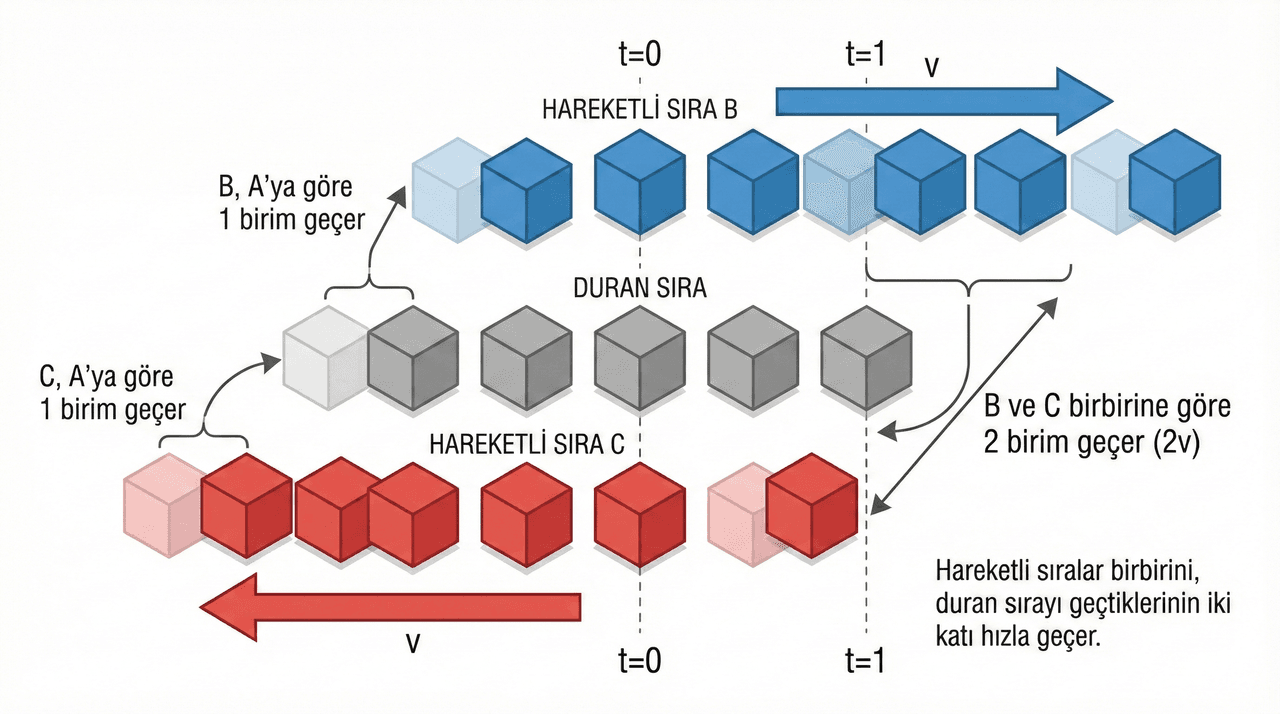
Technical diagram explaining the relativity of motion and how velocity changes depending on the reference point, using moving blocks and vectors. (Generated by Artificial Intelligence)
Zeno also developed arguments against those who assert the existence of plurality.
If objects are many, they must be both finite and infinite in number. They are finite because they are as many as they are; they are infinite because between any two objects there must always be a third (or a part). This creates a logical contradiction. Furthermore, Zeno presents a dilemma regarding size: if entities are composed of indivisible units, they have no size (and thus collectively amount to nothing); if they are divisible, they consist of infinitely many parts and therefore have infinite size.
If everything that exists is in a place, then that “place” itself, being something, must also be in a place. This inquiry into “the place of the place” leads to an infinite regress, rendering the concept of place logically impossible.
When a sack of millet is dropped, it makes a sound, but a single grain or even a fragment of a grain makes no audible sound when it falls. Zeno uses this example to highlight the discrepancy between the principle that the whole is the sum of its parts and sensory perception, thereby emphasizing the unreliability of the senses.
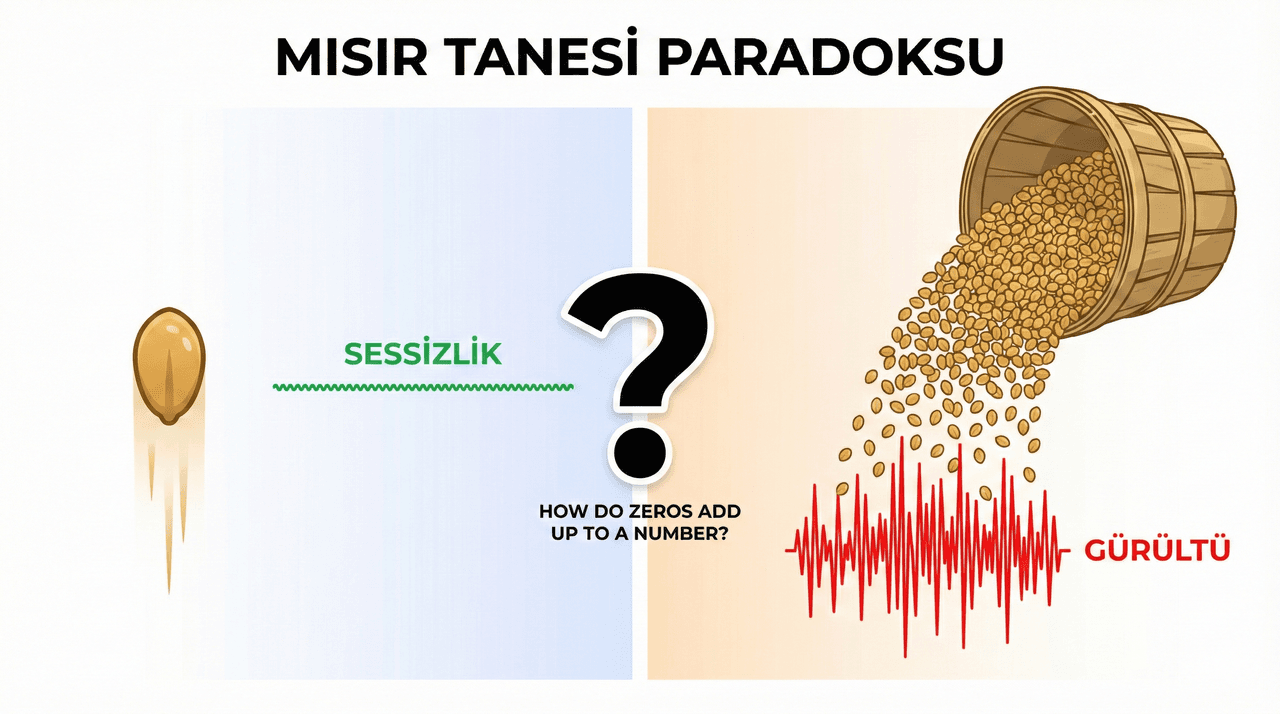
Sound wave analysis highlighting the perceptual contradiction between the silence of a single grain falling and the noise of a sack being poured. (Generated by Artificial Intelligence)
Zeno’s paradoxes have revealed deep ontological problems concerning the nature of continuity, infinity, and divisibility. Aristotle addressed these paradoxes by distinguishing between “potential infinity” and “actual infinity”; according to him, a distance can be potentially divided into infinitely many parts, but it is not actually divided into infinitely many parts.
However, the fundamental logical knot underlying the paradoxes was more clearly understood in the 19th century through the mathematical work of Georg Cantor and Richard Dedekind. Zeno’s error is interpreted as his failure to distinguish between a “dense series” and a “linear continuum.” Rational numbers form a dense series (between any two numbers there is another), but they contain gaps; real numbers, however, constitute a true continuum. Zeno mistakenly treated continuity as the sum of discrete units, confusing infinite divisibility (a necessary condition) with the sufficient condition for continuity. The idea that a line segment is the sum of its points leads to the paradox because these points are “dimensionless”; in modern mathematics, continuity is defined not as the sum of discrete elements but as a different kind of infinity—uncountable infinity.
For centuries, mathematicians and philosophers have developed various methods to refute Zeno’s claims. The development of calculus (differential and integral calculus) provided a mathematical definition of infinitesimals and limits, demonstrating that an infinite series can sum to a finite value . This made it possible to mathematically model situations such as Achilles overtaking the tortoise or traversing a finite distance.
In the 20th century, Abraham Robinson’s non-standard analysis and Edward Nelson’s Internal Set Theory provided a logical foundation for the concept of infinitesimals, offering a new perspective on Zeno’s paradoxes. According to this approach, the infinitesimal intervals between moments or points in motion are mathematically consistent, even if they cannot be observed through standard measurement.
Philosophically, Zeno has played an incitement and foundational role in the development of modern science and logic, particularly in the analysis of space-time structure and the concept of infinity. His arguments are not simple fallacies but mental experiments that reveal the gap between the mathematical modeling of reality and human perception.
Accessed December 8, 2025. - http://www.jstor.org/stable/2251675
Accessed December 8, 2025. - http://www.jstor.org/stable/24942910.
Aygün, Ömer. “Yaygın Zenon Okumasının Bir Eleştirisi.” *Kaygı: Bursa Uludağ Üniversitesi Fen-Edebiyat Fakültesi Felsefe Dergisi* 20, no. 1 (2021): 1–24. Accessed December 8, 2025. - https://dergipark.org.tr/en/download/article-file/1592590
Lee, Harold N. "Are Zeno’s Paradoxes Based on a Mistake?" Mind 74, no. 296 (1965): 563–570.
McLaughlin, William I. "Resolving Zeno’s Paradoxes." Scientific American 271, no. 5 (1994): 84–89.
Çetin, Ali. "Elea Felsefesi ve Zenon Paradoksları." Journal of Islamic Research 33, no. 2 (2022): 503–523.


Historical Context and Position within the Eleatic School
Classification and Content of the Paradoxes
Motion Paradoxes
Dichotomy (Bisection) Paradox
Achilles and the Tortoise Paradox
The Arrow Paradox
The Stadium (Moving Rows) Paradox
Paradoxes of Plurality and Place
Plurality and Density
Place (Topos) Paradox
The Grain of Millet Paradox
Philosophical and Logical Analysis
Mathematical Solutions and Modern Approaches