This article was automatically translated from the original Turkish version.
+2 More
Location | İslahiye Türkiye Gaziantep | ||||||||
|---|---|---|---|---|---|---|---|---|---|
Surface Area | Approximately 40 hectares | ||||||||
Settlement | Early Bronze Age (3rd millennium BCE), Middle Bronze Age II (1800–1600 BCE), Iron Age II (early 1st millennium BCE), 7th century BCE | ||||||||
Discovery(ies) | Osman Hamdi Bey 1884 | ||||||||
Zincirli Höyük is a large archaeological settlement located in the İslahiye Plain of Gaziantep Province, at the foot of the Amanos Mountains and at the northern end of the Karasu Valley. Covering an area of approximately 40 hectares, it is one of the largest centers in the region. The settlement consists of a central citadel (acropolis) measuring 8 hectares and rising 10 meters in height, surrounded by a lower town. The lower town is enclosed by walls that form a near-perfect circle, making it a notable example in Near Eastern urban planning.
Zincirli Höyük was first settled during the Early Bronze Age (3rd millennium BCE). It was reoccupied during the Middle Bronze Age II (1800–1600 BCE), and residential structures and storage facilities from this phase have been uncovered through archaeological excavations. During this period, the movements of the Amorites and Hittite campaigns influenced the region. The Middle Bronze Age layers at Zincirli are believed to have been destroyed by a major fire during the late 17th century BCE campaigns of the Hittite kings Hattusili I and Murshili I.
During the Iron Age II (early 1st millennium BCE), Zincirli became the center of an independent Late Hittite kingdom known as Sam’al. Historical documents written in Akkadian, Luwian hieroglyphs, and Aramaic have been found at the site. These inscriptions confirm that the city served as the capital of an independent kingdom under the name Sam’al during the Iron Age. This kingdom, established around 920 BCE, came under Assyrian pressure in the 8th century BCE and by the 7th century BCE had become a full provincial center of the Assyrian Empire.
Zincirli Höyük was introduced to the scholarly world by Osman Hamdi Bey in 1884. The first excavation permit was granted in 1888 to a German team led by Carl Humann, director of the Berlin Museum. Excavations were carried out in 1888, 1890, 1894, and 1902. These campaigns uncovered numerous basalt reliefs, statues, inscriptions, and city gates. A portion of the finds was sent to Germany with the permission of the Ottoman State under the Asar-ı Atika Nizamnamesi. The work conducted by the Germans provided foundational knowledge about the political and artistic history of the Sam’al kingdom.
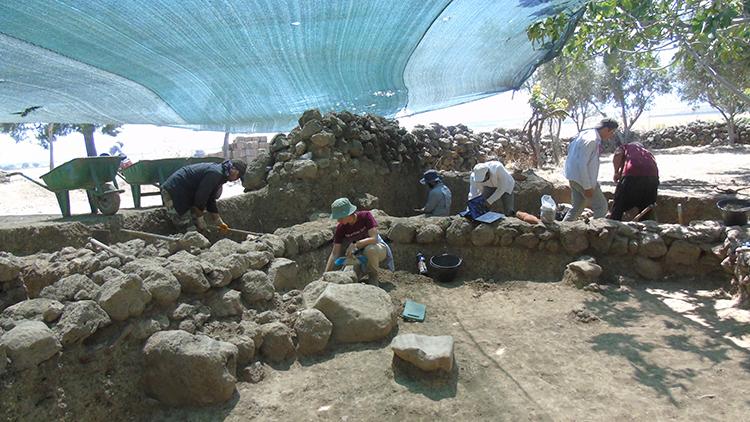
After a long interval, new excavations were initiated in 2006 under the leadership of the University of Chicago (Institute for the Study of Ancient Cultures), later joined by the University of Tübingen. During these investigations, the citadel, lower town, city gates, and residential areas were excavated.
In the 2017 season, excavations revealed that a monumental structure known as Hilani I was not, as previously thought, from the Iron Age but dated to the Middle Bronze Age. During the 2019–2020 campaigns, new finds were uncovered in the southern part of the citadel and at the city gates, and significant data regarding the layout of the early Iron Age settlement in the lower town were obtained.
The wall system of Zincirli Höyük exhibits a nearly perfect circular plan, a rare form in the Near East. The citadel and the surrounding lower town form a planned, unified whole. City gates constructed from basalt blocks and monumental entrances adorned with orthostats reflect the grandeur of the city. Numerous basalt statues and reliefs were recovered during the German excavations. Thanks to modern geophysical surveys, approximately two-thirds of the city has been mapped beneath the surface, revealing the overall urban plan in considerable detail.
Phytolith, macrobotanical, and diatom analyses conducted on Middle Bronze Age II layers indicate intensive cereal processing and storage activities in the region. Agricultural products such as bitter vetch (Vicia ervilia) were found stored in sealed containers. Additionally, remains of reed matting and animal dung spherulites have been identified. These findings demonstrate that agriculture and animal husbandry played a significant role in daily life at the settlement.
Anadolu Ajansı. "Gaziantep'te depremin ardından ara verilen Zincirli Höyük kazı çalışmaları yeniden başladı." Accessed September 30, 2025. https://www.aa.com.tr/tr/kultur/gaziantepte-depremin-ardindan-ara-verilen-zincirli-hoyuk-kazi-calismalari-yeniden-basladi/3309236
Casana, Jesse and Jason T. Herrmann. "Settlement History and Urban Planning at Zincirli Höyük, Southern Turkey." *Journal of Mediterranean Archaeology* 23, no. 1 (2010): 55–80. Accessed September 30, 2025. Erişim Adresi
Herrmann, Virginia R. and David Schloen. "Zincirli Höyük, Ancient Sam’al: A Preliminary Report on the 2017 Excavation Season." *Proceedings of the 11th International Congress on the Archaeology of the Ancient Near East.* Volume 2: Field Reports, Islamic Archaeology. (2020): 129-140. Accessed September 30, 2025. https://www.jstor.org/stable/j.ctv10tq3zv.14?seq=1
Schloen, David, Virginia R. Herrmann, Murat Dirican, Kathryn R. Morgan, Sebastiano Soldi, and Tuna Kalaycı. "Zincirli Höyük Kazıları 2019-2020." *2019-2020 Yılı Kazı Çalışmaları*, Volume 4, Ankara (2022): 403-414. Accessed September 30, 2025. https://www.academia.edu/113358916/Zincirli_H%C3%B6y%C3%BCk_Kaz%C4%B1lar%C4%B1_2019_2020
Schloen, David, Virginia R. Herrmann, and Tuna Kalaycı. "Zincirli Höyük Kazıları 2018." *41. Kazı Sonuçları Toplantısı*, Volume 1, June 17–21, 2019, Diyarbakır. Ankara (2019): 525–536. Accessed September 30, 2025. https://www.academia.edu/43299566/Zincirli_H%C3%B6y%C3%BCk_Kaz%C4%B1lar%C4%B1_2018
Tiryaki, S. Gökhan. "Zincirli Höyük (= Sam’al)." *Türkiye Turizm Ansiklopedisi*. 2020. Accessed September 30, 2025. https://turkiyeturizmansiklopedisi.com/zincirli-hoyuk-samal
Yıldırım, Yıldıray. "Almanlar Tarafından Yapılan Zincirli Höyük [Sam’al] Kazıları ve Osmanlı Devleti’nin Bu Süreçteki Uygulamaları." *Osmanlı Medeniyeti Araştırmaları Dergisi*, no. 23 (December 2024): 93–115. Accessed September 30, 2025. https://dergipark.org.tr/tr/pub/osmed/issue/84051/1470623
Öğüt, Birgül, and Doğa Karakaya. "Plant Ways in Middle Bronze Age Anatolia—an Archaeological Interpretation of Phytoliths and Other Plant Remains from Zincirli Höyük, Türkiye." *Vegetation History and Archaeobotany* 34 (2025): 205–214. Accessed September 30, 2025. https://link.springer.com/article/10.1007/s00334-024-01021-8

Location | İslahiye Türkiye Gaziantep | ||||||||
|---|---|---|---|---|---|---|---|---|---|
Surface Area | Approximately 40 hectares | ||||||||
Settlement | Early Bronze Age (3rd millennium BCE), Middle Bronze Age II (1800–1600 BCE), Iron Age II (early 1st millennium BCE), 7th century BCE | ||||||||
Discovery(ies) | Osman Hamdi Bey 1884 | ||||||||
No Discussion Added Yet
Start discussion for "Zincirli Höyük (Sam'al)" article
History
Discovery and German Excavations
Modern Excavations
Urban Structure and Architecture
Archaeobotanical and Environmental Findings