


Bu içerik Türkçe olarak yazılmış olup yapay zeka ile otomatik olarak İngilizceye çevrilmiştir.
+2 Daha
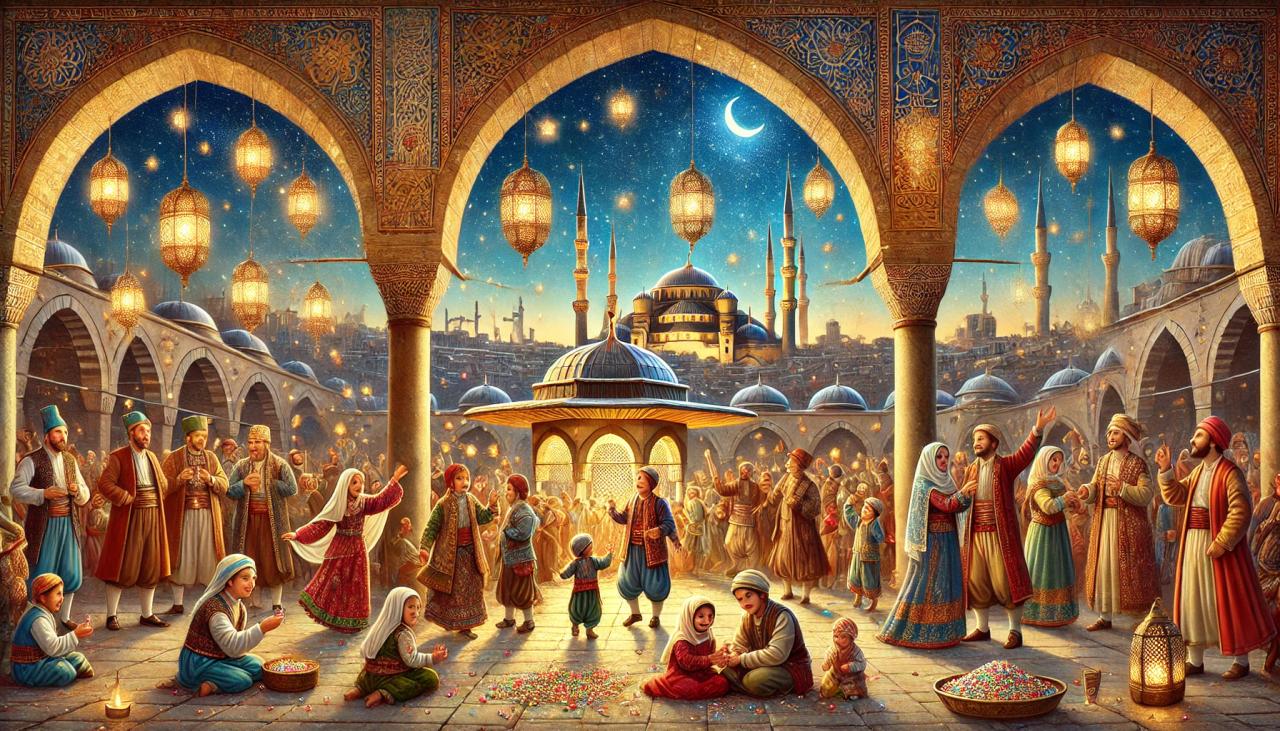
Eid al-Fitr
Type(s) | Religious holiday | ||||||||
|---|---|---|---|---|---|---|---|---|---|
Other Name(s) | Sugar Holiday Eid al-Fitr | ||||||||
Religious Basis | Quran al-Karim (Al-Baqarah 185), Sunnah | ||||||||
First Application | 2nd year of the Hijrah (624) | ||||||||
Date Celebrated | 1st to 3rd days of Shawwal | ||||||||
Duration | 3 days | ||||||||
Places Celebrated | Throughout the Islamic world | ||||||||
Main Practices | Gift-giving Visits Holiday greetings Sadaka al-Fitr Eid prayer | ||||||||
Official Status (Türkiye) | Official holiday (3 days) | ||||||||
Modern Representations | Holiday arrangements Digital greetings Media content | ||||||||
Symbols | Visiting culture Hand-kissing Holiday clothing Sweets and treats | ||||||||
Ramadan Bayramı is a religious holiday celebrated after the completion of the month of Ramadan and the act of fasting in Islam. It promotes social solidarity, sharing, unity, and forgiveness. Rooted in the Qur’an and the sunnah of the Prophet Muhammad, this festival is regarded both as a spiritual milestone marking the end of individual purification and as a collective period in which the identity of the community becomes visibly manifest. Through its varied practices across different regions and historical periods, Ramadan Bayramı embodies a multifaceted tradition that sustains the religious, cultural, and social continuity of Muslim societies.
Ramadan Bayramı is a religious festival observed by Muslim communities upon the conclusion of the month of Ramadan, beginning on the first day of the Hijri month of Shawwal. Known in Arabic as “ʿîdü’l-fıtr” (عيد الفطر), this festival has been practiced since the second year of the Hijra. Ramadan Bayramı is shaped by religious obligations such as the festival prayer and the giving of fıtır sadakası. In this sense, it can be understood as the final link in a period of worship.
An Excerpt on the Significance of Ramadan Bayramı (CNN)
In Islamic law and worship systems, the festival is governed by specific rules. While fasting during Ramadan is an individual act of worship, the days of the festival emphasize collective participation, particularly through congregational acts such as the festival prayer. In this context, Ramadan Bayramı is viewed as a temporal moment where individual purification converges with a social dimension.
Festival days in Muslim societies extend beyond the mere fulfillment of a religious duty; they also serve as periods for the reconstruction of social relationships, the reinforcement of social roles, and the facilitation of intergenerational interaction. Traditional practices such as visiting relatives and neighbors, exchanging gifts, and giving children festival money are cultural manifestations of this function. Moreover, the practice of sadaka-i fıtr aims to direct individuals’ economic responsibilities toward contributing to social balance.
Ramadan Bayramı has been interpreted and practiced in various forms across different eras and social contexts. During the Ottoman period, celebrations were shaped by court-centered ceremonies, congregational prayers held in musallas, and public festivities. In the Republican era, these celebrations acquired distinct ideological, social, and cultural orientations. According to Ali Şahin’s discourse analysis centered on the newspaper Cumhuriyet, in the early Republican period, Ramadan Bayramı was largely framed as a time for rest and shopping, presented to the public with functional and secular emphases rather than religious ones.
Today, Ramadan Bayramı continues to be understood as a multifaceted phenomenon from religious, cultural, and sociological perspectives, encompassing numerous functions such as worship, tradition, social solidarity, belonging, and cultural representation. Thus, this festival is not merely a religious ritual but also a structure where specific historical, cultural, and socio-economic codes converge.
The terminology used to name Ramadan Bayramı reflects an interwoven structure of Arabic and Turkish concepts. In Arabic, the festival is expressed as “ʿîdü’l-fıtr” (عيد الفطر). The term “ʿÎd” derives from the Arabic root “عود” (avd), meaning “to return” or “to recur.” This etymological structure implies that festivals are sacred days that recur annually and correspond to specific periods. Within Islamic tradition, the word “ʿîd” denotes special days symbolizing the believers’ return to joy, unity, and the atmosphere of worship.

A Snapshot of the Sugar-Throwing Tradition in Bilecik (Anadolu Ajansı)
The term “Fıtr” comes from the root “فطر” (fatr), meaning “to break the fast” or “to end the fast.” This explains why the festival is named as such, as it symbolizes the end of the month-long fast. Indeed, the practice of “sadaka-i fıtr” (fitre), which must be given before the festival, is directly related to this meaning. This charity is regarded as the spiritual complement to fasting and a reflection of the social responsibility aligned with the spirit of the festival.
In Turkish, the festival is known as “Ramazan Bayramı.” The word “Bayram” is of Turkish origin and historically referred to special days marked by celebration, amusement, and joy among the ancient Turks. Various theories have been proposed regarding its etymology; some scholars suggest it derives from the elements “bay” (rich, blessed) and “ram” (to rejoice, to be merry). Kaşgarlı Mahmud’s work Dîvânü Lugâti’t-Türk confirms that the term “bayram” had an established usage in the Turkish language.
Video on the Meaning of the Word "Bayram" (DD)
It is known that pre-Islamic Turkish societies also observed celebrations similar to “bayram,” during which sacrifices were offered, communal ceremonies held, and state leaders met with the people. These practices were later integrated into the Islamic festivals of Ramadan and Kurban Bayramı, enriching their conceptual framework. Thus, the expression “Ramazan Bayramı” presents a dual structure, reflecting both the Arabic-origin religious content (ʿîdü’l-fıtr) and Turkish cultural codes (bayram).
This conceptual structure has enabled the festival to take shape both as a universal Islamic act of worship and as a local-cultural tradition. In this sense, “Ramazan Bayramı” refers not only to a celebration following an act of worship but also to a multifaceted symbolic domain shaped by linguistic and cultural contexts.
The historical development of Ramadan Bayramı is not confined to the Islamic era; certain conceptual and practical elements of this festival were present in pre-Islamic cultures. Among ancient Turkic communities, communal ceremonies were held at specific times of the year, involving sacrifices at sacred sites, festive gatherings, and activities aimed at enhancing social cohesion.
An Example Video on Pre-Islamic Turkic Festivals (DW)
In the Hun and Göktürk periods, rituals such as animal sacrifices, communal meals, and prayers held in the fifth month of the year are noteworthy. Chinese sources indicate that Göktürk aristocrats performed rites of veneration at a cave in Ötüken, believed to be the ancestral origin of their lineage.
Similarly, in pre-Islamic Arab societies, certain religious rituals were performed collectively, fairs were held, and these days were regarded as periods for establishing social peace. However, these activities were shaped within the context of tribal customs rather than possessing the Islamic status of “festival.”
A Video on the First Celebration of Ramadan Bayramı (HT)
Ramadan Bayramı emerged in Islamic history during the second year of the Hijra, following the formal obligation of fasting during Ramadan. After the completion of the fasting month, the first day of Shawwal was designated as the festival day. From that time onward, the festival prayer was performed on the morning of the day, fıtır sadakası was given, and social solidarity was emphasized.
According to historical sources, the Prophet would go to the open prayer ground known as the musalla by a different route on the morning of the festival, eat dates before the prayer, deliver a sermon, and encourage the participation of women and children in the communal worship.
The earliest festival practices were not limited to worship alone but also took the form of rituals that restructured social relationships. In this context, festivals served for the Muslim communities to reestablish unity, abandon hostilities, and encourage mutual aid.
Video on Festival Traditions in the Seljuks (A-Para)
As the Islamic world expanded, the manner of celebrating Ramadan Bayramı interacted with local traditions in different regions. During the Abbasid era, festivals became part of the caliphate’s official protocol; practices such as the caliph joining the congregation for the festival prayer, distributing charity to the poor, and appearing before the public became prominent. Similarly, in Seljuk courts, festival days were regarded as occasions for establishing symbolic bonds between the ruler and the people, with various ceremonies organized accordingly.
During these periods, festivals ceased to be merely days for fulfilling religious obligations and became time frames in which state authority was integrated with the people and its legitimacy made visible.
Video on Ottoman Festival Traditions (TRT Haber)
In the Ottoman Empire, Ramadan Bayramı was celebrated with extensive ceremonies at both the court and popular levels. The court ceremony, formalized during the reign of Fatih Sultan Mehmed, followed a fixed protocol: after the sultan performed the morning prayer in the Hırka-i Saadet Chamber, a formal festival greeting ceremony was held. During these ceremonies, the sultan received state officials such as the Sheikh al-Islam, viziers, kazaskers, and the commander of the Janissaries; the rituals, accompanied by the mehter band, concluded with prayers and wishes.
At the popular level, the festival prayer was performed collectively in open areas known as musallas, especially in major cities. Gifts were given to children, charity was distributed to the poor, and tips were provided to service workers such as garbage collectors, guards, and water carriers. Neighborhood imams’ sermons, preparations before the festival, and the baking of special festival pastries were integral parts of the tradition. Festival days were regarded as occasions when social class boundaries were partially erased and neighborhood and kinship ties were renewed.
With the proclamation of the Republic, structural changes were observed in the way Ramadan Bayramı was celebrated. During the early Republican period, as the visibility of religion in the public sphere was restricted, festivals were reshaped under this new orientation. According to Ali Şahin’s analysis of the newspaper Cumhuriyet, Ramadan Bayramı was increasingly framed as a time for shopping, vacation, and rest, with traditional and religious dimensions relegated to the background in public discourse.
Video on Festival Traditions in the Republican Era (TRT2)
Additionally, practices such as official visits by civil servants to homes, formalized during the Ottoman period in 1845 and continued in the early years of the Republic, were abolished on grounds of financial burden and new administrative principles. Nevertheless, the festival’s place in social memory was preserved, sustaining continuity through individual and familial religious and cultural practices.
The status of Ramadan Bayramı in Islam is based directly on the Qur’an and the practical actions of the Prophet Muhammad. Its classification within categories of worship—obligatory, recommended, and sunnah—and its connection to practices such as charity, prayer, and gratitude, as well as its role in reinforcing individual and social ethics, are among the important elements of the Islamic worship system.
Ramadan Bayramı is not explicitly named in the Qur’an; however, verses concerning fasting and the month of Ramadan shape its conceptual framework. In Surah Al-Baqarah, verses 183–185, fasting is declared obligatory. Particularly in verse 185, the phrase “so that you may glorify Allah and be grateful” following the completion of fasting points to the festival’s existence and underscores gratitude as one of its fundamental religious functions.【1】 In this sense, the festival is the culmination and completion of the worship observed throughout Ramadan.
Numerous narrations regarding Ramadan Bayramı are found in authentic hadith collections. Classical hadith sources such as those of Bukhari and Muslim include sections on “Salâtü’l-îdeyn” (the two festival prayers), providing essential information. The Prophet’s practices included going to the musalla on the morning of the festival, giving fıtır sadakası before the prayer, eating dates before the prayer, and returning home by a different route. Women, young girls, and even menstruating women were encouraged to attend the festival gathering.
The Prophet’s tolerance of, and even participation with Aisha in, the spear and shield demonstrations by the Abyssinians in the mosque, serves as an example indicating that the festival was also to be regarded as a day of joy and celebration.
The four major Sunni schools of jurisprudence have offered differing assessments regarding the ruling on the festival prayer:
The prayer is performed on the first day of the festival after sunrise and before the time of the sun’s zenith. The sermon is delivered after the prayer, unlike the Friday prayer, and listening to it is recommended but not obligatory. Although there are minor differences among the schools regarding the number of additional takbirs, there is consensus that the prayer consists of two rak’ahs.
Video on Fıtır Sadakası (Diyanet TV)
The sadaka-i fıtr (fitre), which must be given before Ramadan Bayramı, is regarded in fiqh as either obligatory or strongly recommended. According to the Hanafis, it is obligatory; according to the other three schools, it is a strongly emphasized sunnah. Fitre is given as a quantity of staple food items (wheat, barley, dates, etc.) or their monetary equivalent, delivered to those in need. The purpose of this act is to ensure that every segment of society can share in the joy of the festival.
Unlike zakat, sadaka-i fıtr is exclusively linked to Ramadan Bayramı and is required of those who possess more than their daily needs. This charity aims to ensure that the poor can meet their basic needs on the festival day. Simultaneously, this practice makes visible the social responsibility dimension of the worship performed during Ramadan.
The festival prayer consists of two rak’ahs and is performed in congregation. Additional takbirs (zevâid takbirs) are included:
The imam’s sermon is recommended and is delivered after the prayer. These sermons typically focus on the value of fasting, the importance of sadaka-i fıtr, and themes of social peace and unity.
The festival occurs on the first day of Shawwal, immediately following the end of Ramadan. The determination of this day traditionally relies on the sighting of the crescent moon. Classical fiqh texts require the physical sighting of the crescent; however, in the modern era, many Muslim countries have adopted astronomical calculations. The festival lasts three days; however, the primary acts of worship (prayer and fitre) are confined to the first day. The remaining two days are largely devoted to visiting and social activities.
Video on the Culture of Mutual Aid during the Festival (DHA)
Festival days in Islamic ethics are associated not only with worship but also with peace, forgiveness, solidarity, and social integration. Hadiths emphasize that festival days are “days spent without fasting, in joy and remembrance.” For the individual, the festival is a time of purification; for the community, it is an opportunity for closeness. The Prophet is reported to have advised smiling, maintaining kinship ties, and showing generosity toward the poor on the morning of the festival.
In this sense, Ramadan Bayramı is recognized as a special period in which the ethical and social principles of Islam are lived out beyond acts of worship. Moral values such as resolving grudges, ending past disputes, and reestablishing social peace form the spiritual framework of this festival.
Ramadan Bayramı in Islam is not merely a religious day determined by the calendar; it is also a period during which specific acts of worship and practices are intensified at both individual and communal levels. These practices are shaped according to the rulings in the Qur’an and hadith, and they acquire meaning along the axes of joy, gratitude, sharing, and unity.
Video on How to Perform the Festival Prayer (DD)
One of the most fundamental acts of worship on festival days is the festival prayer. It is performed on the first day of Shawwal, between sunrise and the time of the sun’s zenith. Performing the prayer in congregation is essential, and it is considered sunnah to perform it outside the mosque, in open areas known as musallas.
The festival prayer consists of two rak’ahs, with additional takbirs (zevâid takbirs) in each. According to the Hanafi school, there are three takbirs in the first rak’ah and three in the second, totaling six. After the prayer, the imam delivers a sermon; however, listening to the sermon is recommended but not obligatory. The sermon typically addresses the value of fasting, the importance of sadaka-i fıtr, social solidarity, unity, and brotherhood.
The Prophet encouraged women to attend the festival prayer. Hadith sources indicate that even menstruating women were advised to attend the musalla, though they were encouraged not to participate in the prayer itself but to offer supplications. This practice is regarded as an important tradition supporting the festival’s communal unity.
Sadaka-i fıtr, which must be given before Ramadan Bayramı, is considered an inseparable part of the festival worship. Fitre serves as a symbolic act of purification for the fasting performed during Ramadan and strengthens the dimensions of social equality and sharing within the festival’s meaning. Every Muslim is required to give fitre on their own behalf and on behalf of those they are responsible for.
Fiqh texts specify that the amount of sadaka-i fıtr is measured in specific food items (wheat, dates, barley, etc.) or their market value, delivered in cash to those in need. This charity must reach the poor by the morning of the festival so that they too may partake in the joy of the occasion.
Following the sunnah of the Prophet, it is recommended to eat dates before going to the festival prayer on the morning of Ramadan Bayramı. Some narrations specify eating an odd number of dates (one, three, five, etc.). This practice symbolically marks the end of the fast and emphasizes that the festival is a day of joy.
Taking a ritual bath (gusül), wearing clean and beautiful clothes, applying pleasant perfume, and ideally wearing new garments are also recommended as sunnah. These acts are behavioral expressions of personal cleanliness and social respect.
On festival days, Muslims greeting and saluting one another is an important part of Islamic tradition. Sources report that the phrase “Taqabbala’l-lāhu minnā ve minkum” (May Allah accept it from us and from you) is used during these greetings. Festival greetings are not merely verbal congratulations but also acts of worship that reinforce social bonds.
An Example Video on the Festival Greeting Tradition (ETV)
The festival is a time for visiting elders, neighbors, the sick, the elderly, and graves. Visiting relatives is considered sunnah within the context of sila-i rahim.
Practices such as providing material assistance to the poor, giving gifts to children, and offering tips to service workers are sustained as both sunnah and customary tradition.
Additionally, in Ottoman and classical Islamic societies, providing aid and gifts to mosque staff, muezzins, imams, the poor, prisoners, and travelers were institutionalized practices.
Video on Festival Greeting Traditions (Tire Belediyesi)
Hadiths emphasize that festival days should be a time of peace and well-being. It is reported that the Prophet forbade carrying any weapon that could cause harm on festival days and warned against disturbing the atmosphere of tranquility. This prohibition serves as a practical measure to ensure public safety and preserve the joy of the festival.
The Prophet’s permission for, and even his participation with Aisha in, the spear and shield demonstrations by the Abyssinians, demonstrates that the festival is a day of joy and amusement. However, such entertainment was accepted only if it conformed to Islamic ethics. Practices from the pre-Islamic era such as mixed-gender gatherings, alcohol consumption, or gambling were prohibited.
An Example Video on Festival Entertainment (Kadir Gülmez)
The acts of worship and practices presented here demonstrate that Ramadan Bayramı is not merely a spiritual joy but a systematic framework shaped by religious obligations, strengthening the spirit of the community and reinforcing social structure.
While Ramadan Bayramı is a festival within the Islamic worship system, it also carries a powerful cultural content that reflects across various levels of social life. This festival functions not only as a process of individual purification but also as a vehicle for social integration, cultural continuity, and intergenerational transmission. Various cultural practices such as visiting, gift-giving, festival preparations, neighborhood traditions, child-oriented customs, and festival entertainments stand out in this context.
Festival days are special periods when family bonds, neighborhood relations, and social solidarity become visibly manifest. In Muslim societies, festival greetings are not merely acts of congratulation but also social behaviors that regulate and repair relationships. Practices such as visiting elders on the morning of the festival, the custom of kissing their hands, and giving children money or gifts carry both religious and cultural significance.
During the Ottoman period, communal festival greetings led by neighborhood imams took place around mosques or neighborhood squares. Additionally, drinks such as sherbet, coffee, and sweets offered to guests were integral components of festival culture.
In the Republican era, these traditions continued primarily within families; within public institutions, formalized festival greeting ceremonies were developed under specific protocols. These practices helped define how modern institutional identities related to traditional religious times.

Children’s Scenes during the Festival (Anadolu Ajansı)
The significance of Ramadan Bayramı for children has led to its popular designation as the “sugar festival.” On the morning of the festival, children dressed in new clothes kiss the hands of elders and receive sugar, money, or small gifts. This tradition is a social practice that instills a sense of belonging and helps children experience the festival positively.
In Ottoman Istanbul and provincial cities, special festival pastries, pestil, and akide sugar were distributed to children. Archives also record that in some major cities by the late 19th century, special entertainments were organized for children and neighborhood-level folk games were arranged. Among these, shadow puppet plays using miniature Karagöz puppets were particularly notable.
Video on the Tradition of Festival Money (RTV)
On festival days, gifts are not only given to children but also to service workers, a practice that has become traditional. In Ottoman society, water carriers, garbage collectors, and neighborhood guards would go door to door on the morning of the festival, receive traditional greetings, and then receive “festival tips.” This practice is regarded as a form of social payment combining service and solidarity.
In some households, gifts presented to guests were served on special trays, the design and contents of which were carefully prepared each year, as recorded in women’s magazines of the time. In this context, gift-giving was not merely an economic exchange but also a sign of aesthetic refinement and social elegance.
An Example Video on Cemetery Visits (İHA)
Cemetery visits conducted before or on the morning of the festival serve to connect with the deceased, offer prayers, and recall spiritual continuity. These visits are typically performed after the morning prayer; graves are cleaned, the Qur’an is recited, and prayers are offered. In some regions, food and money are also distributed to the poor at cemeteries.
These practices are unique rituals where Islam’s concept of death merges with social memory. The festival’s dimension of joy combined with remembrance is completed through these visits.
The socio-cultural dimensions of Ramadan Bayramı demonstrate that it is more than a mere religious obligation; it is a building block that brings individuals together, strengthens social structures, sustains traditions, and renews cultural belonging.
In the Ottoman state, Ramadan Bayramı transformed into a layered festival experience, interwoven with ceremonies that reinforced official authority and popular traditions of celebration.
The festival was not merely a period of worship but also a time when social hierarchies were observed, community identity was renewed, and symbolic bonds were formed between the court and the people. In the Ottoman context, festivals were institutionalized structures encompassing religious, political, administrative, and cultural dimensions.
In the Ottoman court, ceremonies for Ramadan Bayramı were formalized into protocol from the reign of Fatih Sultan Mehmed. On the morning of the festival, the sultan performed the morning prayer in the Hırka-i Saadet Chamber of Topkapı Palace; he then gathered with internal and external service staff at the Bâbüssaâde (Gate of Felicity) to perform the formal festival greeting.
During the ceremony, the Sheikh al-Islam, followed by the Grand Vizier and other state officials, paid their respects to the sultan. The sultan addressed everyone according to their rank, distributed gifts, and offered prayers. These practices were symbolic rituals that demonstrated the hierarchical order and centralized authority of the state even on festival days.
Rarely documented information indicates that among the gifts presented to the sultan during these ceremonies were copies of the Qur’an. Some of these were exquisite handwritten manuscripts prepared by calligraphers and recorded in the palace library.
During the ceremonies, the mehter band performed music, and special sherbets and sweets prepared in the palace kitchen were served to protocol members. Many of these delicacies reflected the culinary culture of the era. For instance, the dessert known as “zülbiye” was known to be a special preparation reserved for festival days in the Ottoman period.
In Ottoman cities, festival prayers were performed collectively in large mosques or in open areas outside the city known as musallas. After the prayer, everyone in their new clothes visited their elders, and communal festival greetings took place. Special pastries, halva, and sherbet prepared within neighborhoods were shared among neighbors. A tradition developed among women of undergoing “festival cleaning” in the public baths before the festival. These hamam days were among the most vibrant forms of socialization among women.
Video on the Festival Prayer in Ottoman Society (CNN)
Children, dressed in new clothes on the morning of the festival, kissed the hands of elders and were rewarded with akide sugar or copper coins. In some cities of the period, children were reported to carry “festival sticks” adorned with flags, amulet beads, and miniature lanterns as they greeted others. These sticks were also known among the people as “joy sticks.”
Craft guilds played an important role in the social fabric of the festival. Guilds decorated their shops with flags and colorful fabrics and organized performances specific to their trades. In Istanbul, processions of butchers, bakers, and quilt-makers accompanied by mehter bands through the city not only enhanced the festive spirit but also showcased professional solidarity.
In the Ottoman period, festivals were also special days for the care of the poor and the destitute. The practice of sadaka-i fıtr was carried out within an institutional framework through imarets and waqfs. Before the festival, food parcels prepared by waqfs were distributed to those in need; on the morning of the festival, special meals were served to students in madrasas, mosque staff, and poor families.
Some waqf deeds stipulated that on the morning of the festival, specific numbers of shoes and clothing were to be given to orphans. Such waqf deeds demonstrate that Ottoman festivals were not merely acts of worship and celebration but also moments when institutional aid mechanisms were activated.

Depiction of the Candle-Lighting Tradition at Cemeteries in the Ottoman Period (Generated with AI)
The Ottoman populace visited cemeteries on the morning of the festival or on the eve, cleaned graves, recited the Qur’an, and offered prayers. Major cemeteries such as Eyüp Sultan, Karacaahmet, and Merkezefendi were the most visited during this period. Families often distributed sweets, dates, and sometimes plain pastries at gravesites to offer blessings for the souls of their deceased relatives.
Records also indicate that small candles attached to tombstones were lit on the night of the festival. This practice is a significant symbolic act affirming the spiritual connection with the deceased.
In the Ottoman period, Ramadan Bayramı evolved into a complex structure far beyond the fulfillment of religious obligations, becoming a space where the social fabric, cultural memory, and political legitimacy were regenerated.
This festival experience, which brought the court and the people closer through ceremonial practices, reinforced community identity in neighborhoods, and blended all of this with tradition, provides important insights into the values and functioning of Ottoman social structure.
With the proclamation of the Republic, religious life in Turkish society entered a significant transformation process as part of the reorganization of the public sphere. This transformation directly affected traditional religious practices such as Ramadan Bayramı. Within the framework of the new republic’s secularization policies, the public representation and content of religious festivals were reshaped through both official practices and media discourse.
From the 1920s onward, although the official status of religious festivals in the calendar was preserved, their religious content was withdrawn from the public sphere; festivals were increasingly framed as occasions for vacation and national unity. The manner of celebrating Ramadan Bayramı in public institutions was reorganized to conform to the secular public order, with religious symbols minimized in official festival ceremonies.
Regulations issued in the 1930s fixed the number of festival holidays and systematized paid leave for public employees. However, these practices defined the festival’s meaning in public life solely in terms of time management, without any guidance regarding its worship dimension.
Additionally, the tradition of local officials such as governors, district governors, and mayors visiting homes during the festival was abolished on the grounds that it created “financial burden and inequality.” This reform exemplifies an attempt to restructure social relations on the basis of “equal citizenship.”
In Republican journalism, particularly in the case of Cumhuriyet Gazetesi, the media representation of Ramadan Bayramı emphasized its socio-cultural and public dimensions rather than its religious ones. According to Ali Şahin’s discourse analysis covering 1929–1941, the newspaper described Ramadan Bayramı using terms such as “shopping,” “vacation,” “travel,” and “calmness,” while its worship content was only minimally reflected.

Example of a Festival Greeting from Cumhuriyet Gazetesi (Ali Şahin)
News reports during the festival days in the newspaper prominently featured campaigns by large stores, clothing recommendations, and traffic warnings. Additionally, content such as playgrounds for children and cinema screenings indicated that the festival was interpreted as a “chance for rest and entertainment.” Religious content was published mostly as “greeting announcements” or brief statements from the Diyanet.
Cumhuriyet Gazetesi’s development of a journalistic language supporting Turkish-language worship, Turkish adhan, and Turkish Qur’an readings during this period demonstrates that festivals were also incorporated into this secularizing framework.【2】 The newspaper framed the festival as a common ground for the public, but emphasized its social function rather than its religious dimension.
In the early Republican period, the public visibility of Ramadan Bayramı significantly diminished, and the festival became primarily an experience lived within private, familial contexts. While practices such as family visits, internal festival greetings, and giving gifts to children continued, these practices were now sustained outside the control of public and official domains.
Nevertheless, archival and field sources reveal that public interest in religious festivals did not vanish entirely; in rural areas, attendance at festival prayers continued, sermons and sermons in mosques persisted, and the practice of sadaka-i fıtr remained alive among different segments of society.
The role of festivals in the process of modernization is closely linked to the transformation of traditional values. Particularly in urban areas, festivals were transformed into opportunities for vacation and travel; family visits were replaced by trips to summer resorts or rural areas. Festival tables, clothing purchases, cinema, and entertainment culture began to redefine the festival through individual consumption.

An Example from Cumhuriyet Gazetesi on the Transformation of the Festival (Ali Şahin)
However, this transformation did not entirely erase the festival’s place in social memory; rather, some elements continued to exist in new forms.【3】 For example, festival cards and greeting forms prepared by official institutions in the early Republican period stood out as institutional versions of traditional festival greetings.
In the Republican era, Ramadan Bayramı adopted a multifaceted structure: it retained its traditional religious dimension while undergoing a redefinition of meaning within the process of modernization, losing public visibility and being presented in the media through secular representations. This process also sheds light on a transitional period in which the boundaries between religion and the public sphere were being drawn.
From the last quarter of the 20th century onward, the social, economic, and technological transformations in Türkiye have led to significant changes in the meaning of Ramadan Bayramı. This transformation did not merely affect worship practices; it also altered the ways the festival was represented, its public visibility, its commercialization, and its role in individual-society relationships.
Post-1980 Türkiye became a rapidly changing social structure due to urbanization, internal migration, the rise of the middle class, increased education levels, and global interactions. This process transformed the family- and community-centered ways of celebrating Ramadan Bayramı; particularly in large cities, individualized lifestyles led to new trends in which the festival was perceived more as a vacation, travel, and consumption opportunity.
Nevertheless, the festival’s social function did not disappear entirely; it continued to exist in new forms. Family visits were replaced by extended family gatherings, and home meals were replaced by shared dinners outside the home; yet most of these practices were still considered part of the “festival tradition.” This situation is one example showing how traditional patterns have transformed while persisting.
An Example Video on the Commercialization of Festivals (İHA)
One of the most prominent transformations of Ramadan Bayramı in the modern era is its relationship with consumer culture. The food, textile, cosmetic, entertainment, and tourism sectors regard the festival as one of the year’s most active economic periods. Festival shopping is no longer merely a religious preparation; it has also acquired meaning as a marker of social status, visual representation, and belonging.
With the proliferation of shopping malls, festival shopping has moved beyond traditional bazaars. Festival clothing for children, gift sweets and confections, home decorations, and souvenir items have tightly linked Ramadan Bayramı to a strong commercial rhythm. This commercialization trend has provoked criticism in some social circles regarding the “loss of the festival’s spirit.”
An Example of Festival Celebrations through Media (TRT Arşiv)
Television, the internet, and social media have significantly transformed both individual experiences and collective representations of Ramadan Bayramı. National channels strive to reach broad audiences by broadcasting special programs, nostalgic content, religious discussions, and family films during festival days.
In recent years, social media platforms have become a new medium for the widespread exchange of festival greetings and the sharing of visual and emotional content. Digital festival cards, WhatsApp messages, and Instagram stories have created a new culture of festival greetings among younger generations, even though they have not replaced face-to-face greetings.
This digitalization has led to a multifaceted representation of the festival, experienced not only in physical spaces but also in virtual environments. Simultaneously, the use of new technologies to maintain festival greetings amid increasing geographical distances between individuals is interpreted as the digital adaptation of tradition.
The length of official holidays and the intensity of work life have linked festival holidays to travel and tourism. Trips to holiday destinations highlight the festival’s dimensions of rest and entertainment, sometimes leading to the neglect of its worship and visitation aspects.
In particular, the return of individuals living in large cities to their hometowns creates massive mobility known as the “festival migration.” Although this migration sometimes causes traffic congestion and accidents, it demonstrates the persistence of family bonds and the desire to reconnect with one’s roots.
In the modern era, Ramadan Bayramı has become a hybrid structure where traditional religious rituals coexist with contemporary lifestyles. Represented with different meanings in the domains of worship, family, consumption, media, and travel, the festival continues to serve as a vital instrument of cultural continuity in Muslim societies despite changing social conditions.
Although Ramadan Bayramı is a religious period shaped within the framework of Islamic belief, it has become a multifaceted structure enriched by folkloric and popular elements, particularly in popular culture. Within this structure, religious rituals coexist with folk entertainments, culinary traditions, children’s games, traditional theater forms, and modern media-generated representations.
The folkloric aspects of the festival encompass traditional behavioral patterns shaped in the collective memory of society; its popular aspects include culturally produced elements over the last century driven by media and market forces.
From the Ottoman period to the Republic, festivals were among the rare occasions when communal entertainment gained legitimacy. Traditional performing arts such as Karagöz-Hacivat shadow plays, meddah performances, puppet shows, and ortaoyunu were performed in coffeehouses, neighborhood squares, and picnic areas, especially on festival days. These performances, enjoyed by both children and adults, reflect that the festival was not merely a time of worship but also a day for collective joy.
An Example Video of a Hacivat-Karagöz Play during the Festival (Tower)
In Istanbul’s districts such as Eyüp, Üsküdar, and Sultanahmet, traditional festival entertainment areas featured swings, merry-go-rounds, tent theaters, and candy stalls—among the oldest customs of the festival. Tulumbacı performances, acrobatics, and verbal exchanges between sherbet sellers created a unique festive language among the people.
Rarely documented information mentions “candle processions” held on the nights of Ramadan Bayramı in Istanbul during the late 19th century. In these processions, young people wandered the streets holding candles, both enjoying themselves and reciting prayers as they collectively headed toward cemeteries. This practice was a popular tradition that simultaneously embodied the festival’s joyous and spiritual dimensions.

Image of Zülbiye Dessert (Anadolu Ajansı)
Festival tables are special occasions in which regional cuisines and traditional delicacies are displayed across various regions of Türkiye. Special dishes prepared for Ramadan Bayramı include baklava, kadayıf, lokum, sugar candies, palace halva, pestil, walnut sausage, and special festival pastries. These foods are served to guests during visits, and regardless of a household’s economic status, at least one type of sweet is always prepared.
In Ottoman cuisine, the dessert known as “zülbiye” was served on the morning of Ramadan Bayramı in the palace and at the tables of high social classes. Additionally, in some Anatolian cities, the custom of preparing special “festival börek” or “festival coffee” demonstrates the interweaving of folk cuisine with festival culture.
From the mid-20th century onward, festival representations became part of mass culture through radio and later television. During the TRT era, special programs prepared for Ramadan Bayramı—including religious discussions, folk music concerts, and festival skits—became embedded in the social memory.
TRT Festival Special Program (Fabricio)
In cinema, particularly in Yeşilçam films from the 1960s and 1970s, festival scenes were used as vehicles for representing familial unity, reconciliation of conflicts, and intergenerational love. A reunion, reconciliation, or farewell during the festival became one of the central elements of dramatic storytelling.
Today, short videos, visual festival messages, and nostalgic content shared on social media are re-creating the festival’s traditional values through popular forms, offering an aestheticized representation that appeals particularly to younger generations.
The folkloric and popular aspects of Ramadan Bayramı reveal that it is not merely a religious practice but also a social memory element shaped within popular culture, strengthening social solidarity and transmitted across generations. This broad spectrum—from theatrical performances to festival sweets, from traditional entertainments to media representations—serves as important indicators of the festival’s cultural depth and diversity.
Ramadan Bayramı is one of the two festivals celebrated universally across the Muslim world. Its religious legitimacy, based on the Qur’an and the sunnah of the Prophet Muhammad, ensures that it is observed with similar core acts of worship wherever Muslims live. However, the practices surrounding these acts vary significantly depending on local cultures, geographical conditions, historical processes, and social structures. These variations present a unique structure that renders Ramadan Bayramı both a universal religious worship and a local cultural ritual.
Globally, the common practices of Ramadan Bayramı are shaped within the framework defined by Islamic law. These include the celebration following the completion of Ramadan fasting, the festival prayer, giving fıtır sadakası, festival greetings, family visits, and helping the poor. These commonalities serve to reinforce the ritual unity of the Muslim ummah and its understanding of sacred time.
The most striking aspect of this dimension is that despite differences in language, ethnicity, or geography, Muslims perform the same core acts of worship on the same day, sharing a collective spiritual experience. This situation is an important indicator of how the religious identity of the global Muslim community (ummah) is continuously regenerated over time.
The local variants of Ramadan Bayramı remain faithful to the religious framework but are shaped by cultural and social differences. In Indonesia, the festival is called “Lebaran”; a massive internal migration occurs before the festival, known as “mudik.” In Malaysia, celebrated as “Hari Raya Aidilfitri,” traditional clothing is worn, homes are decorated, and the famous rice dish “ketupat” is prepared. In Egypt, picnics are held along the Nile during “Îd el-Fıtr” days, and special sweets are given to children. In Morocco, the traditional dessert “shabakiya” is indispensable at festival tables.

Festival Prayer in Malaysia (Anadolu Ajansı)
In many regions of Africa, the festival presents a complex structure where tribal identities intertwine with Islamic rituals. In West Africa, the festival is celebrated with communal drum performances and regional dances; in East Africa, communities observe the tradition of making peace agreements during the festival.
Europe and North America, where Muslims are minorities, observe Ramadan Bayramı primarily through community-centered celebrations and mosque-organized events; its public visibility is lower and the experience is largely confined to private spaces. Nevertheless, Muslim communities in these regions interpret the festival through children’s activities, iftar gatherings, charity campaigns, and digital celebrations.
In the 21st century, increased migration and the widespread use of digital communication have transformed the ways Ramadan Bayramı is experienced. Migrant communities strive to maintain their cultural patterns while interacting with the norms of their host societies. This has generated hybrid identity spaces where the festival is re-created in new forms.
Moreover, online festival greetings enable diaspora members to connect simultaneously with their families, partially removing the festival’s dependence on physical location. In this context, digital platforms serve as new tools for sustaining the emotional continuity of the festival.
Ramadan Bayramı is a multifaceted phenomenon reflecting both the shared religious identity and the local cultural richness of the global Muslim community. In this sense, the festival is not merely a ritual time period but a dynamic socio-cultural space where Muslim communities reconstruct their identities and express themselves at both local and universal levels.
Although Ramadan Bayramı is a religious tradition with strong historical and cultural continuity, it has become the subject of various critiques and debates, particularly in the contexts of modernization and globalization. These debates revolve around assessments that the festival has distanced itself from its religious core, becoming commercialized, individualized, losing meaning, or secularized.
These critiques regarding the religious, cultural, and economic dimensions of the festival are directly linked to ongoing discussions in contemporary Muslim societies about identity, authenticity, and tradition.
One of the most frequently voiced critiques of Ramadan Bayramı is that commercialization has weakened its spiritual and social values. Shopping mall campaigns, advertisements in the media, luxury food consumption, increased commercial activity before the festival, and the tourism industry’s transformation of festival days into vacation opportunities have been criticized for integrating the festival into market logic rather than preserving it as a period of worship.
In this context, some religious circles and social commentators argue that values such as charity, mutual aid, and humility have been replaced by brand consumption, ostentatious gifts, and competitive social media representations. The increasing emphasis on the economic dimension of the festival has also generated a social stress factor known as “festival pressure,” particularly among low-income groups.
Another contemporary debate regarding Ramadan Bayramı concerns its religious content being pushed to the background in the process of secularization. Particularly among urban and secular lifestyle groups, the festival is increasingly perceived as stripped of religious worship and viewed entirely as vacation, rest, and travel. This situation has been interpreted by some researchers as “erosion of the festival’s meaning.”
The Presidency of Religious Affairs occasionally draws attention to this issue, urging that festivals not be seen merely as holidays, that participation in the festival prayer be increased, and that social solidarity be strengthened. Nevertheless, sociological research shows that while younger generations have weakened their connection to the worship dimension of the festival, they still embrace its cultural and nostalgic aspects.
The transfer of festival greeting culture to digital platforms is interpreted both as an adaptation process and as the dissolution of traditional communication forms. Critiques are raised that pre-made greeting messages sent via social media lack sincerity and that the decline in face-to-face greetings has led to a loss of warmth in social relationships.
However, it is also acknowledged that digital tools serve as bridges connecting diaspora communities across physical distances. In this framework, critiques are directed not at the use of technological tools but at their use in ways that create distance in human relationships.
Despite the festival’s values of solidarity and equality, modern societies have made visible social inequalities. Particularly in large cities, the contrast between luxury housing complexes, resort towns, and mall-centered festival experiences on one hand, and modest celebrations in informal settlements or rural areas on the other, highlights class divisions.
Although acts such as sadaka-i fıtr are intended to reduce such inequalities, their failure to evolve into a systematic social justice mechanism is criticized as weakening the festival’s egalitarian dimension. Additionally, the fact that aid activities remain limited to individual efforts and lack inter-institutional coordination deepens these debates.
All these critiques and debates reveal that Ramadan Bayramı is not a fixed and unchanging structure but a dynamic cultural phenomenon shaped by historical and social conditions. While its religious foundations are preserved, the ongoing debates in contemporary Muslim societies about what the festival means, how it is lived, and how it is represented are directly linked to broader issues of identity, belonging, tradition, and modernity.
AUDIOVISUAL SOURCES
Arslan, Muhsin. “Bilecik'te çocukları sevindiren 'şeker atma' geleneği 6 asırdır devam ediyor.” Anadolu Ajansı.
Bayraktar, İbrahim. “Bayram.” *Türkiye Diyanet Vakfı İslam Ansiklopedisi*, Volume 5, pp. 259–266. İstanbul: Türkiye Diyanet Vakfı, 1992. Accessed March 28, 2025. Accessed Adresi.
Bozkurt, Nebi. “Bayram.” *Türkiye Diyanet Vakfı İslam Ansiklopedisi*, Volume 5, pp. 259–266. İstanbul: Türkiye Diyanet Vakfı, 1992. Accessed March 28, 2025. Accessed Adresi.
Doğan, Lütfi. “Ramazan Bayramı.” *Diyanet: Dini, Ahlaki, Edebi, Mesleki Aylık Dergi* 9, no. 10–11 (September–October 1970): 343–345. Accessed March 28, 2025. Accessed Adresi.
Ezgin, Mehmet and Fidan, Halil. “Şam'dan İzmir'e uzanan lezzet 'zülbiye' iftar sofralarını tatlandırıyor.” Anadolu Ajansı.
Fabricio. "TRT HATIRASI - Bayram Özel." Accessed [Date]. https://www.youtube.com/watch?v=v2DcC0Zduio
Gülmez, Kadir. “AYAKLI KÖYÜ BAYRAM EĞLENCELERİ.”
Işık, Zekeriya. “Osmanlı Toplumunda Sûfîlerin Ramazan Bayramı Adet ve Gelenekleri.” *Hitit Sosyal Bilimler Dergisi* 15, no. 2 (2022): 393–409. Accessed March 28, 2025. Accessed Adresi.
Karslı, Mehmet. *Tüketim Kültürü ve Dinsellik: Ramazan ve Dini Bayramlar Örneği.* Master's thesis, Atatürk Üniversitesi, 2012. Accessed March 28, 2025. Accessed Adresi.
Küçükçüoğlu, Kemal Edib. “Ramazan Bayramı’nın Aydınlığı İçinde.” *Diyanet: Dini, Ahlaki, Edebi, Mesleki Aylık Dergi* 2, no. 1–2 (January–February 1963): 14–16. Accessed March 28, 2025. Accessed Adresi.
Nutku, Özdemir. “Bayram.” *Türkiye Diyanet Vakfı İslam Ansiklopedisi*, Volume 5, pp. 259–266. İstanbul: Türkiye Diyanet Vakfı, 1992. Accessed March 28, 2025. Accessed Adresi.
Oruç, Mehmet. “Ramazan Bayramı.” *Diyanet: Dini, Ahlaki, Edebi, Mesleki Aylık Dergi* 3, no. 2–3 (February–March 1964): 53–56. Accessed March 28, 2025. Accessed Adresi.
Oğuz, M., Öcal, Mehmet, Kösemek, Nihan, Çiçekoğlu, and Yıldız, Tuna, eds. *Türkiye’de 2011 Yılında Yaşayan Ramazan ve Kurban Bayramı Geleneksel Kutlamaları*. Ankara: Gazi Üniversitesi Türk Halkbilimi Araştırma ve Uygulama Merkezi (THBMER), 2012. Accessed March 28, 2025. Accessed Adresi.
RESEARCH SOURCES
Sülün, İdris. “Malezya'da Ramazan Bayramı Kovid-19 salgınının ardından festival havasında kutlanıyor.” Anadolu Ajansı. Accessed [insert date if provided]. https://www.aa.com.tr/tr/dunya/malezyada-ramazan-bayrami-kovid-19-salgininin-ardindan-festival-havasinda-kutlaniyor/2578611
Türktaş, Metin. “Bazı Alanya Köylerinde Ramazan ve Kurban Bayramı Âdetleri.” *Alanya Tarih ve Kültür Seminerleri: 1992–1995*, yay. haz. Faruk Nafiz Koçak, 343–346. Alanya: ALSAV, 1996. Accessed March 28, 2025. Accessed Adresi.
Yüzendağ, Ahmet. “Ramazan Bayramı.” *Diyanet: Dini-Ahlaki-Edebi-Mesleki Aylık Dergi*, no. 1–2 (January–February 1966): 13–14. Accessed March 28, 2025. Accessed Adresi.
İbiş, Mine. *Meşrutiyet'ten Cumhuriyet'e Geleneksel ve Dini Bayramlar (1908-1938).* Master's thesis, Dokuz Eylül Üniversitesi, 2022. Accessed March 28, 2025. Accessed Adresi.
Şahin, Ali. *Medyada Ramazan ve Dini Bayramlar Cumhuriyet Gazetesi Örneği.* Master's thesis, Uludağ Üniversitesi, 2011. Accessed March 28, 2025. Accessed Adresi.
“500 children deprived of parental care in Şırnak-Silopi receive clothing assistance before the holiday.” *Songelişme.* https://www.youtube.com/watch?v=RPhabTMD3-M
“90-Year-Old Holiday Tradition in Edirne.” ETV. https://www.youtube.com/watch?v=T4AS8NcvWIo
“Arefe ve Bayram Günü Hadislerde Nasıl Anlatılmıştır?” KanalD. Accessed [insert date]. https://www.youtube.com/watch?v=gAOZKy2xVf8
“BAYRAM GÖÇÜ BAŞLADI.” *Beyaz Haber.* Accessed [insert date]. https://www.youtube.com/watch?v=fcIZNd0aT40
“Bayram Gelenekleri | Tarihin Ruhu.” TRT2.
“Bayram Harçlığı Gelenekleri Uzunköprü’de Çocuklara.” ETV. https://www.youtube.com/watch?v=tqDVpiW1eSo
“Bayram Namazı Nasıl Kılınır?” Diyanet Dijital. Accessed [insert date]. https://www.youtube.com/watch?v=z1HITLrgeCk
“Bayram ne demek?” Diyanet Dijital. Accessed [insert date]. https://www.youtube.com/watch?v=bTo4CT2uCPY
“Cemeteries were overwhelmed by visitors on the first day of the holiday.” İHA. https://www.youtube.com/watch?v=M0aXiM-B5n4
“Europe’s Christmas Is Ours.” DW Türkçe.
“Fıtır Sadakası Nedir ve Ne Zaman Verilir?” DiyanetTV. Accessed [insert date].
“Hacivat &Karagöz Gölge Play - Ramadan Bayramı.” Tower.
“Holiday Shopping Rush Begins in Eminönü.” İHA. https://www.youtube.com/watch?v=ljFJv-xcslQ
“Osmanlı'da bayram geleneği.” TRT Haber. Accessed [insert date].
“Osmanlı’da bayram nasıldı? Tarihçi Koray Şerbetçi eski bayramları anlattı.” CNN Türk. Accessed [insert date].
“Osmanlı’dan kalan bayram şekeri toplama geleneği.” Fransızkaldık. Accessed [insert date if provided]. https://www.youtube.com/watch?v=TwrjDWzGwOk
“President Duran’s Holiday Visit to Villages.” Habertürk. Accessed [Date]. https://www.youtube.com/watch?v=wPIdAosXjK0
“Ramazan Bayramı’nın Önemi Nedir?” CNN Türk. Accessed [Date]. https://www.youtube.com/watch?v=4idh5sX5ADw
“Ramazan Kelimesinin Anlamı.” Diyarbakır İl Müftülüğü. Accessed [insert date].
“Ramazan ve Kurban Bayramı ilk ne zaman kutlandı?” HT Tarih. https://www.youtube.com/watch?v=7EUBdBHULwc
“Selçuklularda bayram gelenekleri / Evvel Zaman İçinde.” *A Para.* https://www.youtube.com/watch?v=pTbzPm049t8
“Was There a National Holiday in the Ottoman Empire? How Were Religious Holidays Celebrated During the Ottoman Period?” HT Tarih. https://www.youtube.com/watch?v=Xxvg-fpRce0
“Yusuf Kaplan: The holiday transformation of the holiday is the desertification of human life.” *Sesli Makalem.* https://www.youtube.com/watch?v=BD1ly20cmFo
“Çankırı Orta Karaağaç Köyü Bayramlaşma Kültürü.” *Gökbey.*
“Ünlülerden Bayram Mesajları.” TRT Arşiv. Accessed [insert date if provided]. https://www.youtube.com/watch?v=vbdwXaOVvf8
[1]
Bakara 185: (These are) days in which the Qur’an was revealed as a guide for humanity, with clear proofs of guidance and the distinction between right and wrong. Whoever among you witnesses this month must fast it. But if anyone is ill or traveling, he shall fast an equal number of other days. Allah intends ease for you, not hardship. This is so that you may complete the number of days and glorify Allah for His guidance and be grateful.
[2]
Ali Şahin, Religious Festivals in the Discourse of Cumhuriyet Gazetesi (1929–1941) (Master’s thesis, Ankara University Institute of Social Sciences, 2008). p. 89.
[3]
(Ali Şahin, a.g.e, p. 96)


Eid al-Fitr
Type(s) | Religious holiday | ||||||||
|---|---|---|---|---|---|---|---|---|---|
Other Name(s) | Sugar Holiday Eid al-Fitr | ||||||||
Religious Basis | Quran al-Karim (Al-Baqarah 185), Sunnah | ||||||||
First Application | 2nd year of the Hijrah (624) | ||||||||
Date Celebrated | 1st to 3rd days of Shawwal | ||||||||
Duration | 3 days | ||||||||
Places Celebrated | Throughout the Islamic world | ||||||||
Main Practices | Gift-giving Visits Holiday greetings Sadaka al-Fitr Eid prayer | ||||||||
Official Status (Türkiye) | Official holiday (3 days) | ||||||||
Modern Representations | Holiday arrangements Digital greetings Media content | ||||||||
Symbols | Visiting culture Hand-kissing Holiday clothing Sweets and treats | ||||||||
Henüz Tartışma Girilmemiştir
"Eid al-Fitr" maddesi için tartışma başlatın
Definition and Core Concepts
Etymology and Conceptual Framework
Historical Background
Festival-Like Practices in Pre-Islamic Traditions
Islamic Origins and Early Practices of Ramadan Bayramı
Festival Practices in the Abbasid and Seljuk Periods
Ramadan Bayramı in the Ottoman Period
Reconfiguration of the Festival in the Republican Era
Religious Foundations
References to the Festival in the Qur’an
The Festival in the Sunnah and Hadith Sources
The Ruling on Ramadan Bayramı in Fiqh Literature
Fıtır Sadakası and Its Social Dimension
Structural Features of the Festival Prayer
Calendar Regulation of the Festival
The Spiritual and Ethical Dimensions of the Festival
Forms of Worship
The Festival Prayer
Sadaka-i Fıtr (Fitre)
Eating Dates and Taking a Ritual Bath Before the Festival
Festival Greetings and Congratulatory Practices
Visits and Social Solidarity
Preserving the Serenity of the Festival Day
Folkloric Displays and Legitimate Entertainment
Socio-Cultural Dimension
Festival Culture and Social Relationships
Children, Festival Gifts, and the Sugar Tradition
Gift-Giving and Festival Tips
Visiting Cemeteries and Spiritual Continuity
Ramadan Bayramı in the Ottoman Era
Court-Centered Festival Ceremonies and Political Symbols
The Festival among the People: Social Hierarchy and Shared Joy
Public Assistance and the Effectiveness of Religious Institutions
Cemetery Visits and Spiritual Connection
Ramadan Bayramı in the Republican Era
Official Discourse and Institutional Reforms
Representation of the Festival in the Media
Decline in Public Visibility and Retreat into the Private Sphere
Modernization and the Social Function of the Festival
Ramadan Bayramı in the Modern Era
Changing Social Structure and the Evolving Function of the Festival
Consumer Culture and the Commercialization of the Festival
Representation of the Festival in Media and Digital Platforms
Festival Holidays and Travel Culture
Folkloric and Popular Aspects of the Festival
Festival Entertainments and Spectacular Performances
Festival Foods and Sweet Culture
Representations of the Festival in Popular Culture
Ramadan Bayramı and the Global Muslim Community
Common Elements: The Universal Dimension of Religious Foundations
Local Variants
Globalization, Migration, and New Festival Experiences
Critiques and the Present
Commercialization of the Festival and Consumer Critiques
Secularization and Debates on Meaning Loss
New Generations and Critiques of Digitalization
Class Differences and Social Justice during the Festival