

Bu içerik Türkçe olarak yazılmış olup yapay zeka ile otomatik olarak İngilizceye çevrilmiştir.
+1 Daha
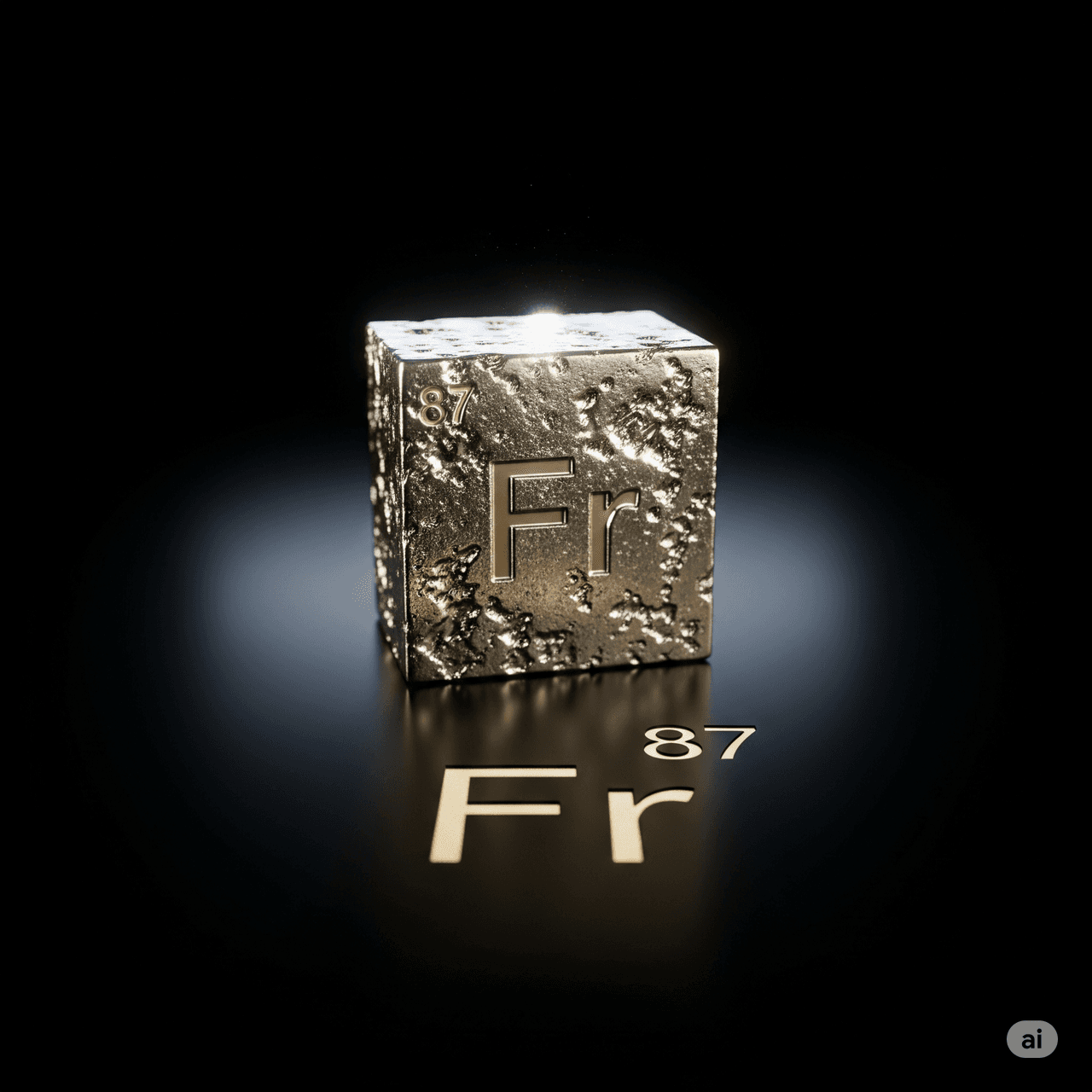
Francium is an extremely radioactive and unstable element with atomic number 87 and chemical symbol Fr, belonging to the alkali metals group in the periodic table and being the heaviest known alkali metal.
Francium is an alkali metal located in group 1A (group 1) of the seventh period of the periodic table. Its electron configuration is [Rn]7s¹, carrying a single valence electron in its outermost shell. This structure makes francium highly chemically reactive and enables it to readily form a +1 ion (Fr⁺) in its compounds. It is the heaviest and most electropositive of all alkali metals. Since all its isotopes are radioactive and even the longest-lived isotope has a very short half-life (approximately 22 minutes), experimental data on its physical and chemical properties are extremely limited, and most properties are estimated theoretically or based on periodic trends. It is expected to be a solid at room temperature with a low melting point of about 21 °C.
Francium was discovered in 1939 by French physicist Marguerite Perey at the Curie Institute in Paris. While studying the alpha decay products of actinium-227 (²²⁷Ac), Perey identified a previously unknown element exhibiting chemical properties similar to cesium. This new element was the isotope francium-223 (²²³Fr), produced by the alpha decay of actinium-227 and possessing a half-life of approximately 22 minutes. Francium is one of the last elements to be discovered in nature, and Marguerite Perey was among the first women to discover a chemical element.
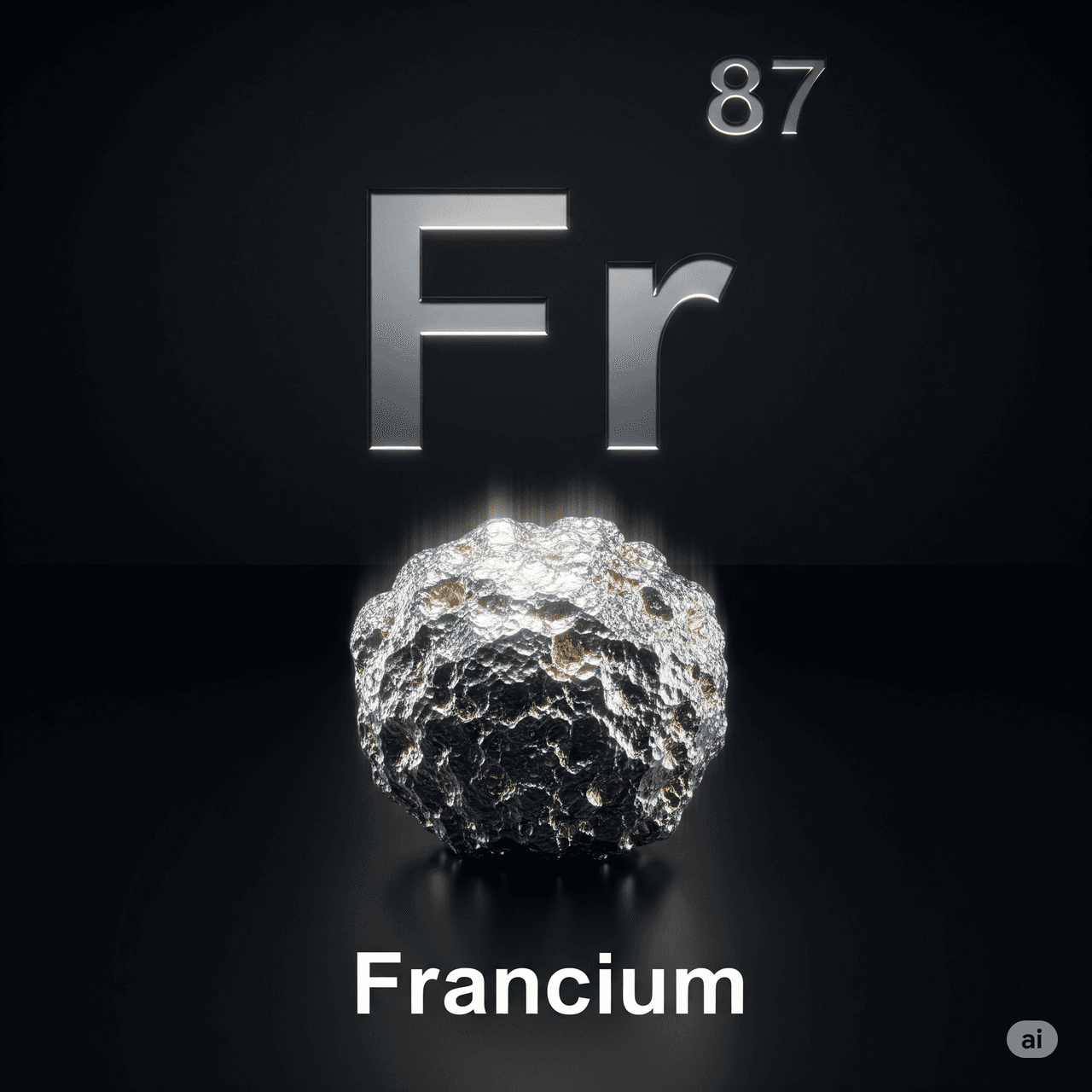
Francium (Generated by Artificial Intelligence.)
The element francium was named by its discoverer, Marguerite Perey, in honor of her home country, France (Latin: Francia). This naming was officially accepted by the International Union of Pure and Applied Chemistry (IUPAC). Its chemical symbol was designated as "Fr".
Due to its extreme radioactivity and instability, francium has never been isolated in macroscopic quantities; therefore, many of its physical properties are either unknown or only theoretically predicted. Francium, with atomic number 87, has the chemical symbol "Fr" and electron configuration [Rn]7s¹. Although its density is unknown, its melting point is estimated at approximately 21 °C and its boiling point at around 650 °C.
The atomic radius of this element is approximately 3.48 Å, its electron affinity is 44.38 kJ/mol, and its electronegativity is 0.7 on the Pauling scale, making it one of the elements with the lowest electronegativity. Although its appearance is unknown, it is expected to have a metallic and lustrous structure like other alkali metals. It is likely to exist as a solid at room temperature.
Chemically, francium is predicted to be extremely reactive, similar to cesium, reacting violently with water to produce francium hydroxide and hydrogen gas. It is one of the most electropositive elements among the alkali metals.
Francium is an extremely rare element in nature. Its primary isotope, francium-223 (²²³Fr), occurs in trace amounts as a short-lived intermediate in the decay chains of naturally occurring radioactive elements such as uranium-235 (²³⁵U) and actinium-227 (²²⁷Ac). The total amount of francium in the Earth's crust at any given moment is estimated to be less than a few dozen grams.
Synthetically, minute quantities can be produced by bombarding radium with neutrons in nuclear reactors or by bombarding thorium with protons. However, due to its instability, it rapidly decays into other elements.
All known isotopes of francium are radioactive. The most significant isotope is ²²³Fr.
Franium has no known commercial or practical applications. The primary reasons are its extreme rarity, difficulty and cost of production, high radioactivity, and the very short half-lives of all its isotopes. It has been studied only briefly in fundamental scientific research, particularly in nuclear structure and spectroscopy studies.
Francium has no known biological role. Due to its high radioactivity, it poses a potential hazard to living organisms and is therefore considered "toxic". However, because it occurs in nature in negligible amounts and can only be produced momentarily under specialized laboratory conditions, it does not constitute a health risk to the general public or the environment. All work involving francium is conducted in specially equipped nuclear research facilities under strict radiation safety and contamination prevention protocols.
National Center for Biotechnology Information. "Francium." *PubChem Compound Database* CID 6328145. Accessed May 30, 2025. https://pubchem.ncbi.nlm.nih.gov/compound/6328145
TÜBİTAK Bilim Genç. "Fransiyum." *Bilim Genç.* Accessed May 30, 2025. https://bilimgenc.tubitak.gov.tr/periyodik-tablo/fransiyum

Henüz Tartışma Girilmemiştir
"Francium (Fr)" maddesi için tartışma başlatın
Classification and Basic Properties
Discovery
Etimology
Physical and Chemical Properties
Natural Occurrence and Production
Isotopes
Applications
Biological Role and Precautions