

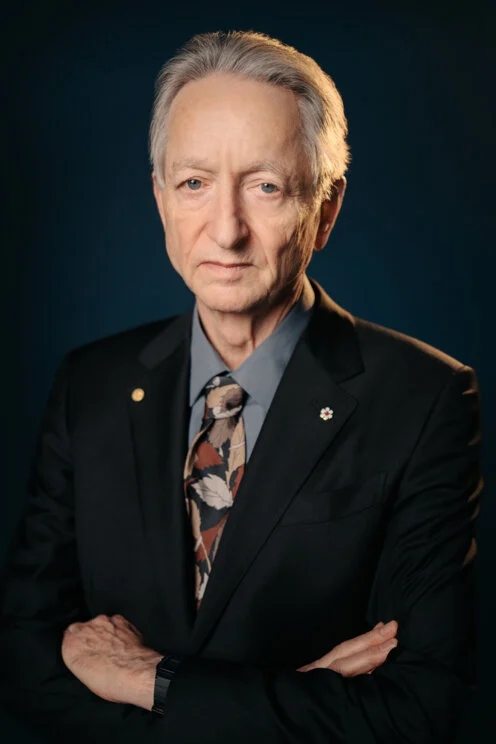

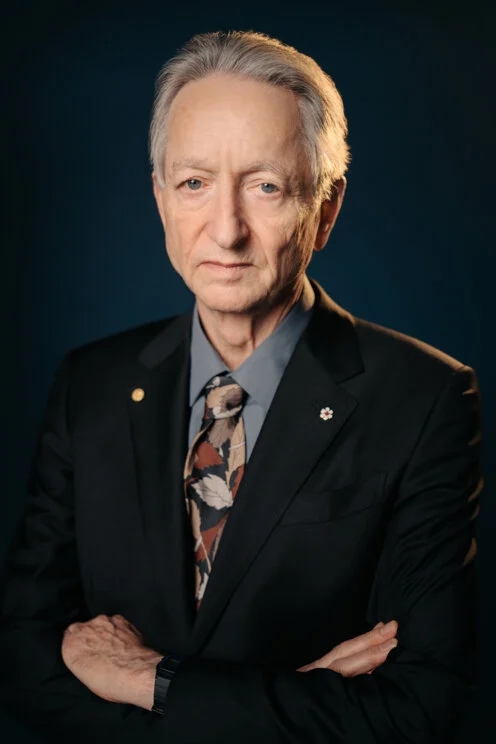
Geoffrey Everest Hinton (6 December 1947, Wimbledon, London) is a British-Canadian computer scientist renowned for pioneering work in deep learning and artificial neural networks. Recognized as one of the fathers of deep learning, Hinton’s research has played a fundamental role in advancing the development of artificial intelligence systems in areas such as visual perception, speech recognition, and natural language processing. His work at Google Brain and the University of Toronto has significantly contributed to shaping modern artificial intelligence.
Geoffrey Hinton was born in 1947 in the Wimbledon district of London. His grandfather, George Boole, was one of the founders of modern logic. His family belonged to an intellectual environment distinguished by a strong scientific heritage. This legacy formed the foundation of Hinton’s interest in cognitive science and artificial intelligence.
Hinton earned his undergraduate degree in Experimental Psychology from the University of Cambridge in 1970 and completed his PhD in Artificial Intelligence at the University of Edinburgh in 1978. He conducted postdoctoral research at the University of Sussex and the University of California, San Diego. He then served on the faculty of the Computer Science Department at Carnegie Mellon University for five years. In 1987, he joined the Canadian Institute for Advanced Research and moved to the Computer Science Department at the University of Toronto the same year. Between 1998 and 2001, he founded and directed the Gatsby Computational Neuroscience Unit at University College London. From 2004 to 2013, he directed the “Neural Computation and Adaptive Perception” program supported by the Canadian Institute for Advanced Research. In 2013, Google acquired Hinton’s Toronto-based startup DNNresearch, and Hinton worked at Google as Vice President and Engineering Fellow until 2023. He is currently Emeritus Professor at the University of Toronto and Chief Scientific Advisor at the Vector Institute.
In 2024, Geoffrey Hinton was awarded the Nobel Prize in Physics jointly with John J. Hopfield. The prize was awarded for their fundamental discoveries and inventions that enabled machine learning through artificial neural networks. The award was shared equally between Hinton and Hopfield.
In 2018, Hinton, along with Yoshua Bengio and Yann LeCun, received the ACM Turing Award, often referred to as the “Nobel Prize of Computer Science.” This recognition was given for their conceptual and engineering contributions that established deep neural networks as a foundational tool in artificial intelligence.
Hinton is a Fellow of the Royal Society of London and the Royal Society of Canada. He is also an international member of the U.S. National Academy of Sciences, the U.S. National Academy of Engineering, and the American Academy of Arts and Sciences. In 2019, he was named a Companion of the Order of Canada, one of the country’s highest civilian honors.
Geoffrey Hinton is the author of numerous pioneering papers in both theoretical and applied aspects of deep learning and artificial neural networks. His foundational works include:
– LeCun, Y., Bengio, Y., & Hinton, G. E. (2015). Deep Learning, Nature, 521, 436–444.
– Hinton, G. E., Osindero, S., & Teh, Y. (2006). A fast learning algorithm for deep belief nets, Neural Computation, 18, 1527–1554.
– Hinton, G. E., & Salakhutdinov, R. R. (2006). Reducing the dimensionality of data with neural networks, Science, 313(5786), 504–507.
His significant recent works include:
– Hinton, G. E. (2022). The Forward-Forward Algorithm: Some Preliminary Investigations, arXiv:2212.13345
– Chen, T., Zhang, R., & Hinton, G. (2022). Analog bits: Generating discrete data using diffusion models with self-conditioning, arXiv:2208.04202
– Ren, M., Kornblith, S., Liao, R., & Hinton, G. (2022). Scaling Forward Gradient With Local Losses, arXiv:2210.03310
– Agarwal, R., et al. (2021). Neural additive models: Interpretable machine learning with neural nets, NeurIPS, 34, 4699–4711.
– Bengio, Y., LeCun, Y., & Hinton, G. (2021). Deep learning for AI, Communications of the ACM, 64(7), 58–65.
Geoffrey Hinton is recognized as one of the researchers who introduced the backpropagation algorithm and was the first to apply it to word embedding learning. He has made numerous foundational contributions to the field of deep learning and artificial neural networks, including Boltzmann machines, distributed representations, time-delay neural networks, mixtures of experts, variational learning, products of experts, and deep belief networks.
Between 1983 and 1985, Hinton developed the Boltzmann machine using tools from statistical physics. This model was among the first algorithms capable of learning characteristic patterns in datasets and has since become a fundamental building block in applications such as classification and image generation.
Hinton is interested not only in the technical aspects of artificial intelligence but also in its ethical dimensions. In recent years, he has spoken out about the need for oversight of advanced AI systems and their societal impacts.
Hinton, a citizen of Canada, has lived in Toronto for long years. Public information about his personal life beyond his scientific productivity is limited.
The methods developed by Hinton are now widely used across a broad spectrum of applications, from healthcare technologies and the automotive industry to language processing systems and security applications. As one of the architects of deep learning, his name has secured a lasting place in the history of artificial intelligence.
Hinton’s students and collaborators are leading a new generation of AI researchers on a global scale. His work has served not only as a catalyst for technical progress but also as a guide in the development of ethical awareness within the field.

Henüz Tartışma Girilmemiştir
"Geoffrey Hinton" maddesi için tartışma başlatın
Childhood and Youth
Academic Career
Awards and Honors
Key Works and Contributions
Academic Publications
Contributions
Personal Life
Hobbies and Interests
Private Life
Impact
Source of Inspiration