

Bu içerik Türkçe olarak yazılmış olup yapay zeka ile otomatik olarak İngilizceye çevrilmiştir.
+2 Daha
RT-2PM2 Topol-M (NATO reporting name: SS-27 "Sickle B", Russian system designation: RT-2PM2 or RS-12M2), is the first intercontinental ballistic missile (ICBM) system fully designed and developed by the Russian Federation after the dissolution of the Soviet Union. Serving as a key element of the strategic deterrence doctrine, the system is based on a solid-fuel, three-stage propulsion architecture and has a range capacity of up to 11,000 kilometers.【1】 The primary motivation behind its development was to create a universal strategic platform capable of overcoming potential enemy missile defense systems while offering high survivability and targeting accuracy.
Work on the new-generation missile system began in the mid-1980s under the codename “Universal” with the aim of further modernizing the existing SS-25 (Topol) system. In the initial phase, the design was jointly developed by the Moscow Institute of Thermal Technology (MIT), an expert in mobile missiles, and the Ukrainian-based Yuzhnoye Design Bureau, experienced in heavy ICBMs. The rocket was planned to have a unified (universal) structure suitable for both fixed silo and mobile platforms, though early designs anticipated differences in launch methods and fuel types.
With the dissolution of the Soviet Union at the end of 1991, the Yuzhnoye Design Bureau became a foreign entity, prompting Russia to consolidate its strategic weapons programs within its own borders. In February 1993, by decree of the then President of Russia, MIT was designated as the sole prime contractor for the Topol-M project, and missile production was distributed among numerous Russian institutions, led by the Votkinsk Mechanical Plant. The first test launch of the restructured project was successfully conducted from the Plesetsk space center in December 1994.

Topol-M (Generated with AI Assistance)
The Topol-M missile has a launch weight of approximately 47 tons, a total length of 22.7 meters, and a body diameter ranging between 1.86 and 1.95 meters.【2】 The missile’s body features a single-piece “cocoon” architecture made of composite materials, and all three flight stages employ powerful solid-fuel propulsion motors. Unlike earlier Topol missiles, the Topol-M’s flight control is achieved not by external grid fins but by directly gimbaled nozzles partially embedded in the main propulsion units.
The first-stage propulsion motor provides rapid acceleration, minimizing the missile’s vulnerable exposure during the active phase of its trajectory. Launch is performed using a “cold launch” method, in which the missile is ejected from its launch container by a special gas generator known as a PAD, followed by motor ignition in mid-air. Flight path determination and guidance are handled by an autonomous digital inertial navigation system (INS) equipped with an integrated GLONASS receiver.【3】
To comply with existing strategic arms control agreements (START-1), the Topol-M entered service with a single monoblock nuclear warhead; its yield is estimated to be between 500 and 550 kilotons.【4】 The system’s design is adaptable to accommodate multiple independently targetable reentry vehicles (MIRVs) when required. The most prominent feature of the Topol-M in military literature is its integrated suite of advanced countermeasures designed to neutralize modern missile defense systems.
The system carries deceptive targets (decoys), active radio jamming generators, aerosol emitters, and radar-absorbent coatings that complicate detection across the electromagnetic, infrared, and radar spectrums. Thrust mechanisms enabling the warhead to perform evasive maneuvers during atmospheric reentry, combined with a flattened ballistic trajectory, significantly complicate interception calculations by anti-ballistic missiles. Additionally, the missile and its components are specially armored against radiation, physical shock, and electromagnetic pulse (EMP) effects from nearby nuclear detonations.

Topol-M (Generated with AI Assistance)
To maximize maneuverability and survivability, the Topol-M features a dual architecture allowing deployment from both underground silos and mobile road vehicles. In the fixed (silo-based) configuration (15P065), previously decommissioned RS-18 and RS-20 heavy ICBM silos were upgraded and reused to reduce costs. These silos are equipped with command and control bunkers, autonomous power sources, and seismic/nuclear blast detection systems, and are constructed to withstand direct hits from high-precision conventional weapons.
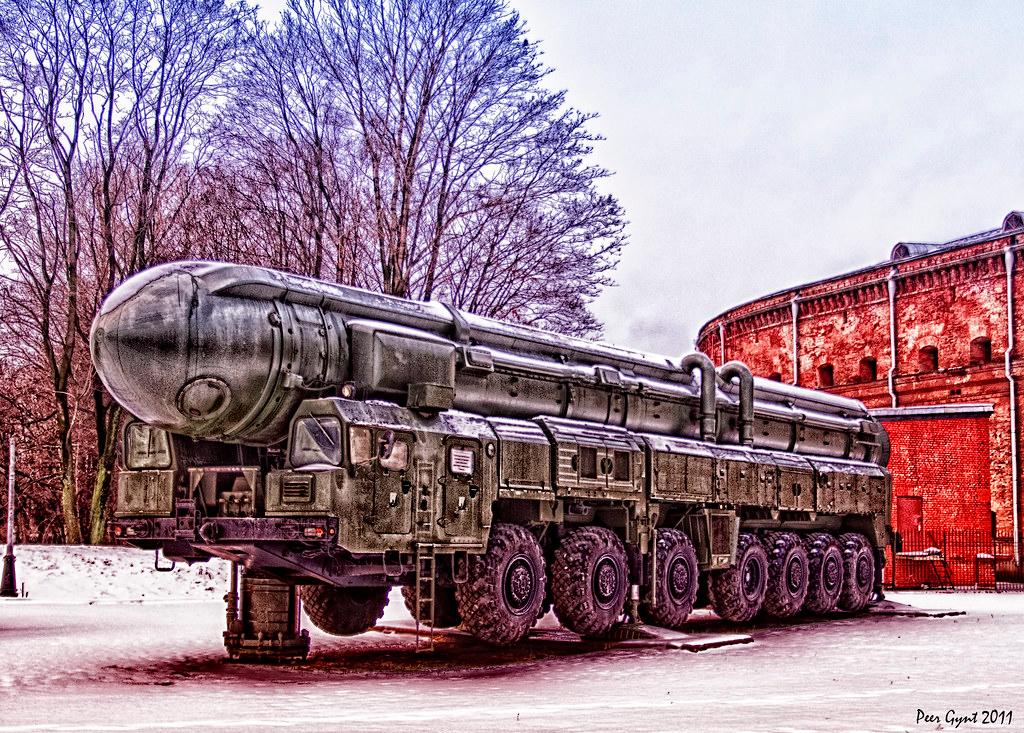
In the mobile configuration (15P165), the missiles are mounted on eight-axle MZKT-79221 (MAZ-7922) heavy tactical wheeled chassis within a high-strength fiberglass launch container (TPK) that performs both transport and launch functions. These launch vehicles, with sixteen wheels and six steerable axles, achieve high mobility even over rough terrain thanks to their 800-horsepower diesel engines. This mobility, combined with the system’s ground-leveling jacks that allow deployment on soft soil, provides operational camouflage against enemy reconnaissance assets and enables surprise counterattack capabilities.【5】
Topol-M (Youtube)
The introduction of Topol-M missiles occurred in phases. The first silo-based Topol-M regiment began operational combat duty in December 1998 at the Tatishchevo unit near Saratov. Delivery of the mobile variant to the armed forces commenced in late 2006 with units stationed near Teykovo.New START agreement-based inventories reported approximately 50 silo-based and 15 to 18 mobile Topol-M missiles in Russia’s strategic inventory.【6】
By 2009, military authorities announced the completion of Topol-M production, and subsequent strategic development budgets were redirected toward the RS-24 (Yars) missile system, a direct derivative of the Topol-M architecture capable of carrying multiple warheads. Despite the transition to next-generation systems, the Topol-M platforms remain one of the foundational mechanisms of the Russian Strategic Rocket Forces and global nuclear deterrence balance in the 21st century due to their technological leap and formidable penetration capabilities.
[1]
Missile Defense Project, “RT-2PM2 Topol-M (SS-27 Mod 1 'Sickle B'),” Missile Threat (Center for Strategic and International Studies), 23 April 2024, Access date: 23 March 2026.
[2]
Nil, “Topol-M (SS-27 Mod 1): The Mobile Fortress of Russian Strategic Deterrence,” Defense Line, 6 July 2025, Access date: 23 March 2026.
https://savunmahatti.com/topol-m-ss-27-mod-1-rus-stratejik-caydiriciliginin-tasinabilir-kalesi/
[3]
Missile Defense Project, “RT-2PM2 Topol-M (SS-27 Mod 1 'Sickle B'),” Missile Threat (Center for Strategic and International Studies), 23 April 2024, Access date: 23 March 2026.
[4]
Nil, “Topol-M (SS-27 Mod 1): The Mobile Fortress of Russian Strategic Deterrence,” Defense Line, 6 July 2025, Access date: 23 March 2026.
https://savunmahatti.com/topol-m-ss-27-mod-1-rus-stratejik-caydiriciliginin-tasinabilir-kalesi/
[5]
“Intercontinental Missile Complex ‘Topol-M,’” Military Review (Topwar.ru), 13 February 2013, Access date: 23 March 2026.
https://tr.topwar.ru/24188-mezhkontinentalnyy-raketnyy-kompleks-topol-m.html
[6]
Missile Defense Project, “RT-2PM2 Topol-M (SS-27 Mod 1 'Sickle B'),” Missile Threat (Center for Strategic and International Studies), 23 April 2024, Access date: 23 March 2026.

Henüz Tartışma Girilmemiştir
"MIT Topol-M" maddesi için tartışma başlatın
Development History and Institutional Structure
Technical Characteristics, Aerodynamic Structure and Propulsion Systems
Warhead Capacity, Countermeasures and Penetration Technologies
Operational Launch Platforms: Silo and Mobile Deployment
Operational Service History and Current Status