


Bu içerik Türkçe olarak yazılmış olup yapay zeka ile otomatik olarak İngilizceye çevrilmiştir.
+2 Daha
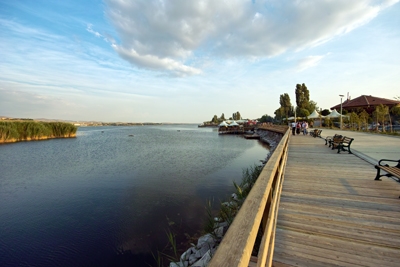
Lake Mogan is located within the boundaries of the Gölbaşı district of Ankara Province, Türkiye, at an elevation of approximately 972 meters above sea level. Its surface area varies seasonally between 5.6 and 8 km². The average depth is 2.4 meters, while the maximum depth ranges from 2.8 to 5.3 meters. The lake lies within the Mogan-Eymir basin, which covers an area of approximately 1010 km².
This area originally formed as a river valley but gradually filled with alluvial deposits carried by streams, eventually taking on the form of a lake. The main surface water sources feeding the lake include the Sukesen, Yavrucak, Gölova and Başpınar streams. The hydrological regime is irregular, and the lake is primarily sustained by surface runoff. It discharges regulated flow into Lake Eymir. The Mogan-Eymir connection has been managed since 1974 for flood control purposes.
Although the region lies within the Mediterranean climatic zone, it exhibits continental climate characteristics due to its high plateau conditions. The annual average temperature is 12°C, and the average annual precipitation is 408 mm. During dry summer months, evaporation exceeds precipitation, leading to seasonal fluctuations in lake levels.
Lake Mogan is one of Türkiye’s most important wetlands. The lake features a rich diversity of habitats, including open water surfaces, extensive reed beds, wet meadows, marshlands, dry agricultural lands, and artificial shelters. Wetlands are critically important for groundwater storage, water purification, and the maintenance of biological diversity.
Flora: A total of 493 plant species have been identified in the region, of which 47 are endemic.
In particular, Centaurea tchichatcheffii (yanardöner/peygamber çiçeği), which is found only in this area, is an endemic and conservation-priority species of Lake Mogan.

Lake Mogan (Ministry of Urbanization and Climate Change, Republic of Türkiye)
Fauna: The lake serves as a vital breeding, staging, and wintering site for herons, ducks, raptors, and several endangered species. According to the Bern Convention, which Türkiye has ratified, protected species include the white-headed duck (Oxyura leucocephala), the lesser kestrel (Falco naumanni), the little bittern (Ardeola ralloides), and the little crake (Ixobrychus minutus).

Lake Mogan (Ministry of Environment, Urbanization and Climate Change of the Republic of Türkiye)
Fish Fauna: Scientific studies conducted in Lake Mogan have identified seven species belonging to the families Cyprinidae, Atherinidae, and Esocidae. These species are: Cyprinus carpio, Carassius gibelio, Tinca tinca, Alburnus escherichii, Pseudorasbora parva, Atherina boyeri, and Esox lucius. Some of these species are invasive and exert pressure on native fish populations (e.g., Carassius gibelio and Pseudorasbora parva).
Lake Mogan and its surroundings were designated as the “Gölbaşı Special Environmental Protection Area” by a Council of Ministers decision dated 22 October 1990. The area has also been classified as an “Important Natural Area (INA)” and an “Important Bird Area (IBA)” and has been nominated under the Ramsar Convention. In 1992, a 1:25,000 scale environmental planning plan was prepared, resulting in the removal of tourist accommodation facilities around the lake and the promotion of day-use activities. Wetlands in the southern part of the lake and Class I agricultural lands were placed under protection, and construction was restricted. However, in subsequent years, pressure for development increased, and new plans introduced in 2014 sparked public debate. The new 1:50,000 scale environmental planning plan, which came into effect in 2017, was criticized for expanding areas open to development despite some revisions; certain provisions were later annulled through judicial review.
The Lake Mogan ecosystem is under threat, particularly over the last 50 years, due to increasing urbanization, industrial activities, agricultural chemicals, and unregulated construction. Major threats include:
Long-term monitoring studies conducted since 1997 by Middle East Technical University provide the most comprehensive dataset on the ecological health of Lake Mogan and Lake Eymir. Through this program, hydrological, chemical, and biological parameters are regularly monitored, enabling restoration and conservation efforts to be based on scientific data.

Henüz Tartışma Girilmemiştir
"Mogan Lake" maddesi için tartışma başlatın
Ecological Characteristics and Biodiversity
Protection Status and Planning Process
Threats and Challenges
Scientific Monitoring and Restoration Efforts