

Bu içerik Türkçe olarak yazılmış olup yapay zeka ile otomatik olarak İngilizceye çevrilmiştir.
Manufacturer(s) | North American Aviation (NAA) | ||||||||
|---|---|---|---|---|---|---|---|---|---|
Type(s) | Prototype Supersonic Strategic Bombing/Research Aircraft | ||||||||
First Flight(s) | 21 September 1964 (AV-1) | ||||||||
Airframe Material | Stainless steel honeycomb sandwich panels and titanium | ||||||||
Maximum Speed | Mach 3.1 (3,310 km/h at 73,000 ft) | ||||||||
Thrust (Each) | ~133 kN (30,000 lbf) (with afterburner) | ||||||||
Engine Type | 6 x General Electric YJ93-GE-3 turbojet | ||||||||
Number Produced | 2 Units (AV-1 and AV-2) | ||||||||
Retirement | 4 February 1969 | ||||||||
Program Cancellation | 1961 (Bombing program cancelled, converted to research platform) | ||||||||
Crew | 2 (Pilot and Co-pilot) | ||||||||
Full Name | North American Aviation XB-70 Valkyrie | ||||||||
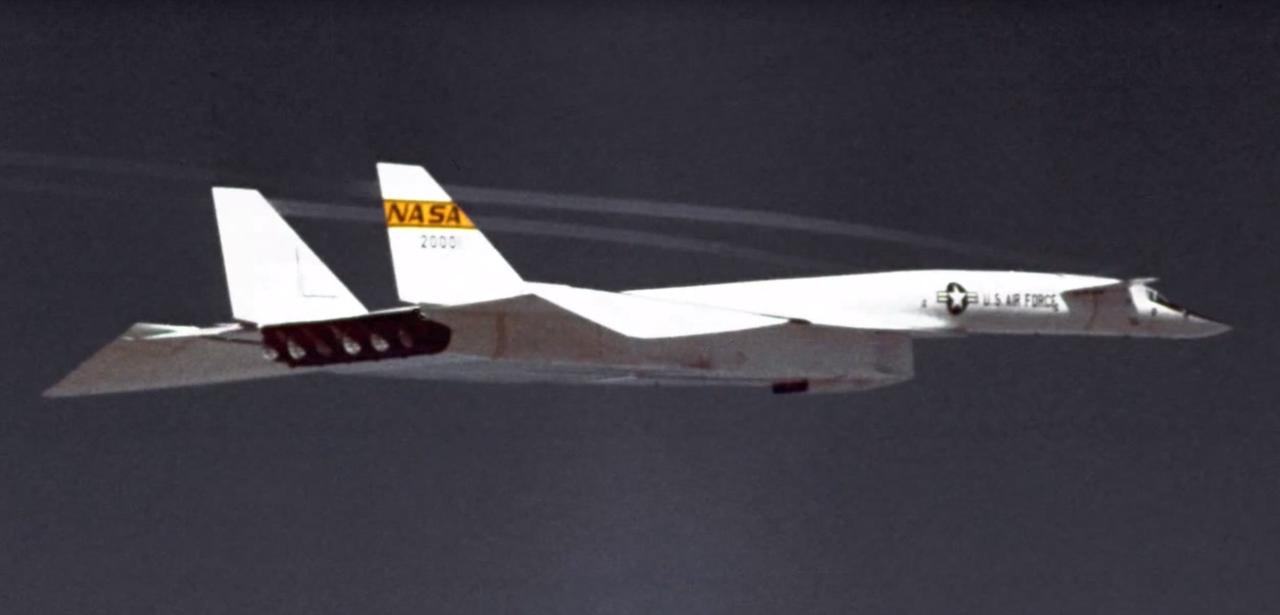
TheNorth American XB-70 Valkyrieis a prototype strategic bomber developed by the United States Air Force (USAF) Strategic Air Command in the late 1950s for nuclear weapons delivery. It features a delta wing design six engines and the capability to reach speeds of Mach 3+. Initially intended to replace the B-52 Stratofortress, the platform was withdrawn from operational bombing duties due to changing defense doctrines and the advancement of intercontinental ballistic missiles (ICBMs) and converted into a research aircraft (XB-70A) for studying supersonic flight dynamics.【1】
North American XB-70 Valkyrie (Gary Danvers Collection)
Although the program initially aimed to produce operational aircraft, it was transformed into an experimental research initiative due to the rapid development of intercontinental ballistic missile (ICBM) technology and high costs.
A total of two flyable prototypes were built:
• AV-1 (Air Vehicle 1): The first prototype with tail number 62-0001 was rolled out of the hangar on 11 May 1964 and made its first flight on 21 September 1964.【2】
• AV-2 (Air Vehicle 2): The second prototype with tail number 62-0207 incorporated aerodynamic improvements including a 5-degree dihedral angle and made its first flight on 17 July 1965. Production of a third prototype (AV-3) was canceled before completion.
The World’s Fastest Bomber: The XB-70 Valkyrie (Mustard)
The XB-70 never entered series production. In 1961 President Kennedy declared the program unnecessary as a military weapons system and downgraded its status to “exploratory and research only.” The aircraft were used in jointNASAand USAF tests to study the aerodynamic thrust and structural effects of Mach 3 flight. AV-1 exceeded Mach 3 on 14 October 1965 but suffered structural damage to its honeycomb panels.
North American XB-70 Valkyrie (Gary Danvers Collection)
The XB-70 features a delta wing configuration with canard controls and six engines. The airframe was constructed largely from stainless steel honeycomb sandwich panels and titanium to withstand the extreme frictional heating generated at Mach 3 speeds (up to 330°C in some areas and higher in engine bays). The techniques used to assemble these panels complicated maintenance and increased costs.
• Flight Augmentation Control System (FACS): A system developed to maintain stability along the pitch roll and yaw axes. It was critical for damping adverse yaw and negative dihedral effects that occurred at speeds above Mach 2.5 and when the wingtips were folded down.【3】
• Folding Wingtips: The most distinctive aerodynamic feature the wingtips could fold downward to 0° at subsonic speeds 25° at transonic speeds and 65° atsupersonic speedsabove Mach 1.4. This mechanism increased vertical stability by allowing a smaller vertical tail reduced trim drag and trapped shock waves beneath the wings to generate “compression lift.” The gearboxes that moved the wingtips had a 32000:1 reduction ratio and each weighed approximately 140 kg.【4】
• Air Inlet Control System (AICS): Two-dimensional variable-geometry inlet ramps and bypass doors adjusted to maintain optimal shockwave positioning within the inlet throat.
• Ejection Capsules: Pressurized encapsulated seats were developed to safely eject the pilot and co-pilot at supersonic speeds and altitudes above 70000 feet. These capsules fully enclosed the crew before ejection to protect them from atmospheric forces.
Property
Value
Crew
2 (Pilot and Co-Pilot)
Length
56.6 m (excluding test boom)
Wingspan
32 m
Height
9.38 m
Empty Weight
~136000 kg
Maximum Takeoff Weight
~246000 kg
Engine
6 x General Electric YJ93-GE-3 turbojet
Thrust (Each)
133 kN (with afterburner)
Maximum Speed
Mach 3.1 (3310 km/h)
Service Ceiling
23580 m (77350 ft)
Range
~6900 km
As the XB-70 remained in the prototype phase it was never equipped with active weapon systems. However its design objectives included:
• Nuclear Armament: A weapons bay beneath the fuselage was planned for nuclear ordnance.【5】
• Weapons Integration: Bombing/navigation systems such as the AN/ASQ-42V were planned for the prototypes but canceled when the aircraft’s role shifted to research.
• XB-70A: The two flight test prototypes built (AV-1 and AV-2).
• XB-70B (AV-3): A third prototype planned with improved features but canceled in July 1964 before production.
• YB-70: A variant planned for operational testing and evaluation but never built.
• RS-70: A proposed variant for reconnaissance-strike missions.
XB-70 Valkyrie - Strategic Bomber Flying at Mach 3 Speed (USA Military Channel)
The original concept of the XB-70 was to provide nuclear deterrence by flying at altitudes and speeds beyond the reach of Soviet interceptor aircraft. However the development of high-altitude surface-to-air missiles (SAMs) rendered this doctrine obsolete.
After the military program was canceled the XB-70 was used as a testbed for NASA and USAF joint research into “National Supersonic Transport” (SST). Data was collected on sonic boom effects high-altitude turbulence aerodynamic heating and flight control systems.
1964 North American XB-70A Valkyrie 001 (Gary Danvers Collection)
Throughout the XB-70 program a total of 129 flights were conducted (combined for AV-1 and AV-2).【6】
• AV-1: 83 flights totaling 160 hours and 16 minutes.
• AV-2: 46 flights totaling 92 hours and 22 minutes.
• Mach 3 Flight: AV-1 exceeded Mach 3 on 14 October 1965 but its speed was later limited to Mach 2.5 due to structural damage (honeycomb panel failures). AV-2 achieved a significant milestone on 19 May 1966 by flying continuously at Mach 3 for 33 minutes.
• Accident (8 June 1966): During a photo shoot to showcase General Electric engines a NASA F-104N Starfighter collided with the right wing of XB-70 AV-2 causing it to spin and sever its vertical stabilizers. In the crash F-104 pilot Joe Walker and XB-70 co-pilot Major Carl Cross were killed. XB-70 pilot Al White survived with serious injuries. As a result AV-2 was lost and the research program continued with only AV-1.【7】
XB-70 Valkyrie Crash Site (Thomas Hart)
The XB-70 Valkyrie was used exclusively by the United States Air Force (USAF) and NASA for testing and research purposes. The only surviving example (AV-1) is on display at the National Museum of the United States Air Force at Wright-Patterson Air Force Base.
The XB-70’s closest conceptual rival was the Soviet Union’s Sukhoi T-4 (Sotka) aircraft.【8】
• Similarities: Both aircraft were designed to reach Mach 3 speeds used titanium and stainless steel construction and incorporated fly-by-wire control systems.
• Differences: TheT-4featured a droop nose to improve visibility during takeoff and landing while the XB-70 used a movable forward canopy ramp. Like the XB-70 the T-4 project remained at the prototype stage and was canceled.
• Advantages: Exceptionally high speed and altitude capability for its size successful application of compression lift resulting in high aerodynamic efficiency (L/D ratio of approximately 6 at Mach 2).
• Weaknesses: High radar cross-section vulnerability to advancing surface-to-air missiles difficulties in manufacturing and maintaining honeycomb panels. Additionally longitudinal trim changes at high speeds and sensitivity in altitude control due to pressure sensor delays increased pilot workload.
Arnaiz, H. H., Schweikhard, W. G. "Validation of the Gas Generator Method of Calculating Jet-Engine Thrust and Evaluation of XB-70-1 Airplane Engine Performance at Ground Static Conditions (NASA TN D-7028)." NASA Technical Reports Server. Accessed January 27, 2026. https://ntrs.nasa.gov/citations/19710003944
Dussart, G. X., Lone, M., O'Rourke, C., Wilson, T. "In-flight Wingtip Folding: Inspiration from the XB-70 Valkyrie." *Scholarly Commons Embry-Riddle Aeronautical University*. Accessed January 27, 2026.
Gary Danvers Collection. “1964 North American XB-70A Valkyrie 001 under construction - Installing the last of the six General Electric YJ93-GE-3 turbojet engines.” Flickr. Accessed January 27, 2026. https://www.flickr.com/photos/gcdnz/42030486772/in/photolist-2736ep3-2736fis-2736fmo-2736esE-2736eim-2gZfRmD-261uPL5-261uPDm-24mkzuu-261uPsQ-2gVoCfk-25Jyeaa-2gZeW1e-261uPQd-2736fCf-2736fG3-2736fAG-25JyeqR-25Jye86-2736fHW-4GDD3v-HrLw94-2n3nThc-2n3mhmz-2j2hkWE-5MSy32-2chxzUt-88SBwK-GRCC6V-88SATr-2dFbfX2-HEWFig-y9pK7a-2n3fQ6P-2aUC68W-pkr2UM-2dFbmox-2czfy8J-2nAL3e4-28tbQCR-bqgCTP-2nwsvht-2iUgGG-2hjzAQN-GRudws-2j2uL3X-88SBbk-2iZzHe2-h1vbP2-2n2V26q
Gary Danvers Collection. “1969 North American XB-70 Valkyrie landing with dragshutes deployed, 4 Feb 1969.” Flickr. Accessed January 27, 2026. https://www.flickr.com/photos/gcdnz/42030491462/in/photolist-2h2GLBU-2736fMU-a4SduV-25Jye3g-JYdPQw-261uQjE-261uPVy-2736fR1-2736eWq-2736f3h-25JydGg-25Jye12-25JydBX-2736evq-261uPYj-2736ffG-2736fEu-2736eM7-25JydKn-24mkzq1-2736ep3-2736fis-2736fmo-2736esE-2736eim-2gZfRmD-261uPL5-261uPDm-24mkzuu-261uPsQ-2gVoCfk-25Jyeaa-2gZeW1e-261uPQd-2736fCf-2736fG3-2736fAG-25JyeqR-25Jye86-2736fHW-4GDD3v-HrLw94-2n3nThc-2n3mhmz-2j2hkWE-5MSy32-2chxzUt-88SBwK-GRCC6V
Gary Danvers Collection. “2015 Staff at the National Museum of the US Air Force in Dayton, Ohio moving the XB-70 into her newly-constructed hangar, 27 Oct 2015.” Flickr. Accessed January 27, 2026. https://www.flickr.com/photos/gcdnz/42030488592/in/photolist-2h2GLBU-2736fMU-a4SduV-25Jye3g-JYdPQw-261uQjE-261uPVy-2736fR1-2736eWq-2736f3h-25JydGg-25Jye12-25JydBX-2736evq-261uPYj-2736ffG-2736fEu-2736eM7-25JydKn-24mkzq1-2736ep3-2736fis-2736fmo-2736esE-2736eim-2gZfRmD-261uPL5-261uPDm-24mkzuu-261uPsQ-2gVoCfk-25Jyeaa-2gZeW1e-261uPQd-2736fCf-2736fG3-2736fAG-25JyeqR-25Jye86-2736fHW-4GDD3v-HrLw94-2n3nThc-2n3mhmz-2j2hkWE-5MSy32-2chxzUt-88SBwK-GRCC6V
Gelzer, C. "XB-70 Valkyrie." NASA. Accessed January 27, 2026. https://www.nasa.gov/centers-and-facilities/armstrong/xb-70-valkyrie/
Goebel, Greg. "General Dynamics B-58 & North American XB-70." AirVectors. Accessed January 27, 2026. https://www.airvectors.net/avb58.html
Hart, T. “XB-70 Valkyrie Crash Site.” Flickr. Accessed January 27, 2026. https://www.flickr.com/photos/hawk59/36737580760/in/photolist-XYnGQQ-XYnHb9-2n31m6L-YmXhf8-29ooMd6-2n32zdG-2n34fip-2n2V2xN-29FhCgC-aUNrFK-YmXgLc-2oVz5P7-Ku53j1-2iZ8m6Y-aUNryx-qL7UJ5-rePgdC-2nsLCTX-qL7Txs-2h6mR7Z-2iZyaJ9-YmXfnF-2aLKEnM-2aLKDQp-2hjyFFW-2gtnHnP-bctc6v-2mazmSp-y9PRRL-JBygiM-2gtnHTt-2hjzAMS-HrLvZ6-bctcqP-bctixc-2nsFqg1-2ngeqm8-29FhDpE-bct9oz-2dLM1io-2iZXw4Y-bctarV-2iYKg3k-bctiEZ-bctipH-bcta2t-26uCBKi-JJpDwp-pRpP9j-91CHFt
Lebrin, P. "North American Aviation XB-70 Valkyrie Flight Manual." Scribd. Accessed January 27, 2026. https://www.scribd.com/document/658249878/North-American-Aviation-XB-70-Valkyrie-Flight-Manual
MiGFlug. "Sukhoi T-4 – The Russian Valkyrie." MiGFlug. Accessed January 27, 2026. https://migflug.com/jetflights/russian-valkyrie-sukhoi-t-4/
Mustard. “The World’s Fastest Bomber: The XB-70 Valkyrie.” YouTube. Accessed January 27, 2026. https://www.youtube.com/watch?v=Yl32c352thE
USA Military Channel. “XB-70 Valkyrie - Strategic Bomber Flying at Mach 3 Speed - XB-70ヴァルキリー・マッハ3で飛ぶ戦略爆撃機.” YouTube. Accessed January 27, 2026. https://www.youtube.com/watch?v=-dD0UcLJbIc
Wolowicz, C. H., Yancey, R. B. "Summary of stability and control characteristics of the XB-70 airplane." NASA Technical Reports Server. Accessed January 27, 2026.


Manufacturer(s) | North American Aviation (NAA) | ||||||||
|---|---|---|---|---|---|---|---|---|---|
Type(s) | Prototype Supersonic Strategic Bombing/Research Aircraft | ||||||||
First Flight(s) | 21 September 1964 (AV-1) | ||||||||
Airframe Material | Stainless steel honeycomb sandwich panels and titanium | ||||||||
Maximum Speed | Mach 3.1 (3,310 km/h at 73,000 ft) | ||||||||
Thrust (Each) | ~133 kN (30,000 lbf) (with afterburner) | ||||||||
Engine Type | 6 x General Electric YJ93-GE-3 turbojet | ||||||||
Number Produced | 2 Units (AV-1 and AV-2) | ||||||||
Retirement | 4 February 1969 | ||||||||
Program Cancellation | 1961 (Bombing program cancelled, converted to research platform) | ||||||||
Crew | 2 (Pilot and Co-pilot) | ||||||||
Full Name | North American Aviation XB-70 Valkyrie | ||||||||
Henüz Tartışma Girilmemiştir
"North American XB-70 Valkyrie" maddesi için tartışma başlatın
Avionics and System Components
Technical Specifications Table
Armament and Capabilities
Existing and Planned Variants
Military Applications
Civilian and Humanitarian Missions
Success Stories and Critical Moments
Performance Advantages and Weaknesses