


Bu içerik Türkçe olarak yazılmış olup yapay zeka ile otomatik olarak İngilizceye çevrilmiştir.
+2 Daha
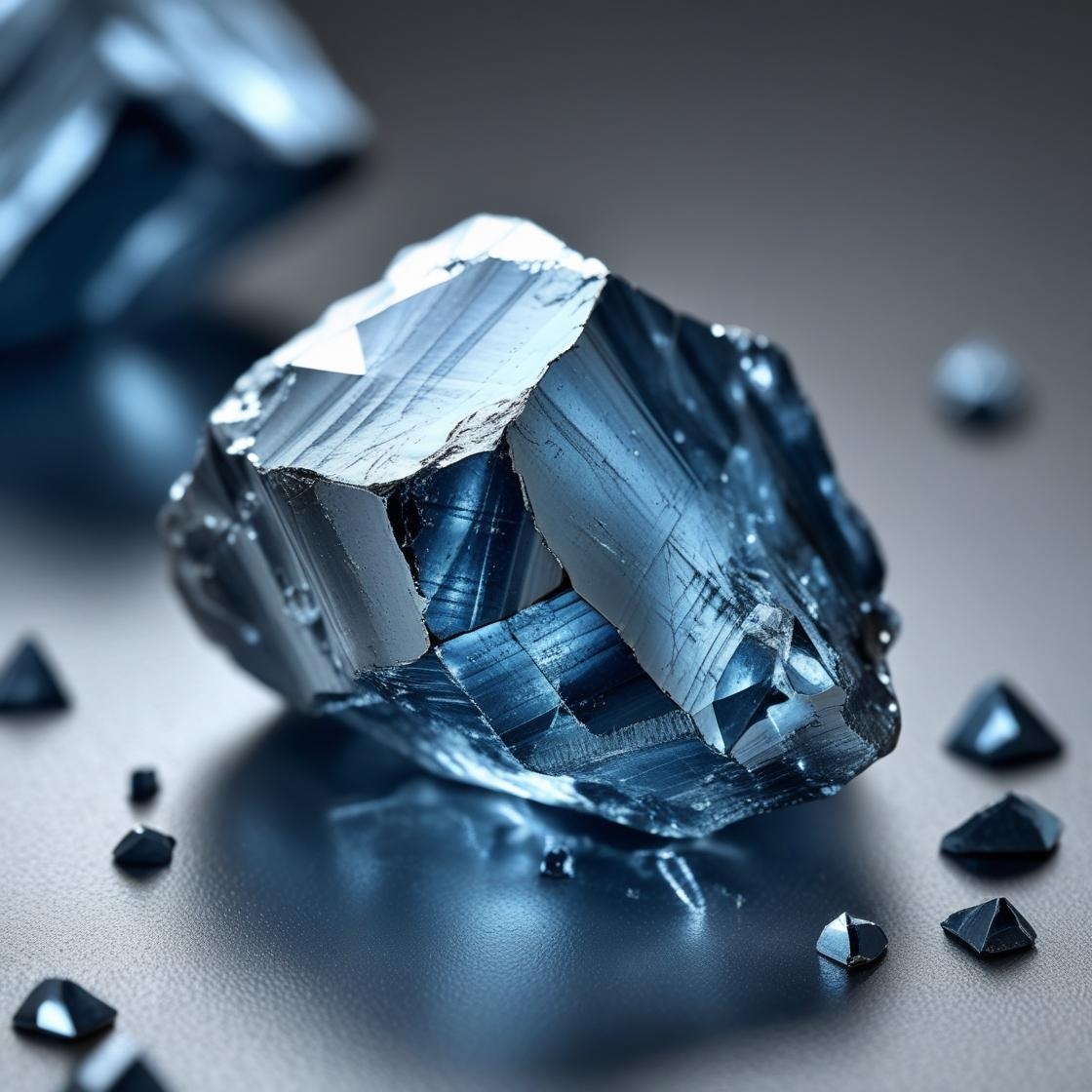
Osmiyum
Osmium is one of the platinum group metals and occupies the 76th position in the periodic table. It has a silvery-white color and is known for being the densest naturally occurring element. Osmium was discovered in 1803 by Smithson Tennant alongside iridium. The element derives its name from its sharp and unpleasant odor, and due to its extreme hardness and high melting point, it is used in specialized alloys and wear-resistant applications.
Osmium (Os) is a transition metal located in the 6th period and 8th group of the periodic table. It belongs to the platinum group metals (ruthenium, rhodium, palladium, iridium, platinum). Its electron configuration is [Xe] 4f¹⁴5d⁶6s². At room temperature it exists as a solid. It is extremely hard and brittle, making it very difficult to machine. Its density is approximately 22.59 g/cm³, the highest of all measurable elements.
Osmium was discovered in 1803 in London by the British chemist Smithson Tennant, alongside iridium. Tennant observed that when he dissolved natural platinum ores from South America in aqua regia, a black insoluble residue remained. Believing this residue contained new elements, he performed careful chemical analyses and successfully isolated two new elements from the black powder. He named one of them “osmium” due to its volatile oxide’s sharp, chlorine-like odor; the other was named “iridium” because of the varied colors of its salts.
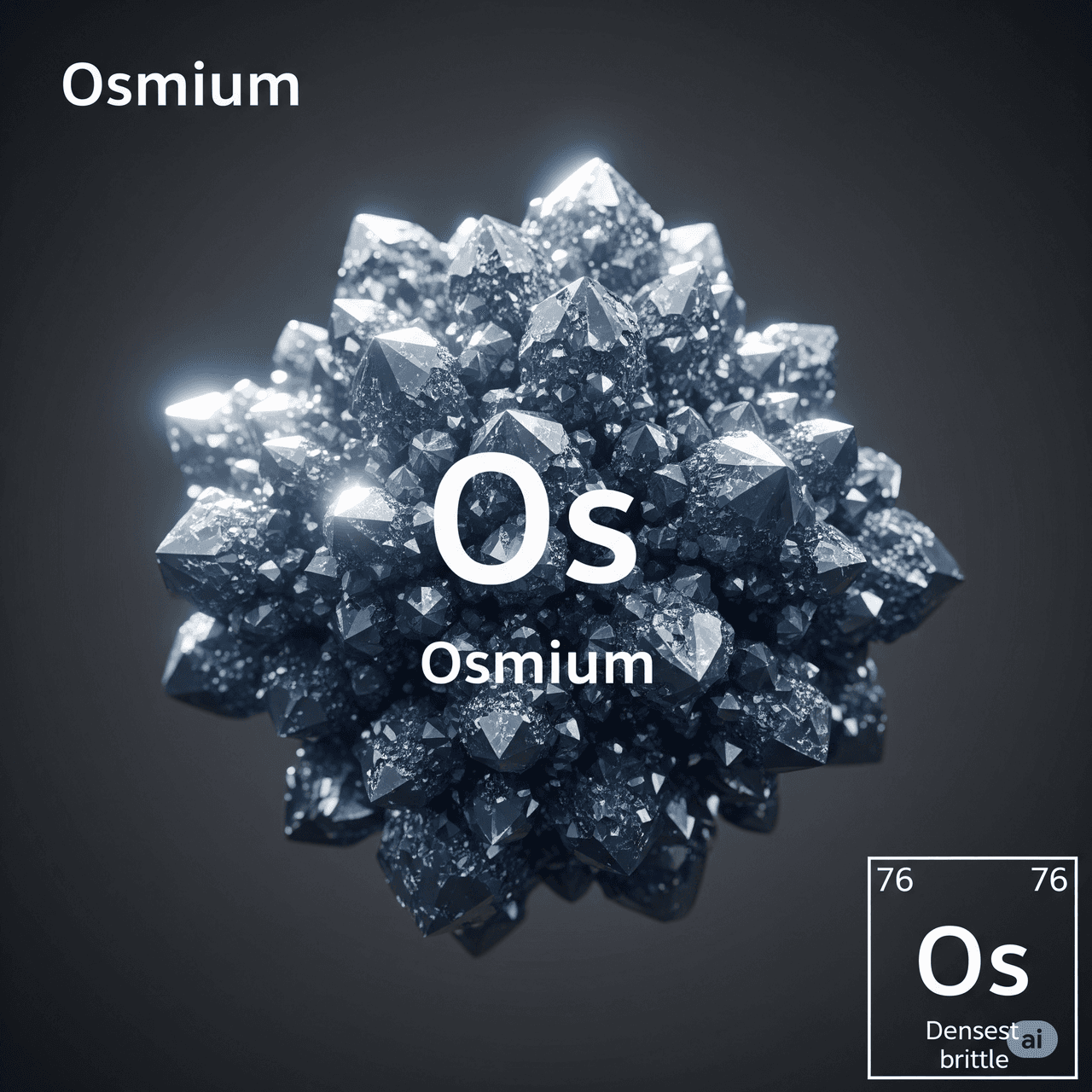
Osmium (Generated by Artificial Intelligence.)
The element’s name was coined by its discoverer Smithson Tennant from the Greek word “osme” (ὀσμή), meaning “odor.” This naming refers to osmium tetroxide (OsO₄), a highly volatile and pungent compound formed when osmium is heated or reacts with oxidizing acids.
Osmium is one of the rarest stable elements in the Earth’s crust, with an abundance similar to that of iridium, rhenium, and gold. It is rarely found in nature in its free state; instead, it occurs combined with other platinum group metals, particularly iridium (in natural alloys known as osmiridium or iridosmine), or in sulfide ores of nickel and copper. Its main commercial sources are nickel and platinum mines in Russia, North and South America, and South Africa. Commercially, osmium is obtained as a byproduct of these mining operations.
Osmium is a bluish-white, extremely hard and brittle metal. It has a melting point of 3033 °C and a boiling point of 5008 °C, among the highest of all elements. Its atomic radius is approximately 216 pm and its electronegativity is 2.2. Its electron affinity is reported as 106.1 kJ/mol. In bulk form, it is unaffected by acids and air at room temperature. However, powdered osmium slowly reacts with air to form osmium tetroxide (OsO₄), a volatile compound with a sharp odor and high toxicity. Osmium tetroxide is a volatile solid that boils at a relatively low temperature of 130 °C. Osmium exhibits a wide range of oxidation states from -2 to +8; the +8 oxidation state, shared with ruthenium, is the highest known stable oxidation state.
Osmium has seven naturally occurring isotopes. Six of them are stable: ¹⁸⁴Os, ¹⁸⁷Os, ¹⁸⁸Os, ¹⁸⁹Os, ¹⁹⁰Os, and ¹⁹²Os. One naturally occurring isotope, ¹⁸⁶Os, is radioactive with an extremely long half-life of approximately 2 × 10¹⁵ years.
Osmium’s hardness, high density, and resistance to wear make it suitable for demanding applications, but its rarity, high cost, and toxic oxide limit its use.
Osmium has no known biological role. Metallic osmium itself is generally considered harmless. However, its most common and volatile compound, osmium tetroxide (OsO₄), is highly toxic and irritating. Its vapor can cause severe damage to the eyes (potentially leading to corneal damage and blindness), skin, and respiratory tract. Inhalation even at low concentrations can lead to pulmonary edema and death. Therefore, working with osmium and especially osmium tetroxide requires stringent safety measures, including specialized fume hoods and full protective equipment.

Osmiyum
Henüz Tartışma Girilmemiştir
"Osmium (Os)" maddesi için tartışma başlatın
Classification and Basic Properties
Discovery
Etimology
Natural Occurrence
Physical and Chemical Properties
Isotopes
Applications
Biological Role and Precautions