

+2 Daha

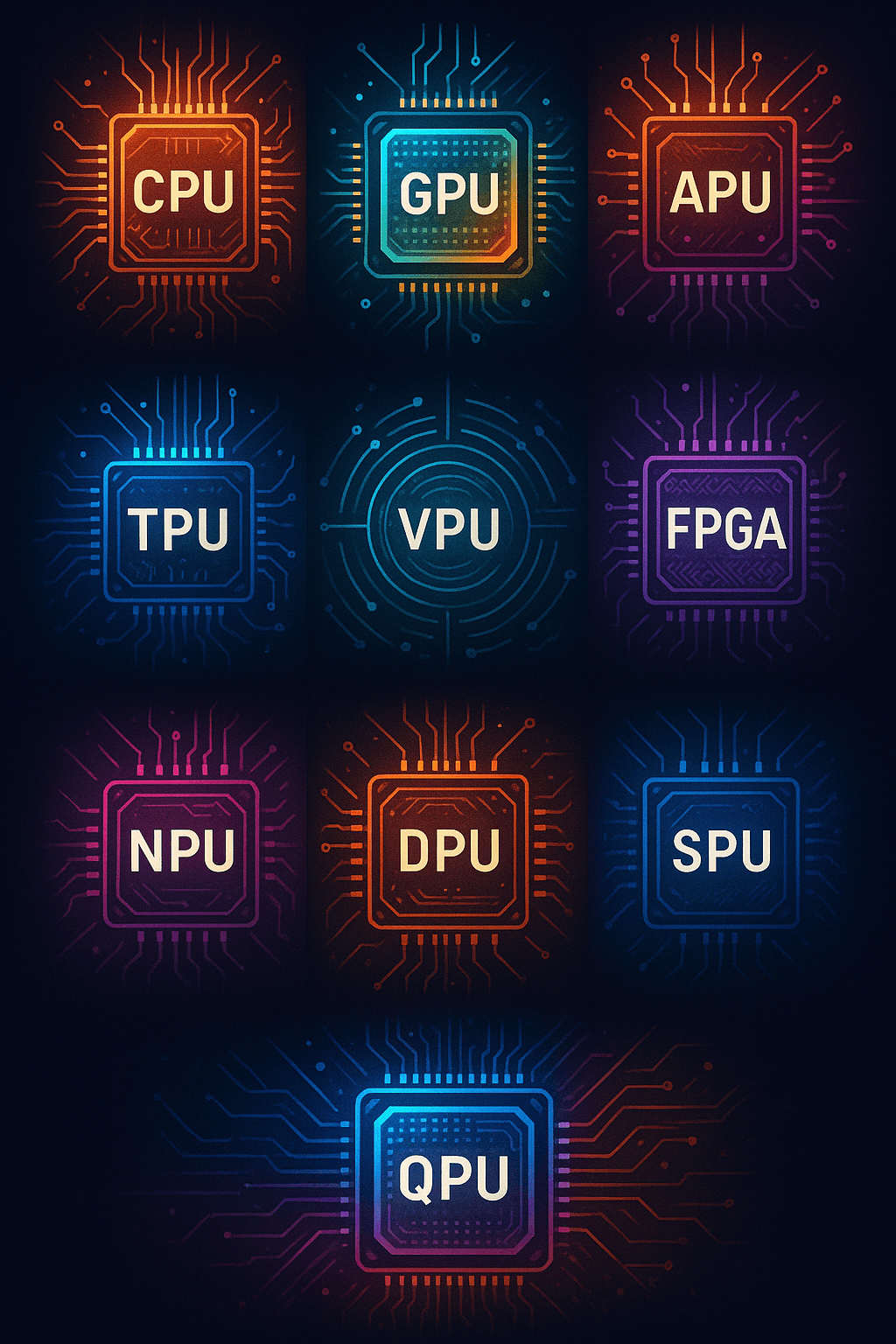
Processing Units
Processor Units | CPU, GPU, APU, TPU, VPU, FPGA, NPU, DPU, SPU, QPU | ||||||||
|---|---|---|---|---|---|---|---|---|---|
Total Processing Units | 10 | ||||||||
Future Processing Units | IPU,RPU, XPU, CXL, NP | ||||||||
Total Future Processing Units | 5 | ||||||||
Leading Manufacturers | Intel, AMD, ARM, IBM, Google, Apple, Huawei, Samsung, D-Wave, Rigetti, Fungible, MediaTek | ||||||||
Processing units are hardware components that execute numerical data operations, enabling computer systems to perform computational and control tasks. Each processing unit is designed to efficiently handle specific types of operations. With the advancement of technology, processing units have evolved beyond just the central processing unit (CPU); specialized processors such as the graphics processing unit (GPU), artificial intelligence accelerators (NPU, TPU), programmable logic units (FPGA), and quantum processors (QPU) have emerged to meet the demands of various computational domains.
The CPU is the general-purpose information processing center of a computer and historically the unit where all operations are executed. It operates based on the Von Neumann architecture. It contains the ALU (Arithmetic Logic Unit) for arithmetic and logical operations, the CU (Control Unit) to process instructions, and registers to hold short-term data. CPUs typically have a few powerful cores and are very effective in sequential task processing.
Personal computers, servers, embedded systems, software development, general operating systems.
– Low parallel processing power
– High clock speed (3-5 GHz range)
– Wide software and OS support
GPUs are specialized processors designed for large-scale parallel operations. These units can have thousands of cores and are especially effective in image processing and math-intensive tasks. They use SIMD (Single Instruction, Multiple Data) architecture to process many data elements simultaneously. Modern GPUs are also used for general-purpose computing (GPGPU).
Gaming, deep learning training, scientific simulations, financial modeling, video processing.
– Multi-core architecture (e.g., NVIDIA RTX 4090 has >16,000 CUDA cores)
– High memory bandwidth
– Very high parallel data processing power
An APU is a hybrid processing unit where CPU and GPU components are integrated on the same chip. It provides performance and energy efficiency through shared memory while offering physical space and cost advantages. It is a cost-effective solution for systems that do not require high-performance graphics.
Laptops, tablets, entry-level desktop systems, gaming consoles (e.g., PlayStation 5, Xbox Series X).
– Shared memory architecture
– Relatively low TDP (thermal design power)
– Integrated graphics processing power
TPUs are specialized ASIC-based processors developed by Google specifically for tensor operations (like matrix multiplications) used in deep learning models. TPUs have very high computational density and are used in low-latency training and inference of deep neural networks.
Machine learning models (CNN, RNN, Transformer), natural language processing, recommendation systems.
– Over 100+ TFLOPS processing power
– Only suitable for specific AI models
– More energy-efficient than CPUs and GPUs
VPUs are low-power processing units designed for image recognition, object detection, and computer vision tasks. They are optimized for real-time analysis in AI-enabled camera applications.
Smart cameras, security systems, AR/VR devices, mobile device image processing.
– Low power consumption (in milliwatts)
– Real-time visual analysis
– Suitable for edge devices
FPGAs are processing units containing configurable hardware logic blocks. Because they can be reprogrammed by users, they offer application-specific acceleration. They are more flexible than ASICs and faster than CPUs/GPUs for certain tasks.
Telecommunications infrastructure, defense industry, embedded systems, financial trading engines.
– Parallel and customizable architecture
– Complex development process
– Used in timing-sensitive applications
NPUs are processors designed specifically for neural network inference. They provide high efficiency at low power, gaining importance with the spread of AI applications in mobile devices.
Smartphones, IoT devices, AI cameras, autonomous systems.
– High performance per watt
– Optimized for inference, not training
– Usually embedded within SoCs
DPUs independently execute network, security, and storage operations in data centers and cloud infrastructure to improve system efficiency. Products like NVIDIA BlueField integrate CPU, NIC, and specialized accelerators.
High-traffic data centers, network processing, hyperscale cloud systems.
– SmartNIC functionality
– Virtualized cores for isolation and security
– Optimized for Network Function Virtualization (NFV)
SPUs provide a hardware-based secure environment to perform encryption, key management, and secure data processing in isolation. Typically integrated separately from the main processor, often as TrustZone or TPM modules.
Mobile device security, biometric data, banking applications, secure processor environments.
– Security-certified architecture
– Hardware encryption support
– Anti-tamper features
QPU uses qubits that leverage quantum mechanics principles like superposition and entanglement instead of classical binary bits. This allows for exponentially faster solutions in specific problems (e.g., complex optimization). However, they are still experimental.
Cryptography, material science simulations, financial modeling, quantum chemistry.
– Superconducting, ion trap, or photonic qubit structures
– Noise-sensitive and error-prone
– Operate in cryogenic environments

Processing Units (Genereated with Artificial Intelligence)

Processing Units (Genereated with Artificial Intelligence)
Hennessy, John L., and David A. Patterson. Computer Architecture: A Quantitative Approach. 6th ed. San Francisco: Morgan Kaufmann, 2019.
Google. "TPU Research." Accessed June 3, 2025. Link
Xilinx. "AMD Completes Acquisition of Xilinx." AMD Newsroom, February 14, 2022. "FPGA Documentation." Accessed June 3, 2025. Link
IBM. "IBM Quantum." Accessed June 3, 2025. Link
ARM. "TrustZone for Cortex-A." Accessed June 3, 2025. Link

Processing Units
Processor Units | CPU, GPU, APU, TPU, VPU, FPGA, NPU, DPU, SPU, QPU | ||||||||
|---|---|---|---|---|---|---|---|---|---|
Total Processing Units | 10 | ||||||||
Future Processing Units | IPU,RPU, XPU, CXL, NP | ||||||||
Total Future Processing Units | 5 | ||||||||
Leading Manufacturers | Intel, AMD, ARM, IBM, Google, Apple, Huawei, Samsung, D-Wave, Rigetti, Fungible, MediaTek | ||||||||
Henüz Tartışma Girilmemiştir
"Processing Units" maddesi için tartışma başlatın
CPU (Central Processing Unit)
Applications
Technical Features
GPU(Graphics Processing Unit)
Applications
Technical Features
APU (Accelerated Processing Unit)
Applications
Technical Features
TPU (Tensor Processing Unit)
Applications
Technical Features
VPU (Vision Processing Unit)
Applications
Technical Features
FPGA (Field-Programmable Gate Array)
Applications
Technical Features
NPU (Neural Processing Unit)
Applications
Technical Features
DPU (Data Processing Unit)
Applications
Technical Features
SPU (Secure Processing Unit)
Applications
Technical Features
QPU (Quantum Processing Unit)
Applications
Technical Features
Advantages and Disadvantages of Processing Units
Manufacturers and Products
Future Processing Units
Bu madde yapay zeka desteği ile üretilmiştir.