



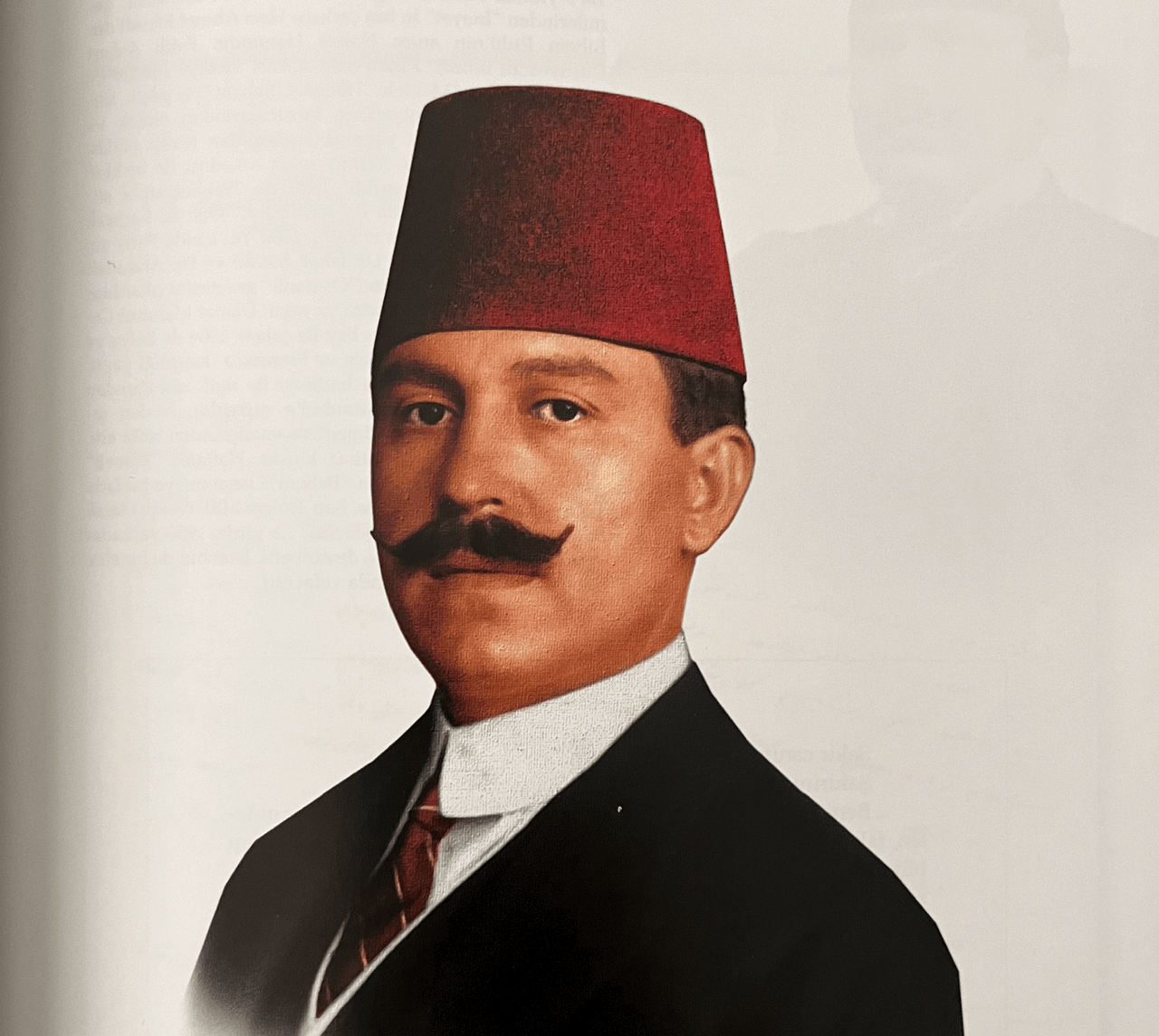
Şakir Zümre (Atilla Oral Arşivi)
Şakir Zümre, a prominent industrialist and entrepreneur, played a decisive role in shaping Turkey’s modern defense industry during the first half of the 20th century and was the owner of the first private military arms and ammunition factory established during the Republic era.
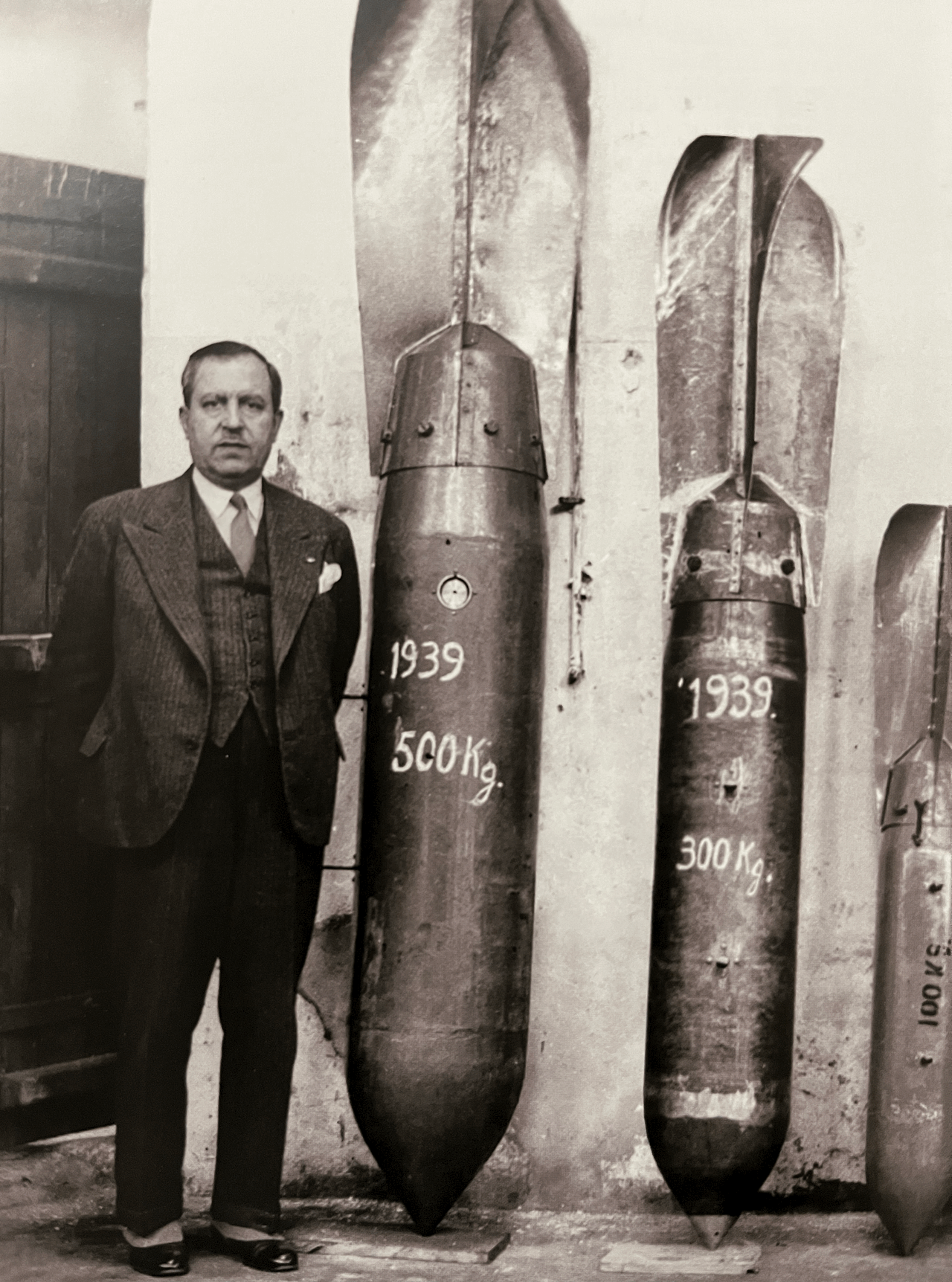
Şakir Zümre and Aircraft Bombs Produced at His Factory (Atilla Oral Archive)
Şakir Zümre’s real name was “Zümrezade Ahmet Şakir.” He was born in 1885 in Varna, Bulgaria. Varna, the city of his birth, was one of the centers with a dense Turkish population during that period. Şakir Zümre’s family belonged to the prominent families of Bulgaria.
Among his family connections was Marshal Fevzi Çakmak, who was the son of Şakir Zümre’s aunt. This familial link demonstrates that Zümre’s family environment maintained contact with the military and political circles of the time.
Şakir Zümre spent his childhood and early youth in Varna, where he completed his primary education. After his schooling in Varna, he traveled to Switzerland for higher education.
Şakir Zümre continued his secondary and higher education in Geneva, Switzerland. He completed his high school education there.
Following high school, he began his legal studies in Geneva and completed his law degree in 1908. This date marks the beginning of his transition from academic training in law to professional life.
The educational process in Geneva consisted of two stages: first high school, followed by legal studies. After completing these studies, he returned to Bulgaria and began his professional activities.
After completing his legal studies in Geneva in 1908, Şakir Zümre returned to Bulgaria and practiced law in Balçık. This period marked his first professional activity following his legal education. Balçık, where he practiced law, was one of the regions with a significant Turkish population at the time. The exact years of his legal practice have not been precisely documented. After this period, he shifted his focus to commercial activities.
After his legal career, Şakir Zümre began engaging in trade along the Bulgaria-Romania border. These commercial activities encompassed the purchase and sale of various goods, procurement of raw materials, transportation, and distribution. Some of the products traded included raw materials used in the defense industry. During this period, he was also involved in the supply chains of materials required for arms and ammunition production. Additionally, he provided financial support, labor recruitment, and logistical assistance to local workshops. Due to the economic dynamism of the Bulgaria-Romania border region, his trade activities involved a wide circulation of materials.
After his commercial endeavors, Şakir Zümre entered political life and served as a Turkish member of parliament representing Varna in the Bulgarian Parliament before the First World War. This role constituted a political effort to represent the Turkish population in Bulgaria. He represented the Varna region in parliament and was among the Turkish minority deputies. His term as a deputy is noted to have occurred in the years preceding the First World War. This position formed a significant part of Şakir Zümre’s political life in Bulgaria.
Şakir Zümre’s meeting with Mustafa Kemal occurred during Mustafa Kemal’s assignment as a military attaché in Bulgaria. Before his official posting, Mustafa Kemal Bey visited the General Staff of the Ottoman Army for a farewell call, during which Fevzi Çakmak mentioned Şakir Zümre to him. Fevzi Çakmak informed Mustafa Kemal that his relative Şakir Zümre in Bulgaria could assist him with certain matters.
Following this information, Mustafa Kemal and Şakir Zümre met at a café in Bulgaria, establishing their first contact. After this meeting, the two maintained regular contact. Fevzi Çakmak’s role in this process was to initiate communication between the two men during the pre-assignment meeting.
During the period when Mustafa Kemal served as a military attaché in Sofia, Şakir Zümre was also in Bulgaria. After their initial meeting, the two maintained regular contact. Accounts indicate that their friendship developed during this time in Sofia and that they frequently spent time together.
During this period, Şakir Zümre was involved in the trade of raw materials used for defense production in the Balkans. He also provided financial, labor, and logistical support to various workshops engaged in defense manufacturing. His interactions with Mustafa Kemal coincided with the period of these activities.
Accounts of the Sofia years emphasize the strength of the friendship established between Mustafa Kemal and Şakir Zümre. It is reported that Mustafa Kemal expressed his opinion regarding Zümre’s future career path and encouraged him to shift from politics to industry. There are also statements indicating that Atatürk, during a conversation, urged Şakir Zümre to pursue industrial activities.
Based on this information, the relationship formed in Sofia emerged as one of the starting points for Şakir Zümre’s later industrial activities in Türkiye.
After returning to Bulgaria, Şakir Zümre established contact with various arms and ammunition workshops in the Balkans engaged in defense production. These workshops in Bulgaria and Macedonia were centers producing modern munitions within the military and political context of the time. Some of the arms and ammunition manufactured in these workshops were dispatched according to the conflict conditions in the region.
The regions where these workshops were located also had significant Turkish populations. Şakir Zümre’s name appears in connection with supporting the activities of these production centers, and his direct involvement in their production processes is clearly evident.
Şakir Zümre provided various forms of support—including financing, labor, and logistics—to these defense production centers in the Balkans.
Financial support encompassed access to raw materials, procurement of necessary production inputs, and sustaining production capacity. Labor support involved organizing skilled craftsmen, technical personnel, and workers for production. Logistics support included the transportation, delivery, and distribution of manufactured munitions.
These contributions played a vital role in sustaining the operations of defense workshops in the Balkans. The execution of production processes, transportation of materials, and establishment of distribution networks formed the core of these contributions.
A portion of the modern arms and ammunition produced in Balkan workshops was transported to Türkiye and used during the War of Independence. The activities conducted in the areas of labor, finance, and logistics were instrumental in ensuring that this munition reached Anatolia.
During Türkiye’s struggle for independence, this munition support contributed significantly to meeting the military’s ammunition needs. For these activities, Şakir Zümre was awarded the Independence Medal.
This medal signifies official recognition of the production and supply efforts carried out in the Balkans. The work undertaken in production and transportation formed essential components of Şakir Zümre’s activities during the War of Independence.
Following his activities during the War of Independence, Şakir Zümre was invited to Türkiye in 1923. The invitation was issued by Mustafa Kemal. According to available accounts, Mustafa Kemal Pasha requested Şakir Zümre to come to Türkiye and engage in industrial activities. In response to this invitation, Şakir Zümre returned to Türkiye, settled in Istanbul, and began his work there.
It is noted that Şakir Zümre responded positively to the invitation due to his prior acquaintance with Mustafa Kemal in Sofia and the continuity of their relationship. After arriving in Türkiye, he prepared for industrial production and initiated efforts to meet the needs arising during the founding period of the Republic.
After Şakir Zümre settled in Türkiye, the state allocated to him an old Ottoman-era tapa factory in Istanbul for production purposes. The allocation was carried out by the state; the factory was located in a former military facility.
This structure provided Şakir Zümre with his first physical space to begin his industrial activities. The facility was situated in the Haliç region of Istanbul and had previously served military purposes. Şakir Zümre conducted his production preparations in this facility after arriving in Türkiye.
Following this allocation, Şakir Zümre embarked on the process of establishing Türkiye’s first private military arms and ammunition factory in 1925. The allocation of the Ottoman tapa factory marked the starting point of this factory’s establishment process.
In 1925, Şakir Zümre established Türkiye’s first private military factory in Istanbul. The factory operated under the name “Zümrezade Ahmet Şakir and Partners” and was known as the “Turkish Military and Metallurgical Factory.” It was located in the Karaağaç area along the Haliç waterfront in Istanbul. The new factory utilized the remnants of the former Karaağaç Tapa Factory, and this location became its site. This establishment was the first military production facility in early Republican Türkiye created through private initiative outside state control.
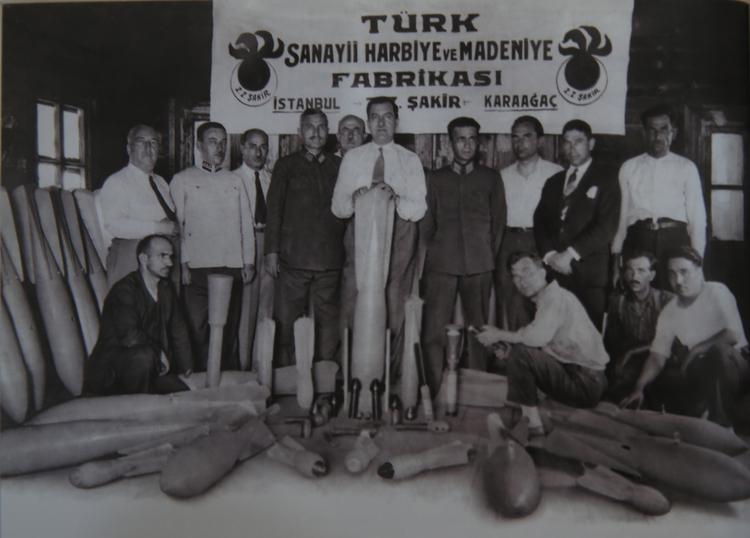
Şakir Zümre and Aircraft Bombs Produced at His Factory (Anadolu Agency)
The factory’s production activities covered a broad range of military ammunition. Aircraft bombs of various weights were manufactured, ranging from 1 kilogram to 900 kilograms. In addition to aircraft bombs, hand grenades for ground forces were produced. The Turkish Navy’s first submarine depth charges were also manufactured in this factory. Furthermore, firearms and ammunition of various calibers were produced, and weapons and ammunition sets were delivered to both ground and naval forces. Mines and other types of ammunition were also included in the factory’s production list.
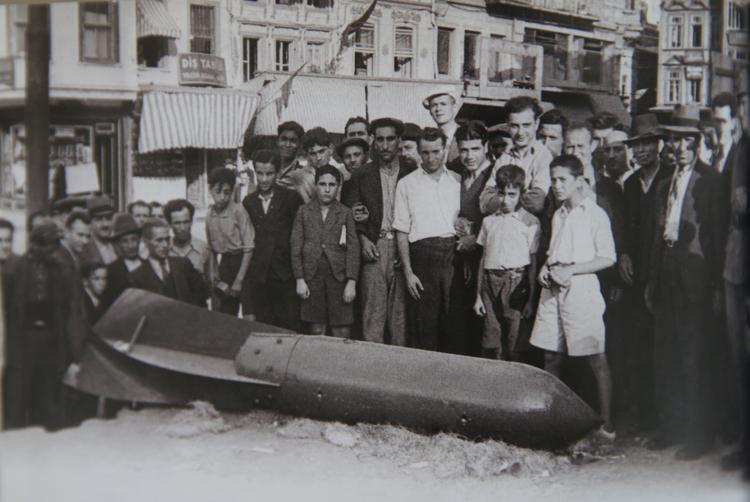
Aircraft Bomb Exhibited at Eminönü Square by the Society for Protection from Air Attacks (Anadolu Agency)
In addition to military production, civil production activities were also carried out; notably, stove manufacturing became widespread and became known as “Şakir Zümre stoves.” Metal piggy banks for Türkiye İş Bankası were also produced at this facility. The Turkish Air Force’s first bombing bombs and the Turkish Navy’s first submarine depth charges were manufactured in this factory.
The factory produced goods to meet the needs of the Turkish Army, Navy, and Air Force. Aircraft bombs, hand grenades, submarine bombs, firearms, and various types of ammunition were delivered to the armed forces. International sales included Greece, Bulgaria, Poland, and Egypt. Aircraft bombs and other types of ammunition were exported to these countries. In 1937, an agreement worth 1.5 million Turkish Liras was signed with Greece for bomb sales.
During the Second World War, Şakir Zümre bombs produced in Türkiye were mentioned alongside aircraft manufactured by Nuri Demirağ. It is reported that technical knowledge for aircraft production was obtained from the German Junkers company and that these bombs were used alongside the aircraft against German forces. Through these production and export activities, the factory operated as a facility serving a broad geographic area within Türkiye’s defense sector.
Approximately 2,000 workers were employed at the factory. Of these, 40 were women who worked in laboratory units, planing machines, and lathes.
A ship was used for raw material procurement, bringing coke coal and steel from Karabük and Zonguldak. Steel was used in manufacturing bomb casings and other ammunition components; coke coal was used in casting and heat treatment processes. Regular testing activities were conducted for the produced bombs and ammunition. Testing of aircraft bombs was carried out in designated areas around Istanbul, including the Hasdal region. Bombs were tested by being dropped from aircraft.
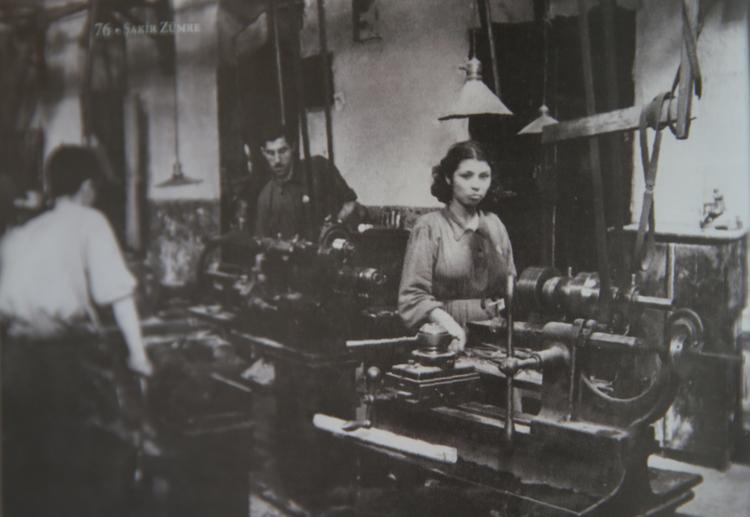
Workers Operating Lathes at Şakir Zümre Factory (Anadolu Agency)
Testing with Junkers aircraft imported to Türkiye after the Second World War was conducted alongside tests with locally produced aircraft from the pre-war period.
The factory’s production units consisted of administrative offices, laboratories, foundries, machining workshops, and assembly lines. Steel and other metal materials were processed through these units to produce final products.
The workforce comprised engineers, master craftsmen, lathe and planing operators, foundry workers, laboratory staff, and support personnel. Female workers were particularly employed in laboratory and precision metalworking sections.
During the Second World War, Şakir Zümre Factory continued and expanded its production activities. The factory’s production range broadened, encompassing various types of ammunition, bombs, and firearms. Despite Türkiye’s neutral stance in the war, various weights of aircraft bombs, hand grenades, submarine bombs, and other ammunition were manufactured to strengthen military preparedness. This period marked the years of intensive utilization of the factory’s production capacity.
During the same period, the factory continued civil production; manufacturing of stoves and other metal goods persisted. However, due to wartime conditions, military production formed the core of the factory’s activities.
The first bombs used by the Turkish Air Force were manufactured at Şakir Zümre Factory. Production covered bombs of various weights ranging from 1 kilogram to 900 kilograms. The manufactured bombs were tested by being dropped from aircraft and then delivered to the air force. It is noted that these tests were conducted in designated aircraft testing areas around Istanbul. These bombs were among the first domestically produced heavy ammunition used by the Turkish Air Force.
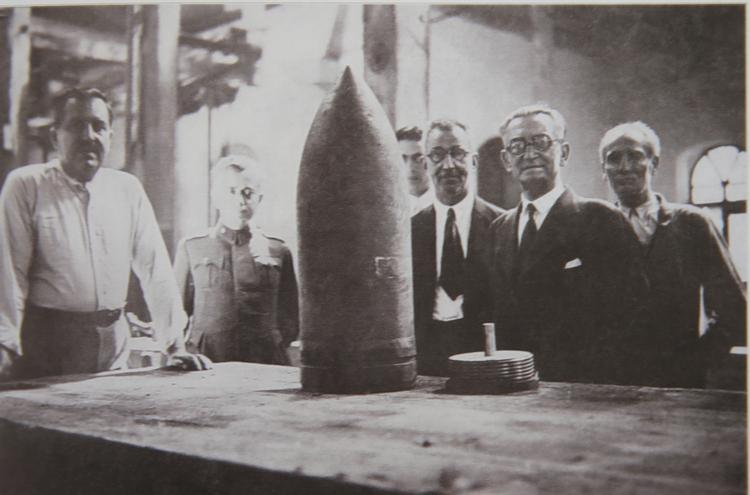
Şakir Zümre Factory with Customers (Anadolu Agency)
The Turkish Navy’s first submarine depth charges were also manufactured by Şakir Zümre Factory. These depth charges were produced to counter submarine threats and delivered to the Turkish Navy. The production process included manufacturing steel casings, filling operations, cap assembly, and field testing. These bombs were among the first naval ammunition produced by the private sector in Türkiye.
It is reported that bombs produced by Şakir Zümre were used in conjunction with some German-made aircraft that arrived in Türkiye after the Second World War. It is stated that Junkers-type aircraft produced in Germany were used in bomb testing conducted in Türkiye.
Additionally, it is noted that technical knowledge for the aircraft produced during the war was obtained from the German Junkers company and that Şakir Zümre bombs were used alongside these aircraft against German forces.
After the Second World War, Türkiye became part of the Marshall Plan and received various economic and military assistance under this program. Defense materials, heavy industrial products, and military equipment were delivered to Türkiye and utilized in post-war reconstruction efforts. The flow of Marshall aid affected the sustainability of Türkiye’s domestically based defense industry.
In addition to Marshall aid, the United States sent free or low-cost arms and ammunition to Türkiye. These shipments included various types of military equipment, and American-made arms and ammunition systems became widely integrated into the inventory of the Turkish Armed Forces. Due to the very low cost or complete lack of payment for this equipment, the share of foreign-sourced products in Türkiye’s military supply increased significantly. As a result, demand for domestic production declined substantially.
Due to the influx of free or low-cost ammunition and arms from the United States, the Turkish Armed Forces’ need for domestic production decreased, and orders for Şakir Zümre Factory dropped. In some ammunition categories, orders ceased entirely, directly affecting the factory’s military production capacity.
With the decline in orders, the factory’s production capacity became idle. Although military production remained technically feasible, it was no longer economically viable. This situation necessitated a change in the factory’s production profile.
After military production ceased, Şakir Zümre Factory redirected its activities toward civil production. Among its most well-known civil products was stove manufacturing. The stoves achieved wide distribution and became known in public opinion as “Şakir Zümre stoves.”
In addition to stove production, agricultural tools and various metal goods were added to the factory’s product line. This transition was an adaptation to sustain operations after the end of its military production role.
During this period, the factory’s production focus shifted from military to civilian products, and the economic structure based on military production became unsustainable due to changing external supply conditions in the NATO era.
After the end of military production, Şakir Zümre Factory redirected its activities toward the civilian sector. As a result, one of its most well-known products became stove manufacturing. The stoves produced were widely marketed and became known in public opinion as “Şakir Zümre stoves.”
The factory’s existing metalworking capacity was utilized for stove production. Existing machinery, foundries, steel processing units, and assembly lines were adapted for civilian product manufacturing; stove bodies, chimney connectors, grates, and other metal components were processed on these lines.
This production line offered a product profile suited to the economic conditions of the post-war period and enabled the factory to sustain its civilian operations.
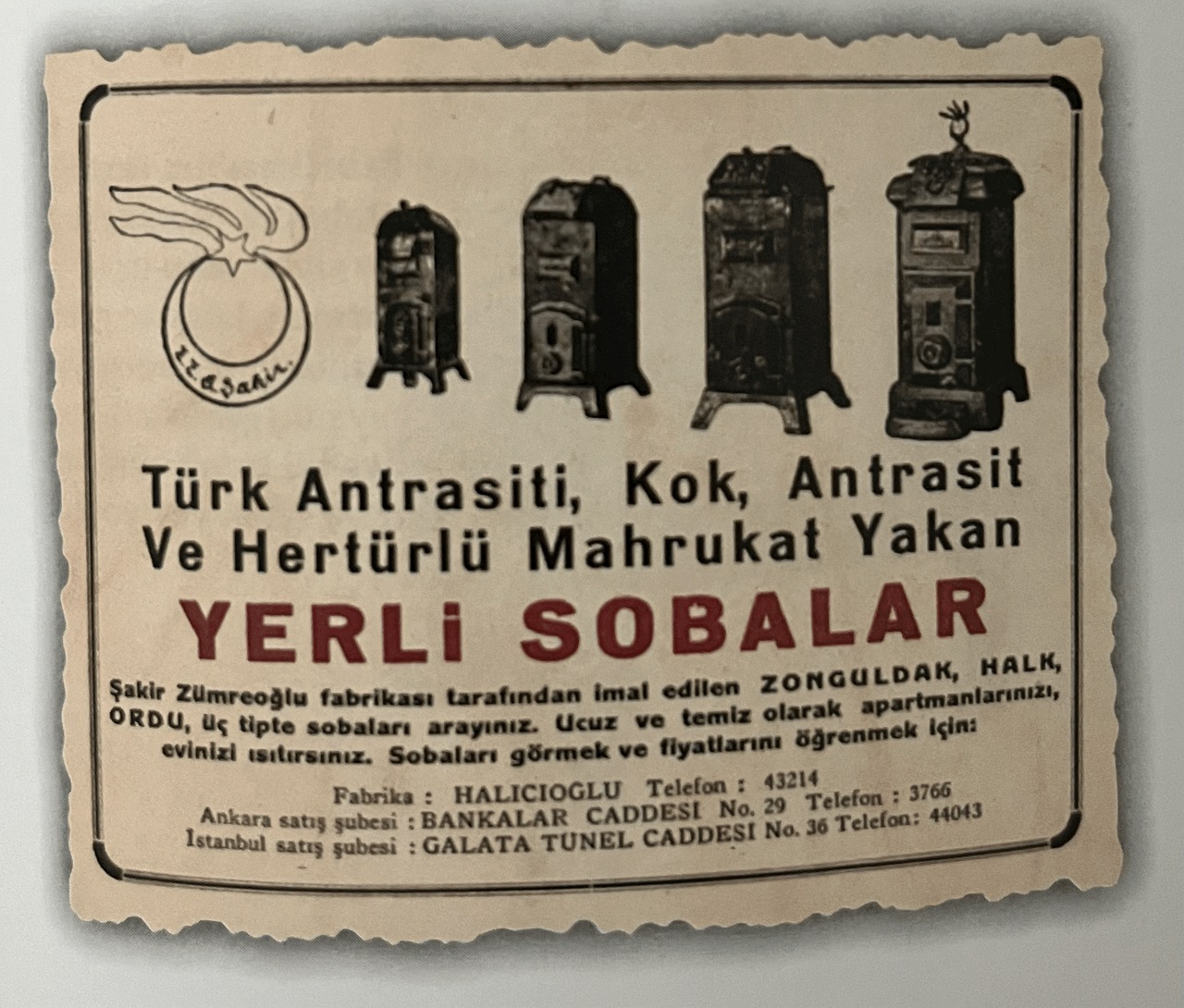
Advertisement Promoting Şakir Zümre Stoves (Atilla Oral Archive)
Another product group in the civil production range was metal piggy banks manufactured for Türkiye İş Bankası. These piggy banks were produced using the factory’s metal cutting, shaping, pressing, and assembly capacities; lock mechanism assembly was also part of the production process. This piggy bank production is one of the examples of the factory’s serial metal manufacturing activities in the post-war period.
With the changing economic and military conditions after the war, Şakir Zümre Factory completely shifted its production profile from military ammunition to civilian production. In this framework, the factory continued its operations by manufacturing stoves, agricultural tools, various household metal goods, and piggy banks for banks.
As part of this transition, the factory’s machinery was reconfigured; machining tools, foundry units, and assembly lines were adapted to meet the technical requirements of civilian production.
This production shift constituted the final phase of the factory’s operations before closure; the product range was expanded, and metal goods were offered to diverse customer groups. The workforce was also reorganized to operate on civilian production lines.
Regarding Şakir Zümre’s response to the decline in the defense industry, his grandson recounted a related behavior during Republic Day parades. According to the account, after the United States began sending free or low-cost ammunition to Türkiye during the NATO era and domestic production ceased, Şakir Zümre was seen walking in these parades wearing a black suit. This behavior is described as a personal protest against the end of domestic defense production.
Although specific details regarding where and in which years this occurred are unavailable, the narrative links this behavior directly to the interruption of domestic defense production.
After Türkiye joined NATO, the United States began sending free or low-cost ammunition and arms, leading to the cessation of military production at Şakir Zümre’s factory. During this period, Şakir Zümre is reported to have felt sorrow over the halt of domestic production. It is stated that this change in production negatively affected him and caused a loss of morale.
It is also noted that the factory ceased military production in 1952–1953 and shifted to stove manufacturing, with the reason cited being the free ammunition sent by the United States to Türkiye.
Şakir Zümre lived for a period in an apartment in Istanbul’s Nişantaşı district with his wife Zeliha Zümre and daughter Remziye. His grandson Ahmet Hüsnü Humbaracıbaşı stated that he spent his childhood in this apartment and lived there with his grandmother and grandfather.
Regarding family structure, it is stated that Remziye was Şakir Zümre’s only child and Ahmet Hüsnü Humbaracıbaşı his only grandson. Thus, Şakir Zümre’s immediate family consisted of his wife Zeliha, daughter Remziye, and grandson Ahmet Hüsnü.
After Zeliha Zümre’s death in 1947, Şakir Zümre moved from the Nişantaşı apartment to a mansion located behind the factory. Ahmet Hüsnü Humbaracıbaşı recounts that after this move, his grandfather took him to live with him when he was 10 or 11 years old.
The mansion, described as the residence Şakir Zümre moved into, was located behind the factory. Humbaracıbaşı recalls that during his grandfather’s time there, there was a pier on the shore, from which they traveled by boat and went to Eyüp Sultan Mosque for Friday prayers.
Şakir Zümre passed away on 16 June 1966. After his death, the factory continued operations for a period. By 1970, the factory had been permanently closed. Before closure, various plans were made regarding the future of the land occupied by the factory as part of the Haliç region’s redevelopment; during this period, a study on modernizing M48 tanks was conducted at the facility, but it was never completed. Subsequently, the factory was definitively closed.
The factory established by Şakir Zümre holds the distinction of being the first facility in Türkiye to produce military equipment using private capital. From 1925 onward, it manufactured aircraft bombs, submarine depth charges, hand grenades, mines, and various types of ammunition, all of which were supplied to the Turkish Army, Navy, and Air Force.
The factory’s production capacity was not limited to Türkiye; ammunition exports were also carried out to countries such as Bulgaria, Greece, Poland, and Egypt.
These production activities constituted a significant step in the development of Türkiye’s defense industry during the early Republic period and represented the first large-scale example of ammunition manufacturing undertaken by the private sector.
Accessed November 26, 2025.
Accessed November 26, 2025.
Accessed November 26, 2025.
Accessed November 26, 2025.
Accessed November 26, 2025.
Accessed November 26, 2025.
Anadolu Ajansı. "Savunma Sanayi Öncüsü Şakir Zümre’nin Torunundan İHA/SİHA’ya ‘Muhteşem’ Yorumu." Accessed December 2, 2025.
Anadolu Ajansı. "Şakir Zümre’nin Türkiye Yüzyılında Hatırlanması Ailesini Gururlandırdı." Accessed December 2, 2025.
Boz, Murat. "Savunma Sanayiinin Yerlileşmesinin Türkiye’nin Ekonomi Güvenliğine Etkileri." Accessed December 2, 2025.
Demir, İsmail. "Transformation of the Turkish Defense Industry: The Story and Rationale of the Great Rise." Insight Turkey 22, no. 3 (2020): 17–40. Accessed December 2, 2025.
Ermiş, Uğur. "1919–1947 ve 1985–2004 Dönemlerinde Türk Savunma Sanayii Kurma Girişimlerinin Karşılaştırmalı Analizi." KAÜİİBFD 14, no. 27 (2023): 438–460. Accessed December 2, 2025.
Kolsuz, Kürşat. "II. Dünya Harbi Arifesinde Türkiye’nin Hava Harp Politikaları." Akademik Tarih ve Araştırmalar Dergisi 3, no. 2 (2020): 30–46. Accessed December 2, 2025.
Kurt, Enes, and Yasin Şehitoğlu. "Erken Cumhuriyet Dönemi Türk Savunma Sanayi Fabrikaları (1923–1950)." Yıldız Sosyal Bilimler Enstitüsü Dergisi 7, no. 1 (August 2023): 39–48. Accessed December 2, 2025.
Kurt, Enes, and Yasin Şehitoğlu. "The Transformation of the Turkish Defence Industry from the Time of the Ottoman Empire to the Republic of Turkey, 1834–1950." Revista de Historia Industrial 31, no. 86 (2022): 143–174. Accessed December 2, 2025.
Oral, Atilla. Şakir Zümre. İstanbul: Demkar Yayınevi, 2012.
Toprak, Serap. "Türk–Yunan Siyasi İlişkileri Çerçevesinde Batı Trakya Sorunu." Bitlis Eren Üniversitesi Sosyal Bilimler Dergisi 3, no. 1 (June 2014): 43–54. Accessed December 2, 2025.
Yalçın, Osman. "1911–1945 Yılları Arasında Türk Hava Harp Sanayisi." In On İkinci Askerî Tarih Sempozyumu Bildirileri – II (Sunulmayan Bildiriler): Kuruluşundan Günümüze Türk Ordusu (20–22 Mayıs 2009 – İstanbul), 181–203. Ankara: T.C. Genelkurmay Başkanlığı, 2010. Accessed December 2, 2025.
Yalçın, Osman. "Cumhuriyet Dönemi Türk Hava Harp Sanayinde Devlet Girişimleri." Demokrasi Platformu 12, no. 38 (2023): 86–134. Accessed December 2, 2025.
Yalçın, Osman. "Cumhuriyet Dönemi Türk Hava Harp Sanayinde Özel Girişimleri." Demokrasi Platformu 13, no. 40 (2024): 76–123. Accessed December 2, 2025.
Yılmaz, Tuğrul Oğuzhan. "Türkiye–Afrika İlişkilerinin Güvenlik Boyutu: Türk Savunma Sanayii ve Afrika." Türk Dünyası Araştırmaları 120, no. 237 (December 2018): 41–66. Accessed December 2, 2025.
Öztürk, Hüsamettin Taha. "Türk Savunma Sanayisinde Ar-Ge ve Yenilik Sistemleri." Selçuk Üniversitesi Sosyal ve Teknik Araştırmalar Dergisi 20 (2022): 129–137. Accessed December 2, 2025.

Şakir Zümre (Atilla Oral Arşivi)
Henüz Tartışma Girilmemiştir
"Şakir Zümre" maddesi için tartışma başlatın
Family Origins, Birth and Educational Life
Years in Varna
High School and Law Studies in Geneva
Professional Activities and Political Life in Bulgaria
Lawyer Period
Commercial Activities on the Bulgaria-Romania Border
Turkish Representation in the Bulgarian Parliament
Meeting and Relationship with Mustafa Kemal
Connection Established Through Fevzi Çakmak
Years in Sofia and Friendship
Contributions to Arms and Ammunition Production in the Balkans
Relationships with Workshops in Bulgaria and Macedonia
Support in Labor, Finance and Logistics
Contributions to the War of Independence and the Independence Medal
Invitation to Türkiye and Settlement in Istanbul (1923)
Atatürk’s Invitation
Allocation of the Ottoman Tapa Factory
Türkiye’s First Private Military Factory (1925)
Establishment of the Factory
Production Profile
Domestic and International Sales
Workforce and Operational Structure
Activities During the Second World War
Production During the War
Türkiye’s First Air Force Bombs
Türkiye’s First Submarine Depth Charges
Use with German Aircraft
NATO Era and Cessation of Production
Marshall Aid
US Free or Low-Cost Arms and Ammunition Shipments
Decline of Domestic Production
Shift to Stove and Agricultural Tool Production
Civil Production Process
“Şakir Zümre Stoves”
Türkiye İş Bankası Piggy Bank Production
Post-War Production Shift
Reactions to the Decline in Defense Industry
Protest March During Republic Day
Attitude Toward the Interruption of Domestic Production
Family Life
Life in Nişantaşı
Move to the Mansion and Family Structure
Death, Factory Closure, and Legacy
Death in 1966 and Factory Closure in 1970
Historical Place in Türkiye’s Defense Industry