


Bu içerik Türkçe olarak yazılmış olup yapay zeka ile otomatik olarak İngilizceye çevrilmiştir.
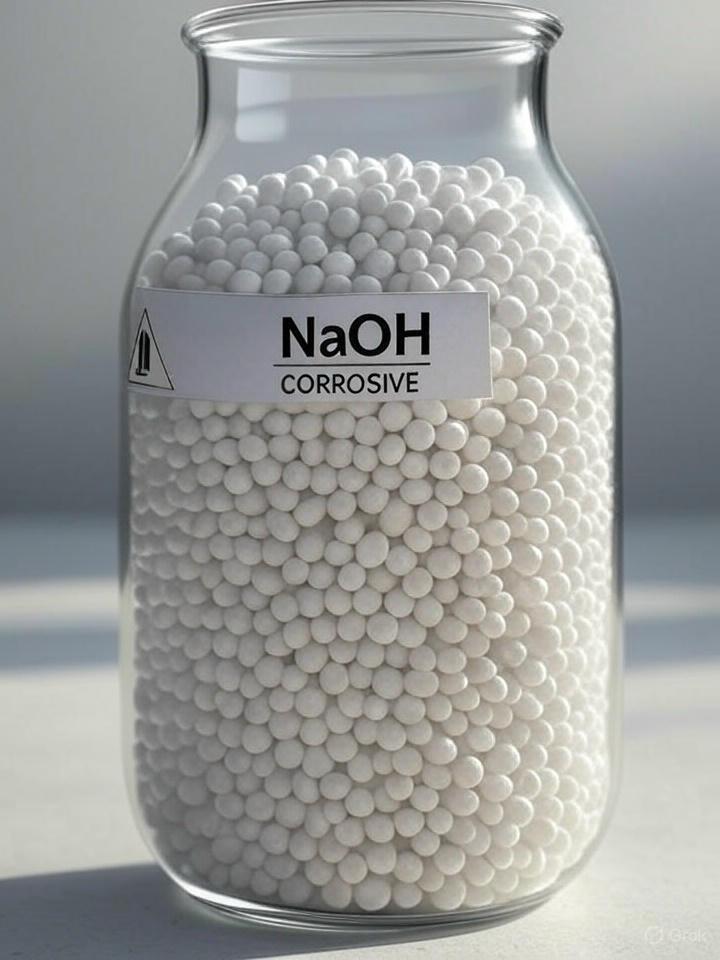
Sodium Hydroxide (NaOH)
Chemical Formula | NaOH | ||||||||
|---|---|---|---|---|---|---|---|---|---|
Other Name(s) | Lye Soda lye Caustic soda | ||||||||
Molecular Weight | 40.00 g/mol | ||||||||
Appearance | White, odorless, hygroscopic solid | ||||||||
pH Value | ~14 (Strong base) | ||||||||
Type(s) | Base (Strong base) | ||||||||
Structure(s) | Crystalline structure | ||||||||
Melting Point | 318 °C | ||||||||
Boiling Point | 1388 °C | ||||||||
Density | 2.13 g/cm³ | ||||||||
Area(s) of Use | Household cleaning products Food processing Petroleum refining and textile processes Water treatment Paper and pulp industry Chemical industry | ||||||||
Sodium hydroxide (NaOH) is an inorganic base that is white odorless dense and corrosive composed of a sodium cation (Na⁺) and a hydroxide anion (OH⁻). In solid form it is commonly found as pellets flakes or granules. It fully ionizes in water exhibiting strong basic properties and is therefore widely used in the preparation of alkaline solutions. Due to its extensive use across various industrial sectors it is also commonly referred to as "caustic soda" or "liquid alkali".
Historically sodium hydroxide was obtained indirectly through the refinement of ash solutions used in processes such as soap production. Modern industrial production of NaOH began in the 19th century with the development of new methods. One of the earliest industrial processes the Lebeau-Claus method is based on the reaction between sodium carbonate and calcium hydroxide. However today the most common method is chlor-alkali electrolysis which directly produces sodium hydroxide hydrogen and chlorine gases from brine. This process is one of the foundational pillars of large-scale chemical industry due to its high energy intensity and significant economic contribution.
Sodium hydroxide is a white crystalline solid at room temperature. Its molecular mass is 40.00 g/mol. Its melting point is approximately 318 °C and its boiling point is 1388 °C. Its density is 2.13 g/cm³. When dissolved in water it undergoes an exothermic reaction and fully ionizes rapidly increasing the temperature of the solution. The following equation describes this dissolution:
This ionization rapidly increases the pH of the solution making it highly alkaline (pH ≈ 14). The highly electrically conductive sodium hydroxide solution is commonly used as a standard solution in acid-base titrations. It is also hygroscopic meaning it absorbs moisture from the air and may gradually liquefy over time. It reacts with carbon dioxide (CO₂) to form sodium carbonate (Na₂CO₃) and therefore prolonged exposure to air is not recommended. Furthermore it participates in reactions with many organic and inorganic substances serving as a key component in chemical processes such as saponification neutralization and hydrolysis.
Industrially sodium hydroxide is produced by the electrolysis of a sodium chloride (NaCl) solution. In this process brine is electrolyzed to produce chlorine gas (Cl₂) hydrogen gas (H₂) and a sodium hydroxide solution. The reaction is as follows:
This process can be carried out using three different cell types: mercury cell diaphragm cell and membrane cell systems. In recent years mercury-based methods have been largely abandoned due to environmental concerns and membrane cell technology which is safer and more efficient has become dominant.
Sodium hydroxide (NaOH) does not occur naturally and has corrosive and toxic effects on biological systems. Contact with skin can cause chemical burns and splashes to the eyes can result in permanent damage. Inhalation may lead to severe irritation edema and lung injury. Therefore personal protective equipment must always be used during handling.
When released uncontrolled into the environment NaOH can disrupt the pH balance of soil and water systems. In aquatic ecosystems high pH levels can be lethal to fish and other aquatic organisms. Excessive alkalinity can cause dissolved minerals to precipitate and reduce biodiversity. Additionally accumulation of sodium ions in soil can degrade soil structure and negatively affect agricultural productivity. Therefore waste containing sodium hydroxide must be neutralized in accordance with environmental regulations before disposal.
ChEBI. "Sodium hydroxide." Chemical Entities of Biological Interest European Bioinformatics Institute. Accessed July 7, 2025. https://www.ebi.ac.uk/chebi/searchId.do?chebiId=CHEBI:32145
National Center for Biotechnology Information. “Sodium Hydroxide.” *PubChem Compound Summary for CID 14798.* Accessed June 25, 2025. https://pubchem.ncbi.nlm.nih.gov/compound/Sodium-hydroxide
National Institute of Standards and Technology. "Sodium Hydroxide." *NIST Chemistry WebBook.* Accessed July 7, 2025. https://webbook.nist.gov/cgi/cbook.cgi?Formula=NaOH&NoIon=on&Units=SI

Sodium Hydroxide (NaOH)
Chemical Formula | NaOH | ||||||||
|---|---|---|---|---|---|---|---|---|---|
Other Name(s) | Lye Soda lye Caustic soda | ||||||||
Molecular Weight | 40.00 g/mol | ||||||||
Appearance | White, odorless, hygroscopic solid | ||||||||
pH Value | ~14 (Strong base) | ||||||||
Type(s) | Base (Strong base) | ||||||||
Structure(s) | Crystalline structure | ||||||||
Melting Point | 318 °C | ||||||||
Boiling Point | 1388 °C | ||||||||
Density | 2.13 g/cm³ | ||||||||
Area(s) of Use | Household cleaning products Food processing Petroleum refining and textile processes Water treatment Paper and pulp industry Chemical industry | ||||||||
Henüz Tartışma Girilmemiştir
"Sodium Hydroxide (NaOH)" maddesi için tartışma başlatın
History
Physical and Chemical Properties
Production Process
Applications
Biological Role and Effects
Environmental Impact