

Bu içerik Türkçe olarak yazılmış olup yapay zeka ile otomatik olarak İngilizceye çevrilmiştir.
+1 Daha
Yıldız Çini ve Porselen Fabrikası is a porcelain manufacturing facility established within the gardens of Yıldız Sarayı as part of the Ottoman Empire’s industrialization efforts initiated by Sultan Abdülhamid II (1876–1909). Commencing production in 1894, the factory operated to meet the porcelain needs of the Ottoman palaces, serving as a counterpart to European court porcelain manufactories such as Sèvres, and aiming to introduce Ottoman porcelain art and the sultan’s identity to the world.

Yıldız Porselen Fabrikası (Republic of Türkiye, Istanbul Governorship)
Preparations for the factory began in the early 1890s and it was officially operational by 1894. Although various accounts exist regarding its establishment, it is generally accepted that the factory was founded under the sultan’s initiative, modeled after the Sèvres Factory in France. Administratively and financially, the factory was subordinate to the Hazine-i Hassa Nezareti, with its expenses covered by revenues from the Emlâk-ı Hümâyûn İdaresi.
The original building suffered damage during the 1894 Istanbul earthquake and was subsequently rebuilt the same year by Italian architect Raimondo d’Aronco. The factory’s architecture constitutes an original example among industrial structures of its period.
The administrative structure comprised a nazır, a dâhiliye müdürü, a müdür muavini, and a muhasebeci. Technical staff included ustabaşılar, ressamlar, kalıpçılar, çamurcular, tornacılar, and fırıncılar. A significant portion of the technical workforce consisted of experts brought from France, who trained local employees in porcelain production techniques, thereby enabling the factory to also fulfill an educational function.
Local raw materials were prioritized in production, although certain essential materials and kilns were imported from France. Porcelain items were shaped from a paste composed of kaolin, quartz, and feldspar, then fired and enriched with decorative embellishments to complete production.

Yıldız Porselen Fabrikası (Republic of Türkiye, Istanbul Governorship)
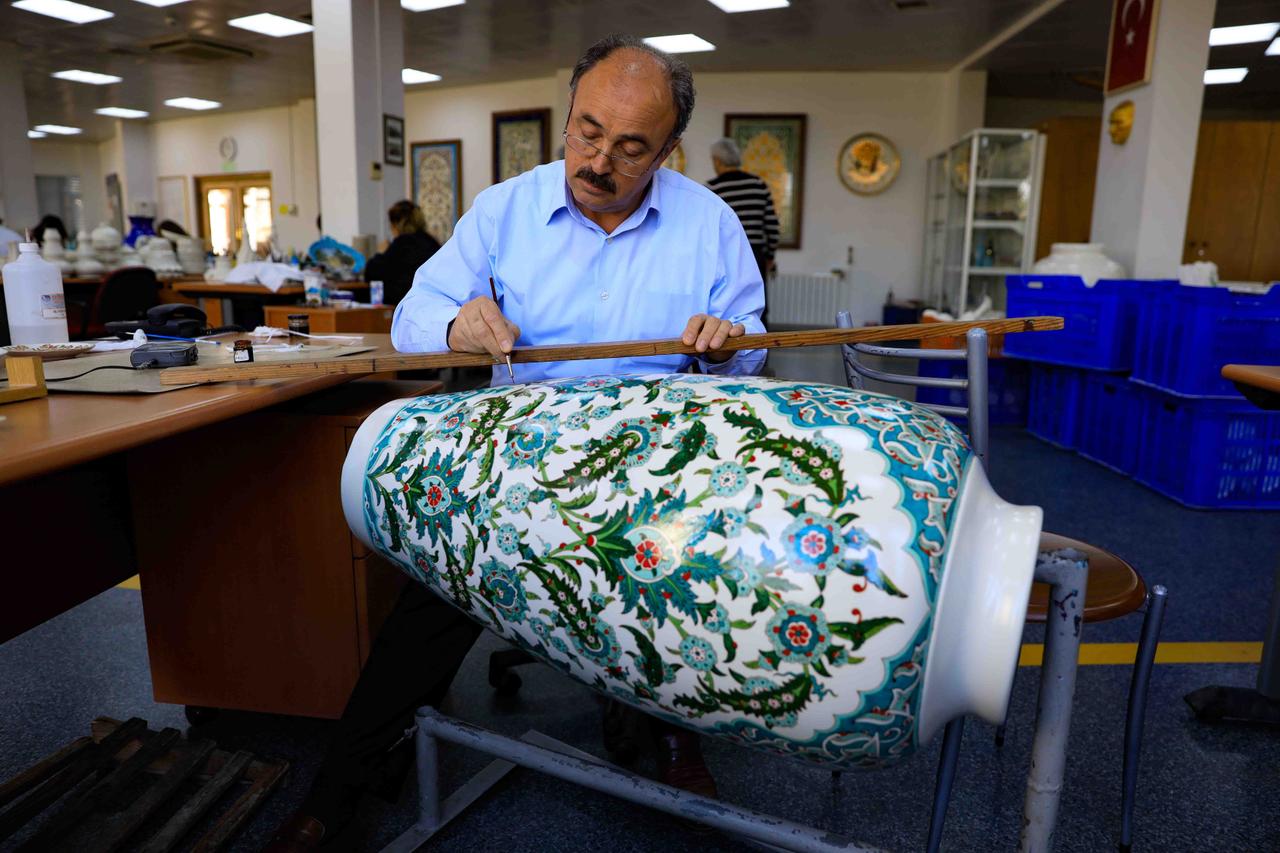
Each product bore the factory’s distinctive crescent and star emblem, beneath which the year of the factory’s founding and the item’s production date were inscribed. This marking system mirrored the dating method used at the Sèvres Factory. Production relied entirely on manual labor, with artists applying naturalistic designs that reflected the architecture and landscapes of the era.
The factory’s product range was extensive, including large decorative vases, plates, cups and coffee sets, writing sets, aşure containers, sugar bowls, and lampshades. These items were supplied for use in palaces and villas and were also sent as gifts to foreign royal houses. Some of the works produced at the factory are now part of the collections at Topkapı Sarayı, Dolmabahçe Sarayı, and Yıldız Sarayı, while others reside in foreign museums and private collections.
The factory’s products were displayed not only within the Ottoman palace but also at international exhibitions. Items were sent to domestic and foreign exhibitions to showcase the Ottoman state’s advancements in industry and art, and were presented to foreign rulers as diplomatic gifts. Through these efforts, the factory assumed the role of promoting Ottoman identity and the prestige of Abdülhamid II on the international stage.
Production ceased in 1909 following the deposition of Abdülhamid II. In 1911, the factory was attached to the Müze-i Hümâyûn İdaresi and reopened, but it was soon closed again due to the First World War. During the early years of the Republic, the factory remained inactive for a long period until it was reopened in 1959 by Sümerbank.
The reopening of the factory was proposed in 1957 and it began operations in 1959 under the management of Sümerbank. During this period, the factory operated under the name “Yıldız Porselen Sanayi Müessesesi,” producing porcelain tableware, decorative items, and wall panels. In 1994, following the privatization of Sümer Holding, it entered a closure process and was transferred in 1995 to the TBMM Millî Saraylar Daire Başkanlığı.
In 2018, the factory was transferred under the authority of the T.C. Cumhurbaşkanlığı Millî Saraylar İdaresi Başkanlığı, in line with the status of similar historical porcelain factories in Europe, and continues production under this administration.
Today, the factory preserves its historical production techniques while also engaging in contemporary design. Replicas of original Ottoman porcelain pieces are produced, and new collections tailored to modern tastes are developed and sold in Millî Saraylar shops. Products such as Topkapı cups, Abdülhamid vases, and Aşiyan bowls are manufactured under their historic names, with designs and decorations enriched by traditional floral motifs and gold gilding.

Yıldız Porselen Fabrikası (Anadolu Agency)
The production process involves specialized personnel in various fields such as hand decoration, modeling, casting, and kiln operation, allowing the factory to maintain its historical continuity and remain one of the rare porcelain facilities preserving its traditional methods.
Anadolu Ajansı. "Türk porselenini 128 yıldır dünyaya tanıtıyor." Accessed August 16, 2025. https://www.aa.com.tr/tr/kultur-sanat/turk-porselenini-128-yildir-dunyaya-tanitiyor-/1404439
Avinal, Sinan. “Yıldız Porselen Fabrikası.” Türkiye Turizm Ansiklopedisi. Accessed August 16, 2025. https://turkiyeturizmansiklopedisi.com/yildiz-porselen-fabrikasi
National Palaces Administration. "Yıldız Çini ve Porselen Fabrikası." Millî Saraylar. Accessed August 16, 2025. https://www.millisaraylar.gov.tr/Lokasyon/18/Yildiz-Cini-ve-Porselen-Fabrikasi
Serin, Sinem. *Yıldız Çini/Porselen Fabrikası*. Master's thesis, İstanbul Üniversitesi, Sosyal Bilimler Enstitüsü, Tarih Anabilim Dalı, 2009. Accessed August 16, 2025. https://nek.istanbul.edu.tr/ekos/TEZ/45146.pdf.
T.C. Bayrampaşa District Governorship. "Yıldız Çini ve Porselen Fabrikası’nda Her Ürün Bir Sanat Eseri." Accessed August 16, 2025. http://www.bayrampasa.gov.tr/yildiz-cini-ve-porselen-fabrikasi-nda-her-urun-bir-sanat-eseri
T.C. İstanbul Valiliği. “Yıldız Çini ve Porselen Fabrikasında Her Ürün Bir Sanat Eseri.” Accessed August 16, 2025. http://www.istanbul.gov.tr/yildiz-cini-ve-porselen-fabrikasinda-her-urun-bir-sanat-eseri

Henüz Tartışma Girilmemiştir
"Star Ceramic and Porcelain Factory" maddesi için tartışma başlatın
Foundation and Construction
Administration and Personnel
Production Techniques
Products and Uses
Promotion and Exhibitions
Post-Abdülhamid and Closure Process
Republican Era
Current Status