


Bu içerik Türkçe olarak yazılmış olup yapay zeka ile otomatik olarak İngilizceye çevrilmiştir.
Truman Show Delusion is a psychotic disorder characterized by the belief that one’s life is a television program in which everyone around them is an actor and their life is secretly filmed and broadcast. Named after the 1998 film The Truman Show, this delusion offers a clear glimpse into one of the negative effects of the digital age on the human mind.
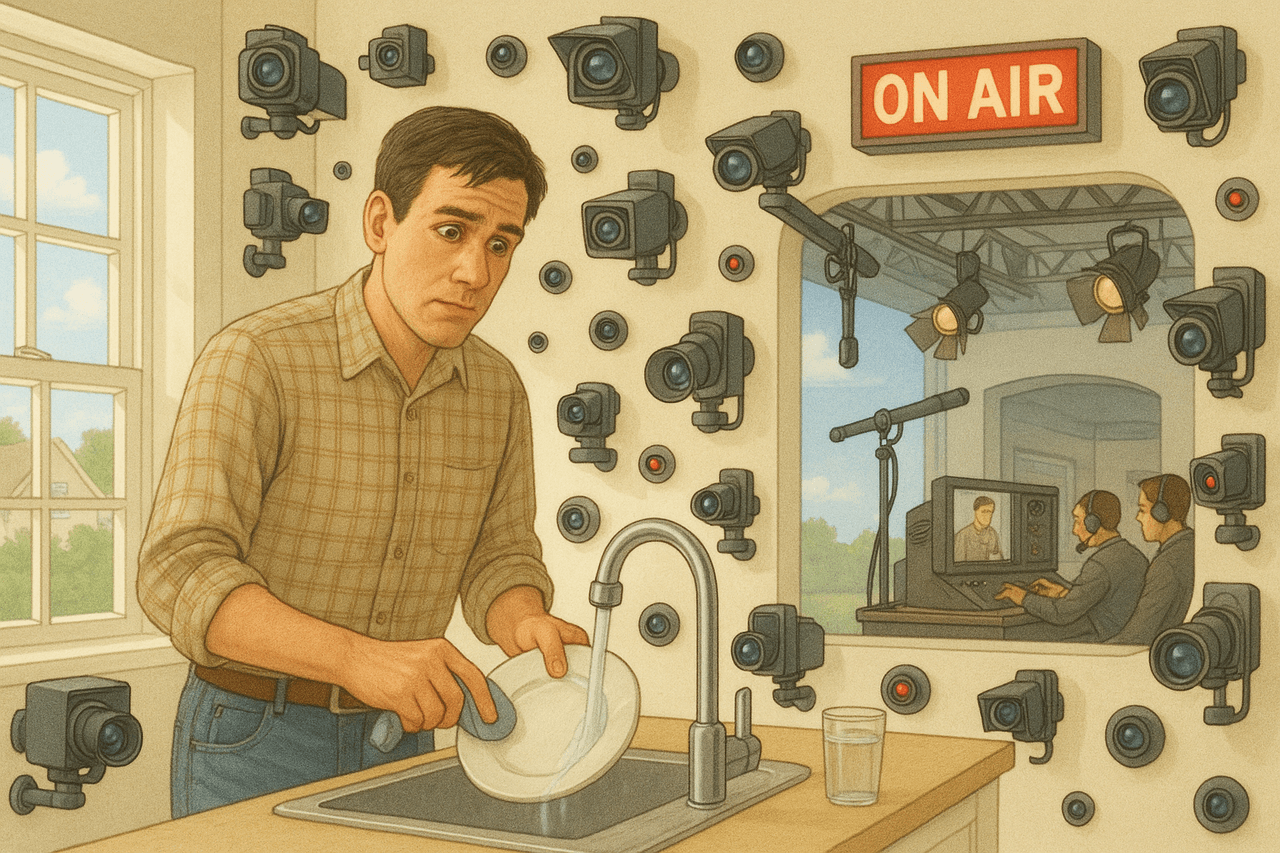
This image was generated with the aid of artificial intelligence.
The Truman Show Delusion presents a rare psychotic structure that dramatically reflects the modern individual’s relationship with identity, reality, and privacy. Named after the 1998 film The Truman Show, this delusion clearly reveals the vulnerabilities created by digitalization in the human mind. Constant interaction with media blurs the boundaries of the self, drawing a curtain between the individual and reality that prevents them from perceiving what is true. At the same time, this delusion also illustrates how various mental illnesses may emerge over time.
Individuals affected by this delusion believe the world is a film set. Like the character in the film The Truman Show, they think every moment of their life is being watched by cameras and broadcast to others. Those afflicted believe their friends, coworkers, and even family members are actors on a set and that their life is directed by a script. This condition is often associated with psychological issues such as extreme paranoia or low self-esteem. Contrary to popular belief, people do not develop this delusion simply after watching the film The Truman Show.
This delusion was named after Jim Carrey’s film The Truman Show, which gave a new label to preexisting fears that everyone is watching or monitoring one’s actions. The formation of this delusion aligns with classical phenomenological psychiatric understanding. Mishara and Fusar-Poli (2013) deepened Jaspers’ phenomenological framework for explaining early psychotic experiences by linking the collapse of an individual’s meaning structures to the concept of “aberrant salience.” Within this theoretical context, the Truman Show Delusion is defined not merely as a cultural reference but as a psychotic structure shaped by biological and neurocognitive mechanisms.
Truman Show (Braincraft).
This delusion, often resulting from excessive television or media consumption, is linked to social media addiction and is frequently accompanied by an isolated lifestyle. Platforms such as television, the internet, and social media can shape people’s perception of reality and hold them in a liminal space between reality and delusion. Individuals who spend excessive time on digital devices such as the internet may lose their sense of reality and struggle to distinguish truth from falsehood. Reality shows and social media phenomena, in particular, can lead people to perceive their own lives as performances and feel compelled to constantly present themselves to an audience. This delusion, therefore, reflects the impact of the digital age on human psychology.
The Truman Delusion may also arise from genetic predisposition. The role of family history becomes particularly notable when evaluated alongside genetically prominent disorders such as narcissistic personality disorder. Individuals with a family history of Truman Delusion or similar behaviors may have a higher likelihood of developing it. However, genetic factors alone are not sufficient to cause the delusion and do not directly trigger its formation.
Because the Truman Delusion typically arises from excessive use of digital devices, it is more commonly observed in individuals who spend little time with family members, fail to form friendships, or are unable to socialize for any reason. In such cases, individuals prefer to spend most of their time online and consequently lose their sense of reality. In particular, the amount of time young children spend on the internet should be monitored by parents, and if excessive, should be limited. Children should also be encouraged to participate in social activities and directed toward diverse pursuits.
Such delusions are primarily evaluated within the framework of schizophrenia spectrum disorders and psychotic disorders, but it is also argued that technological advancements and the culture of digital surveillance contribute to the formation of these thought patterns. Gold (2012) described the Truman Show Delusion as “psychosis in the global village,” noting that such delusions differ from traditional forms of paranoia. It is proposed that modern media, social networks, and the constant state of online presence blur individuals’ perception of reality, thereby intensifying a sense of “excessive self-referentiality” in those prone to Truman Show-like delusions. In the development of this delusion, the pathological link between disturbances in the concept of “self” and the feeling of being observed by others comes to the forefront.
Mishara and Fusar-Poli (2013) associate the Truman Show Delusion with the process of “aberrant salience,” which emerges at the onset of psychotic symptoms. According to this model, dysregulation in dopaminergic systems leads to the attribution of unusual significance to ordinary environmental stimuli. As a result, individuals may perceive neutral events as personally relevant and threatening. This underlies the delusional beliefs seen in the Truman Show Delusion, such as “everyone is watching me” or “my life is a fiction.” Fusar-Poli and colleagues (2008) also demonstrated that “Truman symptoms” can be observed during the prodromal phase in individuals predisposed to psychosis.
Additionally, a case study reported by Ali et al. (2023) described a patient who developed the Truman Show Delusion alongside concurrent delusional parasitosis following amphetamine use, highlighting that pharmacological stimulation of the dopamine system may also trigger this type of delusion. This finding indicates that neurobiological factors can be activated not only endogenously but also through external interventions. Sociocultural factors also play a role in the development of the Truman Show Delusion. In particular, the digital age’s culture of constant observation and sharing can create a foundation for individuals to feel perpetually watched.
In summary, the psychological origins of the Truman Show Delusion exhibit a multidimensional structure. This structure can be explained at biological levels (dopamine system dysfunction, aberrant salience), phenomenological levels (disturbances in selfhood, shifts in reality perception), and sociocultural levels (media influence, surveillance society). The fact that this delusion represents a unique clinical manifestation in modern psychosis necessitates viewing it not merely as a psychiatric symptom but as an indicator reflecting the psychological structure of the age.
The most common symptoms of this syndrome include the belief that every action is being recorded by cameras, heightened anxiety, and attempts to control all behavior as a result. Other symptoms include an inability to trust people around them, even family members. Individuals with these symptoms typically appear tense and withdrawn in daily life. They question reality and struggle to distinguish truth from falsehood. A hallmark feature of this syndrome is the conviction that every event occurring around them is part of a scripted narrative.
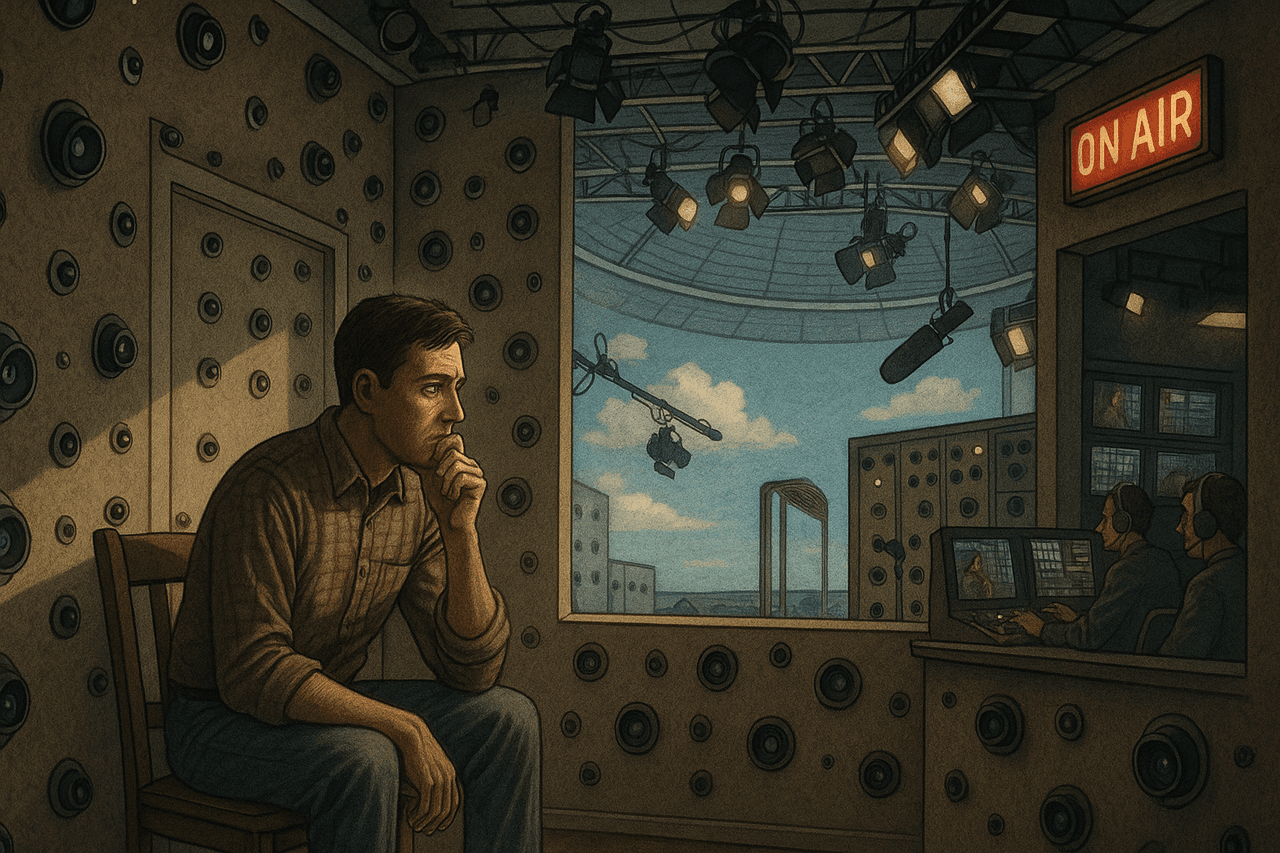
This image was generated with the aid of artificial intelligence.
Advances in clinical literature regarding the treatment of this delusion are promising. Psychotherapeutic approaches are commonly used in treating this syndrome. Sessions are conducted to help the individual recognize and understand the real world. During these sessions, the individual may involve family members or loved ones to reinforce their connection to reality. Additionally, treatment methods aim to reduce dependence on digital devices such as phones and tablets. By distancing themselves from these devices, individuals suffering from this syndrome can overcome it, recognizing that digital addiction may be a contributing factor.
The Truman Syndrome should be viewed not only as an individual psychological condition but also as a reflection of a broader social problem. Re-evaluating, balancing, and critically questioning today’s increasing media consumption habits can help individuals reshape their perception of reality and adopt a healthier lifestyle.
Ali, Z. A., Sanders, B., El-Mallakh, R., Mathews, M., and Brown, S. 2023. "Treatment of Amphetamine-Induced Truman Show Delusion and Delusional Parasitosis with High-Dose Ziprasidone." Harvard Review of Psychiatry 31, no. 4: 202–207.
Braincraft. "The Truman Show Delusion." YouTube Video. Accessed May 8, 2025. https://www.youtube.com/watch?v=DOmQdegW3uk.
DoktorTakvimi. 2023. “Truman Sendromu: Gerçeklikle Sanrı Arasında Bir Yer.” *DoktorTakvimi Blogu*. October 24, 2023. https://www.doktortakvimi.com/blog/truman-sendromu-gerceklikle-sanri-arasinda-bir-yer
Fusar-Poli, P., Howes, O., Valmaggia, L., and McGuire, P. 2008. "‘Truman’ Signs and Vulnerability to Psychosis." The British Journal of Psychiatry 193, no. 2: 168.
Gold, J., and Gold, I. 2012. "The ‘Truman Show’ Delusion: Psychosis in the Global Village." Cognitive Neuropsychiatry 17, no. 6: 455–72.
Mishara, A. L., and Fusar-Poli, P. 2013. "The Phenomenology and Neurobiology of Delusion Formation During Psychosis Onset: Jaspers, Truman Symptoms, and Aberrant Salience." Schizophrenia Bulletin 39, no. 2: 278–86.
What Is the Truman Show Delusion?
Causes of the Truman Delusion
Genetic Factors
Familial and Environmental Factors
Psychological Origins of the Truman Delusion
Symptoms of the Truman Delusion
Treatment of the Truman Delusion
