
This article was automatically translated from the original Turkish version.
+1 More
Name of the Incident | Deepwater Horizon Explosion and Oil Spill | ||||||||
|---|---|---|---|---|---|---|---|---|---|
Date(s) | April 20 2010 2010 – July 15 | ||||||||
Location | Gulf of Mexico approximately 66 km off the coast of Louisiana | ||||||||
Operating Company | British Petroleum (BP) | ||||||||
Platform Owner | Transocean Ltd. | ||||||||
Estimated Spilled Oil Amount | Approximately 4.9 million barrels (780 million liters) | ||||||||
Number of Deaths | 11 (platform workers) | ||||||||
Cleanup Duration | The oil flow was stopped on July 15, 2010, and environmental monitoring and cleanup efforts continued for years. | ||||||||
Deepwater Horizon is a semi-submersible oil drilling platform owned by Transocean and operated by British Petroleum (BP). On 20 April 2010, during drilling operations at the Macondo well in the Gulf of Mexico, a violent explosion occurred, resulting in the destruction of most of the platform and the deaths of 11 workers. In the days following the explosion, uncontrolled leakage of crude oil from the seafloor became the largest marine environmental disaster in history. The leak was not stopped until 87 days later, on 15 July 2010.
According to a technical investigation report published by BP, the primary factors leading to the explosion included inadequate cementing, premature removal of drilling mud, and the failure of the blowout preventer (BOP), an emergency safety valve. The defective cementing allowed natural gas to seep into the well and reach the drilling platform, triggering the explosion. Additionally, it was determined that platform personnel misinterpreted warning signals indicating gas influx and failed to implement necessary evacuation procedures in a timely manner. An official maritime investigation conducted by the Marshall Islands documented significant oversight failures and serious deficiencies in BP’s safety culture, concluding that the disaster was “preventable.”

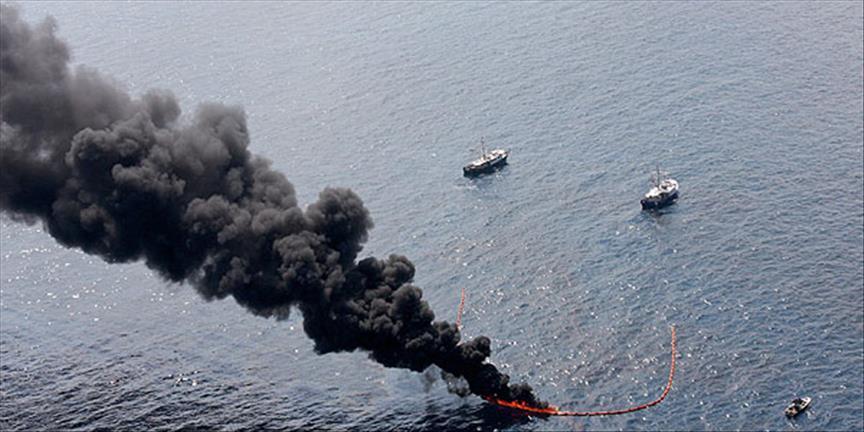
Visual of pollution following the leak. (Anadolu Agency)
As a result of the 87-day leak, approximately 4.9 million barrels of crude oil entered the marine environment, causing lasting damage to marine life. According to NOAA, the Marine Mammal Commission and scientific publications, severe disruptions were observed in the life cycles of numerous species including dolphins, whales, sea turtles and bird populations. Scientific evidence supports that dolphins faced reduced reproductive rates, respiratory illnesses and increased mortality. Furthermore, the majority of deep-sea coral communities died due to toxic hydrocarbons. Wetlands and mangrove areas along the Louisiana coastline, in particular, failed to recover for many years because of the sticky and persistent nature of the oil.
The oil spill did not only harm the environment but also paralyzed the Gulf economy. Major economic losses were suffered by sectors such as fishing, tourism and maritime transport, resulting in the loss of thousands of jobs. Coastal states including Louisiana and Florida reported losses of millions of dollars due to declining tourism and damaged fish stocks. In the aftermath, BP was compelled to pay over 60 billion dollars in compensation, fines and cleanup costs, including a 20.8 billion dollar settlement reached under an investigation by the U.S. Department of Justice.
BP pleaded guilty in a criminal environmental case brought by the U.S. Department of Justice and was fined for charges including environmental pollution, negligence and misleading the public. Senior company executives were required to testify before the U.S. Congress, prompting a comprehensive review of energy policies. Following the disaster, offshore drilling permits in the United States were temporarily suspended and new regulations were introduced to strengthen safety inspections. The incident also reignited international public debate on the unchecked power of energy corporations.

Smoke rising after the explosion. (Anadolu Agency)
After the leak, NOAA, the EPA, various universities and environmental organizations launched long-term ecosystem monitoring programs. Residual oil detected in seafloor and coastal sediments was found to continue exerting toxic effects on biodiversity years later. Certain aromatic hydrocarbons in the oil were shown to damage the DNA of marine organisms. The disaster also exposed the severe inadequacy of response capabilities for oil spills, triggering widespread calls for reform in cleanup methods.
The Deepwater Horizon incident profoundly affected not only the United States but also global understandings of energy security, environmental protection and crisis management. Many countries, including members of the European Union and Canada, tightened their regulations on offshore drilling and environmental oversight. The event has been described as the largest oil spill since the historical Exxon Valdez disaster and has been closely monitored by the media, the scientific community and civil society organizations for years.
AA. "BP Meksika Körfezi’ndeki Sızıntı İçin 1,7 Milyar Dolar Daha Ödeyecek." Accessed August 5, 2025. https://www.aa.com.tr/tr/dunya/bp-meksika-korfezindeki-sizinti-icin-1-7-milyar-dolar-daha-odeyecek-/1032879
BBC Future. “Have We Improved Oil Spill Clean-Ups since BP Deepwater Horizon?” Accessed August 5, 2025. https://www.bbc.com/future/article/20240905-have-we-improved-oil-spill-clean-ups-since-bp-deepwater-horizon
BP. “BP Releases Report on Causes of Gulf of Mexico Tragedy.” Accessed August 5, 2025. https://www.bp.com/en/global/corporate/news-and-insights/press-releases/bp-releases-report-on-causes-of-gulf-of-mexico-tragedy.html
Bloomberg HT. “BP Meksika Körfezi Sızıntısı İçin Rekor Tazminat Ödeyecek.” Accessed August 5, 2025. https://www.bloomberght.com/bp-meksika-korfezi-sizintisi-icin-rekor-tazminat-odeyecek-1810822
EPA. “Deepwater Horizon – BP Gulf of America Oil Spill.” United States Environmental Protection Agency. Accessed August 5, 2025. https://www.epa.gov/enforcement/deepwater-horizon-bp-gulf-america-oil-spill
Ecological House. "Deepwater Horizon Felaketi: Derinlerdeki Kara Belâ." Accessed August 5, 2025. https://www.ekolojikevim.org/post/deepwater-horizon-felaketi-derinlerdeki-kara-bel%C3%A2
IncidentNews (NOAA). “Deepwater Horizon.” Accessed August 5, 2025. https://incidentnews.noaa.gov/incident/8220
MMC. "Gulf of Mexico Deepwater Horizon Oil Spill and Marine Mammals." Marine Mammal Commission. Accessed August 5, 2025. https://www.mmc.gov/priority-topics/offshore-energy-development-and-marine-mammals/gulf-of-mexico-deepwater-horizon-oil-spill-and-marine-mammals/
Mississippi River Delta. "BP Oil Disaster." Accessed August 5, 2025. https://mississippiriverdelta.org/our-coastal-crisis/bp-oil-disaster/
NOAA Ocean Service. "Oil Spills: A Coastal Ocean Tutorial." Accessed August 5, 2025. https://oceanservice.noaa.gov/education/tutorial-coastal/oil-spills/os04-sub-01.html
NOAA. "Deepwater Horizon Oil Spill Case Study." National Oceanic and Atmospheric Administration. Accessed August 5, 2025. https://response.restoration.noaa.gov/deepwater-horizon-oil-spill-case-study
Ocean Portal. "Gulf Oil Spill." Smithsonian Ocean. Accessed August 5, 2025. https://ocean.si.edu/conservation/pollution/gulf-oil-spill
Palacios, David, et al. “Deepwater Horizon Oil Spill: Long-Term Impacts on Dolphins.” National Center for Biotechnology Information (NCBI). Accessed August 5, 2025. https://pmc.ncbi.nlm.nih.gov/articles/PMC5112119/
PopSci Türkiye. "Deepwater Horizon Petrol Sızıntısı Bölgedeki Yunusları Onlarca Yıl Sonra Bile Etkiliyor." Accessed August 5, 2025. https://popsci.com.tr/deepwater-horizon-petrol-sizintisi-bolgedeki-yunuslari-onlarca-yil-sonra-bile-etkiliyor/
Republic of the Marshall Islands. *Marine Casualty Investigation Report: Deepwater Horizon.* Accessed August 5, 2025. https://www.register-iri.com/wp-content/uploads/Republic_of_the_Marshall_Islands_DEEPWATER_HORIZON_Marine_Casualty_Investigation_Report-Low_Resolution.pdf
The New York Times. “Gulf Spill Is the Largest of Its Kind, Scientists Say.” August 3, 2010. Accessed August 5, 2025. https://www.nytimes.com/2010/08/03/us/03spill.html
The Telegraph. “BP Leak: The World’s Worst Accidental Oil Spill.” Accessed August 5, 2025. https://www.telegraph.co.uk/finance/newsbysector/energy/oilandgas/7924009/BP-leak-the-worlds-worst-accidental-oil-spill.html

Name of the Incident | Deepwater Horizon Explosion and Oil Spill | ||||||||
|---|---|---|---|---|---|---|---|---|---|
Date(s) | April 20 2010 2010 – July 15 | ||||||||
Location | Gulf of Mexico approximately 66 km off the coast of Louisiana | ||||||||
Operating Company | British Petroleum (BP) | ||||||||
Platform Owner | Transocean Ltd. | ||||||||
Estimated Spilled Oil Amount | Approximately 4.9 million barrels (780 million liters) | ||||||||
Number of Deaths | 11 (platform workers) | ||||||||
Cleanup Duration | The oil flow was stopped on July 15, 2010, and environmental monitoring and cleanup efforts continued for years. | ||||||||
No Discussion Added Yet
Start discussion for "2010 Deepwater Horizon Disaster" article
Technical Causes of the Explosion
Environmental Impacts
Economic and Social Consequences
Legal and Political Processes
Scientific Research and Long-Term Monitoring
International Repercussions and Legacy