

 Recently Added:
This article was automatically translated from the original Turkish version.
The 46th ASEAN Summit is a high-level diplomatic meeting attended by the leaders of member states of the Association of Southeast Asian Nations (ASEAN), where decisions are made on regional cooperation, global developments, and ASEAN’s future vision. The summit was held on 26–27 May 2025 in Kuala Lumpur, the capital of Malaysia.
46.ASEAN Summit, 26 May 2025 – (Anadolu Ajansı)
The meeting took place at the Kuala Lumpur Convention Centre under Malaysia’s 2025 ASEAN Chairmanship. The summit’s main theme was “Inclusivity and Sustainability.” Under this theme, regional cooperation strategies were discussed to advance resilient, equitable and sustainable development goals among ASEAN countries. The summit aimed to further regional integration within ASEAN and to build common political and economic positions in response to global uncertainties. Leaders from all ten ASEAN member states attended, along with a representative from East Timor in an observer capacity.
The participating leaders included Malaysian Prime Minister Anwar Ibrahim, Vietnamese Prime Minister Pham Minh Chinh, Philippine President Ferdinand Marcos Jr., Indonesian President Prabowo Subianto, Singaporean Prime Minister Lawrence Wong, Thai Prime Minister Paetongtarn Shinawatra, Cambodian Prime Minister Hun Manet, Brunei Sultan Hassanal Bolkiah, Lao Prime Minister Sonexay Siphandone, Myanmar’s Permanent Secretary of the Ministry of Foreign Affairs Aung Kyaw Moe, and East Timorese Prime Minister Xanana Gusmão. ASEAN Secretary-General Dr. Kao Kim Hourn also participated in the summit sessions, offering assessments on the 2025 ASEAN Community-building process and Malaysia’s priorities as chair.
During the summit, two side meetings were also held: the 2nd ASEAN-Gulf Cooperation Council (GCC) Summit and the first ASEAN-GCC-China Trilateral Summit. These meetings were organized in parallel with ASEAN’s goal of deepening its global economic partnerships. At the summit, consensus was reached on the long-term strategic document titled “ASEAN 2045: Our Common Future,” which established a framework for cooperation over the next twenty years in political, economic, socio-cultural and connectivity domains.
Under the theme “Inclusivity and Sustainability,” the summit focused on economic cooperation, regional security and sustainable development among ASEAN countries. Priority agenda items included the impact of customs tariffs imposed by the administration of U.S. President Donald Trump, the ongoing political crisis in Myanmar, and regional tensions in the South China Sea.

46.ASEAN Summit, 26 May 2025 – (Anadolu Ajansı)
One of the key agenda items discussed at the summit was the United States’ planned imposition of new import tariffs ranging from 32% to 49% on six ASEAN member states. This development was viewed as a direct threat to regional economic stability and prompted consultations among ASEAN countries on developing a unified stance. Malaysian Prime Minister Anwar Ibrahim announced that he had sent a letter to U.S. President Donald Trump and proposed holding a new ASEAN-U.S. summit. It was emphasized that such a summit would be critical for shaping the future of trade relations and assessing the regional impact of tariff policies. ASEAN leaders noted that, given the differing conditions among member states, a common position must be developed with due consideration of national circumstances, and consensus was reached on encouraging bilateral negotiations.
The ongoing civil conflict and political crisis in Myanmar following the military coup emerged as another major topic at the summit. Secret meetings held by Malaysian Prime Minister Anwar Ibrahim in his capacity as ASEAN Chair with Myanmar junta leader Min Aung Hlaing in Bangkok, as well as virtual talks with the National Unity Government (NUG), were assessed during summit sessions as “important but fragile steps.”
Before the summit, ASEAN foreign ministers convened special meetings to discuss the Myanmar issue and explored the idea of appointing a permanent ASEAN representative for Myanmar. Additionally, the Malaysian Minister of Foreign Affairs announced plans to make an official visit to Myanmar in June. Myanmar was represented at the summit at the level of its Ministry of Foreign Affairs, while Min Aung Hlaing was not invited due to his failure to comply with ASEAN’s peace plan.
Disputes over maritime jurisdiction in the South China Sea resurfaced, particularly due to China’s activities within the exclusive economic zones of coastal states. Philippine President Ferdinand Marcos Jr. called for accelerated negotiations on a Code of Conduct between ASEAN and China and stressed the importance of a legally binding arrangement. Marcos emphasized the necessity of a legally binding framework to safeguard maritime rights, ensure stability and prevent potential miscalculations. It was noted that technical work on the third round of negotiations between ASEAN and China had been completed and that consensus had been reached on updating the ASEAN-China Free Trade Area.

46.ASEAN Summit opening address by Malaysian Prime Minister Anwar Ibrahim, 26 May 2025 – (Anadolu Ajansı)
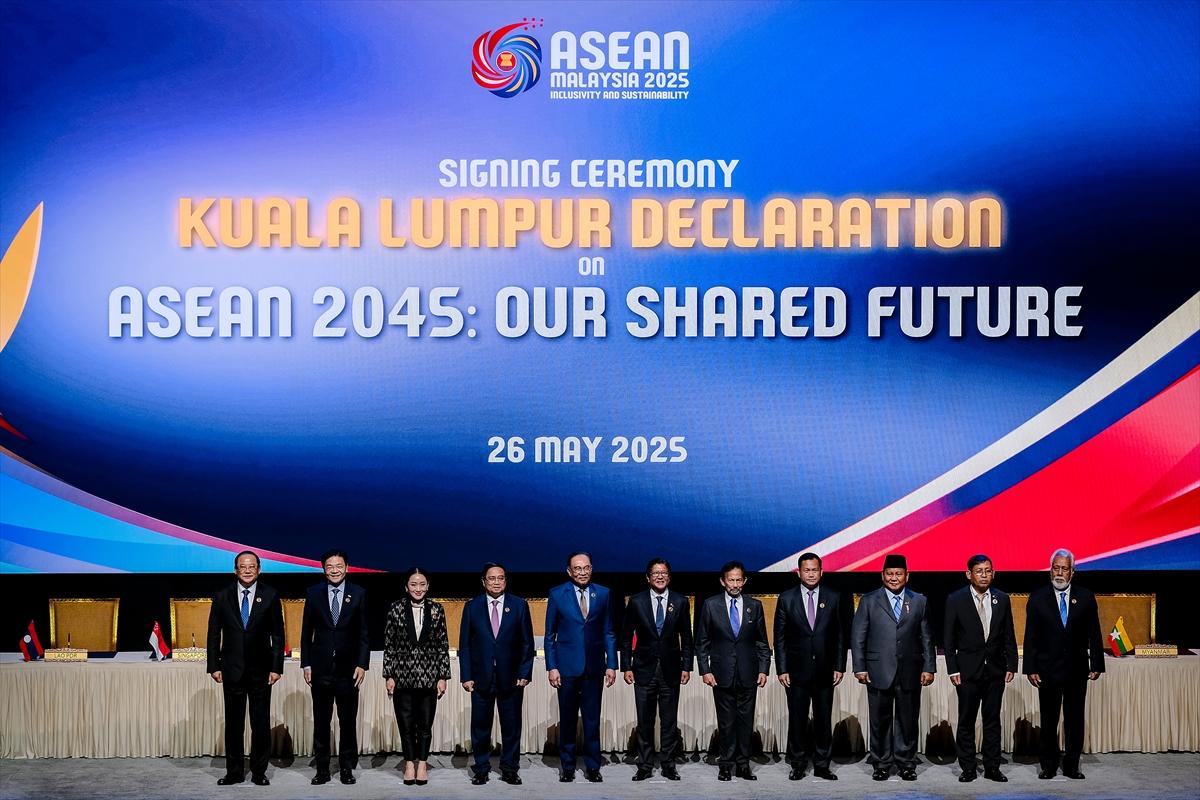
At the summit, the strategic document titled “ASEAN 2045: Our Common Future,” outlining ASEAN’s long-term development goals, was formally adopted. The document establishes integration strategies across four key areas: political-security, economic, socio-cultural and connectivity. The vision goes beyond political declarations by including actionable plans, resource allocation mechanisms, and monitoring and evaluation frameworks. It aims to be integrated into national development plans. Under the Kuala Lumpur Declaration, preparations were also agreed to formalize East Timor’s full membership in ASEAN at the 47th ASEAN Summit.
Leaders from ASEAN member states attended the summit, led by Malaysian Prime Minister Anwar Ibrahim, along with Brunei Sultan Hassanal Bolkiah, Indonesian President Prabowo Subianto, Cambodian Prime Minister Hun Manet, Lao Prime Minister Sonexay Siphandone, Vietnamese Prime Minister Pham Minh Chinh, Philippine President Ferdinand Marcos Jr., Singaporean Prime Minister Lawrence Wong, and Thai Prime Minister Paetongtarn Shinawatra. Myanmar’s Permanent Secretary of the Ministry of Foreign Affairs Aung Kyaw Moe and East Timorese Prime Minister Xanana Gusmão participated as observers.

46.ASEAN Summit participants, 26 May 2025 – (Anadolu Ajansı)
During the 46th ASEAN Summit, the document titled “ASEAN 2045: Our Common Future” was adopted unanimously. It outlines the strategic directions ASEAN will follow until 2045 in the areas of political-security, economic, socio-cultural and connectivity cooperation. The adopted document decided to establish actionable implementation plans, resource allocation mechanisms and monitoring and evaluation structures to achieve long-term integration goals. Agreement was also reached on aligning these strategies with national development plans.
East Timor’s path to full ASEAN membership was also addressed at the summit. ASEAN leaders decided to formally approve Timor-Leste’s accession as the organization’s 11th member at the 47th ASEAN Summit scheduled for October 2025. To this end, authority was granted to relevant ministers and senior officials to negotiate Timor-Leste’s membership documents. Timor-Leste was represented at the summit by Prime Minister Xanana Gusmão.
The summit emphasized deepening regional integration, promoting structural reforms based on sustainable development principles, and strengthening internal connectivity within ASEAN. In line with the theme of inclusivity and sustainability, joint initiatives were discussed on energy security, disaster management, environmental resilience, human rights and climate change. ASEAN leaders underscored that these issues are not only priorities for regional cooperation but also critical for enhancing resilience against global uncertainties. Decisions were made to implement multilateral initiatives such as the ASEAN Energy Network and the ASEAN Digital Economy Framework Agreement.
At the summit, the proposal to establish an ASEAN Monetary Fund to strengthen financial stability was revived. Malaysian Prime Minister Anwar Ibrahim stated that ASEAN must create its own monetary mechanism to enhance regional financial security and build resilience against external economic shocks. Additionally, planning was initiated to develop regulatory frameworks that promote digitalization and support innovation within the region. It was emphasized that public and private sector resources must be directed toward digital transformation, science, technology and innovation-focused projects.
As part of the ASEAN Summit, the 2nd ASEAN-Gulf Cooperation Council (GCC) Summit was held in Kuala Lumpur. The summit aimed to deepen economic, political and energy cooperation between Southeast Asia and Gulf countries. Delegations from Bahrain, Kuwait, Oman, Qatar, Saudi Arabia and the United Arab Emirates, representing the GCC, attended alongside ASEAN leaders. Agreements were discussed on developing concrete partnerships in areas such as energy security, agriculture, digital infrastructure, clean technology and investment.
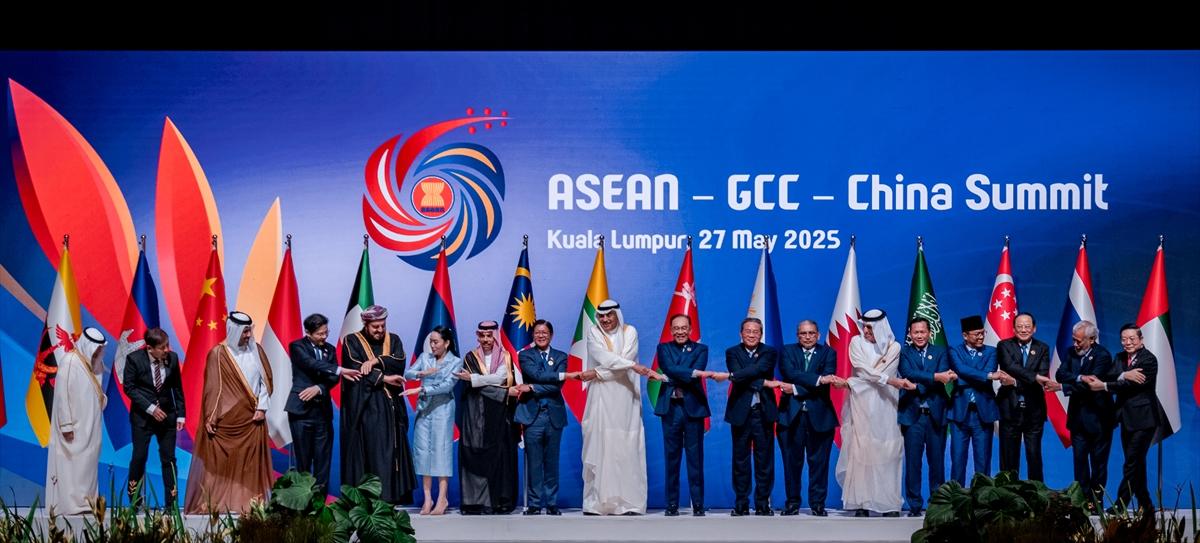
Parallel to the main summit, the first ASEAN-GCC-China Trilateral Summit was held for the first time in a three-party format. The summit was attended by Chinese Premier Li Qiang, ASEAN leaders and representatives from Gulf countries. Discussions prioritized enhancing multilateral trade, diversifying global supply chains and aligning regional development models. The parties aimed to establish new cooperation platforms and promote sustainability and infrastructure-focused projects.

46th ASEAN-GCC-China Summit, 27 May 2025 – (Anadolu Ajansı)
Prior to the summit, negotiations on the ASEAN-China Free Trade Area (ACFTA) Version 3.0 were completed. The negotiation process expanded the existing trade agreement to include updated provisions on investment, digital trade and sustainable development. The parties reached consensus on deepening the free trade regime and expanding coverage to include new sectors.
Malaysian Prime Minister and ASEAN Chair Anwar Ibrahim, in his opening address, emphasized the need to enhance regional cooperation, strengthen economic resilience and maintain balanced relations between ASEAN and global actors. He highlighted the importance of ongoing dialogue with all parties in Myanmar and noted that the “quiet diplomacy” approach had proven an effective tool in the process. Ibrahim announced his proposal for a new ASEAN-U.S. summit to advance bilateral relations.
Vietnamese Prime Minister Pham Minh Chinh, in his speech at the summit, introduced the “Five Strengthenings” approach to bolster ASEAN’s resilience against regional and global uncertainties. This approach includes building collective strength within the bloc, constructing resilient structures, shaping the regional agenda, deepening inclusivity and ensuring sustainability for future generations. Chinh proposed that sustainability be made a core criterion in implementing the ASEAN 2045 vision.
Philippine President Ferdinand Marcos Jr. addressed the current tensions in the South China Sea and called for accelerated negotiations on a Code of Conduct between ASEAN and China. Marcos emphasized that a legally binding agreement is essential to preserve regional stability and safeguard maritime jurisdictions. This appeal was particularly framed within the context of ongoing disputes between China and the Philippines over exclusive economic zones.
ASEAN. "Briefing by Secretary-General of ASEAN on the Outcomes of the 46th ASEAN Summit, 2nd ASEAN-Gulf Cooperation Council (GCC) Summit and ASEAN-GCC-China Summit." ASEAN.org. Accessed May 27, 2025. https://asean.org/briefing-by-secretary-general-of-asean-on-the-outcomes-of-the-46th-asean-summit-2nd-asean-gulf-cooperation-council-gcc-summit-and-asean-gcc-china-summit/
ASEAN. "Secretary-General of ASEAN Joins ASEAN Leaders in the Plenary Session of the 46th ASEAN Summit in Kuala Lumpur, Malaysia." ASEAN.org. Accessed May 27, 2025. https://asean.org/secretary-general-of-asean-joins-asean-leaders-in-the-plenary-session-of-the-46th-asean-summit-in-kuala-lumpur-malaysia/
Al Jazeera. "Gulf States, China Take Centre Stage at Summit of Southeast Asian Nations." Al Jazeera. Accessed May 29, 2025. https://www.aljazeera.com/news/2025/5/28/gulf-states-china-take-centre-stage-at-summit-of-southeast-asian-nations
Anadolu Ajansı. "ASEAN Leaders Gathered Amid U.S. Tariffs and Tensions in the South China Sea." Accessed May 27, 2025. https://www.aa.com.tr/tr/dunya/asean-liderleri-abd-tarifeleri-ile-myanmar-ve-guney-cin-denizindeki-gerilim-gundemiyle-toplandi/3579489#
Anadolu Ajansı. "Malezya Başbakanı: Trump, ASEAN ile Zirve Düzenlemek İsterse Kabul Edeceklerini Bildirdi." Accessed May 27, 2025. https://www.aa.com.tr/tr/dunya/malezya-basbakani-trump-asean-ile-zirve-duzenlemek-isterse-kabul-edeceklerini-bildirdi/3580979
Anadolu Ajansı. "Malezya Başbakanı: Trump, ASEAN ile Zirve Düzenlemek İsterse Kabul Edeceklerini Bildirdi." Accessed May 29, 2025. https://www.aa.com.tr/tr/dunya/malezya-basbakani-trump-asean-ile-zirve-duzenlemek-isterse-kabul-edeceklerini-bildirdi/3580979#
Anadolu Ajansı. “46th ASEAN Summit to Begin Monday in Malaysia with US Tariffs, Myanmar Conflict on Agenda.” Accessed May 27, 2025. https://www.aa.com.tr/en/asia-pacific/46th-asean-summit-to-begin-monday-in-malaysia-with-us-tariffs-myanmar-conflict-on-agenda/3578689#
Anadolu Ajansı. “ASEAN’dan Myanmar Krizi İçin Barışçıl Çözümde Kararlılık Mesajı.” Accessed May 29, 2025. https://www.aa.com.tr/tr/dunya/aseandan-myanmar-krizi-icin-bariscil-cozumde-kararlilik-mesaji/3581144#
Malay Mail. “ASEAN-GCC-China Summit Enters Final Day in KL with Focus on Economic, Regional Cooperation.” Accessed May 27, 2025. https://www.malaymail.com/news/malaysia/2025/05/27/asean-gcc-china-summit-enters-final-day-in-kl-with-focus-on-economic-regional-cooperation/178302
Reuters. "Southeast Asian Leaders Seek Myanmar Peace Progress, Trade Strategies." Accessed May 27, 2025. https://www.reuters.com/world/asia-pacific/southeast-asian-leaders-seek-myanmar-peace-progress-trade-strategies-2025-05-25/
Vietnam News. “46th ASEAN Summit: PM Called for Sustainability Mindset, Greater Intraregional Connectivity and Resilience.” vietnamnews.vn. Accessed May 27, 2025. https://vietnamnews.vn/politics-laws/1718363/46th-asean-summit-pm-called-for-sustainability-mindset-greater-intraregional-connectivity-and-resilience.html

The 46th ASEAN Summit was held in Kuala Lumpur on 26-27 May 2025. The summit addressed U.S. customs tariffs, internal conflicts in Myanmar, and tensions in the South China Sea. The ASEAN 2045 Vision Document was adopted and Timor-Leste’s membership process was initiated. Alongside the summit, ASEAN-GCC and ASEAN-GCC-China summits were also held.
No Discussion Added Yet
Start discussion for "46. ASEAN Summit (2025)" article
May 27, 2025
General Information
May 27, 2025
Main Theme and Key Issues
May 27, 2025
Participating Leaders and Delegations
May 27, 2025
Institutional and Regional Developments
May 27, 2025
Side Summits and Trilateral Talks
May 27, 2025
Key Speeches at the Summit