

This article was automatically translated from the original Turkish version.
Origin Narratives | Originating from Horasan, centered around Hacı Bektaş, traditions of Yağmur Dede | ||||||||
|---|---|---|---|---|---|---|---|---|---|
Geography | Widespread throughout Türkiye with density in Central Anatolia | ||||||||
Belief System | Alevism Bektashism | ||||||||
Main Source of Livelihood | Musicianship, Blacksmithing, Basket weaving | ||||||||
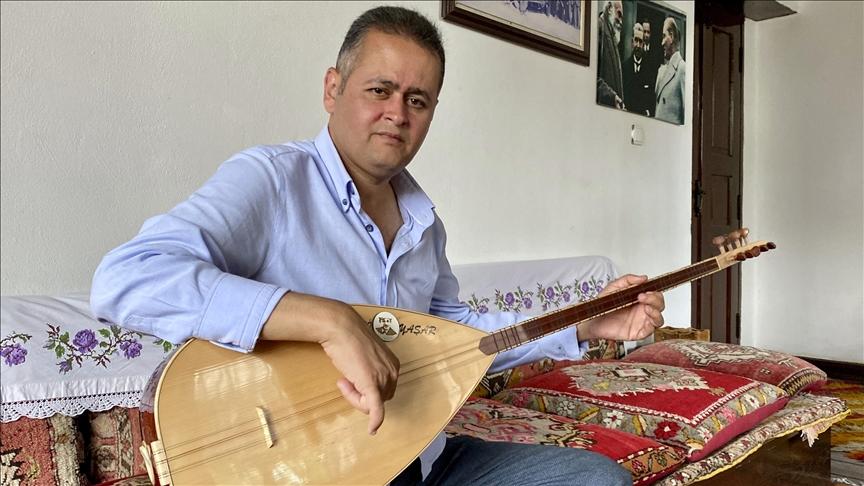
Abdals are communities primarily distributed across various regions of Türkiye, especially Central Anatolia, historically known for semi-nomadic practices and a prominent musical tradition. They predominantly adhere to the Alevi-Bektashi belief system and speak Turkish. Kırşehir and its surroundings are among the main centers where the characteristic sociocultural and religious features of this tradition can be observed. The Abdal community has produced many musicians, the most famous of whom is Neşet Ertaş.
Due to the central role music plays in their daily and ritual life—particularly in the performance of the bağlama, davul, zurna, and bozlak—they are widely recognized for their craftsmanship and musicianship; even today, they continue to shift toward trades and service sectors alongside music.
Although Abdals are often confused with Roma communities due to similar livelihoods and appearances, scholarly literature and field data emphasize that these two groups are distinct in terms of language, belief, and origin. Systematic differences have been identified in their vocabularies, with Abdals prominently identifying as Alevi-Bektashi, while Roma are predominantly Sunni.
In origin narratives and academic assessments, Abdals are consistently described as Turkmen and Alevi. It is asserted that Abdals do not descend from Roma and should be regarded ethnically as Turkish or Turkmen.
The term “Abdal” has been used throughout history with various meanings: in Persian and Ottoman texts, it denoted dervishes or mystics; in Sufi terminology, it referred to a specific rank within the hierarchy of those who have attained the unseen.
One of the most common titles used by heterodox dervish groups in Anatolia—including the Kalenderî, Yesevî, Haydarî, and Vefâî—was “abdal”; Aşıkpaşazâde referred to the Babai movement as “Abdalan-ı Rûm.” The Abdalan-ı Rûm group, which played a role in the Islamization and Turkification of Anatolia from the 14th century onward, is distinct from the contemporary Turkish-speaking Abdal communities studied sociologically today; recent field research emphasizes that despite the similarity in name, a direct historical continuity has not been proven.
Narratives linking Abdals to Horasan-originated dervish movements and the formation of Bektashism help contextualize the historical figure of the Abdal in Anatolia: the Babai synthesis highlights figures such as Rum Abdals (Abdal Musa, Abdal Kumral, etc.) and the influence of Vefâî-Haydarî traditions. Within this framework, connections with Hacı Bektaş-ı Velî and narratives of Horasan mystics form the foundational context of the early period.
Place names indicating the presence of Abdals in Anatolia—such as Abdallar, Kara Abdal, and Köse Abdal—were compiled in early 20th-century studies. Villages and districts across various provinces offer tangible evidence of their historical presence. In Antalya, population registers and tax records from 1831–1841 are among the primary sources documenting the presence of Abdals in the 19th century.
Oral narratives regarding the origins of the Abdals center on a heritage from Horasan and their settlement in Central Anatolia. In Kırşehir, traditions recount that the community arrived under the leadership of Yağmur Dede and settled in Yağmurlu Büyükoba, later moving to Bağbaşı Mahallesi. This narrative underscores the historical ties between Abdals and Turkmen communities, as well as their transition to a sedentary lifestyle. Kırşehir’s dense Alevi Turkmen population and its historical connection to Hacı Bektaş-ı Veli are emphasized as fundamental background factors in the formation of the local Abdal identity.

【1】
Abdals identify themselves as Alevi-Bektashi Muslims. In their belief system, the triad of Allah, Muhammad, and Ali, devotion to the Ahl al-Bayt, and emphasis on the Twelve Imams are central. Among Abdals in Antalya and Kırşehir, key elements include the triads-sevens-forties, tevellâ–teberrâ, the dede–talip relationship, musahiplik, and the institution of düşkünlük.
In Abdal communities, religious and social organization is centered around the “ocak.” Structures of talip-musahip are formed around ocakzadeler and dedes, who periodically visit their talips to conduct görgü cem ceremonies.
The dede institution is distinguished by hierarchical respect and a guiding function; traditionally, it is viewed in Abdal narratives as “yol hizmeti”—a service rendered without expectation of material compensation.
Core rituals and worship practices revolve around the cem. These include the görgü cemi (led by a tercüman), musahiplik (becoming bilezer), düşkünlük, dârdan indirme, the Muharrem fast followed by ashure, as well as celebrations of Ramadan and Kurban Bayram, rain prayers, Hıdrellez, and Nevruz—rituals associated with abundance. These ceremonies are sustained not through written texts but through oral transmission and the principle of “yol bir, sürek bin bir.”
Abdal communities are known to be settled not only in Central Anatolia but across a wide geographical area extending from Antalya to Bolu, Çorum, Denizli, Eskişehir, Kayseri, Kırşehir, Konya, Nevşehir, Sinop, Sivas, Tokat, and Yozgat, as well as Aydın, Balıkesir, Bursa, Diyarbakır, Elazığ, Erzurum, Giresun, Hatay, Isparta, Kars, Kastamonu, Manisa, Muş, Niğde, Samsun, Trabzon, Tunceli, Urfa, Van, and Zonguldak. This widespread distribution indicates a dispersed presence across diverse regions of Anatolia.

【2】
Oral history and field data collectively convey the settlement of Kırşehir by narratives originating from Horasan and their subsequent spread to surrounding districts. Current settlement units include Kırşehir Central (Bağbaşı, Aşıkpaşa), Kaman (Sarıuşağı), Çiçekdağı (Fevzi Çakmak), Akpınar (Kırtıllar), and Mucur (Büyük Solaklı, Karşıyaka). The density of the Abdal population in Kırşehir and its historical religious networks centered around Hacı Bektaş render this province one of the “representative” hubs of the Central Anatolian distribution.
In the Abdal belief system, the understanding of God, Muhammad, and Ali, the veneration of Ehl-i Beyt, and the emphasis on the Twelve Imams are prominent. The cem ritual is central, and since cem houses are not available in most areas, cems are conducted in suitable private homes. In places where a dede is not present, a dede is invited from neighboring provinces; in the absence of a dede, the guide/ocakzade assumes responsibility for guiding the ritual.
The cem is also known as the congregational prayer. Rituals highlight specific types of cem such as the Abdal Musa cem, görgü cem (translator cem), and dârdan indirme. The cem is symbolized by twelve roles or services; the ritual cannot begin until the roles of dede, guide, zakir, çerağcı, pervane, and others are fulfilled. Gülbank (charity/prayer) is an inseparable component of cems; collective recitations of blessings accompanied by saz music, as well as communal food and sacrificial gülbank offerings, reinforce both collective unity and ritual motivation.
The dâr is a council centered on accountability and reconciliation; it functions as a mechanism for social control and conflict resolution within the community. While urbanization and changing lifestyles have weakened dâr practices in some areas, their influence persists in examples such as Zeytinköy and Finike/Yuvalı.
In cems, semah is a path and set of ritual knowledge transmitted orally. Those summoned to perform semah are called pervane or selman; the meaning of semah is interpreted as purification from sins and the experience of divine love.
In contemporary practice, some Abdals observe the Ramadan fast and participate in Friday prayers at mosques, which they describe as a form of piety consistent with their Alevi-Bektaşi identity. The Muharram (mourning) fast is observed for twelve days to commemorate the tragedy of Karbala; it is carried out according to detailed rules such as abstaining from rising for suhoor, refraining from drinking water, and avoiding entertainment.
Hıdrellez (the night of May 5–6) is celebrated by families with picnics, vows, prayers, and rituals such as jumping over fire; young people entrust their wishes to the earth or beneath rose trees. Nevruz (March 21) is celebrated as the “harbinger of spring” with sacrifices, festivities, and in some places, professional performances accompanied by davul and zurna.
Although Abdals generally do not directly participate in rain prayers due to their limited involvement in agriculture, they are reported to join the prayers of surrounding communities. Practices to “calm” excessive rain or hail are also documented. In Mersin, children parading a “rain bride” while reciting rhymes have been recorded as carrying traces of pre-Islamic beliefs.
Abdal identity is constructed through the use of the name Abdal, adherence to Alevi-Bektaşi belief, occasional attribution of Romani identity, and emphasis on citizenship and Kemalism. Language (internal speech or secret dialect) is one of the most prominent markers of identity and remains a living sign of belonging, particularly among middle-aged generations in rural areas.
Historically, Abdals have been conflated with Roma (Rom/Dom, etc.) due to similarities in lifestyle and occupation; this conflation has caused discomfort within the community. Alongside linguistic and traditional distinctions, the emphasis on Alevi-Bektaşi identity has emerged as a primary criterion for differentiation. The presence of communities in some neighborhoods of Mersin who identify themselves as “Rom” further complicates local nomenclature and external perceptions.
Anadolu Ajansı. "Abdal kültürünü bağlamasıyla düğünlerde yaşatıyor." Accessed September 21, 2025. https://www.aa.com.tr/tr/kultur/abdal-kulturunu-baglamasiyla-dugunlerde-yasatiyor/3305407
Anadolu Ajansı. "Abdalların efsane müzisyeni: Neşet Ertaş." Accessed September 21, 2025. https://www.aa.com.tr/tr/kultur-sanat/abdallarin-efsane-muzisyeni-neset-ertas/2373979
Can, Döndü. *Mersin Abdalları Halkbilimi Araştırması*. Master's thesis, Mersin University Institute of Social Sciences, 2010. https://tez.yok.gov.tr/UlusalTezMerkezi/TezGoster?key=ZeTyprYuef2HkaF3xt4wYvuHqoou1dlHonZQaZXRR3rZb9o9WRmn3ReC2AQ2zzWb
Demir, Dilek. *Kırşehir Abdallarının Hayat Tarzında Bektaşiliğin Yeri*. Master's thesis, Kırşehir Ahi Evran University Institute of Social Sciences, Kırşehir, 2024. https://tez.yok.gov.tr/UlusalTezMerkezi/TezGoster?key=LY6e5xGA7WWUpEdrBmEPLqKPMQnpeIZK_ANNK2yeykm1qA8IOIXXRmK7m3lshs_p
Demir, Erdi. *Abdallar Üzerine Etnografik Bir Alan Araştırması: Antalya Abdalları, Kültür, Kimlik ve Toplumsal Değişme*. PhD thesis, Akdeniz University Akdeniz Civilizations Research Institute, Antalya, 2023. https://tez.yok.gov.tr/UlusalTezMerkezi/TezGoster?key=j_Fjwp4JS4mk97Puqti8rqnnas5CqrL44cmMEmPUjIQxBpYfBk9wHfvNhr5GHXt0
Çapraz, Akif. *Sosyal Dışlanma Örneği Olarak Abdallar: Isparta Göktaş Köyü Örneği*. Master's thesis, Gazi University Institute of Social Sciences, 2019. https://tez.yok.gov.tr/UlusalTezMerkezi/TezGoster?key=npGs9H39x7G6401x51yqpHFM33QyhnoLG5XYk8a334wPsr2NC24qCVaaehYxRqvO
[1]
Erdi Demir, Abdallar Üzerine Etnografik Bir Alan Araştırması: Antalya Abdalları, Kültür, Kimlik ve Toplumsal Değişme (Doktora tezi, Akdeniz Üniversitesi Akdeniz Uygarlıkları Araştırma Enstitüsü, Antalya, 2023), s. 325. https://tez.yok.gov.tr/UlusalTezMerkezi/TezGoster?key=j_Fjwp4JS4mk97Puqti8rqnnas5CqrL44cmMEmPUjIQxBpYfBk9wHfvNhr5GHXt0
[2]
Döndü Can, Mersin Abdalları Halkbilimi Araştırması (Yüksek lisans tezi, Mersin Üniversitesi Sosyal Bilimler Enstitüsü, Mersin, 2010) Ekler Bölümü

Origin Narratives | Originating from Horasan, centered around Hacı Bektaş, traditions of Yağmur Dede | ||||||||
|---|---|---|---|---|---|---|---|---|---|
Geography | Widespread throughout Türkiye with density in Central Anatolia | ||||||||
Belief System | Alevism Bektashism | ||||||||
Main Source of Livelihood | Musicianship, Blacksmithing, Basket weaving | ||||||||
History
Nomenclature and Early Traces
Abdals in Anatolia
Origin Narratives, Belief Tradition, and Religious Positioning
Geographical Distribution
Beliefs and Worship Practices
Types of Cem
Dâr and Internal Law
Semah and Pervane
Fasting in Ramadan and Muharram
Hıdrellez, Nevruz, and Rain-Related Beliefs
Social Perception and Exclusion