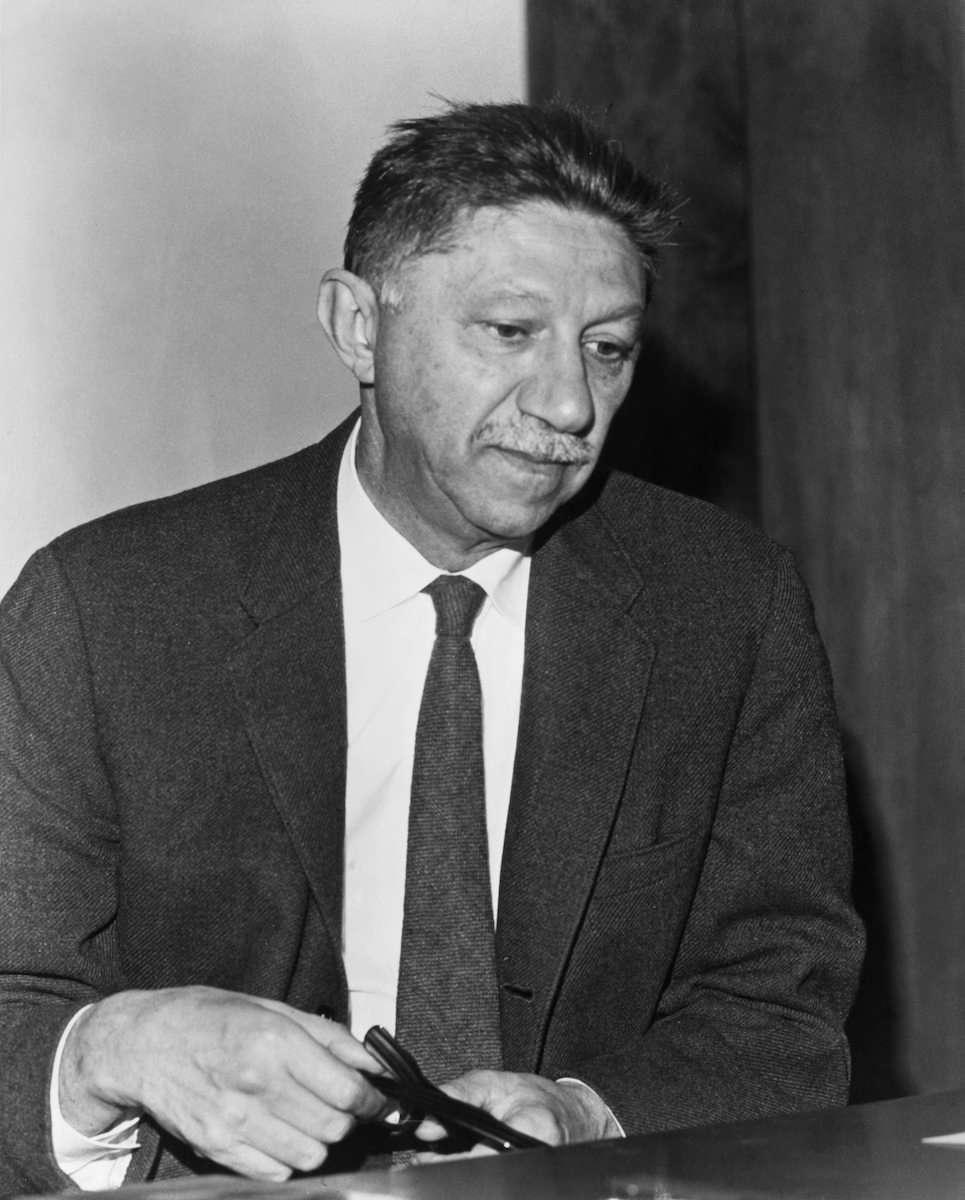
+2 More

Doğum tarihi | 1908-04-01 | ||||||||
|---|---|---|---|---|---|---|---|---|---|
Ölüm tarihi | 1970-06-08 | ||||||||
Education | University of Wisconsin (Ph.D.) Brooklyn College (Bachelor's) | ||||||||
Important Theories | Hierarchy of Needs, Self-Actualization | ||||||||
Abraham Harold Maslow (1908–1970) was born on April 1, 1908, in the Brooklyn neighborhood of New York City. His family was of Jewish descent and had migrated from Russia; Maslow was the eldest of seven children. His childhood was shaped by economic hardship and social pressures, which contributed to the early development of personal solitude and introspective ability. Maslow’s intellectual curiosity manifested in childhood through books and libraries, laying the foundation for his later theoretical insights into human nature and psychology.
Maslow received his secondary education at Boys High School in New York, where he actively participated in Latin and physics clubs. After completing his undergraduate studies at the City College of New York, he briefly studied at Cornell University but had to suspend his education due to financial difficulties. He later transferred to the University of Wisconsin, where he earned his bachelor’s degree in psychology (1930), master’s degree (1931), and doctorate (1934).
Maslow began his academic career at Brooklyn College in 1937, where he served as a psychology instructor until 1951. During this period, he focused particularly on human motivation, learning, and behavioral processes, producing work that supported the transition from behaviorist psychology to humanistic psychology. In 1951, he moved to Brandeis University, where he assumed the role of head of the psychology department and continued his work until 1969. His tenure at Brandeis marked a critical period characterized by research emphasizing the positive dimensions of human psychology and the foundational development of humanistic psychology.
Another notable aspect of Maslow’s academic career was his integration of teaching and research, his emphasis on students’ individual development, and his effort to understand human behavior not merely through deficits but through the lenses of potential and self-actualization.
Maslow’s hierarchy of needs theory is a foundational model developed to understand and explain human motivation. The theory does not merely explain human behavior through deficiency-based needs but also addresses motivations aimed at realizing an individual’s potential.
The model consists of five primary levels:
The hierarchy of needs provides a robust framework for understanding motivation and is applied in education, psychotherapy, management, and organizational psychology. The theory is significant because it systematically addresses individuals’ potential and intrinsic motivation in explaining human behavior.
In Maslow’s theory, self-actualization is defined as the process through which an individual maximizes their potential. This process is not limited to academic or professional achievement; it also encompasses creative activities, aesthetic sensitivity, ethical awareness, and spiritual experiences. According to Maslow, an individual’s psychological well-being and life satisfaction are directly linked to self-actualization.
During the process of self-actualization, individuals draw upon their social and cultural environment to shape their personal values and search for meaning. Maslow emphasized that religious and spiritual experiences also play a vital role in uncovering an individual’s potential.
In Maslow’s theoretical framework, religious and spiritual motifs play a critical role in human motivation and the process of self-actualization. Kaba and Kula (2024) highlight that Maslow viewed religious experiences as tools that facilitate an individual’s journey toward self-actualization. This perspective extends human psychology beyond behavioral or cognitive dimensions to include spiritual and existential needs.
According to Maslow, spiritual experiences and religious beliefs support an individual’s search for meaning and value, contributing to creative and ethical development. This approach enables a more holistic understanding of human psychology and expands the dimensions of the self-actualization concept.
Maslow’s key works systematically present humanistic psychology and theories of motivation:
These works serve as essential references for understanding human potential and individual development processes.
Maslow’s theories are applied not only in psychology and psychotherapy but also in education, management, and the business world. In education, the hierarchy of needs model is used to understand student motivation and optimize learning environments. In the workplace and leadership studies, the theory informs efforts to comprehend employee motivation and enhance performance.
Although Maslow’s hierarchy of needs and self-actualization theories have made revolutionary contributions to the study of human psychology and motivation, they have also faced academic criticism. The main points of critique are as follows:
Cultural and Universal Validity Concerns: Maslow’s hierarchy of needs is grounded in the individualistic and person-centered psychological structure of Western societies. Consequently, the need hierarchies and motivational processes of individuals in collectivist cultures may differ significantly. Critics emphasize that the model does not offer a universal framework and neglects cultural context.
Scientific Measurability and Methodological Limitations: Maslow’s theory is largely based on observational and phenomenological foundations. One of its shortcomings is the lack of empirical evidence supporting the hierarchical ordering of needs. Research has shown that some individuals enter self-actualization processes even before their basic needs are fully satisfied. This challenges the theory’s validity and reliability criteria.
Overlooking Individual Differences: Maslow presents needs within a fixed hierarchy, yet motivational differences among individuals are substantial. Some individuals may pursue creative or spiritual experiences even when their safety or belongingness needs are unmet. This indicates that the theory inadequately accounts for individual variability.
Application Limitations: Although Maslow’s theory has broad applications in education, business, and psychotherapy, it cannot be uniformly applied to every individual in practice. For instance, while the theory can be used in organizational psychology and leadership studies to understand employee motivation, the hierarchical order may vary from person to person. Therefore, its practical applications require flexibility and adaptation.
Complexity of Religious and Spiritual Dimensions: Although religious and spiritual dimensions hold an important place in Maslow’s theory, these areas are not scientifically measurable or generalizable. The theory’s validity across individuals with diverse religious beliefs and cultural backgrounds remains limited.
Nevertheless, Maslow’s theory remains a classic reference point in psychological literature and continues to enrich the fields of human motivation and individual development. The criticized aspects of the theory offer researchers opportunities to develop new hypotheses and cross-cultural studies.
Brandeis University. (2013, May). Memory of Abraham Maslow faded, not forgotten. *BrandeisNOW*. Accessed August 17, 2025. https://www.brandeis.edu/now/2013/may/maslow.html
Kaba, B., & Kula, M. N. (2024). Abraham Maslow'un psikolojik yaklaşımında dini motifler. *Hikem*, 2(2), 53–65. Accessed August 17, 2025. https://dergipark.org.tr/en/download/article-file/4089839
Research.com. (n.d.). Abraham H. Maslow. Author: Research.com Staff. Accessed August 17, 2025. https://research.com/u/abraham-h-maslow
Şengöz, Murat. “Maslow’un İhtiyaçlar Hiyerarşisi Kendini Gerçekleştirme Modelinin Bütünleşik Bir Süreç Olarak Yeniden Yorumlanması.” DergiPark, 2017. Accessed August 17, 2025. https://dergipark.org.tr/tr/download/article-file/1905538

Doğum tarihi | 1908-04-01 | ||||||||
|---|---|---|---|---|---|---|---|---|---|
Ölüm tarihi | 1970-06-08 | ||||||||
Education | University of Wisconsin (Ph.D.) Brooklyn College (Bachelor's) | ||||||||
Important Theories | Hierarchy of Needs, Self-Actualization | ||||||||
No Discussion Added Yet
Start discussion for "Abraham Harold Maslow" article
Educational Background and Academic Career Development
Theoretical Contributions and Impact on Psychology
Hierarchy of Needs Theory
The Concept of Self-Actualization
The Role of Religious and Spiritual Motifs
Major Works and Academic Publications
Applications and Impact of His Theories
Criticism and Limitations of His Theories