This article was automatically translated from the original Turkish version.
+2 More
Location | Afyonkarahisar | ||||||||
|---|---|---|---|---|---|---|---|---|---|
Patron | Sâhipataoğlu Nusretiddin Hasan | ||||||||
Architect(s) | Emir Hâc Bey el-Neccar | ||||||||
Plan Type | Kufic-type hypostyle plan | ||||||||
Material(s) | Rubble stone Cut stone Wood | ||||||||
Number of Columns | 40 wooden pillars | ||||||||
Mihrab | Stone with muqarnas decoration | ||||||||
Minbar | with geometric interlacing decoration Wood | ||||||||
Minaret | Single-minaret | ||||||||
Afyonkarahisar Ulu Camii was commissioned by Sâhipataoğlu Nusretiddin Hasan during the Anatolian Seljuk period between 1272 and 1277 for Emir Hâc Bey el-Neccar. Construction began in 671 AH and was completed in 676 AH. The structure is an original example of the group of Seljuk-era mosques with wooden columns and flat ceilings, and over time it has also been known as "Cami-i Kebir" and "Hocabey Camisi."
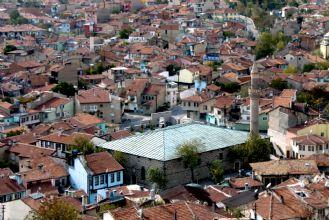
The mosque is located in the center of Afyonkarahisar, within the boundaries of Tac Ahmet Mahallesi, between Karahisar Castle and Hıdırlık Hill. Situated within an urban conservation area, it is positioned on plot 5, parcel 502, map sheet 54. The mosque has three entrances facing north, west, and east. Today, it and its surroundings are protected under official registration.

Afyonkarahisar Ulu Cami (Türkiye Culture Portal)
Afyonkarahisar Ulu Camii features a basilical five-aisle hypostyle plan. Its roof is supported by forty wooden columns arranged in five rows, a characteristic that has earned it the popular name "Kırk Direkli Cami" (Forty Columns Mosque). The wooden columns are crowned with baklava slice and muqarnas-decorated capitals. Some of the columns have been replaced over time; the original ones are preserved in the Afyonkarahisar Archaeology Museum.
The mihrab is made of stone and adorned with six rows of muqarnas. The wooden minbar is decorated with geometric lattice panels; the inscription above the minbar’s door records the construction year as 671 AH and names Emir Hâc Bey as the architect. Adjacent to the northeast corner of the mosque stands a single-balcony brick minaret. The mosque was constructed using cut stone, rubble stone, and wood; its roof, now in a broken-pitch style, is covered with lead.
%2520kopya(1).jpg&w=1280&q=75)
Interior View with Wooden Columns (Türkiye Culture Portal)
Since its construction, the mosque has undergone numerous repairs. The first major restoration was carried out in 1341 by Emir Minüddin Abdullah Bey, who added an inscription above the eastern entrance. During a comprehensive restoration in 1947 under the Republic era, the structure was largely rebuilt. The roof was renewed in a broken-pitch style in 1977, and further planned interventions took place in 1984 and 2006. Conservation efforts have continued with the removal of unsuitable structures around the mosque and the improvement of its surroundings.
Afyonkarahisar Ulu Camii was inscribed on UNESCO’s Tentative List in 2018 under the title “Wooden Columned and Beam-Structured Mosques of Medieval Anatolia” and was officially added to the World Heritage List in 2023 within the same serial nomination. Other mosques included in this listing are Eskişehir Sivrihisar Ulu Camii, Ankara Ahi Şerafettin (Arslanhane) Camii, Konya Eşrefoğlu Camii, and Kastamonu Mahmut Bey Camii.
These mosques are recognized as a distinguished group within Islamic architecture for their wooden ceilings and wooden column supports, constructed during the 13th and 14th centuries. Their wooden structures, columns, penwork decorations, and holistic integrity as immovable cultural heritage attract particular attention.
Afyonkarahisar Belediyesi. "Tarihi Ulu Cami Dünya Mirası Oldu." Afyonkarahisar Municipality. Accessed July 7, 2025. https://www.afyon.bel.tr/haber/1/10880/tarihi-ulu-cami-dunya-mirasi-oldu.
Ministry of Culture and Tourism of the Republic of Türkiye. "Ulu Camii." *Kültür Portalı*. Accessed July 7, 2025. https://www.kulturportali.gov.tr/turkiye/afyonkarahisar/gezilecekyer/ulu-camii839501.
Ministry of Culture and Tourism. "Afyonkarahisar Ulu Camii Yönetim Planı." *Kültür Varlıkları ve Müzeler Genel Müdürlüğü*. Accessed July 7, 2025. https://kvmgm.ktb.gov.tr/Eklenti/93109,uyp-afyonkarahisar-ulu-camii-yonetim-planipdf.pdf?0.
Ministry of Culture and Tourism. "Ulu Camii Dünya Mirası Geçici Listesinde." *Afyonkarahisar İl Kültür veTurizm Müdürlüğü. Accessed July 7, 2025. https://afyon.ktb.gov.tr/TR-211045/ulu-camii-dunya-mirasi-gecici-listesinde.html.

Location | Afyonkarahisar | ||||||||
|---|---|---|---|---|---|---|---|---|---|
Patron | Sâhipataoğlu Nusretiddin Hasan | ||||||||
Architect(s) | Emir Hâc Bey el-Neccar | ||||||||
Plan Type | Kufic-type hypostyle plan | ||||||||
Material(s) | Rubble stone Cut stone Wood | ||||||||
Number of Columns | 40 wooden pillars | ||||||||
Mihrab | Stone with muqarnas decoration | ||||||||
Minbar | with geometric interlacing decoration Wood | ||||||||
Minaret | Single-minaret | ||||||||
No Discussion Added Yet
Start discussion for "Afyonkarahisar Ulu Camii" article
Architectural Features
Restoration and Conservation Process
World Heritage Status