


This article was automatically translated from the original Turkish version.
+2 More
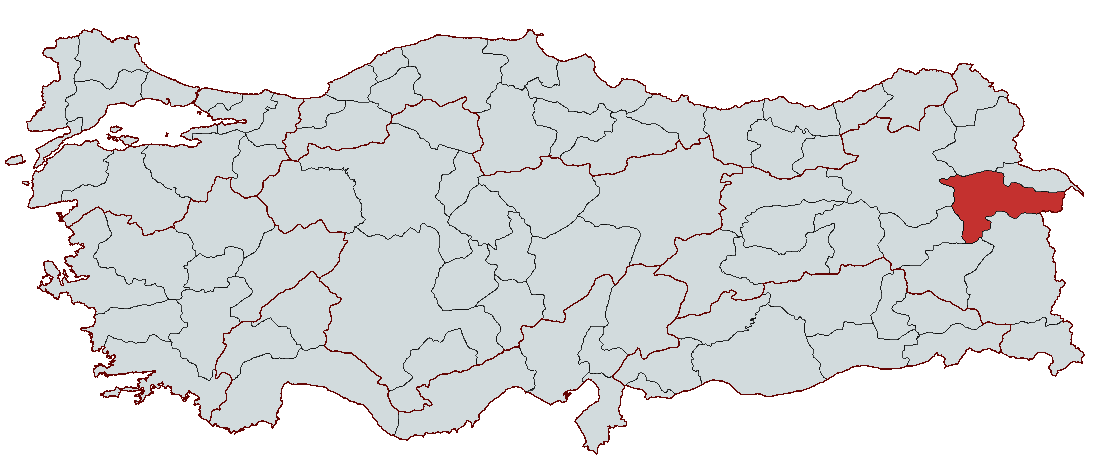
Ağrı (Province)
Country | Türkiye | ||||||||
|---|---|---|---|---|---|---|---|---|---|
Region(s) | Eastern Anatolia Region | ||||||||
Population | 499,801 (2023) | ||||||||
Area(s) | 11 099 km² | ||||||||
Climate(s) | Continental Climate | ||||||||
Important Structure(s) | Diyadin Kaplıcaları İshak Paşa Sarayı | ||||||||
Area Code(s) | 472 | ||||||||
License Plate Code | 04 | ||||||||
Governor(s) | Mustafa Koç | ||||||||
Mayor(s) | Hazal Aras | ||||||||
Ağrı Province, located in Türkiye’s East Anatolia Region, has attracted attention throughout history as a region that has been home to various civilizations. Due to its geographical position along the transit routes between Asia and Anatolia, it has drawn the interest of numerous peoples and states throughout history.
The earliest known inhabitants of Ağrı were the Hurrians, who settled in the region between 1340 and 1200 BCE but did not remain permanently. Subsequently, the Urartians expanded their territory northward and northeastward, reaching the lands of Ağrı. During the reign of Urartian King Menua (810–786 BCE), military campaigns were conducted in the region, and Urartian inscriptions found on the slopes of Mount Ağrı serve as evidence of this dominance.
Following the decline of the Urartians, the Cimmerians arrived in the region in the 7th century BCE but failed to establish a lasting presence. Later, the Medes incorporated Ağrı and its surroundings into their territory after the fall of the Assyrian Empire. The Persians then absorbed the region into the Achaemenid Empire after eliminating the Medes. Beginning in 331 BCE, following Alexander the Great’s defeat of Persian King Darius III, Hellenistic influences began to spread into Anatolia.
During the Roman and Byzantine periods, the region experienced multiple changes in control. In the 7th century CE, during the time of Hz. Osman, Islamic armies conquered Ağrı and its surroundings, though conflicts with the Byzantines continued during the Abbasid period. After the Battle of Manzikert in 1071, Seljuks gained control of the region, initiating the process of Turkification.
In the 13th century, Mongols invaded and began to control the region. Subsequently, the Jalayirids and Ilkhanids became dominant, with the Ilkhanids even holding some of their kurultais at the foot of Mount Ağrı. In the early 15th century, Kara Koyunlu and Akkoyunlu emerged as significant political powers in the region. After the Battle of Chaldiran in 1514, in which Yavuz Sultan Selim defeated Safavid Shah Ismail, the region came under Ottoman control.
During the Ottoman period, the region was administered under various sanjaks and changed hands between Van and Erzurum provinces. The Ottoman-Iranian wars of the 19th century further increased the strategic importance of the region. Ağrı suffered temporary Russian occupations during the Ottoman-Russian wars of 1828–1829, 1854–1856, and 1877–1878.
After the proclamation of the Republic, Ağrı became a provincial center in 1927. In 1938, its name was changed from Karaköse to Ağrı, inspired by the region’s most prominent geographical feature, Mount Ağrı.
Ağrı Province is located in Türkiye’s Eastern Anatolia Region and is notable for its morphological, hydrographic, and climatic characteristics. Geographically, it borders Kars and Iğdır to the north, Erzurum and Muş to the west, Bitlis and Van to the south, and Iran to the east. With an area of 11,099 km², Ağrı covers approximately 1.4% of Türkiye’s total land area. Situated at an average elevation of 1,640 meters above sea level, Ağrı is generally mountainous and rugged.

The majority of Ağrı’s topography consists of mountains. The province’s territory comprises 46% mountainous areas, 29% plains, 18% plateaus, and 7% highland pastures. Ağrı lies within the Alpine-Himalayan volcanic belt, and volcanic mountains are common in the region. The most prominent elevated areas are Greater Ağrı Mountain (5,137 m) and Lesser Ağrı Mountain (3,896 m). Additionally, Tendürek Mountain (3,533 m), Süp caravanserai Mountain (4,049 m), and Kösedağ (3,340 m) are significant highland features. Tendürek Mountain is also known as one of Türkiye’s most active volcanoes.
The geological evolution of Ağrı Province is divided into four main periods. During the Paleozoic, formations developed, followed by ophiolitic melange in the Cretaceous period, during which sandstone, limestone, and tuff structures became prominent.
The plains of Ağrı Province are generally confined by fault lines and mountain ranges and cover limited areas. The most important plains are Ağrı Plain, Eleşkirt Plain, Patnos Plain, Doğubayazıt Plain, and Tutak Plain. These plains are vital for agriculture and livestock, supporting the cultivation of cereals, sugar beet, and forage crops.
The largest river in the region is the Murat River, a major tributary of the Euphrates. The Murat River forms from streams originating in Diyadin, merging with tributaries from Aladağ and Muratbaşı Mountain, and flows toward the Eleşkirt and Malazgirt plains.
The dominant climate in Ağrı Province is continental. Summers are hot and dry, while winters are cold and severe. Annual average temperatures range from 6.2 to 9.2 °C. The highest recorded temperature is 39.9 °C (August), and the lowest is -45.6 °C (January). The average number of rainy days is 44.8, and snow cover remains on the ground for approximately 116.8 days annually.
The region’s vegetation is primarily composed of steppe grasslands. Due to climatic conditions, forested areas are extremely limited, and mountains and plains are generally covered by herbaceous plants. The steppe ecosystem is most dense in the Eleşkirt, Ağrı center, and Upper Murat River regions.
Ağrı Province is rich in thermal springs. The hot springs in Diyadin district are notable for water temperatures reaching up to 75 °C. These thermal waters are used by both local residents and visitors for their purported therapeutic benefits against various ailments.
Ağrı Province has an economy primarily based on agriculture and livestock, with mining activities showing relatively limited development. The region’s economic potential is closely linked to its natural resources, climatic conditions, and geographical structure.
Agriculture is one of the main economic activities in Ağrı Province. However, due to its mountainous and rugged terrain, arable land is limited. Despite the restricted total agricultural area, the region produces drought-resistant cereal crops such as wheat, barley, and sugar beet. Additionally, near the Murat River marshlands, flax, hemp, rice, maize, and barley are cultivated. Limited irrigable land reduces agricultural productivity. Consequently, irrigation projects are being developed in the Doğubayazıt, Patnos, and Tutak plains.
Livestock is one of the region’s most important economic activities. Due to the limited availability of arable land and the presence of extensive pastures, livestock farming serves as a vital source of income. Sheep rearing is the most prominent livestock activity. Cattle, buffalo, and small ruminant animal farming are also practiced.
Extensive meadows and highland pastures provide suitable conditions for livestock activities. Transhumant livestock farming remains a widespread practice, particularly in rural areas. Animal products such as meat, milk, and wool hold significant economic value.
Mining activities in Ağrı Province are limited, but several mineral deposits have been identified. The region contains resources such as asbestos, sulfur, pumice, salt, mineral water, hot springs, cement raw materials, lime, brick, and tile-making materials. Additionally, lignite deposits have been identified in the Eleşkirt region, though their economic value and processing feasibility remain limited.
The industrial sector is still emerging and primarily focuses on processing agricultural and livestock products. Major industrial facilities in Ağrı include the sugar factory, which began operations in 1984, the Doğu Bayezıt Feed Factory, the Ağrı Brick Factory, the Meat-Fish Corporation Complex, cheese and butter factories, flour mills, and carpet-kilim workshops.
Textile crafts, particularly tiftik production, are prominent. Tiftik-made hats, gloves, and scarves are part of the region’s traditional handicrafts. Additionally, carpet and kilim weaving is widespread in the Doğu Bayezıt, Karaköse, and Taşlıçay areas. These products are marketed domestically and internationally and hold an important place in regional trade.
The energy sector is in development. Planning is underway for the Diyadin hydroelectric power plant and the Patnos and Şekerovasi dams. These projects aim to enhance agricultural irrigation capacity and meet energy demands.
Ağrı Province is a strategic land route link between Türkiye and Asia. The Trabzon-Erzurum-Tabriz route is the region’s most important highway, and the Gürbulak Border Gate on this corridor is one of Türkiye’s key commercial entry points with Iran. Additionally, the Ağrı-Patnos-Van and Ağrı-Doğubayazıt-Iğdır-Kars roads form vital transportation corridors. Due to heavy snowfall during Winter months, transportation in the region can be delayed.
Ağrı Province is Türkiye’s 26th largest by area but has a low population density. According to ADNKS data, the province’s total population exceeds 500,000, with a density below the national average. The province’s population growth rate varies depending on local economic and social dynamics.
The urbanization rate has increased in recent years, yet a large portion of the population continues to reside in rural areas. Observations indicate that internal migration from rural to urban areas due to economic factors has contributed to population growth in urban centers.
Ağrı Province is one of Türkiye’s provinces with the highest emigration rates, and population mobility is primarily driven by economic conditions. With agriculture and livestock as the primary livelihoods, and limited industrial and employment opportunities, migration is predominantly directed toward major cities.
Migrants typically move to industrialized provinces such as Istanbul, İzmir, Ankara, and Bursa. This migration trend creates imbalances in the region’s population structure, leading to labor shortages and economic contraction, as well as population decline in rural areas.
Urban population in Ağrı Province is increasing, yet rural population remains significant. In rural areas where agriculture and livestock are widespread, a large portion of the population continues these activities. Meanwhile, industrialization and commercial development in urban areas continue to drive urban population growth.
As a result of migration to urban centers, population concentration has increased in districts such as Ağrı center and Doğu Bayezıt. Particularly, Doğu Bayezıt, due to its role in border trade, trade, and transportation access, continues to attract migrants.
Ağrı Province has a young population structure. Birth rates are higher than the national average, and a large proportion of the population falls within the 0–14 age age group. The youth-dominated population pyramid has notable economic and social implications.
Gender distribution is balanced, but male population figures show greater variability due to migration patterns. The migration of men to other provinces for work and employment has led to a higher concentration of women in rural areas.

Mustafa Ram served as Governor of Niğde from 2022 to 2023. On 09.08.2023, by Presidential Decree No. 2023/376, he was appointed Governor of Ağrı and assumed office on 18.08.2023.
· Diyadin
· Doğubayazıt
· Eleşkirt
· Dough
· Patnos
· Taşlıçay
· Tutak
Ağrı Belediyesi. "Coğrafi Konum." Accessed February 13, 2025. https://www.agri.bel.tr/sayfa/cografi-konum/.
Ağrı Valiliği. "Ağrı Valisi Mustafa Koç." Accessed February 13, 2025. http://www.agri.gov.tr/vali-mustafa-koc.
Ağrı Valiliği. "İlin Tarihi." Accessed February 13, 2025. http://www.agri.gov.tr/ilin-tarihi.
Ağrı Üniversitesi. "Ağrı Üniversitesi." Accessed February 13, 2025. https://www.agri.edu.tr/detail.aspx?id=277&bid=1&tid=7.
Ağrı Üniversitesi. "Ağrı Üniversitesi." Accessed February 13, 2025. https://www.agri.edu.tr/detail.aspx?id=278&bid=1&tid=7.
Ağrı İl Kültür ve Turizm Müdürlüğü. "Ağrı Merkez." Accessed February 13, 2025. https://agri.ktb.gov.tr/TR-392604/agri-merkez.html.
Serhat Kalkınma Agency (SERKA). "Ağrı Coğrafya." Accessed February 13, 2025. https://www.serka.gov.tr/bolgemiz/agri/agri-cografya/.
Serhat Kalkınma Agency (SERKA). "Ağrı Tarihçe." Accessed February 13, 2025. https://www.serka.gov.tr/bolgemiz/agri/tarihce/.
Serhat Kalkınma Agency (SERKA). "Ağrı’da Gezilecek Yerler." Accessed February 13, 2025. https://www.serka.gov.tr/bolgemiz/agri/agri-da-gezilecek-yerler/.
Yılmaz, Murat. "21. Yüzyılda Ağrı İlinde Demografik Yapının Değişimi." Accessed February 13, 2025. https://www.agri.edu.tr/detail.aspx?id=5868&bid=680&tid=5&dil=tr-TR#:~:text=%C4%B0l%C3%A7eler%3A%20A%C4%9Fr%C4%B1%20ili%20merkez%20il%C3%A7e,Patnos%2C%20Ta%C5%9Fl%C4%B1%C3%A7ay%2C%20Tutak%20il%C3%A7eleridir.
Öztürk, Hülya. "Ağrı’nın Tarihçesi Üzerine Bir Değerlendirme." Accessed February 13, 2025. May 23, 2013. https://www.agri.edu.tr/detail.aspx?id=5868&bid=680&tid=5&dil=tr-TR#:~:text=%C4%B0l%C3%A7eler%3A%20A%C4%9Fr%C4%B1%20ili%20merkez%20il%C3%A7e,Patnos%2C%20Ta%C5%9Fl%C4%B1%C3%A7ay%2C%20Tutak%20il%C3%A7eleridir.

Ağrı (Province)
Country | Türkiye | ||||||||
|---|---|---|---|---|---|---|---|---|---|
Region(s) | Eastern Anatolia Region | ||||||||
Population | 499,801 (2023) | ||||||||
Area(s) | 11 099 km² | ||||||||
Climate(s) | Continental Climate | ||||||||
Important Structure(s) | Diyadin Kaplıcaları İshak Paşa Sarayı | ||||||||
Area Code(s) | 472 | ||||||||
License Plate Code | 04 | ||||||||
Governor(s) | Mustafa Koç | ||||||||
Mayor(s) | Hazal Aras | ||||||||
History
Mongol, Akkoyunlu, and Ottoman Periods
Republican Era
Geographical Structure
Topography and Geological Structure
Plains and Rivers
Climate and Vegetation
Hot Springs and Thermal Sources
Economic Structure
Agriculture
Livestock
Mining
Industry and Trade
Energy and Transportation
Demographic Structure
Migration Patterns
Urban-Rural Population Distribution
Age and Gender Distribution
Tourism
Local Administration
Governor
Districts