


This article was automatically translated from the original Turkish version.
+2 More
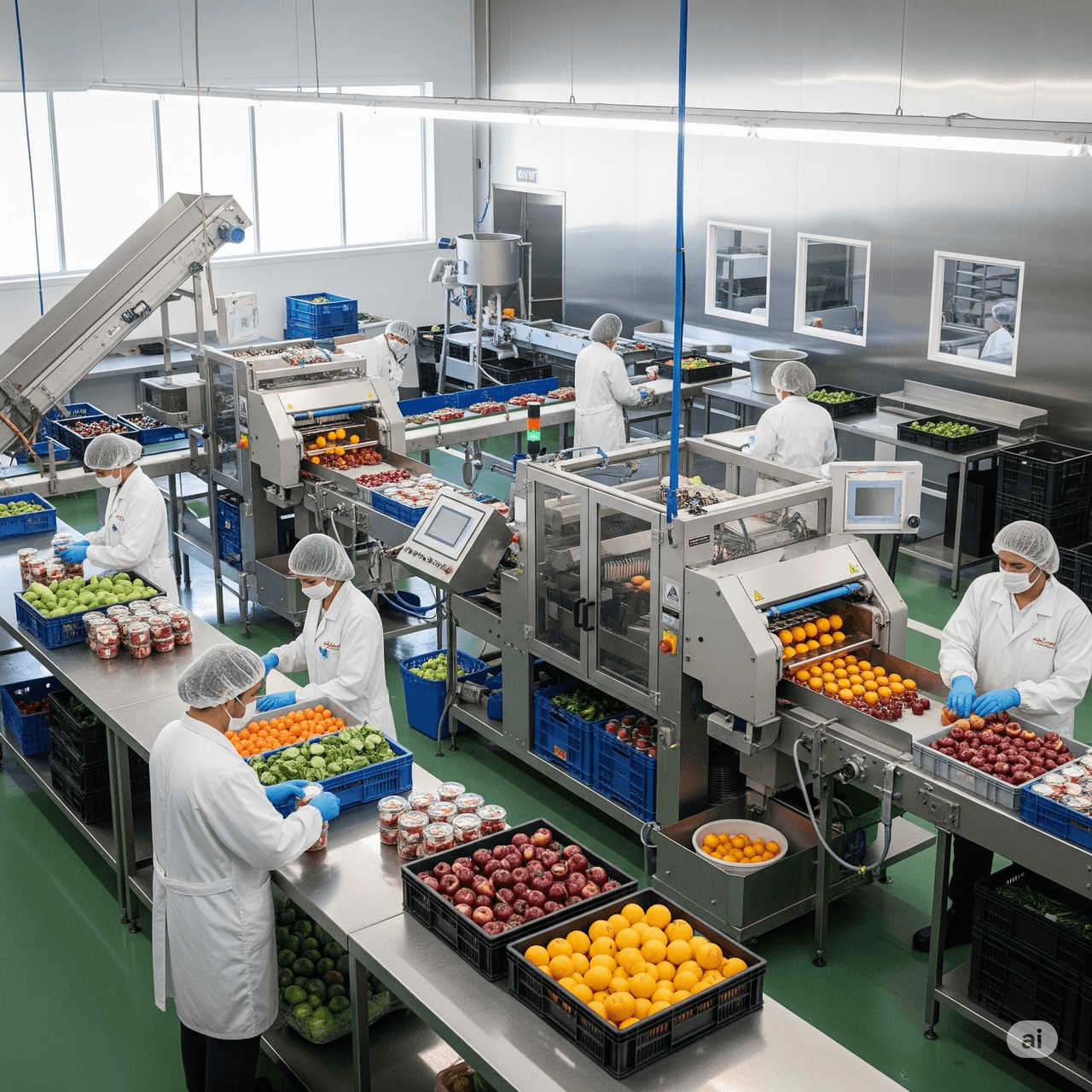
Agricultural Food Processing (Generated with Artificial Intelligence)
Definition(s) | The processing of agricultural raw materials into value-added food products ready for consumption. | ||||||||
|---|---|---|---|---|---|---|---|---|---|
Basic Objectives | Ensuring food safety, extending shelf life, preserving nutritional value, and enhancing flavor. | ||||||||
Main Stages | Agricultural production, processing, packaging, distribution and logistics, retail sales. | ||||||||
Subsectors | Meat, dairy, cereal products, fruits and vegetables, vegetable oils, sugary products, aquatic products. | ||||||||
Important Topics | Food safety, sustainability, technological innovations, waste management, quality control. | ||||||||
Agri-food processing is the process of transforming agricultural raw materials or products into consumable food items with extended shelf life, enhanced nutritional value, and improved flavor. This process represents a broad industrial activity encompassing various stages such as the processing, packaging, and distribution of agricultural products. Food processing converts raw agricultural inputs into different food forms and constitutes a fundamental component of the food chain, which spans a wide spectrum from farmers to manufacturers, suppliers to retailers, and ultimately to consumers. The core function of the sector is to process agricultural raw materials into healthy and high-quality food products and ensure their delivery to consumers in compliance with food safety standards.
The food processing industry consists of a series of organized steps extending from farm to table. This process covers all activities from the acquisition of raw materials to the delivery of the final product to the consumer and typically comprises the following key stages:
The process begins with agricultural production. Raw agricultural products such as fruits, vegetables, cereals, dairy, meat, and fish are cultivated and harvested on farms or production facilities. These products are then transported to food processing plants for further processing.
This stage is a central step in which raw agricultural products are converted into various food items. Operations include a wide range of applications such as cleaning, cutting, chopping, cooking, pasteurization, freezing, drying, and mixing. Food processing facilities may specialize in specific categories such as canned goods, dairy products, meat processing, cereal products, and beverages.
Processed food products are packaged under hygienic conditions to preserve freshness, facilitate transportation, and ensure safe delivery to consumers. Packaging protects products from external factors and is carried out using materials that comply with food safety standards.
Produced and packaged food products are transported from manufacturing facilities to retail outlets through food logistics, which includes storage, transportation, and distribution. In this stage, maintaining the cold chain is critical, especially for perishable items.
In the final stage of the process, food products are made available to consumers through supermarkets, grocery stores, restaurants, and other food service providers.

Food Packaging and Sales Processes (Generated by Artificial Intelligence)
Food processing is broadly categorized into two main groups: traditional and novel methods. These methods directly affect the properties, shelf life, and safety of food.
Traditional food processing methods form the foundation of food production and typically involve intensive thermal treatments. Techniques such as pasteurization, sterilization, drying, and fermentation fall into this category. These methods are widely used to eliminate microorganisms, ensure food safety, and extend product shelf life.
Technological advancements in the food industry have led to the emergence of novel non-thermal processing methods. Technologies such as high hydrostatic pressure, ultrasound, pulsed electric fields, irradiation, and plasma belong to this group. The most significant advantage of these new methods is that they cause minimal changes to the nutritional and sensory properties of food—such as taste, aroma, and texture—compared to traditional methods. However, these technologies also have disadvantages, including complex process parameters and high investment costs. Many of these methods are still in the phase of commercial adoption.
The food processing industry comprises a diverse range of subindustries and plays a significant role in the global economy. The main subsectors include:
This sector has substantial potential for job creation. It also serves as a vital source of added value and export revenue for agricultural-based economies.
The food processing industry adheres to strict standards and quality control procedures to protect consumer health. Food safety involves ensuring hygiene and safety standards throughout production processes. It is closely monitored by national and international institutions such as the U.S. Food and Drug Administration (FDA). Due to the prevalence of workplace accidents such as burns, cuts, and slips in processing facilities, the use of personal protective equipment (PPE) is mandatory for worker safety.
Organic food processing is subject to specific regulations. Organic processors must ensure product traceability and transparency, establish a robust documentation system, and clearly separate organic products from conventional ones. This separation is achieved through dedicated storage areas or production at different times. The use of genetically modified organisms (GMOs) and certain additives is prohibited in organic products.

Food Processing Processes (Generated by Artificial Intelligence)
Agri-food systems have significant environmental impacts. Between 2000 and 2022, greenhouse gas emissions from agri-food systems increased by 10 percent; approximately 54 percent of these emissions originated from livestock production. During the same period, pesticide use increased by 70 percent and inorganic fertilizer use by 37 percent. Water scarcity has become a critical issue threatening the sustainability of agricultural production, particularly in regions such as the Middle East and North Africa.
In response to these environmental pressures, new approaches such as circular bioeconomy are gaining importance. This approach aims to revalue waste and by-products generated during agricultural and food processing activities. For example, these wastes can serve as raw material sources for extracting valuable components such as proteins and bioactive peptides. This offers potential solutions to both economic and environmental challenges.
The food processing industry faces various challenges. In Türkiye, key issues include small-scale operations, underutilized capacity, deficiencies in sales and marketing organization, insufficient capital, and inadequate cold chain infrastructure. Globally, challenges include the adverse effects of climate change, sustainable use of water resources, preservation of soil productivity, and market fluctuations.
Despite these challenges, the industry continues to evolve and innovate. Future trends include:
Ansell. "Gıda İşleme." Ansell Türkiye. Accessed July 17, 2025. https://www.ansell.com/tr/tr/sectors/food-processing.
Dikçal Makina. "Gıda Sanayi." December 5, 2023. https://www.dikcalmakina.com/gida-sanayi.
EUROLAB Laboratuvar A.Ş. "Gıda Sektörü - Gıda İşlemesi." Denetim.com. Accessed July 17, 2025. https://www.denetim.com/sektorler/gida/gida-sektoru-gida-islemesi/.
Environmental Protection Agency (EPA). "Agriculture Sector Emissions." Accessed July 17, 2025. https://www.epa.gov/ghgemissions/agriculture-sector-emissions.
FAO. *Science and Innovation Day at the FAO Representation Office in the Kyrgyz Republic: Concept Note and Agenda*. Bishkek, Kyrgyzstan: FAO, 2023. Accessed July 29, 2025. https://openknowledge.fao.org/handle/20.500.14283/cc8050en.
FAO. Accessed July 17, 2025. https://www.fao.org/statistics/highlights-archive/highlights-detail/pesticides-use-and-trade-1990-2022/en.
Food and Agriculture Organization of the United Nations (FAO). *AQUASTAT Global Information System on Water and Agriculture*. Roma: FAO. Accessed July 17, 2025. https://www.fao.org/aquastat/en.
Food and Agriculture Organization of the United Nations (FAO). Pesticides Use and Trade: 1990–2022. Roma:
Food and Agriculture Organization of the United Nations. "Tarım-gıda sistemleri." FAO Knowledge Repository, 2021. https://openknowledge.fao.org/server/api/core/bitstreams/33637690-3388-4c7b-a383-c43655cf6b62/content.
Güneşer, Onur, and Buket Aydeniz Güneşer. "Gıda İşleme ve Yeni Teknolojiler." In *Gıda Endüstrisi ve Beslenmede Yeni Akımlar*, edited by S. Karakaya, 1–20. Ankara: Türkiye Klinikleri, 2024. https://www.turkiyeklinikleri.com/article/tr-gida-isleme-ve-yeni-teknolojiler-108115.html.
Index Copernicus Journals. "Tarımsal Gıda Tedarik Zinciri Alanındaki Yayınların Bibliyometrik Analizi." Accessed July 17, 2025. https://journals.indexcopernicus.com/api/file/viewByFileId/1958172.
Indusren. "TARIM VE GIDA İŞLEME." Accessed July 17, 2025. https://indusren.com/tr/agriculture-and-food-processing/.
Kayos Belgelendirme. "Gıda İşleme." Accessed July 17, 2025. https://www.kayos.com.tr/gida-isleme/.
Klasser. "Gıda & Tarım & Hayvancılık." Accessed July 17, 2025. https://www.klasser.com.tr/gida-tarim-hayvancilik.
TSKB. *Sürdürülebilir Gıda Sistemleri Tema Raporu*. March 2022. https://www.tskb.com.tr/uploads/file/tskb-bakis-surdurulebilir-gida-sistemleri.pdf.
Tubiello, Francesco N., et al. "Greenhouse Gas Emissions from Agrifood Systems: Global, Regional and Country Trends 2000–2022." ResearchGate. Accessed July 17, 2025. https://www.researchgate.net/publication/385813016_Greenhouse_gas_emissions_from_agrifood_systems_Global_regional_and_country_trends_2000-2022.
Xu, Yunan, and Yiyuan Chen. “The Agrochemical Complex of China: Historical, Global and Intersectoral Connections.” *The Journal of Peasant Studies* 52 (2024): 1–28. https://doi.org/10.1080/03066150.2024.2429477.
Yay, Cansu, Kevser Betül Kalyon, and Müge İşleten Hoşoğlu. "Tarımsal ve Gıda İşleme Atık/Yan Ürünlerinden Döngüsel Biyoekonomi Çerçevesinde Protein Hidrolizat/Peptitlerin Eldesi ve Biyoaktif Özelliklerine Genel Bir Bakış." In Gıda Endüstrisi ve Beslenmede Yeni Akımlar, edited by S. Karakaya, 67–74. Ankara: Türkiye Klinikleri, 2024. https://www.turkiyeklinikleri.com/article/tr-tarimsal-ve-gida-isleme-atikyan-urunlerinden-dongusel-biyoekonomi-cercevesinde-protein-hidrolizatpeptitlerin-eldesi-ve-biyoaktif-ozelliklerine-genel-bir-bakis-108121.html.

Agricultural Food Processing (Generated with Artificial Intelligence)
Definition(s) | The processing of agricultural raw materials into value-added food products ready for consumption. | ||||||||
|---|---|---|---|---|---|---|---|---|---|
Basic Objectives | Ensuring food safety, extending shelf life, preserving nutritional value, and enhancing flavor. | ||||||||
Main Stages | Agricultural production, processing, packaging, distribution and logistics, retail sales. | ||||||||
Subsectors | Meat, dairy, cereal products, fruits and vegetables, vegetable oils, sugary products, aquatic products. | ||||||||
Important Topics | Food safety, sustainability, technological innovations, waste management, quality control. | ||||||||
No Discussion Added Yet
Start discussion for "Agricultural Food Processing" article
Agri-Food Processing Processes and Stages
Agriculture and Food Production
Food Processing and Manufacturing
Packaging and Packaging
Distribution and Logistics
Retail Sales and Consumption
Food Processing Methods
Traditional Methods
New Technologies
Subsectors of the Food Processing Industry and Its Economic Importance
Food Safety, Quality Control, and Regulations
Sustainability and Environmental Impacts
Challenges and Future Trends in the Industry