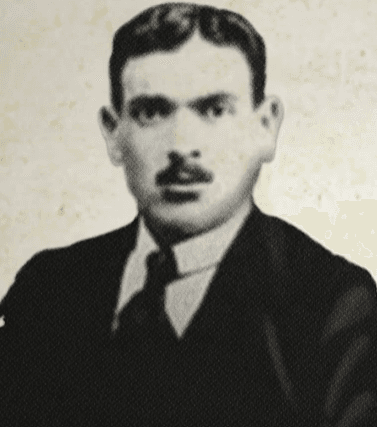



Real Surname | Ahundzade | ||||||||
|---|---|---|---|---|---|---|---|---|---|
Pen Name | Cevat | ||||||||
Doğum tarihi | 1892-01-05 | ||||||||
Place of Birth | Gence or Şemkir/Seyfeli nahiyesi, Mehirli village | ||||||||
Annesi | Yahşı (Yaxşı) Hanım | ||||||||
Babası | Imam Mehmed Ali Bey | ||||||||
Education | Madrasa education in Gence | ||||||||
Teaching Authorization | Diploma in Turkish and Persian teaching in 1913 | ||||||||
Profession(s) | Poet journal and publishing house manager translator teacher | ||||||||
Most Famous Works | National Anthem of Azerbaijan, Çırpınırdın Karadeniz Poem | ||||||||
Cause of Death | Punished by the Soviets for his Turkist views | ||||||||
Opinions Regarding Date of Death | 13 October 1937 or 13 November 1937 | ||||||||
Ahmet Cevat was born on 5 May 1892. His original surname is Ahundzade. His place of birth is recorded in sources as the city of Ganja or the village of Mehirli in the Seyfeli subdistrict of Şemkir.
The Vefa Evening Held in Memory of Ahmet Cevat (TRT News)
His mother was Yahşı (Yaxşı) Hanım and his father was Imam Mehmed Ali Bey, a respected religious figure in the region. He received his initial religious education from his father and began reading and memorizing the Qur’an at an early age. After his father’s death when he was eight, he moved with his mother to live with relatives.
During his childhood, he participated in intellectual and spiritual gatherings supported by his family’s standing and his father’s guidance, developing an exceptional memory and rhetorical ability at an early age.
His formal education began in 1906 at the madrasas of Ganja.
Cevat’s formal education commenced after his father’s death at the madrasa attached to the Şah Abbas Mosque in Ganja, where he became a student of intellectuals such as Hüseyin Cavit, Abdullah Sur, and Idris Ahundzade.
At the madrasa, he studied Arabic, Persian, and Russian and began translating works from these languages. He wrote his first poems in 1910 and published a translation of a story by Tolstoy in 1911. His madrasa studies ended in 1912, and in 1913 he received a diploma certifying him as a teacher of Turkish and Persian, signed by the Caucasian Sheikh al-Islam Pişnamazzade. His first postings were in Ganja, Quba, and Baku.
Between 1915 and 1920, he taught Turkish and Russian in Şemkir, Gedebey, Zakatala, and Ganja; between 1920 and 1922, he taught in Gusar. He occasionally held positions as school principal and provincial director of national education.
He completed his higher education through in-service programs at the Workers’ Faculty (1922) and the Ali Pedagogical Institute (1925). Between 1927 and 1934, he taught Azerbaijani Turkish language and literature at higher education institutions and institutes in Baku and Ganja, during which he earned the titles of associate professor and professor.
His identity as an educator also influenced curriculum development; he participated in designing the syllabi for schools opened by Azerbaijani Turkish intellectuals.
He was also active in journals and publishing houses. From 1924 to 1926, he served as chief writer for the Baku Literary Society; from 1925 onward, he directed the journal İnkılap ve Medeniyet; and in 1935 he was appointed to the Azerbaijan State Publishing House in Baku.
In 1912, Ahmet Cevat enlisted in the “Caucasian Volunteer Contingent” organized in Istanbul and served as a volunteer in the Ottoman Army during the Balkan Wars.
In his interrogation record, he stated that he entered Türkiye using a Persian passport obtained through a Greek intermediary in Batum, was accepted into the volunteer group alongside Idris Ahundzade and Isa Alizade, participated in battles against Bulgarian forces, and returned to Russia in the autumn of 1913. Some sources indicate that his volunteer service took place on the Thrace front.
This period also strengthened his intellectual ties with Türkiye. Some accounts mention that he met Yusuf Akçura and was encouraged to return to his homeland after the war.
In the spring of 1915, Ahmet Cevat arrived in Kars as a member of the Türkiye branch of the Baku Muslim Society Hayriye, which aided war victims. As the society’s special representative, he served as assistant and responsible secretary to the front delegate Hüsrev Paşa Bey, traveling across regions, compiling lists of war victims, distributing material aid, visiting wounded and captured Ottoman soldiers to monitor their needs, identifying priority requirements such as hospitals, schools, mosques, and orphanages in the region, reporting them to headquarters, and personally assisting in their fulfillment. During these humanitarian activities across a large part of Eastern Anatolia, he observed the conditions of the civilian population and reflected them in his poetry.
He published his field observations in an article titled “The Work Seen by the Kars Delegation,” sent from Soğanlık on 31 March 1915 to the İkbal newspaper in Baku.
The central theme in Ahmet Cevat’s poetry is the idea of homeland and nation. Concepts of unity, sacrifice, and flag symbolism are particularly prominent in poems such as “Azerbaijan March” and “You Stirred, Black Sea.” In these works, he intertwined feelings of freedom and resistance with the foundational elements of national identity.
In language and style, his aim was to produce a clear and accessible Turkish capable of reaching broad audiences. He maintained a critical stance against foreign word usage and linguistic carelessness. The critical tone in his poem “Dilimiz” reflects his views on purifying the Turkish language and adopting correct orthography.
His thematic range is not limited to nationalism. His roles as educator, journalist, soldier, and “a grieving father” resonate in his lyrical poetry. Personal pain and love are expressed lyrically in texts such as “Şükrüyem İçin” and “Elmasım İçin.” Some poems narrate the drama of those subjected to political repression and oppression. “Sesli Kız” and “Müellim” are examples of this line of thought.
The poet’s sensitivity is grounded not only in local patriotism but also in a solidarity extending to the broader “Turkic world.” This perspective was nourished by his volunteer military service and experiences in Anatolia, taking shape in his poetry as a vibrant social consciousness.
Ahmet Cevat sought to make Turkish “simple and comprehensible” by criticizing foreign word usage, a position he clearly articulated in his poem “Dilimiz.” He regarded the defense of correct orthography and spelling as a cultural issue and proposed views on linguistic unity and literacy.
In his poetry, he sometimes transformed narrative into the form of a “poem” (lyrical narrative); in texts such as “Sesli Kız” and “Müellim,” he treated oppression and social injustice through dramatic storytelling. His inclination toward lyricism became more pronounced during periods of political repression; these poems drew attention through powerful expression and apt figurative language. Symbolism, particularly through signs such as “moon and star,” enabled him to construct a discourse evoking national sentiment; the poem “Göy Göl” is regarded as a turning point in this regard. The rhythm and diction of the national anthem text are built on repetitions that elevate patriotic fervor and imperative or call-to-action structures. His vocabulary and imagery are extensive. His lyrical discourse, constructed around motifs of flag, army, and homeland, unites personal grief (as expressed in poems dedicated to his wife and daughter) with collective emotion.
His poetry collections include Koşma (1916, published on behalf of Hayriye Society), Dalga (1919), and early works compiled in Medrese Şiirleri and Şükriyename, as well as Kuk-kulu-gu, written for children. He also authored a work on language instruction titled Sarf ve Nahiv (Arabic grammar).
Among his poems of national anthem stature, “Azerbaijan Homeland March” stands out. The text was published in 1919 in Milli Nağmeler and later, after being set to music, became the Azerbaijan National Anthem. “You Stirred, Black Sea” is another symbolic work that gained wide circulation.
Performance of “You Stirred, Black Sea,” with Lyrics by Ahmet Cevat (TRT Avaz)
His articles and letters written during the war years, including “The Work Seen by the Kars Delegation” (İkbal, 14 April 1915), “Letters from Adjara,” “Language in Adjara,” “Help for the Laz,” “From the Suhum Road,” “Victims of the Rize and Trabzon Disasters,” “From the Batum Muslim Unity Society,” and “Georgian Press and Adjara,” were published in the Baku press.
His translations form a broad selection from classical and modern world literature. He translated Shakespeare’s Othello and Romeo and Juliet; Şota Rustaveli’s The Man in the Panther Skin; Turgenev’s Fathers and Sons; Pushkin’s “The Tsar’s Dead Daughter and the New Wrestler,” “The Red Rooster,” and The Bronze Horseman; Lermontov’s “To the Courtier” and “To the Nobility”; Georg Weerth’s “Only Eighteen Years Old”; and La Fontaine’s “The Council of the Mice” and “The Funeral of the Lioness.”
Ahmet Cevat is the author of the lyrics for the “Homeland March” published in 1919 by the state press in Milli Nağmeler. The text was later set to music by composer Üzeyir Hacıbeyov with some modifications, becoming the Azerbaijan National Anthem. Competitions held during the People’s Republic period for a national anthem could not be concluded due to the occupation on 27 April 1920. After the interruption during the Soviet era, the anthem with lyrics by Ahmet Cevad and music by Üzeyir Hacıbeyov was officially adopted by the Azerbaijan National Assembly on 27 May 1992.
Azerbaijan National Anthem with Lyrics by Ahmed Cevad ()
During the Soviet period, Ahmet Cevat became a target of investigations into “nationalism/panturkism.” His first detention began in 1923 on suspicion of association with the case of Mirza Bala Mehmedzade, who allegedly fled to Türkiye using a forged passport.
The publication of his poem “Göy Göl” in 1925 triggered accusations of “Turkist propaganda” due to its use of the crescent and star symbolism, leading Cevad to be arrested multiple times under various pretexts after this date.
Throughout the 1930s, he was interrogated under cases labeled as “enemy of the people/nationalist.” In 1937, his home was ransacked, and a significant portion of his manuscripts and books were destroyed.
He was tried before the Military Collegium of the Supreme Court of the Soviet Union on charges of opposing the regime, nationalism, and connections with separatist organizations. His trial lasted only a short time, and he was not assigned a defense counsel.
Sources cite two different dates for his execution. He is believed to have been shot in Baku on the night of 13 October 1937 or sentenced to death and executed on 13 November 1937. Some accounts claim he was beaten to death in Bayıl Prison.
The accusation of “traitor to the homeland” leveled against Ahmet Cevat was lifted in 1955 after the Soviet Prosecutor General’s Office reviewed its files, and his innocence and acquittal were formally recognized.
During the period when his works were banned, their publication and reading were prohibited; a significant portion of surviving copies were preserved within his family circle, and his manuscripts were transferred to the Institute of Manuscripts named after Fuzûlî at the Azerbaijan National Academy of Sciences in Baku.
After rehabilitation, his first poetry anthology was published in 1958; subsequent years saw successive editions of selected works. With Azerbaijan’s declaration of independence on 18 October 1991, research and publication activities concerning Cevad significantly increased, and his poems and writings were republished in new editions.
Anadolu Ajansı. "Çırpınırdı Karadeniz"in şairi Ahmet Cevat, vefatının 84. yılında anılıyor." Accessed September 25, 2025. https://www.aa.com.tr/tr/kultur-sanat/cirpinirdi-karadenizin-sairi-ahmet-cevat-vefatinin-84-yilinda-aniliyor/2390700
Esen, Suna. *Ahmet Cevat’ın Şiirlerinin Söz Yapımı Açısından İncelenmesi.* Master's thesis, Ankara Hacı Bayram Veli Üniversitesi, Lisansüstü Eğitim Enstitüsü, August 2019. https://tez.yok.gov.tr/UlusalTezMerkezi/TezGoster?key=npGs9H39x7G6401x51yqpJe5RYwi-3_BOeW_lmCNeAqkFwGZizyt1FSRYsRpFyvI
Güzel, Kenan. *Ahmet Cevat’ın Hayatı, Eserleri ve Edebi Şahsiyeti.* Master's thesis, Qafqaz University, Institute of Sciences, Department of Turkish Language and Literature, Baku, 2005. https://tez.yok.gov.tr/UlusalTezMerkezi/TezGoster?key=X-M9ZoIuIoNTj2P7iY13hXF9mJTZmN88DNI2tmQjMgwDKqgwMDsEfc9-zAVxuf2f
Memmedli-Saraçlı, Afina. “Azerbaycanlı Şair Ahmed Cevad’ın Kars Serüveni.” *Sosyal Bilimler Enstitüsü Dergisi*, no. 1 (Spring 2008): 167–174. https://www.kafkas.edu.tr/dosyalar/sobedergi/file/01%20(11).pdf
Mimar Gökhan Demir Youtube Kanalı. "Azerbaycan ve Türkiye İstiklal marşları- TİAP programında Azerin seslendirdi." Accessed September 25, 2025. https://www.youtube.com/watch?v=rKTWx8jRfR8&list=RDrKTWx8jRfR8&start_radio=1
TRT Haber YouTube Channel. "TRT'den Ahmet Cevad anısına vefa gecesi." Accessed September 25, 2025. https://www.youtube.com/watch?v=1C2Dj0kr6-Y

Real Surname | Ahundzade | ||||||||
|---|---|---|---|---|---|---|---|---|---|
Pen Name | Cevat | ||||||||
Doğum tarihi | 1892-01-05 | ||||||||
Place of Birth | Gence or Şemkir/Seyfeli nahiyesi, Mehirli village | ||||||||
Annesi | Yahşı (Yaxşı) Hanım | ||||||||
Babası | Imam Mehmed Ali Bey | ||||||||
Education | Madrasa education in Gence | ||||||||
Teaching Authorization | Diploma in Turkish and Persian teaching in 1913 | ||||||||
Profession(s) | Poet journal and publishing house manager translator teacher | ||||||||
Most Famous Works | National Anthem of Azerbaijan, Çırpınırdın Karadeniz Poem | ||||||||
Cause of Death | Punished by the Soviets for his Turkist views | ||||||||
Opinions Regarding Date of Death | 13 October 1937 or 13 November 1937 | ||||||||
Family Origins and Childhood
Education and Career
Volunteer Military Service in the Ottoman Empire
Years of the First World War
Literary Characteristics
Works and Translations
Connection to the Azerbaijan National Anthem
Political Repression, Arrests, and Assassination
Restoration of Reputation and Aftermath