


+2 More

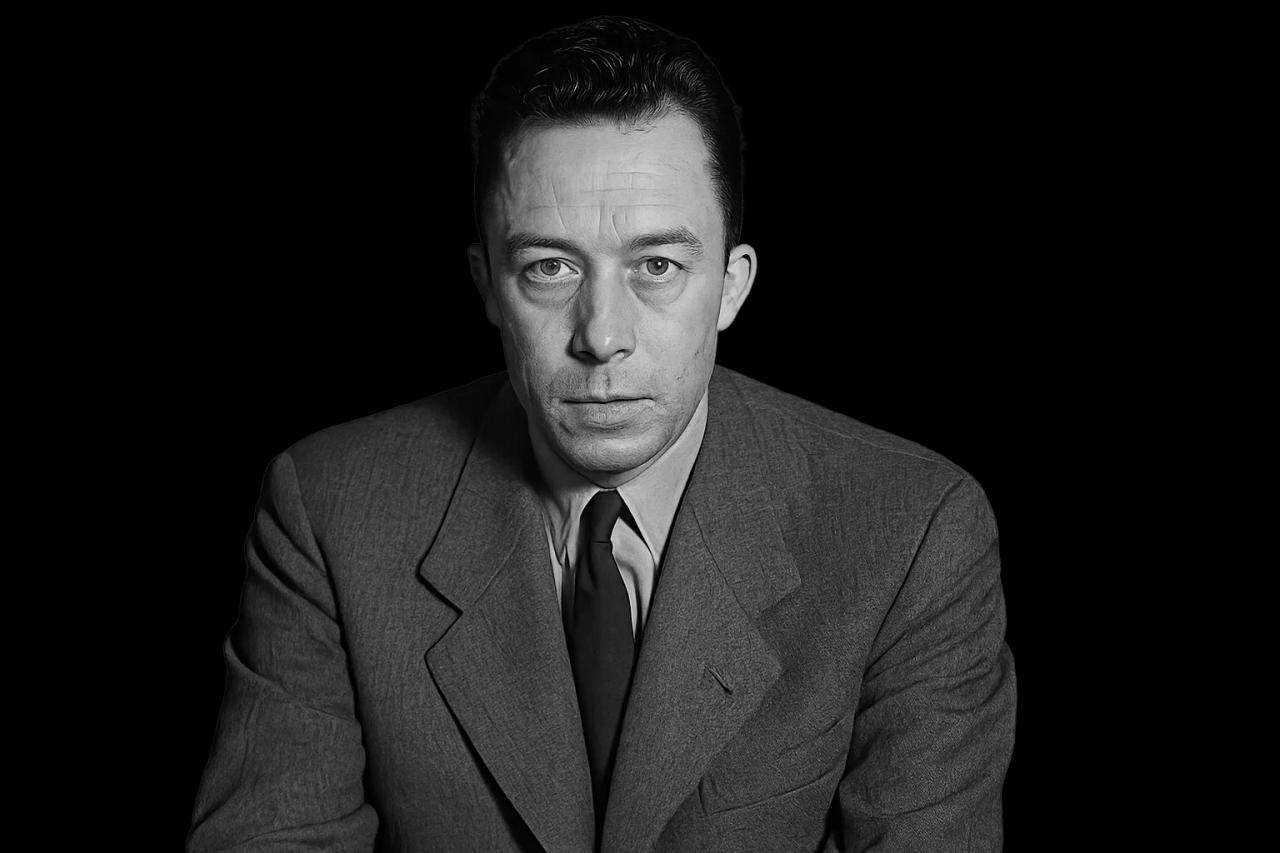
Albert Camus (generated by artificial intelligence).
Birth | 7 November 1913, Mondovi, French Algeria | ||||||||
|---|---|---|---|---|---|---|---|---|---|
Death | 4 January 1960, Sens, France | ||||||||
Nationality | French | ||||||||
Occupation(s) | Writer thinker journalist | ||||||||
Types of Works | Novel, essay, theater, article | ||||||||
Philosophical Concepts | Absurd, rebellion, existence, freedom | ||||||||
Award Received | Nobel Prize in Literature (1957) | ||||||||
Language(s) | French | ||||||||
Albert Camus (1913–1960) is one of the leading writers, essayists, journalists, and thinkers in French literature and intellectual history. His works explore themes such as human existence, freedom, justice, the search for meaning, and rebellion. He was awarded the Nobel Prize in Literature in 1957. The prize was granted for his “important literary production, which with clear-sighted earnestness illuminates the problems of the human conscience in our time.”

Albert Camus (Generated by Artificial Intelligence.)
Albert Camus was born on 7 November 1913 in the town of Mondovi, French Algeria. His father, Lucien Auguste Camus, was a French-origin worker employed at a winery. His mother, Catherine Sintes Camus, was a factory worker of Spanish descent. His father died from wounds sustained during the Battle of the Marne in World War I. The only information Camus ever had about his father was that he had fallen ill after witnessing an execution and subsequently died. This event profoundly influenced his later opposition to the death penalty.
After his father’s death, Camus moved with his mother to the Belcourt district of Algiers, where he lived with his grandmother and uncle. His mother was illiterate and partially deaf. Camus described this period as one of poverty, silence, and light. He completed his primary education at Ecole Communale and, with the support of his teacher Louis Germain, won a scholarship to attend Grand Lycée. During this time he studied Latin and English and developed an interest in literature and theater.
In 1932 he enrolled at the University of Algiers, where he studied philosophy and earned certificates in sociology and psychology. He graduated in 1936 with a thesis titled Plotinus and Augustine on the Concept of God, in which he examined the relationship between Greek philosophy and Christian thought.
In 1935 Camus founded the theater group Théâtre du Travail, where he worked as an actor, director, and playwright. In 1938 he reorganized his theater under the name Théâtre de l’Équipe. That same year he began working as a reporter for the newspaper Alger Républicain, publishing articles on the living conditions of Algerians, poverty, and inequality. His series of articles titled “Kabylie Reports” offered a critique of the colonial system in Algeria.
In 1937 his first work, L’Envers et l’endroit (The Reverse and the Front), was published. In 1938 he released the essay collection Noces (Nuptials), which explored the transience of life and the bond with nature in the Mediterranean region. During this period he continued his activities in theater, philosophy, and journalism simultaneously.
In 1940 Camus moved to France. During World War II he participated in the French Resistance. From 1943 to 1947 he served as chief editor of the resistance newspaper Combat. His wartime articles emphasized themes of freedom, justice, and humanity. In 1942 he published the novel L’Étranger (The Stranger) and the philosophical essay Le Mythe de Sisyphe (The Myth of Sisyphus). These two works laid the foundation for his concept of the absurd. During the same period he wrote the plays Caligula and Le Malentendu (The Misunderstanding).
After the war, Camus continued his work at Combat. His 1947 novel La Peste (The Plague) is widely regarded as an allegory of the Nazi occupation. In 1951 he published the essay L’Homme Révolté (The Rebel), in which he examined revolution, freedom, and human dignity, while opposing violence and ideological dogmatism. These views led to a major intellectual rift with the leftist circles of his time and with Jean-Paul Sartre.
In 1956 he published the novel La Chute (The Fall), which deals with themes of guilt, judgment, and the human confrontation with oneself. In 1957 he released the short story collection Exil et le Royaume (Exile and the Kingdom). That same year he received the Nobel Prize in Literature.
Camus died on 4 January 1960 in a car accident near Sens. The driver, his publisher Michel Gallimard, also died in the crash. In Camus’s bag was the handwritten manuscript of his unpublished novel Le Premier Homme (The First Man).
Camus viewed journalism as an ethical responsibility. In his writings for Combat, he addressed themes of freedom, resistance, human rights, and justice. During the war, his series of articles titled “Letters to a German Friend” defended ideals of freedom and humanity.
In Camus’s thought, the absurd is the contradiction between the human search for meaning and the silent indifference of the world. In Le Mythe de Sisyphe, he systematized this concept. Beginning with the statement “There is but one truly serious philosophical problem, and that is suicide,” the essay argues not for rejecting life’s meaninglessness but for accepting it. The stone Sisyphus endlessly rolls up the hill symbolizes the human act of confronting fate with full awareness.
Although often associated with existentialism, Camus never identified himself as an existentialist. Unlike Jean-Paul Sartre, he viewed human freedom not as liberation but as the burden of existence. For Camus, one can live authentically in a godless world by accepting the absurdity of life. This acceptance requires rejecting suicide and returning to life.
In L’Homme Révolté, Camus defines rebellion as an ethical act of the individual. Rebellion is the individual’s resistance against both their own fate and oppression. It is not a destructive act but a movement of solidarity on behalf of humanity. The purpose of rebellion is to protect the individual and others.
Camus rejected the existence of God and characterized religious hope as an escape from worldly reality. In Noces he expressed this view with the phrase “The world is beautiful and there is no salvation outside it.” In his philosophy, hope is an illusion that distances the individual from concrete experience in this world.
In Camus’s works, the concepts of humanity, freedom, and solidarity are interwoven. The character Dr. Rieux in La Peste represents the conscious individual who resists evil. For Camus, even in the absence of meaning, human beings must live in solidarity.
On 10 December 1957, in his Nobel Prize acceptance speech in Stockholm, Albert Camus defined the artist’s duty as “service to truth and freedom.” He emphasized that the artist must not remain silent in the face of oppression and injustice. “The writer must serve those who suffer from history, not those who make it,”【1】 he said, expressing this philosophy.
After the war, Camus maintained close ties with thinkers such as Jean-Paul Sartre and Simone de Beauvoir. However, after the publication of L’Homme Révolté, he experienced a major intellectual break with Sartre. The core of this disagreement lay in Camus’s anti-violent, morally grounded approach versus Sartre’s view of historical necessity.
After Albert Camus’s death, Le Premier Homme (The First Man) was published. It is an autobiographical text centered on his childhood and roots in Algeria. In a tribute published after Camus’s death, Jean-Paul Sartre described him as “a writer who defended the dignity of humanity.”
Aydınalp, Esra Başak. “Albert Camus’da Saçma Kavramı – Sisifos’u Mutlu Düşünmek.” *Söylem Filoloji Dergisi* 5, no. 2 (2020): 529-540. https://doi.org/10.29110/soylemdergi.781867
Beyazyüz, Selim. “Albert Camus’nün Varoluşçuluk, Yabancılaşma ve Absürd Kavramlarının Jean-Paul Sartre Özelinde Sinema Anlatıları Üzerinden Okunması.” *International Journal of Cultural and Social Studies* 6, no. 1 (2020): 300-313. https://dergipark.org.tr/tr/pub/intjcss/issue/55225/741256
Cengiz Karataş. “Ana Çizgileriyle Varoluşçuluk ve Türk Edebiyat ve Fikir Hayatındaki Yansımalarına Bir Bakış.” *Akademik Dil Ve Edebiyat Dergisi* 5, no. 4 (2021): 2463-2479. https://doi.org/10.34083/akaded.1007385
Internet Encyclopedia of Philosophy. “Albert Camus.” IEP. Accessed October 16, 2025. https://iep.utm.edu/albert-camus/
NobelPrize.org. "Albert Camus Facts." The Nobel Prize. Accessed October 16, 2025. https://www.nobelprize.org/prizes/literature/1957/camus/facts/
NobelPrize.org. "Albert Camus – Nobel Lecture (1957)." The Nobel Prize. Accessed October 16, 2025. https://www.nobelprize.org/prizes/literature/1957/camus/speech/
Plato Stanford Encyclopedia. "Camus, Albert." Stanford Encyclopedia of Philosophy. Accessed October 16, 2025. https://plato.stanford.edu/entries/camus/
The Atlantic. "Albert Camus, A Good Man." The Atlantic, May 1958. Accessed October 16, 2025. https://www.theatlantic.com/magazine/archive/1958/05/albert-camus-a-good-man/640286/
[1]
NobelPrize.org, “Albert Camus – Nobel Lecture (1957),” The Nobel Prize, erişim 16 Ekim 2025, https://www.nobelprize.org/prizes/literature/1957/camus/speech/

Albert Camus (generated by artificial intelligence).
Birth | 7 November 1913, Mondovi, French Algeria | ||||||||
|---|---|---|---|---|---|---|---|---|---|
Death | 4 January 1960, Sens, France | ||||||||
Nationality | French | ||||||||
Occupation(s) | Writer thinker journalist | ||||||||
Types of Works | Novel, essay, theater, article | ||||||||
Philosophical Concepts | Absurd, rebellion, existence, freedom | ||||||||
Award Received | Nobel Prize in Literature (1957) | ||||||||
Language(s) | French | ||||||||
Life
Childhood and Youth
Journalism and Theater Work
World War II and the Resistance
Postwar Period
Works
Novels
Philosophical Essays
Theatrical Works
Journalism and Articles
Philosophy
The Concept of the Absurd
Existence and Distinction from Sartre
The Concept of Rebellion
Religion, Hope, and Nihilism
Humanity and Solidarity
Artistic Vision and Nobel Lecture
Relationships with Contemporaries
After His Death