


This article was automatically translated from the original Turkish version.
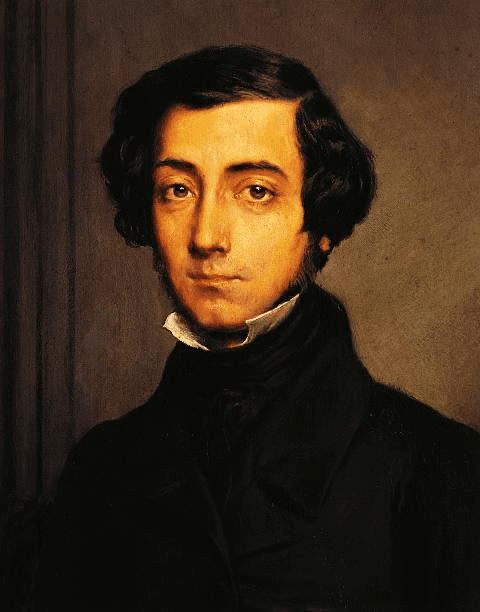
Alexis Charles Henri Maurice Clérel de Tocqueville was born on 29 July 1805 in Paris, France, and died on 16 April 1859 in Cannes. A member of a French aristocratic family, Tocqueville is recognized as a scientist, thinker, historian, and politician. His family had a noble lineage that suffered execution during the French Revolution. This situation profoundly influenced his engagement with themes of aristocratic privilege, societal transformation, and the future of democracy like within his intellectual world importance.
Tocqueville gained widespread recognition for his work Democracy in America (De la Démocratie en Amérique), written after his journey to the United States in the 1830s (Volume I published in 1835, Volume II in 1840). This work is regarded as one of the most profound studies of the nature of democracy in the West world. His deep reflections on the functioning and weaknesses of democratic regimes form the core of his arguments. Additionally, he served as Minister of Foreign Affairs during the Second French Republic established after the 1848 Revolution. During this period, he actively participated in efforts to restructure and modernize French politics place.
Another of his major works is The Old Regime and the Revolution (L'Ancien Régime et la Révolution) (1856). This study analyzes the origins and social transformation of the French Revolution, detailing the underlying conditions that led to it. Through his analyses of democratization and societal change, Tocqueville developed intellectual methods that transcended his era. His contributions to social and political history provided significant insights into the formation of Western social thought.
Alexis de Tocqueville was born into an aristocratic family. His father, Hervé-Louis-François-Jean Bonaventure Clérel, was a nobleman known as the Duke of Chateaubriand and a monarchist loyal to the Bourbon dynasty. The Tocqueville family roots in Normandy, western France, trace back to a long-standing aristocratic heritage. His mother, Louise Madeleine Le Peletier de Rosanbo, belonged to another distinguished French noble family. During the French Revolution, his family faced severe threats; his mother and other relatives were tried by revolutionary courts and sentenced to death. Punishment The sentence was not carried out at the last moment, and the family survived. These experiences fostered in Tocqueville a deep sensitivity toward issues of nobility, society, and revolution.
He began his education at the Collège de Metz, one of the most prestigious schools of the time. There he received classical training, focusing on history, law and political science, building an intellectual foundation. University He continued his education at the law faculty in Paris. Legal education deepened his interest in the legal foundations of social and political structures and significantly contributed to his later political and intellectual career.
After completing his legal studies, Tocqueville was appointed as a judge in Versailles in 1827. During this early stage of his life, he began to engage with the tensions between monarchy and constitutional government, advocating for constitutional reforms. His early interest in liberal and constitutional ideas intensified with the political developments in France. During this period, he began to articulate his critiques and observations on France’s democratization efforts to the public.
In 1831, Alexis de Tocqueville traveled to the United States with his friend Gustave de Beaumont on an official study mission. The stated purpose of the journey was to examine the American prison system and report on its potential for reform in France. However, Tocqueville stated that his true aim was to observe American social and political structures in depth and draw lessons for France’s own democratization process. During his approximately nine moon stay in America, he visited numerous cities including New York, Boston, Philadelphia, Baltimore, Cincinnati, and New Orleans.
Tocqueville thoroughly examined the democratic structure of American society, the functioning of local governance, and the influence of religion on social life. Throughout his stay, he met with numerous politicians, intellectuals, and ordinary citizens, accumulating a broad information body of knowledge. He made significant observations by contrasting the egalitarian and participatory nature of American democracy with the monarchical and hierarchical systems of Europe. These observations formed the foundation of his masterpiece, Democracy in America (De la Démocratie en Amérique). In this seminal work, notable for its foundational role in the social science tradition, he analyzed the advantages, dangers, and potential future developments of modern democratic societies, making major contributions to political thought.
In 1839, Alexis de Tocqueville entered the French National Assembly as a deputy representing the Manche department in Normandy. At the time, France was undergoing intense political struggles between monarchy and republicanism. Tocqueville, known for his liberal views, positioned himself between monarchy and republic, seeking balance. During the 1848 Revolution, he supported the establishment of the Second Republic and briefly served as Minister of Foreign Affairs, playing an active role in the new constitution initiatives.
His political career included both rises and falls. Due to his strong commitment to intellectual independence, he often found himself isolated within political parties. His loyalty to parliamentary function led to his withdrawal from politics after the Bonaparte coup. Opposing Louis-Napoleon Bonaparte’s 1851 coup, Tocqueville was forced to withdraw from political life due to his opponent stance. He participated in influential debates in parliament on democracy, individual rights, and centralization. He advocated strengthening local governance against centralization and emphasized the need to protect individual rights against the tyranny of the majority. This approach mirrored his observations on American democracy. Tocqueville’s ideas exerted significant intellectual influence on France’s political transformation process, but his turbulent political career prevented him from fully realizing his ideals in active politics.
The work that brought Tocqueville great intellectual fame, De la Démocratie en Amérique (Democracy in America), was published in two volumes in 1835 and 1840. Tocqueville examined the social, political, and cultural functioning of the democratic system in the United States with the aim of illuminating democratization processes in Europe. The book analyzes how democracy became institutionalized in America and how social equality shaped social life.
The first volume details the political structure of American society, the operation of the federal system, the role of local governance, and the influence of civil society. The second volume addresses the impact of democracy on individual freedoms, equality, and social structure. Tocqueville warns of the risk that democracy may lead to the tyranny of the majority and emphasizes the importance of safeguarding individual liberties.
In the second volume, he focuses on how democratic societies shape individual thought, emotions, and daily life. Tocqueville elaborates on how the pursuit of equality transforms mental habits, family structures, and social relations. According to him, the quest for equality in democratic societies can weaken interpersonal bonds and intensify individualism. Yet this may also lead to the dangerous risk of excessive individualism and growing indifference to public affairs. Tocqueville stresses the need to encourage social ties and civil participation to counter the isolating effects of democracy. In this context, he particularly highlights the importance of associations and local governance in strengthening social cohesion.
Democracy in America also made methodological contributions to the social sciences. This contribution is evident in Tocqueville’s approach to democracy not merely as a form of government but as a phenomenon shaping the social and cultural fabric of societies. His comparative analyses advanced methodological approaches in the social sciences and offered a conceptual framework for understanding democratic societies. By treating democracy not only as a system of governance but also as a social form, Tocqueville’s work remains a vital reference in political science and sociology.
Alexis de Tocqueville’s 1856 work, L’Ancien Régime et la Révolution, provides a historical and sociological framework for understanding and evaluating the French Revolution. In this work, Tocqueville examines the structure of the Old Regime in France, the social and administrative problems that prepared the ground for revolution, and the revolution’s fundamental dynamics. His major contribution to the study of the French Revolution was to move beyond the prevailing view of the revolution as a rupture, instead explaining how the old monarchical structures gradually filtered into the new societal demands.
The book consists of two main parts. In the first, Tocqueville details the centralized structure of the Old Regime, its bureaucracy, and administrative mechanisms. He reveals a system in which local governance had weakened and a powerful central authority had emerged. In the second part, he discusses how the French Revolution inherited this centralized structure and attempted to establish a new system of governance. Tocqueville notes that while the revolution embraced principles of equality, it simultaneously strengthened centralization.
The Old Regime and the Revolution also offers methodological contributions through its approach to analyzing social transformation. His use of historical tools and especially primary historical sources represented a methodological advance for his time. By treating the revolution not merely as a political event but as a historical, social, and cultural phenomenon, he encouraged a new approach in modern historiography and sociological analysis. The work remains a key reference for understanding the impact of revolutions on social structures and the birth of the modern state.
In Tocqueville’s thought, civil society holds a central place. He views civil society as a space where individuals freely come together to pursue social, cultural, and political objectives. movement Tocqueville believes civil society plays a vital role in preserving and developing democratic governance. This building empowers individuals against the state and helps prevent individual freedoms from being subordinated. The functionality of civil society creates a counterbalance to centralized state structures by increasing citizen participation in democratic societies. balance
Observing American society, Tocqueville noted that civil society organizations play a crucial role in protecting and strengthening individual rights and freedoms. He argued that in societies with strong civil institutions, individuals have greater agency over social issues, which ensures the healthy functioning of democracy. Tocqueville emphasizes that these organizations, by strengthening social solidarity, prevent individuals from becoming isolated in opposition to centralized authority.
In Tocqueville’s social thought, the importance of the individual and civil society are deeply intertwined. He considers individual freedom the cornerstone of democratic societies. However, preserving this freedom requires individuals to participate in social and public life. According to him, tendencies toward individual isolation and detachment from society can weaken democracy. Therefore, active participation through civil society is essential for individuals to defend their rights and strengthen social cohesion. Tocqueville argues that the more free and autonomous individuals are, the more balanced and resilient the social structure becomes. This idea is recognized as one of the earliest comprehensive formulations of active citizenship in modern democracies.
In Tocqueville’s thought, slavery is treated as a critical problem related to the fundamental dynamics of social and political structures. During his travels in America, Tocqueville observed how slavery harmed democratic values and the principle of equality. These observations deepened his criticism of the institution of slavery. He argued that slavery, by denying individual rights, divides people socially and economically and obstructs the development of democratic societies. He contends that slavery exacerbates social inequalities and paves the way for despotism. root
When examining the American slavery system, Tocqueville noted that it led to deeper divisions and economic backwardness in the southern states. According to him, societies that rely on slavery lag behind those based on free labor in economic and cultural terms. Tocqueville emphasizes that slavery negatively affects not only the enslaved but also the moral and social development of slaveholders. slave He warned that this situation could lead to deep societal conflicts and advocated for the abolition of slavery.
In his views on slavery, Tocqueville treats the institution not only as a moral issue but also as a political and economic problem. He argues that slavery, in contradiction to the principles of liberty and equality, is an obstacle to the development of a democratic society. In this context, abolishing slavery is a necessity for securing individual rights and social equality. Tocqueville’s analyses on this issue clearly reveal the destructive impact of slavery on the entire society and underscore the necessity of its abolition for preserving democratic values.
Alexis de Tocqueville spent his final years at his family estate in Cannes, France. After his active political life during the 1848 Revolution and the Second Republic, he was forced to withdraw from politics due to his loyalty to republican ideals, which ended with Louis-Napoleon Bonaparte’s 1851 coup. Despite his withdrawal from the political arena, Tocqueville continued his intellectual activities, persisting in research on history, politics, and social structures.
Tocqueville died on 16 April 1859 at the age of 53. His death cause of death was recorded as tuberculosis. He had become weakened by illness and struggled with health problems for some time. His death was regarded as a great loss to the intellectual world of his time.
He left behind a powerful intellectual legacy. His works, particularly Democracy in America and The Old Regime and the Revolution, which examine the nature of modern democracy and its impact on societies, have left enduring marks in political science and sociology. Tocqueville’s ideas have served as a guide on the advantages and dangers of democratic governance, the protection of individual liberties, and the tyranny of the majority. His emphasis on constitutional principles, individual rights, and the importance of local governance significantly influenced the development of contemporary democratic thought. Tocqueville’s analyses have profoundly affected modern politicians, thinkers, and academics who emphasize the strengthening of democratic systems, individual freedoms, and civil society. His works remain a vital reference for understanding both the opportunities and threats of democracy.
Brogan, Hugh. Alexis de Tocqueville: A Life. New Haven: Yale University Press, 2006.
Can, Nevzat. “Democracy as a Social and Political Phenomenon in Alexis de Tocqueville”. Felsefe Dünyası, no 40 (2004).
Dana, Villa. “Tocqueville and Civil Society”. In The Cambridge Companion to Tocqueville, 216-45. Cambridge: Cambridge University Press, 2006.
Furet, François. Interpreting the French Revolution. Cambridge: Cambridge University Press, 1981.
Gershman, Sally. “Alexis de Tocqueville and Slavery”. French Historical Studies, no 9 (1976).
Jardin, André. Tocqueville: A Biography. Baltimore: Johns Hopkins University Press, 1988.
Kahan, Alan S. Alexis de Tocqueville (Major Conservative and Libertarian Thinkers). New York: Continuum International Publishing Group, 2010.
Kaledin, Arthur. Tocqueville and His America: A Darker Horizon. New Haven: Yale University Press, 2011.
Okatan, Firdevs, and Murat Tumay. “Civil Society According to Alexis de Tocqueville”. Gazi University Faculty of Law Journal, no 19 (2015).
Schleifer, James T. The Making of Tocqueville’s Democracy in America. Chapel Hill: University of North Carolina Press, 1980.
Siedentop, Larry. Tocqueville. Oxford: Oxford University Press, 1999.
Tocqueville, Alexis de. De la démocratie en Amérique. 2 vols. Paris: Librairie de Charles Gosselin, 1840.
———. L’Ancien Régime et la Révolution. Paris: Michel Lévy Frères, 1856.
Wolin, Sheldon S. Tocqueville Between Two Worlds: The Making of a Political and Theoretical Life. Princeton: Princeton University Press, 2011.
André Jardin, Tocqueville: A Biography (Baltimore: Johns Hopkins University Press, 1988), 3-5.
François Furet, Interpreting the French Revolution (Cambridge: Cambridge University Press, 1981), 123-25.
James T. Schleifer, The Making of Tocqueville’s Democracy in America (Chapel Hill: University of North Carolina Press, 1980), 15-18.
Hugh Brogan, Alexis de Tocqueville: A Life (New Haven: Yale University Press, 2006), 350-52.
Jardin, Tocqueville: A Biography, 9-12.
Arthur Kaledin, Tocqueville and His America: A Darker Horizon (New Haven: Yale University Press, 2011), 384.
Kaledin, 385.
Sheldon S. Wolin, Tocqueville Between Two Worlds: The Making of a Political and Theoretical Life (Princeton: Princeton University Press, 2011), 22-24.
Wolin, 114.
Wolin, 105.
Wolin, 149, 171.
Alan S. Kahan, Alexis de Tocqueville (Major Conservative and Libertarian Thinkers) (New York: Continuum International Publishing Group, 2010), 13.
Kahan, 15.
Alexis de Tocqueville, De la démocratie en Amérique, 2 vols. (Paris: Librairie de Charles Gosselin, 1840).
Larry Siedentop, Tocqueville (Oxford: Oxford University Press, 1999), 41, 69.
Alexis de Tocqueville, L’Ancien Régime et la Révolution (Paris: Michel Lévy Frères, 1856).
Firdevs Okatan and Murat Tumay, “Civil Society According to Alexis de Tocqueville”, Gazi University Faculty of Law Journal, no 19 (2015): 328.
Okatan and Tumay, 331.
Villa Dana, “Tocqueville and Civil Society”, in The Cambridge Companion to Tocqueville (Cambridge: Cambridge University Press, 2006), 222.
Sally Gershman, “Alexis de Tocqueville and Slavery”, French Historical Studies, no 9 (1976): 470.
Gershman, 470, 471.
Kaledin, Tocqueville and His America: A Darker Horizon, 33.
Kaledin, 35.

No Discussion Added Yet
Start discussion for "ALEXIS DE TOCQUEVILLE" article
ALEXIS DE TOCQUEVILLE
EARLY YEARS
TRAVEL TO AMERICA
A THINKER IN POLITICS
DEMOCRACY IN AMERICA
THE OLD REGIME AND THE REVOLUTION
CIVIL SOCIETY AND THE INDIVIDUAL
ON SLAVERY
AFTER TOCQUEVILLE
REFERENCES