
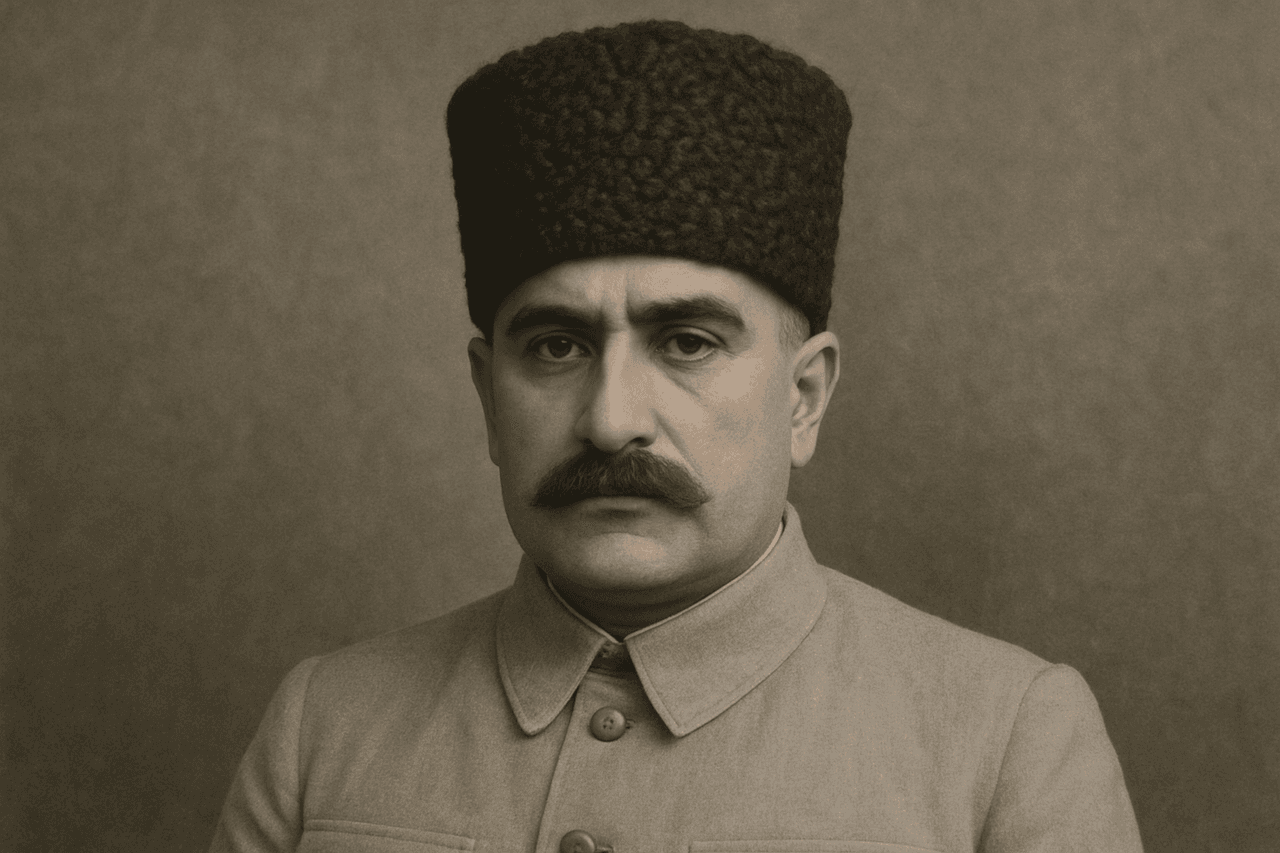

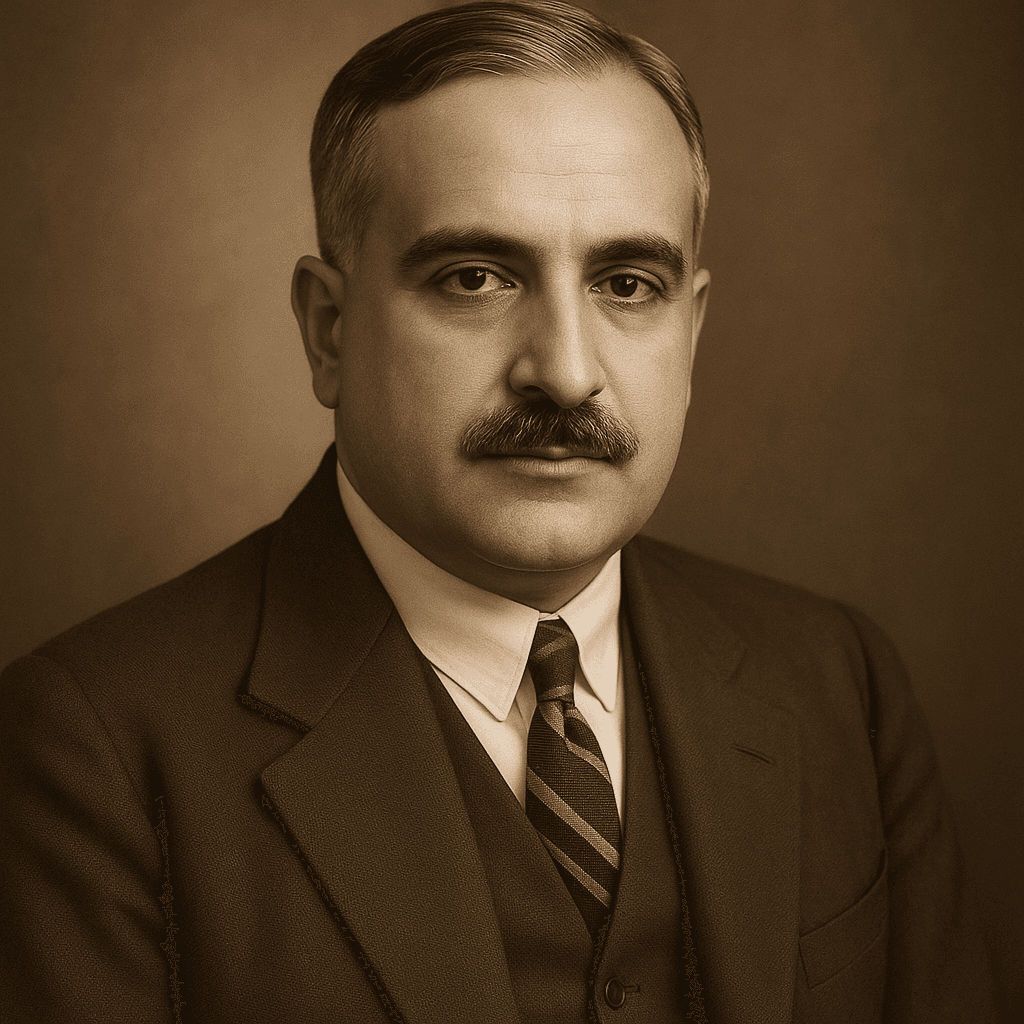
Ali Saip Ursavaş (1885, Revandız – 26 September 1939, Kadirli) was a military officer who transitioned into politics during the late Ottoman and early Turkish Republic periods and played a central role in the War of Independence. His leadership in the liberation of Urfa, his active participation in numerous battles, and his influential political engagement during the early years of the Grand National Assembly of Türkiye (TBMM) established him as one of the recognized figures in Republican history. Having personally experienced the social, political, and military dynamics of his era, Ali Saip Ursavaş left behind a rich historical legacy documented across numerous topics—from the Independence Courts to parliamentary activities and regional resistance movements.
Ali Saip Ursavaş was born in 1885 in Revandız. His father, Emin Efendi, was a retired lieutenant. Like every child born within the Ottoman territories of the time, he grew up in a multiethnic, multilingual, conflict-ridden, and contradictory world. As the son of a military family, he was directed early toward military discipline and state service. Entering the Military Academy at a young age, he graduated on 14 October 1905 as a cavalry officer.
In the same year, he enrolled in the War Academy. Ali Saip, described in his records as short in stature, wheat-colored in skin tone, and black-eyed, embodied the prototype of a young Ottoman officer of his time. He was promoted to senior lieutenant in 1912, captain in 1917, and major in 1924. In 1913, he transferred to the Gendarmerie, specializing particularly in internal security and rural control. Through his education, he gained not only military expertise but also deep insight into the political and strategic structure of his era.
After beginning his military career, Ali Saip Ursavaş served in critical conflicts coinciding with the dissolution of the Ottoman state. While stationed at the Derne front during the Italo-Turkish War, he met Mustafa Kemal. This period marked the development of both his military and political consciousness. He was awarded the 5th Class and 4th Class Order of the Medjidie for his service in Libya and the Balkan Wars respectively, along with a war medal and seniority increments.
During World War I, he served in key centers such as Deir ez-Zor, Aleppo, Damascus, and Mosul, where his activities in Deir ez-Zor attracted particular attention. Through his relationships with local tribes, he successfully won over the Anizah Tribe, which was under the influence of the British agent Lawrence, to the Ottoman side. For this achievement, he was rewarded with three years of seniority increment.
When he assumed command of the Kadirli Gendarmerie Unit in 1919, the region was engulfed in chaos due to French occupation and clashes between Armenian gangs and Turkish Kuva-yı Milliye forces. Ali Saip, while appearing to cooperate with French authorities and even seeming to collaborate with Armenian gendarmes, was in fact seeking ways to establish contact with the Kuva-yı Milliye. Leveraging the trust he had built with French officials, he first initiated contact through Cezmi Bey and later directly with Tufan Bey to negotiate joining the Kuva-yı Milliye. Finally, in late December 1919, he was appointed commander of the Urfa Gendarmerie Battalion and directly entered the struggle against the occupation.
Shortly after assuming his post in Urfa, Ali Saip began organizing resistance. He established contact with tribal leaders. The planned uprising, originally scheduled for 28 January 1920, was postponed first to 31 January and then to 22 February. Ultimately, on the night of 21–22 February, the uprising in Urfa began. Against the French force of 560 stationed in the city, gendarmerie units, prisoners, and armed civilians launched a joint resistance. After months of fighting, Urfa was liberated from occupation on 10 April 1920.
During this period, Ali Saip corresponded under the pseudonym “Namık,” coordinating the resistance both from within and from outside. After the liberation of Urfa, he was elected as a deputy for Urfa to the First Term of the Grand National Assembly of Türkiye in 1920. While serving in the Assembly, he undertook special political duties concerning the Southern Front and the Mosul region, explaining the requirements of the National Struggle to the local population and engaging in propaganda activities. The Command of the El-Cezire Front, which he led, reported its success directly to the Presidency of the TBMM.
His appointment as president of the Şark İstiklal Mahkemesi (Eastern Independence Court) established after the Sheikh Said Rebellion in 1925 was interpreted as a sign of the Republic’s confidence in him. The cases he presided over generated widespread public reaction, and the court’s rulings during its term were either criticized or defended.
Ali Saip Ursavaş was married to Esma Fehime Hanım. The couple had two daughters, Perihan and İstiklal, and two sons, Timur and Bozkurt. Although sources provide limited information about his family life, it is clear that he led a disciplined and duty-oriented life. The fact that his wife actively participated in communication efforts during the resistance period indicates a relationship built on mutual trust.
In 1935, he was put on trial after allegations linked him to an assassination plot against Atatürk orchestrated by Çerkez Ethem. Although no direct involvement in the assassination plan was proven, he was suspected due to his contacts with smugglers.
He was acquitted in 1936, but the incident permanently damaged his relationship with Atatürk. Attempts to renew contact through Hasan Rıza Soyak remained unanswered. He died on 26 September 1939 while still serving as a deputy in the Sixth Term, in the Kadirli district of Adana, and was buried in the Adana Asri Cemetery.
Ali Saip Ursavaş occupies a place in the national memory as both a founding and controversial figure of Republican history. His struggle in Urfa has been recounted as a legendary resistance. On the other hand, his memoirs titled Kilikya Faciaları ve Urfa’nın Kurtuluşu were criticized by other actors of the era, who accused him of presenting a one-sided account of events.
His name has been given to a high school, a barracks, and various streets and alleys in Urfa. Following the Surname Law, the surname “Ursavaş” was personally bestowed upon him by Atatürk. His military service spanned 21 years, and with seniority increments, his total state career exceeded 34 years.
Kılıç, Ezgi. *Ali Saip Ursavaş’ın Biyografisi ve Faaliyetleri.* Master's thesis,Harran Üniversitesi Institute of Social Sciences, 2021. Accessed May 21, 2025. http://acikerisim.harran.edu.tr:8080/xmlui/bitstream/handle/11513/3184/ALİ%20SAİP%20URSAVAŞ.pdf?sequence=1&isAllowed=y
İlyas, Ahmet. “Millî Mücadelede Önemli Bir Şahsiyet: Ali Saip Ursavaş.” Turkish Studies 10, no. 9 (2015): 241–250. https://doi.org/10.7827/TURKISHSTUDIES.7470
“Ali Saib Ursavaş.” *Biography.* Accessed May 21, 2025. (Image obtained and enhanced with AI assistance: sharpened, resolution increased, and colorized). https://www.biyografya.com/tr/biographies/ali-saib-ursavas-b54db6b5
“Ali Sâib Ursavaş (1885–1939).” *Atatürk Ansiklopedisi.* Accessed May 10, 2025.
Youth and Education
Career and Achievements
Key Activities and Contributions
Personal Life
Final Years and Death
Legacy and Influence