This article was automatically translated from the original Turkish version.
+2 More
Location | Karpuzlu Türkiye Aydın | ||||||||
|---|---|---|---|---|---|---|---|---|---|
Region(s) | Caria | ||||||||
Foundation | 2nd Millennium BC (Early Settlement), 4th Century BC (Urbanization) | ||||||||
Notable Structures | Agora, Theatre, Walls, Aqueduct, Temple Foundations, Sarcophagi | ||||||||
Period(s) | Hellenistic Byzantine Roman | ||||||||
Alinda, located within the boundaries of the Karpuzlu district of Aydın Province in Türkiye, is one of the significant cities of ancient Caria. The city was built on two steep rocky hills to the south and east, which made access difficult, situated on the western edge of the Karpuzlu plain. Alinda attracts attention due to its settlement history extending back to the 2nd millennium BCE, with particularly notable remains dating to the 4th century BCE. Based on ancient sources, especially the accounts of Strabo, the political history of the city and certain events from the Hellenistic period can be elucidated.
.JPG&w=1280&q=75)
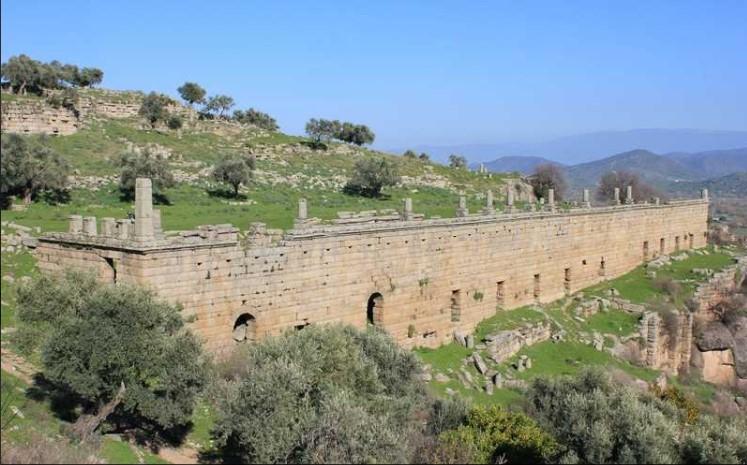
Alinda Excavation Site (Türkiye Culture Portal)
According to Strabo, Ada, daughter of Hecatomnus, was expelled from Halicarnassus by her brother Pixodarus and retreated to Alinda in 340 BCE, making it her capital. In 334 BCE, during Alexander the Great’s campaign in Caria, Ada surrendered Alinda to Alexander and, with his support, regained her position as ruler. As a result of these developments, Alinda rapidly adopted Greek culture during the Hellenistic period. The city bore the name “Alexandria” for a time during this era.
During the Roman period, Alinda retained its importance and continued to mint coins bearing its own name until the 3rd century CE. In the Byzantine period, it became a bishopric under the Metropolitanate of Aphrodisias.
.JPG&w=1280&q=75)
Alinda Excavation Site (Türkiye Culture Portal)
The Ancient City of Alinda features a dual-acropolis settlement pattern, shaped by its topography. Its placement on steep, rocky terrain to the south and east, which hindered access, reflects a deliberate strategic choice for defense. The city was fortified by walls constructed from local granite stone, enclosing its perimeter. These walls are reinforced in places by two-story towers and have survived to the present day in relatively good condition. This wall system provides important insights into Alinda’s defensive architecture.
The city’s infrastructure includes aqueducts that reflect an advanced engineering approach, as exemplified by the structure located at the western end of the Upper Acropolis. This circular arch, supported by four piers, along with its water channel and the approximately square water reservoir it connected to, documents the city’s organized water supply system.
Alinda houses significant public architectural remains that reflect the social and economic structure of its time. The agora, oriented east-west and built in three levels, draws attention for its upper level arranged as a stoa, forming a market complex. This structure served as the center of commerce and social interaction. The theater, situated on the southwest slope of the acropolis, was constructed in harmony with the natural topography and dates to the Hellenistic period. The cavea and seating rows have been largely preserved in their original height; the structure was later modified during the Roman period to maintain its functionality.
Regarding religious structures, only two temple foundations have been identified at Alinda, visible only at the plan level. Although religious architectural evidence is limited in this regard, the necropolis spread across the southern slopes of the city and, particularly, the Carian-style sarcophagi found within the Karpuzlu settlement, hold significance for understanding burial practices and funerary architecture. These sarcophagi constitute archaeological reflections of Alinda’s cultural fabric, both formally and functionally. This architectural coherence offers the opportunity to evaluate the city’s spatial organization alongside its social structure.
.JPG&w=1280&q=75)
Alinda Excavation Site (Türkiye Culture Portal)
Kültür Portalı. "Alinda." T.C. Kültür ve Turizm Bakanlığı. Accessed June 25, 2025. https://www.kulturportali.gov.tr/turkiye/aydin/gezilecekyer/alinda
T.C. Ministry of Culture and Tourism. "Alinda Örenyeri." *Müze.gov.tr*. Accessed June 25, 2025. https://muze.gov.tr/muze-detay?SectionId=ALI01&DistId=MRK
Turkish Museums. “Aydın – Alinda Örenyeri.” Turkishmuseums.com. Accessed June 25, 2025. https://www.turkishmuseums.com/museum/detail/1983-aydin-alinda-orenyeri/1983/1

Location | Karpuzlu Türkiye Aydın | ||||||||
|---|---|---|---|---|---|---|---|---|---|
Region(s) | Caria | ||||||||
Foundation | 2nd Millennium BC (Early Settlement), 4th Century BC (Urbanization) | ||||||||
Notable Structures | Agora, Theatre, Walls, Aqueduct, Temple Foundations, Sarcophagi | ||||||||
Period(s) | Hellenistic Byzantine Roman | ||||||||
No Discussion Added Yet
Start discussion for "Alinda Archaeological Site" article
History
Urban Plan and Architectural Features