

This article was automatically translated from the original Turkish version.
+2 More
Location | Aydın | ||||||||
|---|---|---|---|---|---|---|---|---|---|
Founding Period | early 2nd century BCE | ||||||||
Population (Roman Period) | approximately 10,000 people | ||||||||
UNESCO World Heritage List | Recorded 9 July 2017 | ||||||||
First Systematic Excavations | 1961 (Prof. Kenan Erim) | ||||||||
Aphrodisias Ancient City is an ancient settlement located within the boundaries of Geyre Village, in the Karacasu district of Aydın. It lies in the interior region of ancient Caria. Nearby well-preserved ancient cities include Hierapolis (Pamukkale) to the northeast and Nysa to the northwest. The site contains one of the largest ornamental pools of the ancient world and one of the best-preserved stadiums. Aphrodisias aids our understanding of Roman-era sculptural practices through its well-preserved marble quarries, the renowned sculptural school within the site, and the statues displayed in the museum. The Ancient City of Aphrodisias was inscribed on the UNESCO World Heritage List on 9 July 2017.

Aphrodisias Ancient City (Türkiye Culture Portal)
Aphrodisias has been inhabited since the fifth millennium BCE (Late Chalcolithic period). It was established in the early second century BCE as a Greek city-state under the encouragement of the Seleucid kings. Throughout the first century BCE, the city consistently supported Rome during its conflicts in Anatolia and was rewarded with various privileges, including autonomy and tax exemptions, by the Roman Senate in 39 BCE. These privileges are believed to have been secured through the mediation of Zoilos, a former slave of Octavian-Augustus, who became the most influential figure in the city from the 30s BCE into the 20s BCE. The earliest marble structures in Aphrodisias date to this period and are associated with Zoilos.
During the Roman period, Aphrodisias was transformed into a medium-sized grid-planned city. Despite covering an area of 72 hectares and having a population of approximately 10,000, its architectural design exhibited the grandeur typically associated with major metropolises. As an autonomous city within the Roman province of Asia, Aphrodisias gained fame for its sacred precinct dedicated to its patron goddess Aphrodite and its marble sculptural works. The population grew wealthy during the Early and Middle Roman periods (first and second centuries CE), and all public buildings expected in a Roman city were constructed in marble. In the late third century, Aphrodisias was chosen as the capital and metropolis of the newly established Roman province of Caria, and it successfully preserved its classical urban layout and way of life until the general urban decline of the seventh century CE. After this period, the city shrank and continued to exist as a smaller settlement. From the thirteenth century onward, the entire region came under Turkish rule. The few remaining households in the gradually abandoned village were relocated in 1974 to a new settlement one kilometer away, known today as New Geyre. The current population of Geyre resides in this new settlement immediately northwest of the archaeological site and has made significant contributions to the ongoing work at Aphrodisias.
During the Roman period, Aphrodisias was transformed into a medium-sized grid-planned city. Despite covering an area of 72 hectares and having a population of approximately 10,000, its architectural design exhibited the grandeur typically associated with major metropolises. During the Early and Middle Roman periods (first and second centuries CE), all public buildings expected in a Roman city were constructed in marble. The city is home to one of the largest ornamental pools of the ancient world and one of the best-preserved stadiums.
Sebasteion: A temple complex dedicated to Aphrodite and the Julio-Claudian dynasty. It is adorned with nearly 200 marble reliefs, 80 of which depict mythological narratives and imperial achievements and are now exhibited in the museum.
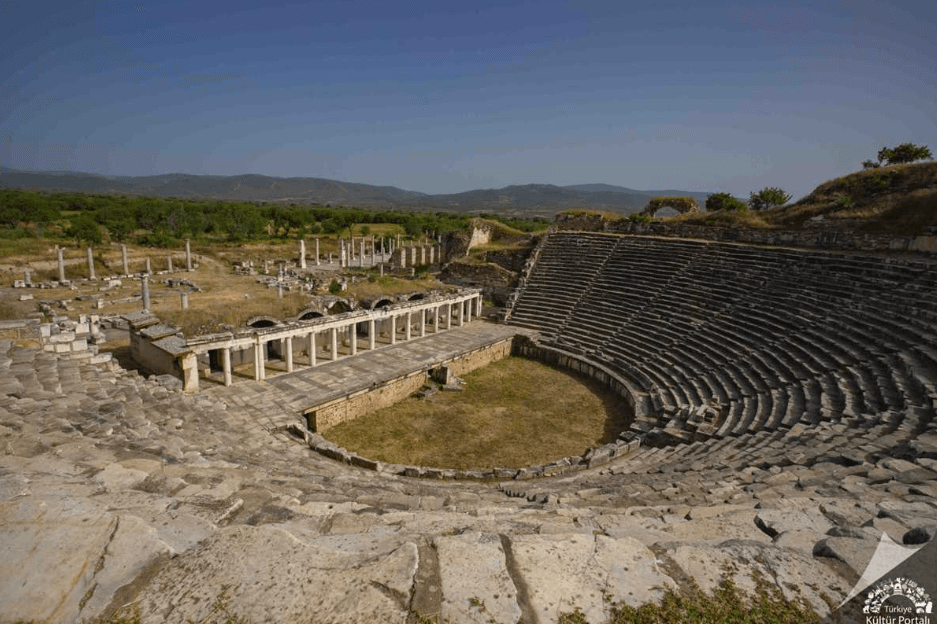
Theatre: A well-preserved structure with a capacity of approximately 7,000 seats. It was used for entertainment and public gatherings and was converted into a Byzantine fortress in the seventh century. The Archive Wall, containing important documents from the city archives, is located here.
South Agora / Palm Grove and Pool: The city’s second public square, featuring a pool measuring 170 by 30 metres. The pool is one of the largest ornamental water features of antiquity and resembles Roman urban parks.
Civil Basilica: A large public building measuring approximately 145 by 30 metres, used for administration, commerce, and justice. In 301 CE, Emperor Diocletian’s famous Edict on Maximum Prices was inscribed on its walls.
Hadrian’s Baths: Built in the early second century CE in honor of Emperor Hadrian, this was the largest bath complex in the city, serving as a bathing facility, social center, and sculpture museum.
Tetrapylon Street: The main road running east of the city center, preserving layers of historical development, including traces of shops, workshops, and luxury residences.
Assembly Building (Bouleuterion): Reconstructed in the second century CE as a small, roofed theatre-like structure with marble cladding, this was the center of political power in the city and had a capacity of 1,700 people.
Sculpture Workshop: Located north of the Assembly Building, the workshop has been preserved in its early fourth or fifth century CE state, containing stone-carving tools, unfinished statues, and fragments used for training purposes.
Temple of Aphrodite and Church: The Temple of Aphrodite, built by Zoilos in the 30s CE, was converted in around 500 CE into a basilica-style church dedicated to the Archangel Michael.
Stadium: Constructed in the late first century CE, this stadium with a capacity of approximately 30,000 is one of the best-preserved and largest ancient stadiums. It hosted athletic competitions, gladiatorial contests, and animal fights.
Tetrapylon: The monumental entrance to the Sacred Area of Aphrodite. Built in the second century CE and richly decorated, this quadrifrontal gateway was largely restored in 1991 using original blocks.
Marble Quarries: Located northeast of the city, the quarries supplied the material for construction and sculpture. Rather than exporting raw stone, the city exported finished marble works.

Aphrodisias Ancient City (Türkiye Culture Portal)
Aphrodisias has been visited by European travelers since the eighteenth century, and various publications on the site have appeared since then. Brief excavation campaigns were conducted by P. Gaudin and G. Mendel in 1904–1905, A. Boulanger in 1913, and G. Jacopi in 1937. Systematic excavations continue under the auspices of the Turkish Ministry of Culture and Tourism in cooperation with New York University.
Professor Kenan Erim directed the excavations from 1961 to 1990. During this period, intensive work focused on major structures including the Temple of Aphrodite, the Theatre, the South Agora, the Assembly Building, the Basilica, and the Sebasteion. Artifacts uncovered during these excavations are displayed in the Aphrodisias Museum.
Following Professor Erim’s death in 1990, the directorship of the excavations was transferred to Professor R.R.R. Smith of the Institute of Fine Arts at New York University. Since 1995, the project has been conducted in collaboration with the University of Oxford. Current work focuses on documentation, conservation, publication, and the display of finds. The team consists of experts and students from various nations. Financial support is provided by New York University, the University of Oxford, the Geyre Foundation, and various other institutions.
As of 2020, seven major projects have been prioritized: Tetrapylon Street, the House of Kybele, the Basilica, Hadrian’s Baths, the South Agora Pool, the Sebasteion Temple, and a new exhibition hall in the Aphrodisias Museum.
SMITH, R R R. (2020). "Aphrodisias Antik Kenti Kazı Çalışmaları." *Türkiye Turizm Ansiklopedisi*. Accessed July 7, 2025. https://turkiyeturizmansiklopedisi.com/aphrodisias-antik-kenti-kazi-calismalari
T.C. Ministry of Culture and Tourism. "Afrodisias Antik Kenti." Türkiye Kültür Portalı. Accessed July 7, 2025. https://www.kulturportali.gov.tr/portal/afrodisiasantikkenti

Location | Aydın | ||||||||
|---|---|---|---|---|---|---|---|---|---|
Founding Period | early 2nd century BCE | ||||||||
Population (Roman Period) | approximately 10,000 people | ||||||||
UNESCO World Heritage List | Recorded 9 July 2017 | ||||||||
First Systematic Excavations | 1961 (Prof. Kenan Erim) | ||||||||
No Discussion Added Yet
Start discussion for "Ancient City of Aphrodisias" article
Historical Development and Significance
Architectural Structures and Urban Planning
Key Structures
Research and Excavations