This article was automatically translated from the original Turkish version.
Type of Geographical İndication | Mahreç Signal | ||||||||
|---|---|---|---|---|---|---|---|---|---|
Application Date | 24.11.2022 | ||||||||
Registration Number | 1511 | ||||||||
Registration Date | 22.12.2023 | ||||||||
Product / Product Group(s) | Textiles | ||||||||
Province(s) | Ankara | ||||||||
Applicant/Registrant(s) | Republic of Turkey Ankara Governorship | ||||||||
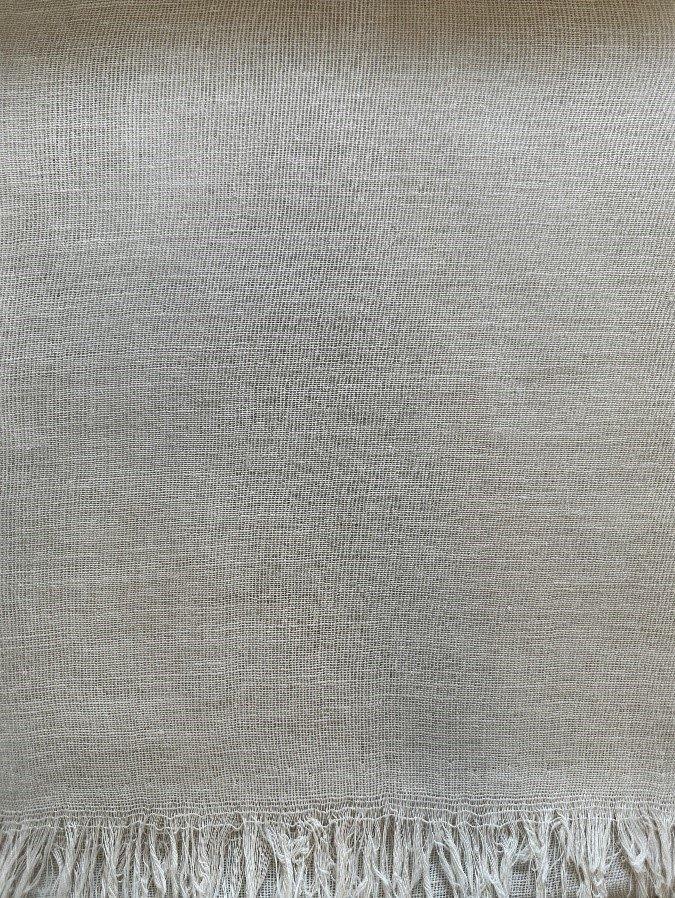
Ankara Sof Fabric is a traditional woven textile made exclusively from yarn spun from tiftik fibers, characterized by its soft and glossy surface. The raw material, Ankara Tiftik, is officially registered under Geographical Indication No. 802 and imparts both aesthetic and functional qualities to the fabric. Due to its properties such as coolness retention, low wrinkling, and moisture resistance, it is used in the production of garments, shawls, scarves, upholstery fabrics, and blankets.

Ankara Sof Fabric (Ankara Maturation Institute)
Ankara Sof Fabric is produced only within the geographical boundary encompassing the provinces of Ankara, Çankırı, and Bolu. This boundary is decisive both because it corresponds to the region where Ankara Tiftik is cultivated and because it has historically been the center of sof fabric production. All stages of production must occur within this geographical limit.
Tiftik is soaked in water overnight, then washed in stream water using the tokachlama method without soap or chemicals. The dried tiftik is fluffed with a stick, then passed through a fine iron comb and twisted with a kirmen. The twisted fibers are spun into yarn using a spindle, dipped in water at 60 °C, and subjected to the cendere process to remove the fine hairs.
Dyeing is performed using root dyeing techniques. Natural dye materials include pine, oak, walnut shells, and pomegranate flowers. Ten liters of water are added to one kilogram of plant material and boiled; once cooled to 60 °C, the yarn is immersed to absorb the color. The yarn is then washed with olive oil soap made from oak ash and fixed with white vinegar.
The yarn is wound onto spindles and then onto large bobbins, brushed with boiled water, and dried. It is transferred to smaller spools using a winding machine to prepare it for the warp.
Weaving is carried out on two-legged looms with at least two frames and harnesses. The loom consists of the warp beam, side boards, reed, and harness frames. Each frame’s movement is controlled by pedals.
Warping: Warp threads are arranged in two ways: through the harness and the reed.
Shed Opening: Warp threads are divided into two groups to create an opening through which the shuttle can pass.
Shuttle Insertion: The weft yarn, wound on a bobbin, is passed through the shuttle.
Beat-up: The weft yarn is pushed toward the fabric edge using the reed to compact it. With each weft insertion, the shed narrows and the weaving progresses.
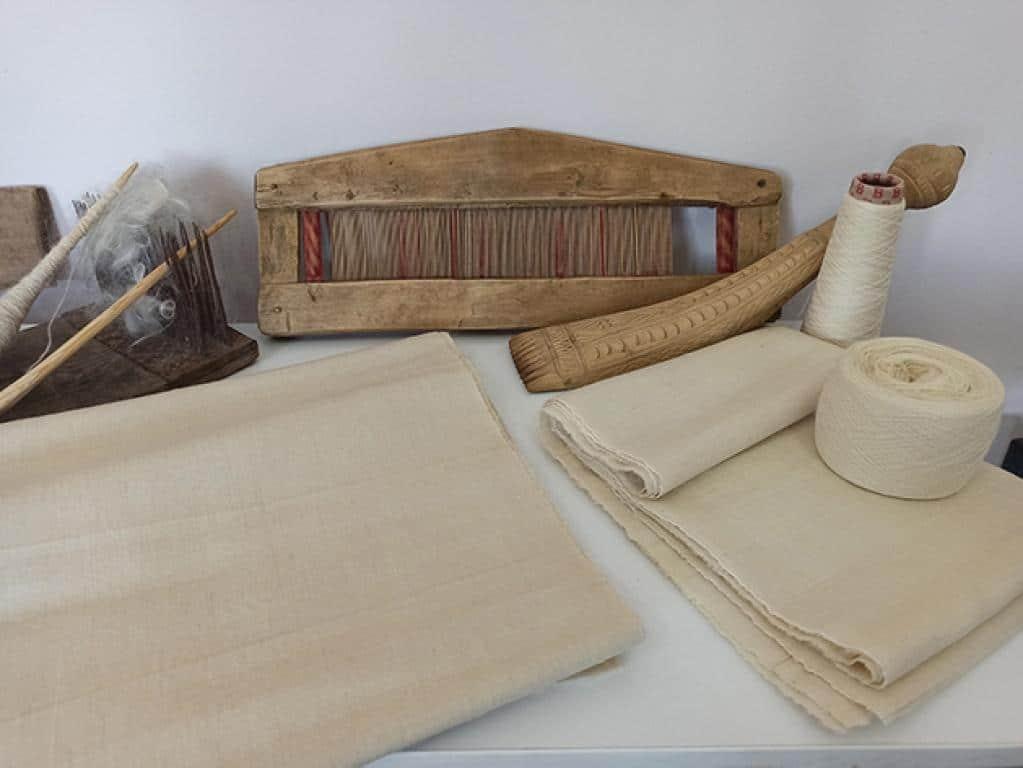
Ankara Sof Fabric (Ankara Maturation Institute)
The woven fabric is soaked overnight in cold water to remove the sizing. It is then treated again in boiling water and softened on a cendere press. It is ironed for one hour using an industrial iron. If re-dyeing is required, the fabric is dyed with root dyes, washed with soap, and fixed with vinegar. In the final stage, it is rolled into bolt form for storage.
Ankara Sof Fabric is classified into types such as “mevicli,” “hareli,” “muhayyer,” “fine,” and “thick.” The warp density of fine, medium, and coarse fabrics ranges from 60 to 160 threads per 5 cm. The fabric width varies between 30 and 75 cm, and its length between 5 and 10 m.
Traditional colors used in dyeing include rabbit ear, light wine, petroleum green, black, and rose pink. These colors reflect the historical elegance and cultural identity of the sof fabric.
Ankara Sof Fabric is registered under Law No. 6769 on Industrial Property. The designation “Ankara Sof Fabric” and its official emblem must be visibly displayed on product packaging or within the production facility.
Inspections are conducted at least once a year under the coordination of the Ankara Governorship, and additionally when deemed necessary or upon complaint. The inspection authorities include:
Inspection criteria include the use of Ankara Tiftik, compliance with production methods, and correct application of the registered mark.
Ankara Sof Atölyesi. Ankara Olgunlaşma Enstitüsü. Date Published: December 21, 2023; Updated: January 3, 2024, 14:50. Accessed August 16, 2025. https://ankaraolgunlasma.meb.k12.tr/icerikler/sof-atolyesi_14607619.html
Ankara Sof Kumaşı. Mahreç İşareti. File No: C2022/000416. Accessed August 16, 2025. https://ci.turkpatent.gov.tr/cografi-isaretler/detay/8022 Coğrafi İşaret Platformu
Ankara Sof Kumaşı. Turkish Patent and Trademark Office, Geographical Indications. Accessed August 16, 2025. https://ci.turkpatent.gov.tr/Files/GeographicalSigns/0620fe4e-697f-4ab5-a1e2-963902d706a9.pdf

Type of Geographical İndication | Mahreç Signal | ||||||||
|---|---|---|---|---|---|---|---|---|---|
Application Date | 24.11.2022 | ||||||||
Registration Number | 1511 | ||||||||
Registration Date | 22.12.2023 | ||||||||
Product / Product Group(s) | Textiles | ||||||||
Province(s) | Ankara | ||||||||
Applicant/Registrant(s) | Republic of Turkey Ankara Governorship | ||||||||
Geographical Context and Reputation
Production Process and Technical Stages
Transformation of Tiftik into Yarn
Dyeing
Winding and Preparation
Weaving Process
Loom Structure and Techniques
Cendere and Final Treatments
Varieties and Technical Characteristics
Colors and Aesthetics
Registration Information
Inspection Process