This article was automatically translated from the original Turkish version.
Type of Geographical İndication | Mahreç Sign | ||||||||
|---|---|---|---|---|---|---|---|---|---|
Registration Number | 1066 | ||||||||
Registration Date | 07.04.2022 | ||||||||
Product / Product Group(s) | vegetables and mushrooms Processed and unprocessed fruits | ||||||||
Province(s) | Gaziantep | ||||||||
Applicant/Registrant(s) | Gaziantep Chamber of Commerce | ||||||||
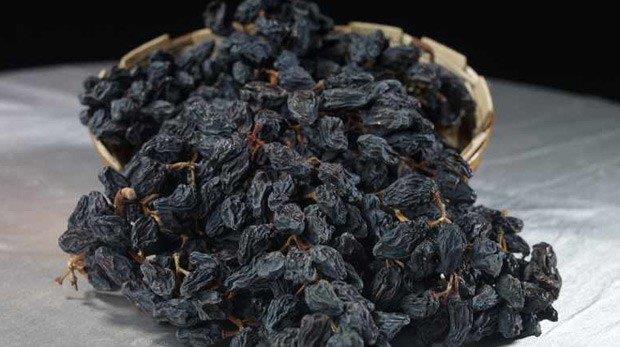
Antep Karaması Raisin is a dried fruit derived from the Horoz Karaması grape variety, cultivated within the boundaries of Gaziantep Province, and defined by its unique physical and chemical properties. This product was officially registered with a geographical indication on 7 April 2022 and is produced using traditional methods shaped directly by Gaziantep’s climatic and agricultural conditions.
Antep Karaması Raisin is obtained by drying the fresh Horoz Karaması grapes of the species Vitis vinifera L. It has a flat shape, a matte black skin, and dark brown flesh. The individual berry weight ranges from 8 to 9 grams; the skin thickness is medium, and each berry contains 2 to 3 seeds. It is distinguished by its tannic aroma. The dry matter content is 18–20%, the moisture content does not exceed 14%, and the acidity level ranges from 4.8 to 6.5 g/L. Anthocyanins are either absent or present in negligible amounts in the flesh.
The average temperatures in Gaziantep during August and September are 27 °C and 23 °C respectively, with wind speeds of 8.6–10.7 km/h and relative humidity levels of 40–45%, providing optimal natural conditions for the drying process.
The production process begins in January with the opening of vine bases and the cleaning of root suckers. Soil preparation, fertilization, pruning, and planting are carried out in February and March. From April to July, vineyard maintenance operations such as shoot thinning, tying to trellises, and pest and disease control continue. Harvesting starts in August and continues until mid-October.
Harvested fresh grapes are transported in plastic crates or baskets of up to 25 kg to drying facilities located near the vineyards. Here, clusters are separated from rotten berries and washed in a dipping solution containing 5% potassium carbonate and 1% olive oil. Drying areas have surfaces made of food-grade polypropylene or concrete. Clusters are split lengthwise to maximize exposure to sunlight. The drying period averages 7–10 days.
After drying, the grapes are separated from their stems, cleaned using a winnowing machine, and stored in sacks or plastic crates of up to 50 kg in cool, dry environments. Storage temperature is maintained at 5–10 °C with relative humidity around 65%.
All stages of production must be carried out within the boundaries of Gaziantep Province. Inspections are conducted at least once annually by a minimum three-member authority composed of expert representatives from relevant public and professional organizations, coordinated by the Gaziantep Chamber of Commerce. Inspection criteria include the suitability of the grape variety, adherence to the production method, storage conditions, and correct use of the geographical indication mark.
Turk Patent and Trademark Office. "Antep Karası Kuru Üzümü." Turk Patent and Trademark Office. Accessed October 21, 2025. https://ci.turkpatent.gov.tr/Files/GeographicalSigns/8ad00bc8-f813-4b49-a97c-a73afd051259.pdf
Turk Patent and Trademark Office. "Antep Karası Kuru Üzümü." Turk Patent and Trademark Office. Accessed October 21, 2025. https://ci.turkpatent.gov.tr/cografi-isaretler/detay/38443

Type of Geographical İndication | Mahreç Sign | ||||||||
|---|---|---|---|---|---|---|---|---|---|
Registration Number | 1066 | ||||||||
Registration Date | 07.04.2022 | ||||||||
Product / Product Group(s) | vegetables and mushrooms Processed and unprocessed fruits | ||||||||
Province(s) | Gaziantep | ||||||||
Applicant/Registrant(s) | Gaziantep Chamber of Commerce | ||||||||
No Discussion Added Yet
Start discussion for "Antep Karası Dried Grapes" article
Definition and Distinctive Characteristics
Physical and Chemical Properties
Production Method
Geographical Boundary and Control