

This article was automatically translated from the original Turkish version.
+1 More
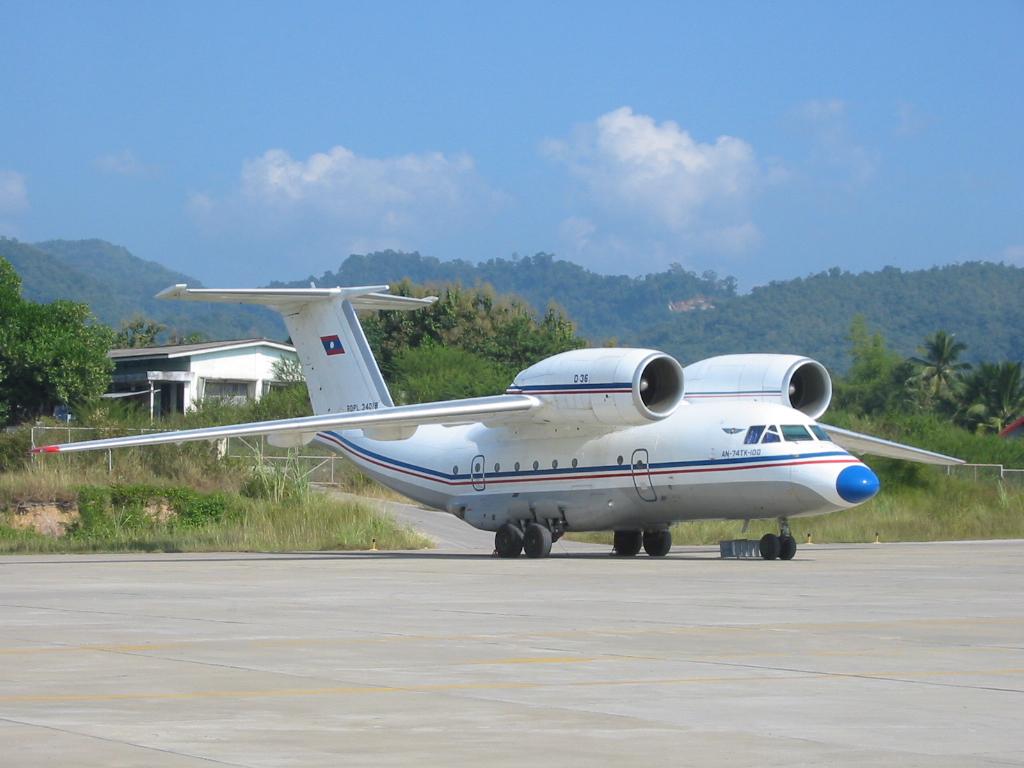
Antonov An-72 is a twin-engine jet transport aircraft developed by the Antonov Design Bureau during the Soviet Union era, featuring short takeoff and landing (STOL) capability. First flown on 31 August 1977, this aircraft was specifically designed to provide logistical support in remote areas with unprepared or short runways. Its most distinctive feature is the placement of its engines above the wings; this design choice utilizes the aerodynamic principle known as the "Coanda Effect" to generate high lift even at low speeds.
Thanks to its high fuselage clearance and engine placement, the An-72 can operate on unprepared surfaces such as soil, ice, or sand while minimizing the risk of foreign object damage (FOD) to its engines. Originally intended to replace the Antonov An-26 and to transport military units under challenging geographical conditions, the aircraft has since been widely adopted by civilian operators for cargo and passenger transport. Its rear-mounted multifunctional loading ramp enables rapid deployment of vehicles and heavy equipment, while the aircraft’s distinctive silhouette has earned it the nickname "Cheburashka" among aviation circles.

Antonov AN-72 (Rob Schleiffert)
The design philosophy of the Antonov An-72 was driven by the Soviet Union’s need to conduct operations from short and unprepared runways in its most remote regions, including the Arctic, deserts, and high-altitude mountainous areas. In the mid-1970s, the Antonov Design Bureau adopted a radical configuration based on the "Coanda Effect" to赋予 the aircraft exceptional short takeoff and landing (STOL) performance. In this design, the engines are mounted high and far forward on the upper surface of the wings, allowing the high-velocity exhaust flow to adhere to the upper wing surface and follow its curvature, thereby generating additional lift over the leading edge.
During development, the aircraft’s durability was optimized to prevent engine ingestion of foreign objects. The elevated position of the engines above the wing significantly reduced the risk of engine damage when operating on gravel, sand, or snow-covered runways. Additionally, the fuselage structure was reinforced to withstand heavy loading and unloading operations, and the landing gear was fitted with low-pressure tires to enable movement over soft terrain without sinking. These engineering solutions represent the most fundamental features distinguishing the An-72 from conventional jet transport aircraft of its era.【1】
Following successful prototype testing and flight trials that demonstrated the system’s efficiency, the design entered series production and served as the foundation for later variants such as the more specialized An-74, adapted for polar conditions. The aircraft’s characteristic "frog-eye" engine arrangement not only provided an aerodynamic advantage but also endowed it with a unique identity in aviation literature. Thanks to this innovative approach, the An-72 retains the ability to land fully loaded on runways shorter than 600 meters.
The Antonov An-72 features a compact airframe measuring approximately 28.07 meters in length and 31.89 meters in wingspan, optimized for short-range operations. Its primary powerplant consists of two Ivchenko-Progress D-36 series high-bypass turbofan engines, each mounted above the wing. These engines generate approximately 63.7 kN of thrust at sea level, enabling the aircraft to achieve a maximum takeoff weight of 34,500 kg (34.5 metric tons). The cargo compartment, measuring 10.5 meters in length and 2.15 meters in height, offers a useful load capacity of approximately 10 metric tons.【2】

Antonov An-72 Technical drawing (generated by artificial intelligence)
In terms of performance, the An-72 achieves a cruise speed of 700–705 km/h and operates at a service ceiling of approximately 11,800 meters (38,700 feet). Its range varies depending on the STOL configuration: with maximum payload, it can fly about 1,150 kilometers, while fuel-efficient loadings extend this range up to 4,300 kilometers. The aircraft’s most critical performance metric is its requirement of only 620 meters for takeoff and 420 meters for landing when fully loaded, making it one of the most versatile jet transport aircraft in its class.【3】
The landing gear consists of five main wheel units, designed to accommodate heavy ground conditions. Supported by hydraulic systems, this configuration enables safe takeoffs and landings not only on concrete runways but also on soft soils with low CBR (California Bearing Ratio) values. Furthermore, the positioning of the engines above the wings allows exhaust gases to be directed over the wing flaps, enhancing maneuverability at low speeds and enabling steep approach angles to the runway.
The Antonov An-72 entered service with the Soviet Air Forces in the early 1980s and quickly became a strategic logistical asset in challenging terrains such as during the Soviet-Afghan War. The aircraft’s high engine placement and STOL capability enabled safe deployment of military units onto unprepared airstrips in mountainous regions. After the Cold War, its durability attracted civilian operators, who widely used it for cargo transport to locations inaccessible to conventional jet aircraft, particularly in mining and energy projects across Siberia, Africa, and Central Asia.【4】

Antonov An-72 (Anna Zvereva)
One of the most notable aspects of its operational history is its adaptability to extreme climatic conditions. The An-72 is designed to operate reliably between -60°C and +45°C, a feature that has played a critical role in supplying scientific stations in the Arctic and Antarctic regions. Used by the Russian Border Guard and Navy for patrol and personnel transport missions, the aircraft demonstrates high stability during low-altitude flights over water, thanks to its high wing structure and powerful engines.【5】
Today, the An-72 continues to serve actively in the air forces of Ukraine and Russia, as well as with several specialized cargo airlines. The aircraft’s simple maintenance requirements and advanced STOL capabilities render it indispensable in certain niche roles, even compared to modern transport aircraft. Its performance in delivering first-response equipment and medical supplies to damaged runways in disaster zones remains a vital part of its operational legacy.
The aerodynamic design of the Antonov An-72 is built upon the Coanda Effect, a principle that grants the jet-powered aircraft an unusually short takeoff and landing (STOL) capability. Named after Romanian inventor Henri Coandă, this physical phenomenon describes the tendency of a high-velocity fluid jet to adhere to and follow the curvature of a nearby surface. In the An-72, the engines are positioned close to the wing’s upper surface and leading edge, directing hot exhaust gases over specially designed upper wing flaps downward, thereby generating additional lift even at low speeds.
Antonov An-72 (Хит ТВ)
This aerodynamic configuration enables the aircraft to remain airborne at much lower speeds than conventional transports and to approach the runway at steep angles. The upper surface blowing (USB) engine placement not only increases lift but also reduces ground noise by shielding the engine exhaust downward with the wing structure. However, this design required the use of heat-resistant titanium alloys and composite materials to prevent the high-temperature exhaust from damaging the wing structure. Another critical aerodynamic advantage is the minimization of foreign object damage (FOD) risk. With the engine intakes positioned approximately four meters above the ground, the aircraft avoids ingesting stones, soil, or ice fragments during takeoff and landing. This combination of aerodynamic efficiency and operational resilience has made the An-72 one of the rare jet aircraft capable of operating in the world’s most challenging geographical conditions.
The Antonov An-72 platform has spawned a broad family of variants adapted for diverse operational roles, built upon the success of the original transport design. The initial production model, the An-72, was designed for standard military transport and light cargo missions. Its most common and well-known civilian derivative is the An-74, optimized specifically for operations in polar regions such as the Arctic and Antarctic. The An-74 variant features advanced radar systems, de-icing equipment, and larger landing gear units to ensure sustained flight capability under harsh climatic conditions.【6】

Antonov An-74 (fsll2)
In the military domain, specialized variants have been developed to demonstrate the aircraft’s versatility. The most notable is the An-71 (NATO reporting name: "Madcap"), a prototype airborne early warning and control (AEW&C) aircraft. In this variant, the aircraft’s signature engine placement was retained, but a large radar disk (rotodome) was integrated onto the vertical stabilizer. Another important military version is the An-72P, developed for maritime patrol and border surveillance missions. This model was converted into an armed platform by adding a 23 mm cannon mounted under the fuselage, underwing weapons stations, and a maritime surveillance radar.
Modernization efforts have also introduced variants that enhance performance and civil aviation compatibility. The An-72-100 is a civil-certified version for cargo operators, while the An-72-200 offers increased payload capacity and upgraded avionics. Additionally, the experimental An-74TK-300 variant, which relocates the engines beneath the wings in a conventional configuration, was developed to improve fuel efficiency and reduce maintenance costs; however, this design abandons the defining characteristic of the original model—the Coanda Effect.
The Antonov An-72 is regarded as an engineering milestone that challenged the perception that jet-powered aircraft were solely dependent on major airports and modern runways. By combining the efficiency of jet propulsion with the short-field and unprepared-surface capabilities traditionally reserved for turboprop aircraft, the An-72 pioneered a paradigm shift in this domain. Its successful design is one of the few platforms to have successfully transferred the "upper surface blowing" (USB) technology, similar to experimental U.S. projects such as the Boeing YC-14, into series production.
The aircraft’s greatest industry legacy is the concept of the "robust jet" developed for extreme-condition logistics operations. The An-74 variant, built on the An-72’s airframe, set the standard for polar aviation and is recognized as one of the most resilient members of the "utility jet" class in civil cargo transport. The design’s low FOD risk and high takeoff angle have become important reference points in aviation literature, highlighting the operational flexibility conferred by engine placement in modern military transport aircraft design.
Aerospaceweb. "Aircraft Museum - An-72 / An-74 ‘Coaler’." Aerospaceweb. Accessed March 14, 2026. https://aerospaceweb.org/aircraft/transport-m/an72/.
Air Vectors. "Antonov An-72 & An-74." Air Vectors. Accessed March 14, 2026. https://www.airvectors.net/avan72.html.
Antonov Company Official Site. "An-72." Accessed March 14, 2026. https://www.antonov.com/en/history/an-72.
Aviastar. "Antonov An-72 - transport." Aviastar. Accessed March 14, 2026. https://www.aviastar.org/air/russia/an-72.php.
FAS (Federation of American Scientists). "An-72 COALER (ANTONOV)." FAS. Accessed March 14, 2026. https://man.fas.org/dod-101/sys/ac/row/an-72.htm.
GlobalSecurity. "An-72 COALER." GlobalSecurity. Accessed March 14, 2026. https://www.globalsecurity.org/military/world/russia/an-72.htm.
Hit TV. "Antonov An-72 | Takeoff at field | Ан-72." YouTube. Accessed March 14, 2026.
Military Factory. "Antonov An-72 / An-74 (Coaler)." Accessed March 14, 2026. https://www.militaryfactory.com/aircraft/detail.php?aircraft_id=509.
Pigalle. "Lao People’s Liberation Army Air Force Antonov An-74, Louangphrabang". Flickr, 05 Kasım 2003. Accessed March 14, 2026. https://www.flickr.com/photos/pigalleworld/5380372365/.
Schleiffert, Rob. "An-72." Flickr, March 13, 2019. Accessed March 14, 2026. https://www.flickr.com/photos/109661044@N07/40406964173/.
Telsek. "Antonov An-72 RF-72016." Flickr, January 1, 2021. Accessed March 14, 2026. https://www.flickr.com/photos/telsek/51651893723/.
The Aviation Zone. "Antonov An-72 Coaler." The Aviation Zone. Accessed March 14, 2026. https://www.theaviationzone.com/antonov-an-72/.
Zvereva, Anna. "Russian Air Force, RF-72965, Antonov An-72". June 1, 2021. Flickr. Accessed March 14, 2026. https://www.flickr.com/photos/130961247@N06/51264774323/.
fsll2. "Antonov An-74 UR-74038." June 1, 1999. Flickr. Accessed March 14, 2026.
[1]
GlobalSecurity. An-72 COALER". GlobalSecurity.org. erişim 14 Mart 2026.https://www.globalsecurity.org/military/world/russia/an-72.htm.
[2]
Antonov Company Official Site."An-72" .Antonov Company Official Site. erişim 14 Mart 2026.https://www.antonov.com/en/history/an-72.
[3]
Antonov Company Official Site."An-72" .Antonov Company Official Site. erişim 14 Mart 2026.https://www.antonov.com/en/history/an-72.
[4]
Antonov Company Official Site."An-72" .Antonov Company Official Site. erişim 14 Mart 2026.https://www.antonov.com/en/history/an-72.
[5]
The Aviation Zone. "Antonov An-72 Coaler."The Aviation Zone. Erişim 14 Mart 2026.https://www.theaviationzone.com/antonov-an-72/.
[6]
Military Factory. "Antonov An-72 / An-74 (Coaler)."Military Factory. Erişim 14 Mart 2026. https://www.militaryfactory.com/aircraft/detail.php?aircraft_id=509.

Design and Development
Technical Specifications and Performance
Operational History
Aerodynamics and the Coanda Effect
Variants
Industry Legacy