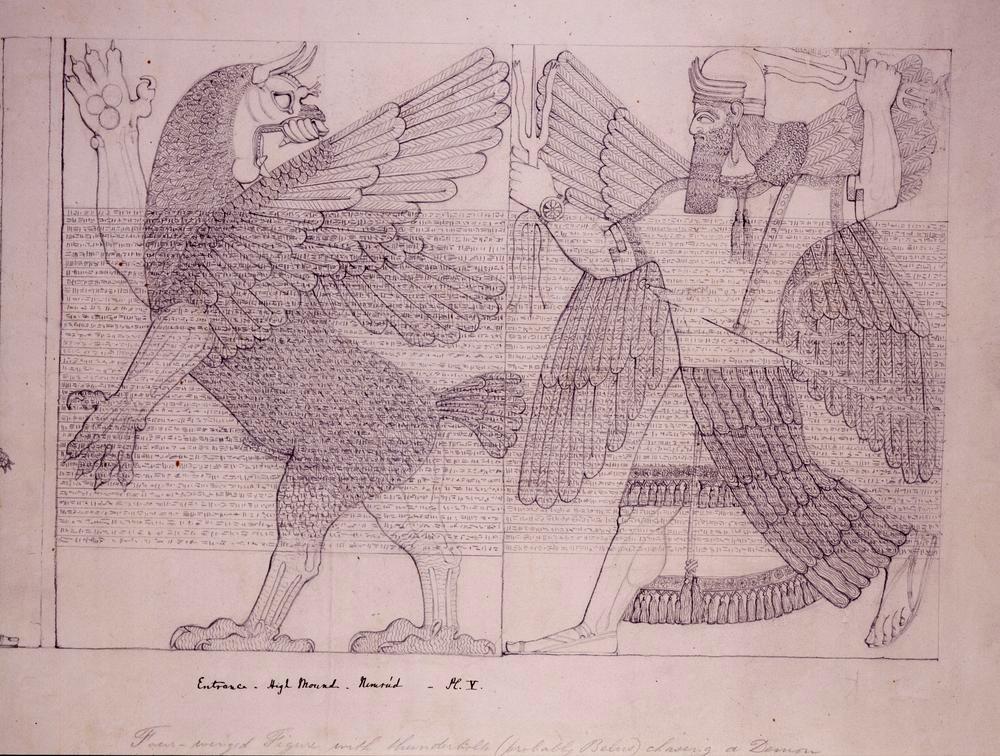


This article was automatically translated from the original Turkish version.
Type(s) | Mythological entity | ||||||||
|---|---|---|---|---|---|---|---|---|---|
Origin(s) | Southern Mesopotamia | ||||||||
Other Name(s) | Anzud AN.IM.DUGUD | ||||||||
Related Deities | Enlil, Ninurta (in mythological context) | ||||||||
Physical Feature | Bird-bodied, lion-headed hybrid figure | ||||||||
Cultural Context | Sumerian and Akkadian cultures | ||||||||
Anzu, known in Sumerian as Anzud and in Akkadian as Anzu, is a hybrid mythological figure with the body of an eagle and the head of a lion.【1】It first appears in seal impressions dated to the second half of the 4th millennium BCE during the Uruk period. In Mesopotamian mythology, Anzu was initially regarded as a being connected to the gods and the divine order, emerging prominently as a symbol of Ningirsu in the city of Lagash. Over time it became associated with other deities such as Enlil, Ninhursag, and Bau.
In literary texts, Anzu is described as symbolizing storm clouds, generating hurricanes with the flapping of its wings, and inhabiting mountainous regions. Mythological narratives highlight its theft of the Tablets of Destiny belonging to Enlil and its subsequent defeat by Ninurta.【2】
In visual depictions, Anzu is portrayed with its wings open or partially open, sometimes grasping other figures with its talons. While depictions of Anzu declined in Mesopotamia during the 2nd millennium BCE, representations have been found in Anatolian sites such as Kültepe, where the figure retained its iconic structure but underwent modifications influenced by local traditions.
The Anzu Bird occupies a place in Mesopotamian belief as a mythological figure associated with the gods. In Sumerian and Akkadian texts, Anzu was not initially perceived as a chaotic entity but as an element linked to the divine order. Its association with Ningirsu in the context of Lagash indicates that Anzu held a specific position within divine symbolism. Furthermore, evidence links Anzu to other deities such as Enlil, Ninhursag, and Bau. This demonstrates that Anzu was not confined to a single deity but was integrated into a broader religious framework within Mesopotamian belief.
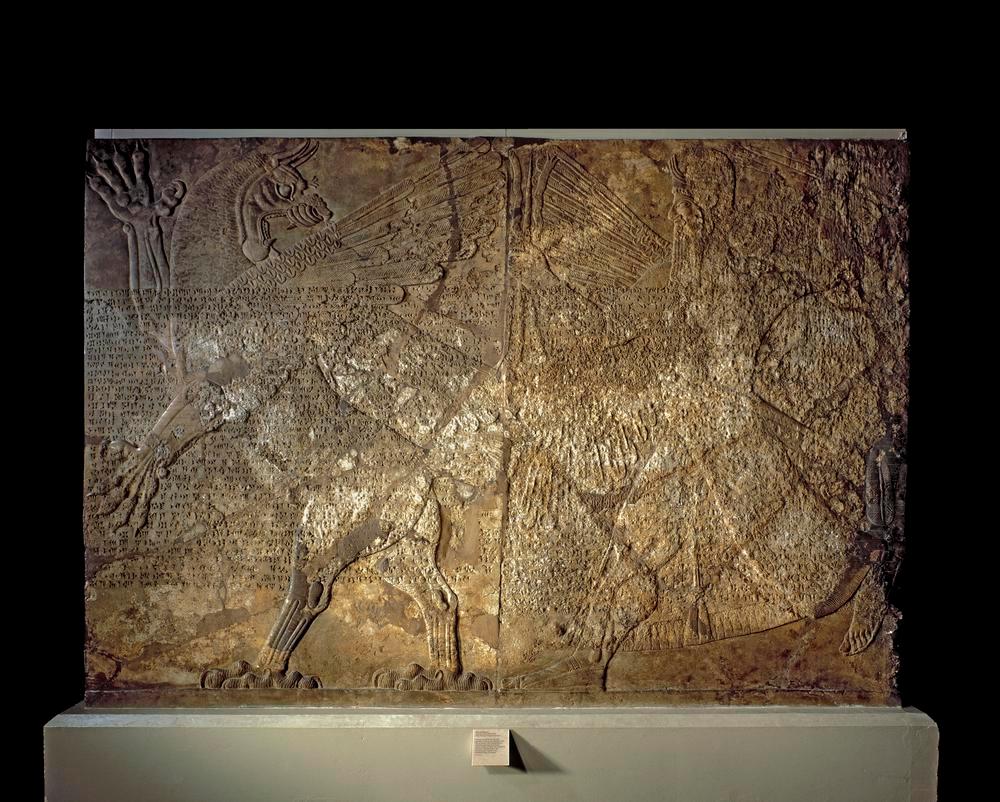
Anzu'yu Kovalayan Ninurta'yı Betimleyen Alçı Duvar Paneli Kabartması, Yeni Asur Dönemi (The British Museum)
Anzu’s association with natural elements, particularly mountainous regions and atmospheric phenomena, aligns with Mesopotamian cosmology, in which mountains and natural forces were perceived as sacred and liminal zones. In this context, Anzu is understood as a figure positioned at the boundary between the divine order and the human world.
The most prominent narrative of Anzu in Mesopotamian mythology is its seizure of the Tablets of Destiny belonging to Enlil, who stands at the head of the divine hierarchy. The theft of the tablets is presented as an act that directly threatens the functioning of the cosmos and the distribution of authority among the gods.
In response, the gods initiate a struggle to restore order, with Ninurta assigned the task of confronting Anzu. Ninurta’s battle with Anzu and the recovery of the Tablets of Destiny symbolize the reestablishment of divine order.
The Anzu myth is regarded as part of the broader Mesopotamian mythological theme of chaos and order. Anzu’s theft of the Tablets of Destiny is constructed as an event that temporarily disrupts the existing cosmic order. In this context, Anzu represents chaos as a figure associated with mountainous regions and positioned outside the established, orderly world.
However, Anzu’s defeat and the recovery of the tablets signify the restoration of order. This narrative structure reflects a recurring theme in Mesopotamian mythology: the emergence of chaos and its resolution through divine intervention. Within this process, Anzu functions as a figure that triggers chaos but ultimately contributes to the strengthening of divine order.
Anzu is depicted in Mesopotamian iconography as a hybrid creature. Written and visual sources consistently show Anzu with the body of an eagle and the head of a lion. These features link Anzu to both celestial and terrestrial powers.
Iconographic evidence indicates that the earliest depictions of Anzu appear on seals and seal impressions. In these representations, Anzu is typically shown in profile with wings open or partially open. Some scenes depict Anzu grasping other figures with its talons, an interpretation consistent with its mythological function.
The earliest depictions of Anzu date to the second half of the 4th millennium BCE during the Uruk period and appear on seals and seal impressions. These early examples are rendered in a schematic and stylized manner and are found in certain settlements in southern Mesopotamia, notably Uruk.
From the beginning of the 3rd millennium BCE, particularly during the Early Dynastic III period, there was a significant increase in depictions of Anzu. During this time, its hybrid form—eagle body and lion head—became more pronounced, and the figure frequently appears with wings open, engaged in combat with other beings. The geographical spread of these depictions extended northward to sites such as Ebla, Tell Brak, and Tell Chuera in Syria. Lagash was the center with the highest concentration of Anzu imagery during this period.
During the Akkad period, depictions of Anzu show a marked decline. However, in the Third Dynasty of Ur, Anzu was depicted again in a limited number of artifacts, primarily originating from Lagash.【3】
During the 2nd millennium BCE, depictions of Anzu in Mesopotamia became increasingly rare. In contrast, the figure reappeared in neighboring regions in cultural contact with Mesopotamia, particularly in Anatolia, where it was reinterpreted. In this context, Kültepe (Kaniş/Karum) emerges as a key center. Here, depictions of Anzu have been identified on both cylinder and stamp seals. On cylinder seals, the figure’s Mesopotamian iconographic traditions were maintained, but new compositions emerged, such as its depiction alongside local deities.
On some stamp seals from Kültepe, Anzu is depicted as a two-headed creature with one head of a lion and one of an eagle. This iconographic feature, not found in Mesopotamian tradition, is regarded as a local innovation unique to Anatolia.【4】This form of depiction indicates that Anzu was incorporated into a new mythological framework within the local context. The posture, feather details, and positioning of the figure within the scenes reflect both Mesopotamian influences and local interpretations.
Overall, the chronological development of Anzu depictions reveals the figure’s origins in Mesopotamia, its functional and iconographic transformations across different periods, and its subsequent reconfiguration through cultural interaction in new regions such as Anatolia.
Evidence related to the Anzu Bird indicates that its origins were not confined to Mesopotamia and that it was transmitted to surrounding regions over time. Particularly during the 2nd millennium BCE, depictions and motifs associated with Anzu have been identified in areas engaged in commercial and cultural exchange with Mesopotamia. It is clear that Anzu was transmitted both as a visual motif and as a mythological element during this period.
The most concrete evidence regarding the Anzu Bird in Anatolia comes from the finds at Kültepe (Kaniş/Karum). The depictions of Anzu on Kültepe seals and seal impressions dating to the 2nd millennium BCE reflect the transmission of Mesopotamian iconographic traditions into Anatolia. These depictions preserve Anzu’s core iconographic features but also incorporate local elements in composition and execution.
On a cylinder seal impression from the Karum area, four distinct depictions of Anzu appear in the same scene alongside Anatolian deities. Three of these depictions are associated with the chief goddess of Kaniş: two are shown before her, and one is positioned in the lower section between two bull-men. The fourth depiction of Anzu is shown above a bull, in front of the god of the air.
The Kültepe examples demonstrate that Anzu was one of the mythological figures transmitted between Mesopotamia and Anatolia within the framework of cultural interaction.
Maynard, Glynnis. “The Intervisuality of Anzu in Neo-Assyrian Mythologies of Kingship.” Iraq (2025): 1-19. Accessed January 28, 2026. https://www.cambridge.org/core/journals/iraq/article/intervisuality-of-anzu-in-neoassyrian-mythologies-of-kingship/E2E54951462079CFA3FF5610D5302CC5
The British Museum. “wall panel; relief.” *British Museum Collection Online*. Accessed January 28, 2026. https://www.britishmuseum.org/collection/object/W_1851-0902-501
Wazana, Nili. “Anzu and Ziz: Great Mythical Birds in Ancient Near Eastern, Biblical, and Rabbinic Traditions.” *Journal of the Ancient Near Eastern Society* 31, no. 1 (2008): 111–135. Accessed January 28, 2026. https://janes.scholasticahq.com/article/2460-anzu-and-ziz-great-mythical-birds-in-ancient-near-eastern-biblical-and-rabbinic-traditions
Öğreten, M. Tarık. “ANZU: Güney Mezopotamya’dan Kültepe’ye.” *Ankara Üniversitesi Dil ve Tarih-Coğrafya Fakültesi Dergisi* 62, no. 2 (2022): 1221–1239. Accessed January 28, 2026. https://dergipark.org.tr/tr/download/article-file/2209431
[1]
Mehmet Tarık Öğreten, “ANZU: Güney Mezopotamya’dan Kültepe’ye,” Ankara Üniversitesi Dil ve Tarih-Coğrafya Fakültesi Dergisi 62, no. 2 (2022): syf 1223, https://www.researchgate.net/publication/365937738_ANZU_GUNEY_MEZOPOTAMYA'DAN_KULTEPE'YEANZU_FROM_SOUTHERN_MESOPOTAMIA_TO_KULTEPE.
[2]
Nili Wazana, “Anzu and Ziz: Great Mythical Birds in Ancient Near Eastern, Biblical, and Rabbinic Traditions,” Journal of the Ancient Near Eastern Society 31, no. 1 (2008): syf 114, https://janes.scholasticahq.com/article/2460-anzu-and-ziz-great-mythical-birds-in-ancient-near-eastern-biblical-and-rabbinic-traditions
[3]
Tarık Öğreten, M. “ANZU: Güney Mezopotamya’dan Kültepe’ye,” Ankara Üniversitesi Dil ve Tarih-Coğrafya Fakültesi Dergisi 62, no. 2 (2022): syf 1224, https://dergipark.org.tr/tr/download/article-file/2209431
[4]
Tarık Öğreten, M. “ANZU: Güney Mezopotamya’dan Kültepe’ye,” Ankara Üniversitesi Dil ve Tarih-Coğrafya Fakültesi Dergisi 62, no. 2 (2022): syf 1225, https://dergipark.org.tr/tr/download/article-file/2209431

Type(s) | Mythological entity | ||||||||
|---|---|---|---|---|---|---|---|---|---|
Origin(s) | Southern Mesopotamia | ||||||||
Other Name(s) | Anzud AN.IM.DUGUD | ||||||||
Related Deities | Enlil, Ninurta (in mythological context) | ||||||||
Physical Feature | Bird-bodied, lion-headed hybrid figure | ||||||||
Cultural Context | Sumerian and Akkadian cultures | ||||||||
Anzu in the Mesopotamian Belief System
The Anzu Myth and the Tablets of Destiny
Anzu in Narratives of Chaos and Order
Physical Characteristics and Iconography
Chronological Development of Anzu Depictions
Cultural Spread and Areas of Interaction of Anzu
Anzu in Anatolia: The Case of Kültepe