This article was automatically translated from the original Turkish version.
+1 More
Location | Ardahan Türkiye | ||||||||
|---|---|---|---|---|---|---|---|---|---|
Construction Date(s) | MS. 1544 | ||||||||
First Settlement | BC 3500–2000 | ||||||||
Total Wall Length | 745 metres | ||||||||
Construction Material | Horasan mortar Regularly cut basalt stone | ||||||||
Number of Gates | 4 | ||||||||
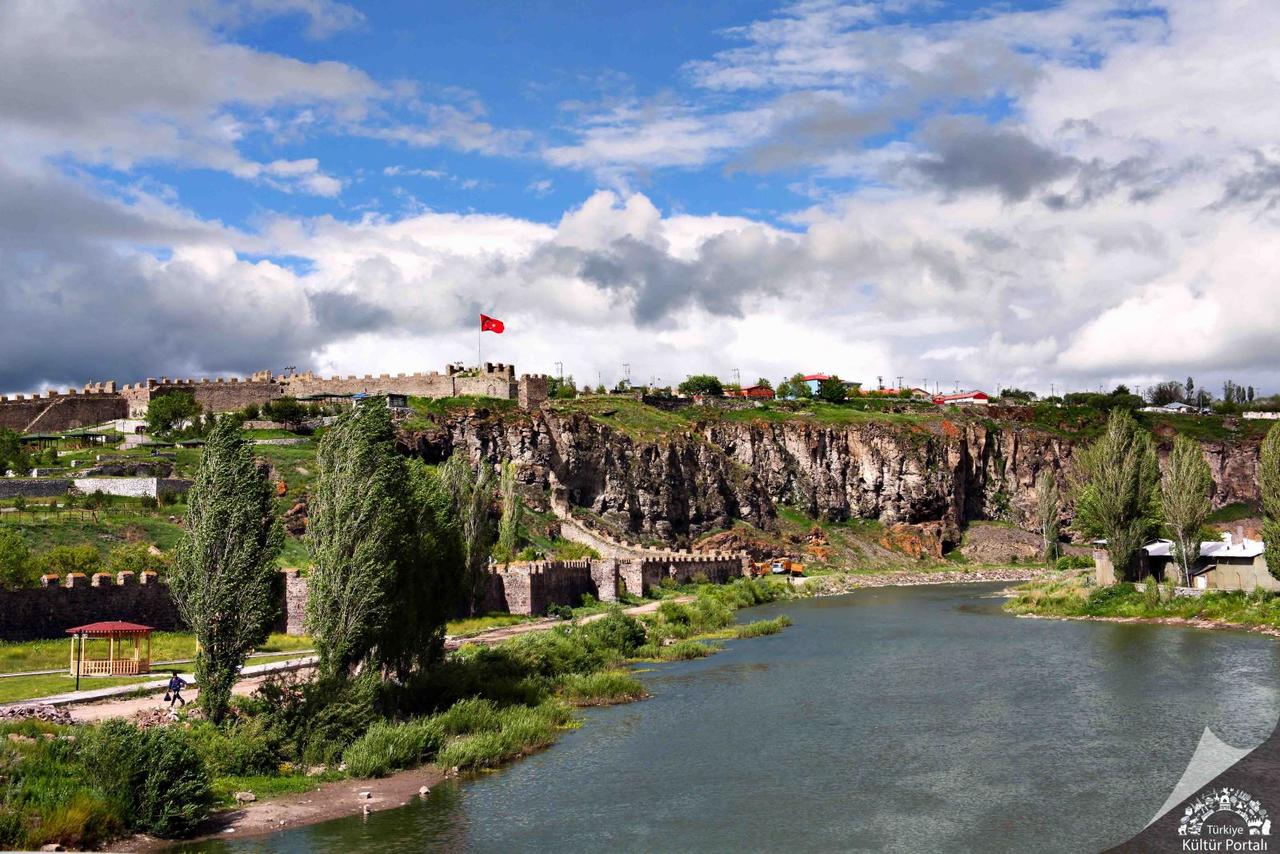
Ardahan Castle is located on the left bank of the Kura River, which separates the Halil Efendi Neighborhood from the city center, to the north of Ardahan city center in Türkiye. The castle was positioned along the riverbank to overlook the Ardahan Plain. Today, Ardahan Castle continues to exist within the urban fabric and preserves its historical structure.

Ardahan Castle (Türkiye Culture Portal)
The exact date of the castle’s initial construction is unknown; however, prehistoric research conducted in the region indicates that human settlement extends as far back as 3500–2000 BCE, during the Early Bronze Age. In this context, findings dating to prehistoric periods have been discovered around the castle. The current structure of Ardahan Castle dates to the Ottoman period. It was commissioned by Sultan Süleyman the Magnificent and constructed in 963 AH / 1544 CE. The Arabic inscription above the castle gate reads:
"Built in the name of Sultan Süleyman the Great, son of Sultan Selim, sovereign of the lands and seas of Arabia, Rome and Persia. May his dominion endure until the Day of Judgment."
The castle has a rectangular plan and was constructed in harmony with the topography. The curtain walls are reinforced by numerous square and polygonal towers, with a total length of 745 meters. The walls were built using finely cut basalt stones, bonded with Horasan mortar and lime-based joints. The upper sections of the walls feature machicolations (dendans). The wall construction technique, polygonal tower forms, and overall layout bear similarities to Rumeli Hisarı. The main entrance is situated on the western side and consists of a slightly pointed arch flanked by two towers, enclosed within a vaulted space resembling an iwan. In addition, there are three other gates: one to the north, one to the east, and one facing the river (huruç). The northern gate has been sealed over time.
The local basalt stones forming the castle’s walls present a distinctive visual contrast against the green landscape due to their light and dark tones. Lichen growth has been observed on the lime mortar joints on the eastern facade. However, the structure has suffered damage over time due to treasure hunting and unauthorized interventions. In particular, the removal of wooden battlements and wind gaps has compromised the integrity of the walls.
Ardahan Castle served not only to oversee the city center of Ardahan but also the entire Ardahan Plain. As a military structure, it formed part of a defensive line together with fortifications on the opposite bank and played a significant role in the region’s security for many centuries.
Within the boundaries of Ardahan Province, numerous other castles exist besides Ardahan Castle. These include Savaşır (Cancak) Castle in Posof, Kinzi Castle near Bağdeşe Village, Sevimli (Vel) Castle near Hanak, Kalecik Castle in Göle District, Şeytan Castle and Kurtkale in Çıldır District, Kazan Castle in the northeast of Ardahan, Altaş (Ur) Castle, and Kırnav Castle near Hanak District. While the exact construction dates of most of these castles are unknown, some have been dated to the Middle Ages and others to the 7th–8th centuries. Castles exhibiting construction techniques similar to those of Ardahan Castle reveal the historical defensive organization of the region.
Ministry of Culture and Tourism. "Ardahan İl." *Ministry of Culture and Tourism, Ardahan Provincial Directorate of Culture and Tourism*. Accessed July 8, 2025. https://ardahan.ktb.gov.tr/TR-55800/ardahan-kalesi.html.
Ministry of Culture and Tourism. "Kaleler." *Ministry of Culture and TourismArdahan İl Directorate of Culture and Tourism*. Accessed July 8, 2025. https://ardahan.ktb.gov.tr/TR-55799/kaleler.html.
T.C. Kültür ve Turizm Bakanlığı. "Ardahan Kalesi." Kültür Portalı. Accessed July 8, 2025. https://www.kulturportali.gov.tr/turkiye/ardahan/gezilecekyer/ardahan-kalesi-1.

Location | Ardahan Türkiye | ||||||||
|---|---|---|---|---|---|---|---|---|---|
Construction Date(s) | MS. 1544 | ||||||||
First Settlement | BC 3500–2000 | ||||||||
Total Wall Length | 745 metres | ||||||||
Construction Material | Horasan mortar Regularly cut basalt stone | ||||||||
Number of Gates | 4 | ||||||||
History
Architectural Features
Materials and Conservation Status
Historical Role
Other Castles in the Vicinity