This article was automatically translated from the original Turkish version.
+2 More
Type of Geographical İndication | Mahreç Sign | ||||||||
|---|---|---|---|---|---|---|---|---|---|
Application Date | 26.11.2012 | ||||||||
Registration Number | 228 | ||||||||
Registration Date | 15.11.2017 | ||||||||
Product / Product Group(s) | Textiles | ||||||||
Province(s) | Sinop | ||||||||
Applicant/Registrant(s) | Ayancık Adult Education Center Evening Art School Directorate | ||||||||
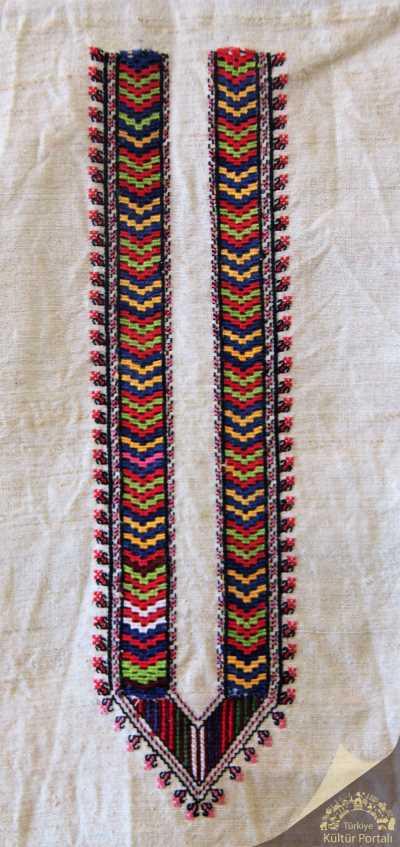
Ayancık Göynek Yakası is a traditional craft product unique to the district of Ayancık in the Sinop province of Türkiye’s Black Sea Region. The göynek collars worn by local women in both daily life and on special occasions are regarded not merely as aesthetic details but as carriers of cultural identity.
The history of göynek collars is deeply intertwined with Ayancık’s linen weaving tradition. This craft tradition, sustained since the 1950s through various technical adaptations, has been shaped by the skill and interpretation of women. Embroideries applied on fabrics woven from linen or cotton reflect a local manifestation of Anatolia’s textile heritage.
The Ayancık Göynek Yakası has been granted legal protection under Law No. 6769 on Industrial Property as a geographical indication with registration number 228 on 15 November 2017, registered by the Ayancık People’s Education Center and Akşam Art School Directorate. This certification affirms the regional character and cultural uniqueness of its production methods.
Göynek collars are typically embroidered on fabrics woven from cotton and linen thread. Embroidery can be applied directly onto the göynek or first executed on a separate fabric and then mounted onto the göynek collar.
The traditional cleaning method in the region, the use of ash water, signifies cultural continuity in the maintenance of these embroideries.
Embroidery practices are categorized into three main techniques:
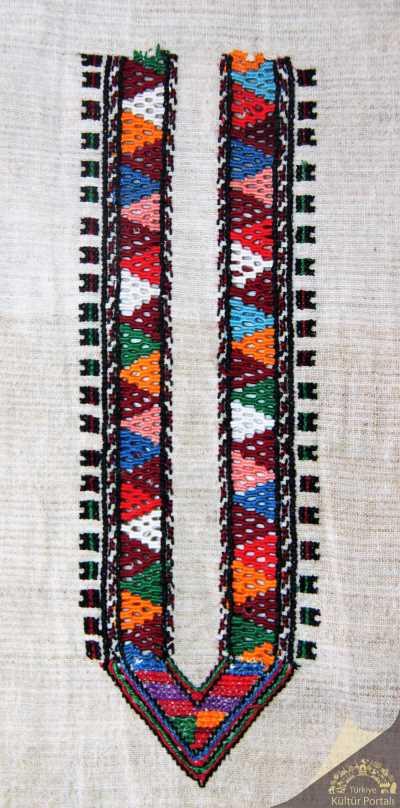
Ayancık Göynek Yakası (Culture Portal)
In the Ayancık region, the embroidery techniques applied to göynek collars are known by unique local names. Each technique presents a distinct narrative through its formal characteristics and cultural associations:
These names elevate embroidery from a mere technical process to a tangible element of folk culture. Each collar bears traces not only of the maker’s skill but also of her cultural memory.
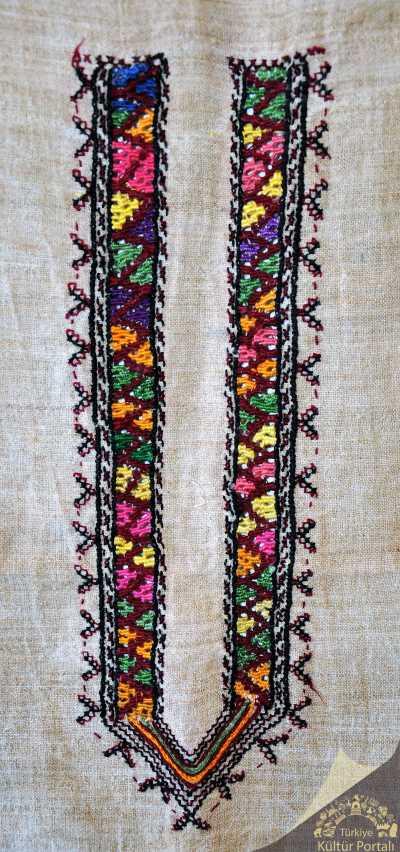
Ayancık Göynek Yakası (Culture Portal)
Today, the craft of Ayancık göynek yakası is sustained primarily through the production of souvenir items. Due to the high level of manual labor and patience required, the work is carried out voluntarily by women.
The declining traditions of linen weaving and göynek embroidery in the region were revitalized in 2020 through the launch of the “Linen Thread Production Project”. Conducted in collaboration between the Ministry of Culture and Tourism and the United Nations Anatolia-Efes Project, this initiative strengthened the technical infrastructure of local production. The previously closed Kurtuluş Primary School was repurposed as the “Linen House,” housing weaving workshops, spinning sections, exhibition areas, and a linen cultivation field.
Women collect vintage göynek collars and reinterpret them by transforming them into bags, accessories, or garments, thereby ensuring the sustainability of regional products.
The Ayancık göynek yakası is regarded not merely as a garment element but as a cultural memory artifact. The registration as a geographical indication ensures the legal and ethical protection of traditional production methods, while the active participation of women in production sustains the vitality of cultural transmission.
Cebeci, Dilek Tüm. “Geleneksel Ayancık Göynek Yakaları ve Giysi Tasarımlarında Kullanımı.” *Uluslararası Sosyal Araştırmalar Dergisi* 13, no. 72 (August 2020): 505–515. Accessed July 13, 2025. https://www.sosyalarastirmalar.com/articles/traditional-ayancik-goynek-collars-and-their-use-in-dressing-design.pdf.
Güven, İ. M. V. Noyan, and Esra Kavcı Özdemir. “Günümüz Sinop-Ayancık Keten Dokumaları ve Göyneklerinin Durumu Üzerine Bir Değerlendirme.” *Fikriyat Sosyal Bilimler Araştırmaları Dergisi* 2, no. 2 (December 2022): 117–130. Accessed July 13, 2025. https://dergipark.org.tr/tr/download/article-file/2793134.
Ministry of Culture and Tourism. "Ayancık – El Sanatları." *Kültür Portalı*. Accessed July 13, 2025. https://www.kulturportali.gov.tr/medya/fotograf/kategori/elsanatlari/ayanc%C4%B1k.
Turkish Patent and Trademark Office. "Ayancık Göynek Yakası – Coğrafi İşaret Detayı." *Coğrafi İşaretler Portalı*. Accessed July 13, 2025. https://ci.turkpatent.gov.tr/cografi-isaretler/detay/38082.

Type of Geographical İndication | Mahreç Sign | ||||||||
|---|---|---|---|---|---|---|---|---|---|
Application Date | 26.11.2012 | ||||||||
Registration Number | 228 | ||||||||
Registration Date | 15.11.2017 | ||||||||
Product / Product Group(s) | Textiles | ||||||||
Province(s) | Sinop | ||||||||
Applicant/Registrant(s) | Ayancık Adult Education Center Evening Art School Directorate | ||||||||
No Discussion Added Yet
Start discussion for "Ayancık Göynek Yakası" article
Technical Structure and Processing Methods
Traditional Technique Nomenclature
Production Process and Current Status
Cultural Function and Transmission to the Future