


This article was automatically translated from the original Turkish version.
+1 More
Aydın fig is a fig variety grown in Aydın Province in western Anatolia, Türkiye, and internationally known as “sarı lop.” This product, one of Türkiye’s registered geographical indications, is consumed both fresh and dried. Due to the ideal climatic and soil conditions of the region, Aydın fig is regarded among the highest quality dried figs in the world.
Fig has been cultivated in Aydın and its surroundings for thousands of years. This product, which has been part of the region’s culture since antiquity, forms the foundation of Aydın’s fig farming. From the Ottoman period onward, exports of Aydın fig increased significantly, especially during the 19th century when they were shipped to Europe and America via the Port of İzmir. In the 2000s, it was officially registered as a geographical indication, initiating its branding process.

Fig Tree (AA)
Aydın fig is primarily cultivated in the Büyük Menderes Basin. The basin’s climate features hot dry summers and mild wet winters. It is widely grown across nearly all districts of Aydın, especially in Nazilli, Germencik, İncirliova, Köşk, Sultanhisar and Efeler. Thanks to microclimate effects, this region offers the most suitable climatic zone in the world for the sarı lop variety.
The sarı lop variety has skin that changes from pale yellowish-green to amber yellow as the fruit ripens and becomes softer. The interior flesh turns a deep pink to red hue. Mature fruits are large, juicy, thin-skinned and high in sugar content. In dried form, they exhibit clear advantages in shape, color, aroma and taste. The trees have a broad canopy structure and high yield.

Aydın Fig (AA)
Fig production begins with pruning in January and February. Fertilization and soil preparation take place in March and April. Irrigation, pest control and the release of the fig wasp (Blastophaga psenes) occur in May and June. Fresh figs are harvested at the end of July and beginning of August, while figs intended for drying are allowed to fall naturally from the tree and dried by sun exposure. After drying, the figs undergo sorting and packaging.

Dried Fig Harvest (AA)
Pollination of Aydın fig requires exclusively the fig wasp (Blastophaga psenes). Female wasps emerge from male figs (caprifigs) and pollinate the flowers of female trees. This symbiotic relationship is essential for successful fig production. Therefore, caprifig trees are specifically cultivated in the Aydın region and hung on female trees during designated periods.
Aydın fig holds a significant position in Türkiye’s dried fruit exports. Approximately 50 percent of global dried fig production is supplied by Türkiye, with over 80 percent originating from the Aydın region. It is exported primarily to European Union countries, as well as the United States, Russia and Middle Eastern nations. As a vital source of livelihood for local communities, it also supports employment in the regional economy.
Aydın fig was granted geographical indication protection by the Turkish Patent and Trademark Office in 2005. This registration permits only figs grown within the boundaries of Aydın Province and meeting specific production standards to be marketed as “Aydın fig.” The certification ensures quality and plays a crucial role in combating counterfeiting.
Aydın fig is consumed both fresh and dried. Dried figs are eaten directly and also used in lokum, ezme, desserts and baked goods. Industrially, they are processed into fig jam, energy bars, chips, fruit juice and vinegar. Additionally, due to their high fiber, calcium and natural sugar content, they are an important food for healthy nutrition.
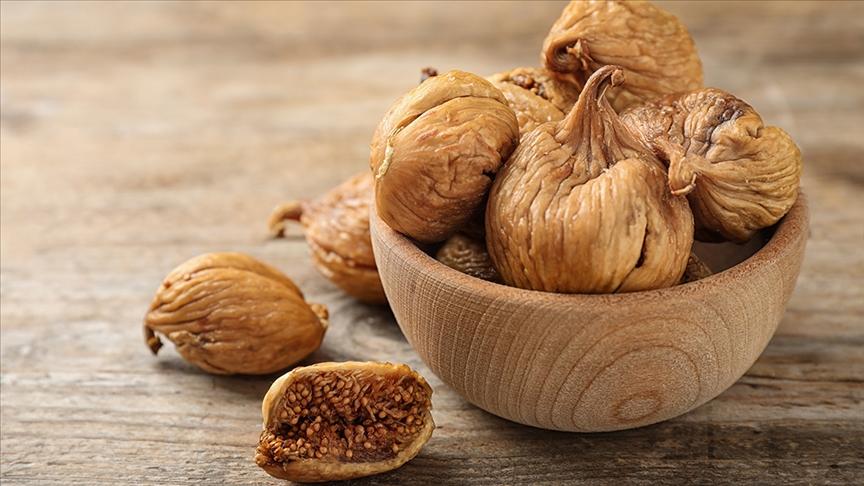
Dried Fig (AA)
Aydın fig production is threatened by climate change, pests, extreme heat and unsustainable farming practices. Diseases such as fig psyllid, fig moth and souring bacteria reduce quality. In response, the Ministry of Agriculture and Forestry and local associations conduct training programs for producers, promote biotechnological pest control methods and incentivize organic farming to enhance quality.
Anadolu Ajansı. “Aydın'da üreticiler 'incirler çürümesin' diye gece gündüz mesaide”. Anadolu Ajansı. Accessed May 14, 2025. Accessed Adresi.
Anadolu Ajansı. “Aşırı sıcaklar kuru incirde hasadı öne çekti”. Accessed May 14, 2025. Accessed Adresi.
Anadolu Ajansı. “Kuru incir ihracatında hedef 70 bin ton.” Accessed May 14, 2025. Accessed Adresi.
Anadolu Ajansı. “İncirin başkentinde hasat başladı”. Accessed May 14, 2025. Accessed Adresi.
Aydın İl Directorate of Agriculture and Forestry. "İncir Kitabı." Aydın Provincial Directorate of Agriculture and Forestry Website. Accessed May 14, 2025. https://aydin.tarimorman.gov.tr/Belgeler/%C4%B0l%20M%C3%BCd%C3%BCrl%C3%BC%C4%9F%C3%BC%20Bas%C4%B1l%C4%B1%20Yay%C4%B1nlar/AYDIN%27IN%20D%C3%96RT%20EFES%C4%B0/%C4%B0NC%C4%B0R%20K%C4%B0TABI%20.pdf
Doğan, Pınar. "Aydın Yöresinde Yetiştirilen ‘Sarılop’ İncir Fidanlarında Farklı Sulama Uygulamalarının Vejetatif Gelişme ve Bitki Su Tüketimine Etkilerinin Araştırılması." Master's thesis, Aydın AdnanMenderes Üniversitesi, 2020. Accessed May 14, 2025. http://adudspace.adu.edu.tr:8080/jspui/bitstream/11607/4182/1/623679.pdf
T.C. Ministry of Food, Agriculture and Livestock,Aydın İl Directorate. "İncir Yetiştiriciliği." T.C. Ministry of Food, Agriculture and Livestock, Aydın Provincial Directorate Website. Accessed May 14, 2025. https://aydin.tarimorman.gov.tr/Belgeler/%C4%B0l%20M%C3%BCd%C3%BCrl%C3%BC%C4%9F%C3%BC%20Bas%C4%B1l%C4%B1%20Yay%C4%B1nlar/incir%20yetistiriciligi.pdf
Turk Patent and Trademark Office. "Aydın İnciri." Turk Patent and Trademark Office Website. Accessed May 14, 2025. https://ci.turkpatent.gov.tr/Files/GeographicalSigns/43b1c502-7631-4f69-aeff-9c1be7558c65.pdf
Özatalay, Zeynep. "Aydın Yöresi Halk Hekimliği İncirin Kullanımı." KMÜ Sosyal ve EkonomikAraştırmalar Dergı 16 (Özel Sayı II): 151–154, Karamanoğlu Mehmetbey Üniversitesi, 2014. Accessed May 14, 2025. https://dergi.kmu.edu.tr/userfiles/file/Mayis20142/24m.pdf

History
Growing Areas
Botanical Characteristics
Production Process
Fig Wasp and Pollination
Economic Importance
Geographical Indication and Quality Protection
Processing and Consumption Methods
Protection Measures