

This article was automatically translated from the original Turkish version.
+2 More
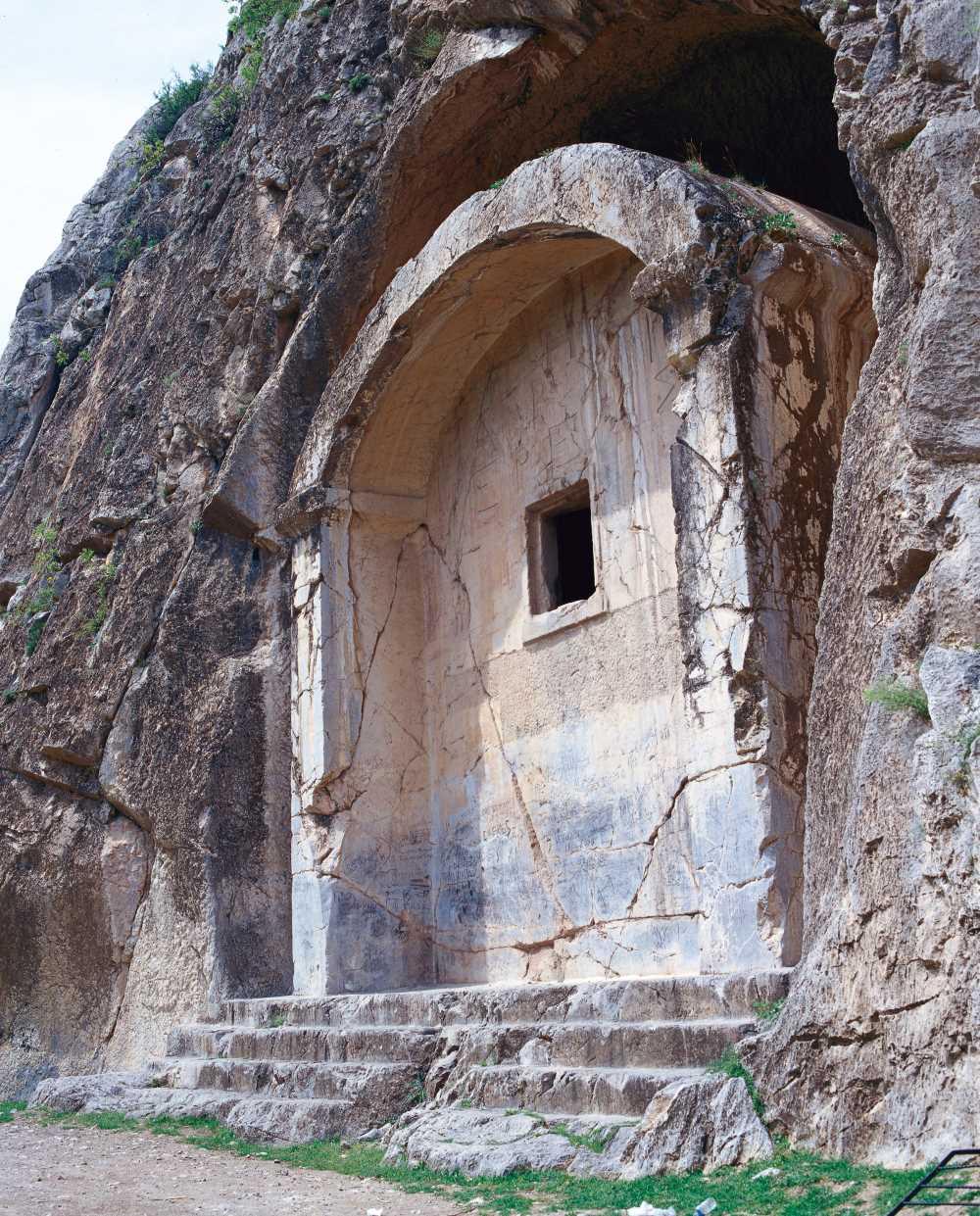
Aynalı Mağara is a rock tomb carved into a mass of limestone rock, located approximately 3.3 kilometers from the center of Amasya, along the Ziyaret village road and on the right bank of the Yeşilırmak Valley【1】. When compared with other rock tombs in the Amasya Valley, the craftsmanship details of this structure are clearly completed. The monument derives its name from the polished exterior surface that reflects sunlight and glows. Unlike other rock tombs in the valley, this tomb is carved entirely on an independent rock block and is included in the inventory of Hellenistic period monuments in the region due to its facade decorations and physical location【2】.
The dimensions of the monumental tomb, carved from a flat rock mass, have been determined as 9.8 meters in width and 13 meters in height【3】. Access to the entrance, positioned at a height of approximately 4 to 5 meters above ground level, is provided via a four-step stone staircase designed in alignment with the structure【4】. The front facade of the tomb has been smoothed and polished using the region’s characteristic polishing technique, giving it a marble-like appearance. This surface treatment has contributed to the long-term preservation of the structure’s physical integrity. The external mass and internal spatial sections of the tomb were planned according to a specific volumetric ratio, and its physical dimensions are visible from surrounding vantage points【5】. The internal layout consists of two independent rooms with square and rectangular forms. The rectangular room serves as the main burial chamber. The stone carving and finishing techniques observed on the internal walls and external cladding reflect regional construction practices and technical capabilities of the period. The formal arrangements around the entrance and the transitions between internal chambers provide evidence that the structure functioned not only as a burial site but also as a monumental gathering space【6】.
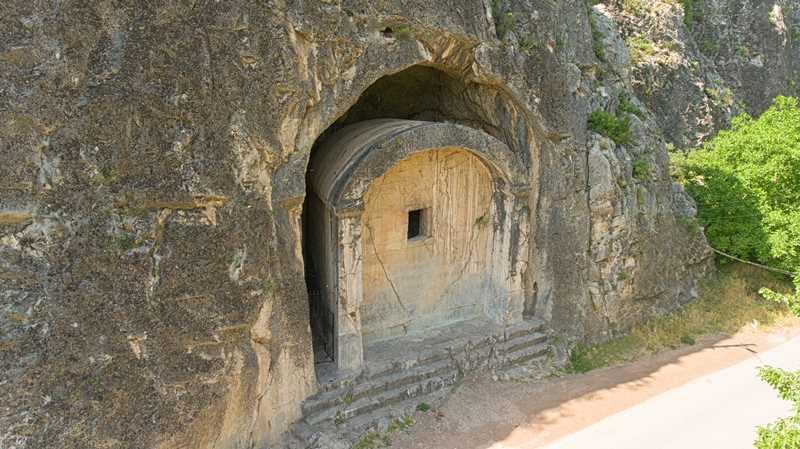
Aynalı Mağara (Amasya)
Historical evidence indicates that the rock tomb monument was constructed during the 2nd century BCE as part of the cultural and religious framework of the region under the name of Mithra’s High Priest【7】. An epigraphic inscription in Greek script reading “THE APX IEPEYE” (High Priest Tes) is located on the lintel above the entrance. This inscription serves as a primary datum for dating the structure and confirms a direct connection between the monument and the religious beliefs of the period. The association with the Mithraic belief system elucidates the monument’s functions and purposes during antiquity.【8】. After the completion of its initial use in antiquity, the structure was repurposed during the Byzantine period, dated to the 11th century, by Christian clergy for worship, ascetic retreat, and shelter【9】. During this phase, the interior walls surrounding the burial chambers were painted using the fresco technique, and the structure acquired the characteristics of a chapel. The colored murals found on the walls of the square chamber, including depictions of the Twelve Apostles on the vaulted ceiling and various scenes from biblical texts, serve as evidence of this period of use. Particularly, the Deisis composition on the eastern facade, featuring figures of Jesus Christ, the Virgin Mary, and John the Baptist (Ioannes), demonstrates the monument’s significance within Byzantine religious history【10】.
According to oral tradition passed down through generations, the structure is the subject of a folk narrative centered on a princess known as “Güzelce Kız,” who concealed her face with a veil at all times, and a poor young man who sought to marry her. According to the legend, the king declared that he would give his daughter in marriage to anyone who could lift her veil; numerous attempts were made but none succeeded. At the moment the poor youth finally lifted the veil, a brilliant flash of light and fire erupted, resulting in the death of both figures【11】. The continuation of the oral account states that immediately after the event, the bodies of both figures were placed within the monumental rock tomb, each in one of the two separate chambers—square and rectangular. The physical luminosity observed on the tomb’s outer facade is explained by local tradition as the reflection left by the princess’s face upon the rock surface. This legend, still alive in regional culture, is regarded as a sociological datum illustrating how an archaeological site becomes intertwined with collective memory and folk culture【12】.
[1]
T.C. Kültür ve Turizm Bakanlığı, "Aynalı Mağara - Amasya", Kültür Portalı, erişim tarihi 18 Şubat 2026,https://www.kulturportali.gov.tr/turkiye/amasya/gezilecekyer/aynali-magara
[2]
T.C. Kültür ve Turizm Bakanlığı, "Aynalı Mağara - Amasya", Kültür Portalı, erişim tarihi 18 Şubat 2026,https://www.kulturportali.gov.tr/turkiye/amasya/gezilecekyer/aynali-magara
[3]
Amasya Belediyesi. “Aynalı Mağara.” Amasya Belediyesi Kent Rehberi. Erişim 18 Şubat 2026.https://kentrehberi.amasya.bel.tr/kategoriler/oren-yerleri/aynali-magara
[4]
Amasya Belediyesi. “Aynalı Mağara.” Amasya Belediyesi Kent Rehberi. Erişim 18 Şubat 2026.https://kentrehberi.amasya.bel.tr/kategoriler/oren-yerleri/aynali-magara
[5]
Amasya Belediyesi. “Aynalı Mağara.” Amasya Belediyesi Kent Rehberi. Erişim 18 Şubat 2026.https://kentrehberi.amasya.bel.tr/kategoriler/oren-yerleri/aynali-magara
[6]
Göksu Demircan, "Aynalı Mağara", Türkiye Turizm Ansiklopedisi, erişim tarihi 18 Şubat 2026,https://turkiyeturizmansiklopedisi.com/aynali-magara
[7]
Amasya Belediyesi. “Aynalı Mağara.” Amasya Belediyesi Kent Rehberi. Erişim 18 Şubat 2026.https://kentrehberi.amasya.bel.tr/kategoriler/oren-yerleri/aynali-magara
[8]
Amasya Belediyesi. “Aynalı Mağara.” Amasya Belediyesi Kent Rehberi. Erişim 18 Şubat 2026.https://kentrehberi.amasya.bel.tr/kategoriler/oren-yerleri/aynali-magara
[9]
T.C. Kültür ve Turizm Bakanlığı, "Aynalı Mağara - Amasya", Kültür Portalı, erişim tarihi 18 Şubat 2026,https://www.kulturportali.gov.tr/turkiye/amasya/gezilecekyer/aynali-magara
[10]
T.C. Kültür ve Turizm Bakanlığı, "Aynalı Mağara - Amasya", Kültür Portalı, erişim tarihi 18 Şubat 2026,https://www.kulturportali.gov.tr/turkiye/amasya/gezilecekyer/aynali-magara
[11]
T.C. Kültür ve Turizm Bakanlığı, "Aynalı Mağara - Amasya", Kültür Portalı, erişim tarihi 18 Şubat 2026,https://www.kulturportali.gov.tr/turkiye/amasya/gezilecekyer/aynali-magara
[12]
T.C. Kültür ve Turizm Bakanlığı, "Aynalı Mağara - Amasya", Kültür Portalı, erişim tarihi 18 Şubat 2026,https://www.kulturportali.gov.tr/turkiye/amasya/gezilecekyer/aynali-magara

No Discussion Added Yet
Start discussion for "Aynalı Cave (Amasya)" article
Architectural Features
History and Religious Use
The Legend of the Beautiful Girl