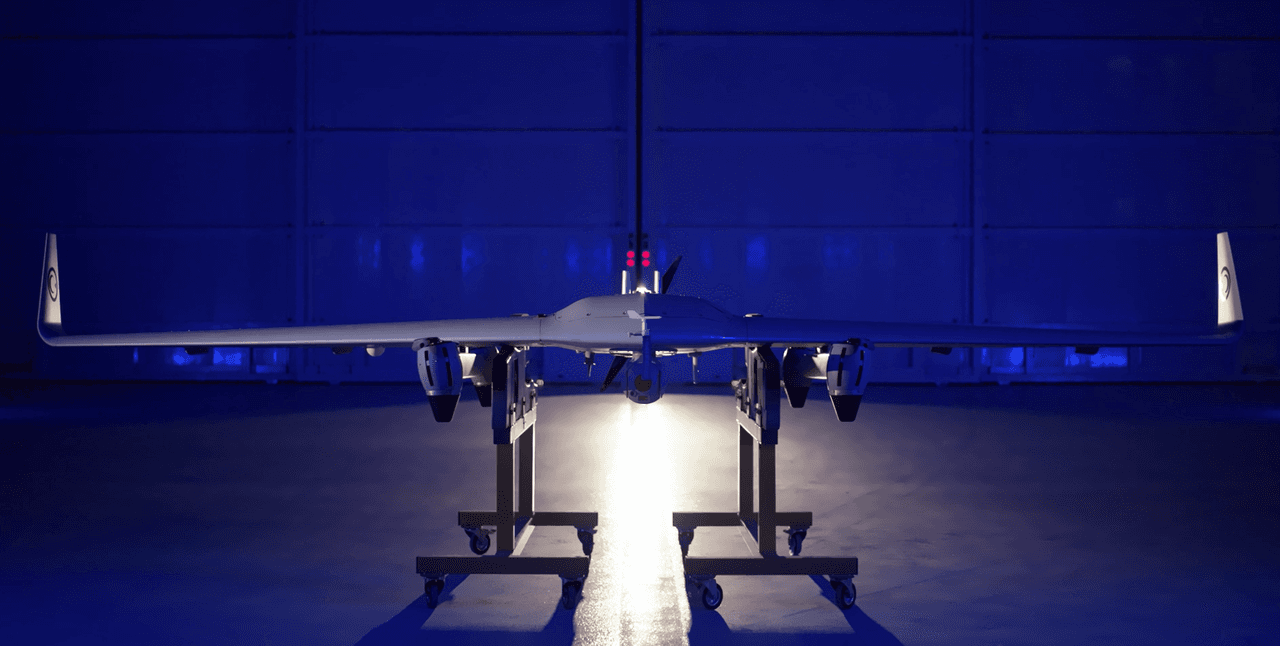
This article was automatically translated from the original Turkish version.
Type(s) | Vertical Takeoff and Landing Unmanned Aerial Vehicle | ||||||||
|---|---|---|---|---|---|---|---|---|---|
National Origin | Türkiye | ||||||||
Developer(s) | Baykar Teknoloji | ||||||||
First Flight(s) | 19.04.2022 | ||||||||
The Bayraktar KALKAN Vertical Takeoff and Landing Unmanned Aerial Vehicle (VTOL UAV), developed by Baykar Technology, is a tactical UAV designed for reconnaissance and intelligence missions. Its vertical takeoff and landing capability eliminates the need for runways, providing operational flexibility in challenging terrain and confined spaces.
KALKAN DİHA is an innovative platform offering advanced technological solutions tailored to modern military and civilian operational needs. Despite its compact size, the vehicle features long endurance and a versatile mission profile. Bayraktar DİHA delivers a broad range of services to both military and civilian users by enhancing operational flexibility.
Bayraktar KALKAN DİHA (Baykar)
Baykar announced that development of the Bayraktar KALKAN DİHA began in 2019. TEKNOFEST The KALKAN DİHA, unveiled to the public in 2021, is designed for deployment on maritime platforms, at outposts, or within units without requiring a runway. The system’s most distinctive engineering feature is its hybrid propulsion system, which uses electric motors for vertical takeoff and landing and a gasoline-powered internal combustion engine for cruise flight.
Testing of the KALKAN DİHA was conducted at Baykar’s Flight Training and Test Center in Keşan. During its transition from prototype stages (PT-1, PT-6, etc.) to serial production configuration, the system evolved from a purely reconnaissance-focused platform into a weaponized FPV drone carrier capable of carrying SkyDagger kamikaze drones, thereby enriching its development with operational versatility.
Bayraktar KALKAN DİHA FPV Drone Launch Test (Baykar)
The Bayraktar KALKAN DİHA derives its power from four electric motors—two forward and two aft—and a single low-consumption gasoline engine. After vertical takeoff using the electric motors, it transitions to cruise flight powered by the gasoline engine. This hybrid propulsion design is regarded in the industry as a pioneering feature for energy efficiency and operational flexibility. electricity only path (or) trail (Note: In encyclopedic contexts, "çığır" is often used metaphorically to mean "a new path" or "a groundbreaking direction," as in "çığır açmak" — to blaze a trail. The appropriate translation depends on context. If referring literally to a physical path, use "path" or "trail." If used figuratively, consider "trail," "path," or "groundbreaking direction." For general encyclopedic use, "path" is the most neutral and widely applicable translation.)
Another key feature of the KALKAN DİHA is the BG-160, an electro-optical (EO) system developed in-house by Baykar. Designed to operate in harsh weather conditions over land and sea, the KALKAN DİHA has a maximum takeoff weight of 75 kg and a planned cruise speed of 148 km/h (50 KTAS). Although its operational altitude is set at 8,000 feet (approximately 2,438 meters), during a test flight on 7 July 2024, the KALKAN DİHA reached an altitude of 14,500 feet. During a test flight on 2 February 2024, it remained airborne for 2 hours and 30 minutes and achieved a range of 40 km. Its ultimate range is determined at 100 km.
The Bayraktar KALKAN DİHA is a notable unmanned aerial vehicle platform distinguished by its advanced avionics systems. The semi-autonomous flight mode enables the aircraft to reliably execute specific flight missions without human intervention. The fault-tolerant system architecture is designed to ensure operational safety by preventing any potential in-flight faults from compromising mission integrity, meeting high safety standards. technical building This architecture is supported by a triple-redundant flight control system and redundant servo actuators, which ensure system continuity and minimize risks during missions.
The KALKAN DİHA is equipped with sensors including Vehicle, Electro-Optical (EO) and Infrared (IR) camera modules, a laser rangefinder, and a laser designator. Particularly noteworthy is the BG160 EO/IR sensor module developed by Baykar, which integrates laser designator and rangefinder functions to deliver high performance through a multi-sensor camera system. Additionally, fully autonomous takeoff, landing, and flight capabilities supported by sensor fusion significantly enhance the vehicle’s autonomous operational capacity. With Digital, data, and video link infrastructure enabling real-time data transmission, real avionics systems the system significantly improves the effectiveness and reliability of the Bayraktar KALKAN DİHA in both military and civilian missions.
Technical Specifications Table (Baykar)
The Bayraktar KALKAN VTOL UAV is an unmanned aerial vehicle distinguished by its autonomous capabilities, enabling it to perform automatic route tracking, target tracking, orbiting, and return-to-base modes. These capabilities are supported by the BG-160 Electro-Optical (EO) Camera System, fully developed indigenously by Baykar.
The BG-160 system delivers high-resolution imagery during both day and night operations thanks to its thermal imaging capability, delivering superior performance under low-visibility conditions. Mounted on the front underside of the airframe and weighing 3 kg, this EO system enhances the platform’s effectiveness in surveillance, reconnaissance, and target tracking missions.
The BG-160 camera system has been actively used in flight tests, with results confirming its high precision and reliability.
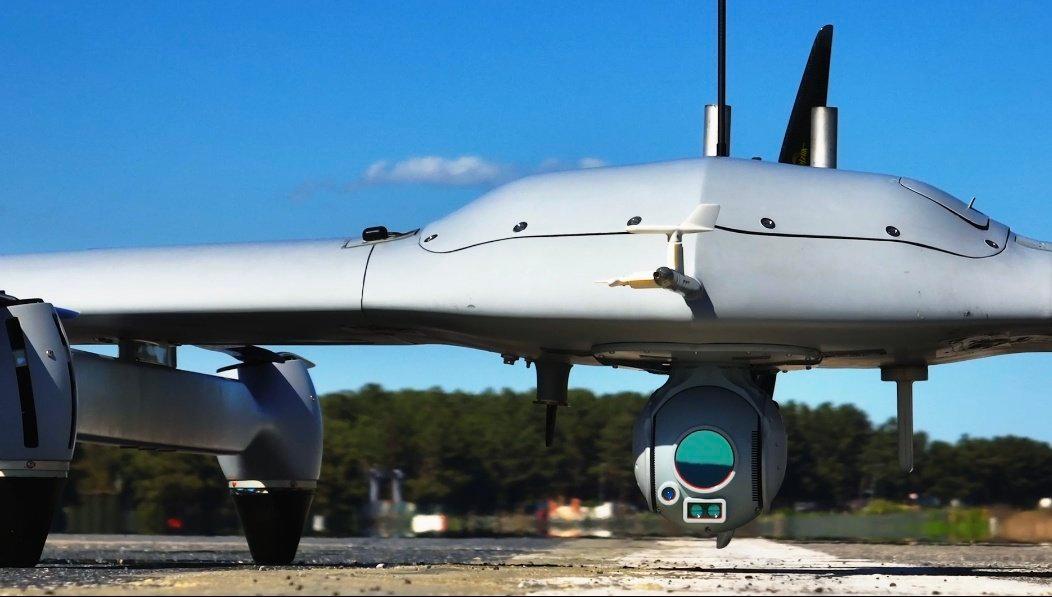
BG-160 Electro-Optical System (Baykar)
The KALKAN UAV eliminates the need for runways, enabling operations in confined and inaccessible areas. This feature allows takeoff and landing on challenging terrains and mobile platforms.
The Bayraktar KALKAN UAV ensures operational continuity even under adverse weather conditions through its sub-cloud flight capability, effectively observing areas beneath cloud cover. Its ability to fly at low altitudes provides a significant advantage in missions such as border security, smuggling detection, and search and rescue. Additionally, the increased likelihood of evading radar detection during low-altitude flight offers a tactical advantage in military operations. strategic Clear visibility below cloud level enables effective use of systems such as laser rangefinders and laser designators.
Thanks to its vertical takeoff and landing capability, the Bayraktar KALKAN UAV can be easily deployed on open seas and mobile platforms without requiring runways. This provides a practical deployment option aboard ships and during maritime operations. Within maritime missions, it can effectively carry out critical operations such as exploration and surveillance of economic zones, detection of illegal activities, search and rescue, and logistical support. Its ability to perform stable takeoffs and landings in rough seas grants it operational independence from adverse weather conditions. Thanks to its compact and modular design, the KALKAN UAV can be easily integrated onto maritime platforms, enhancing operational efficiency through optimized ship-based deployment configurations.
Primarily designed for military reconnaissance and surveillance operations on land and at sea, the KALKAN UAV is expected to be employed in a wide range of civilian applications, including logistical support, disaster management, agricultural monitoring, environment surveillance, and humanitarian aid operations.
The Bayraktar UAV is designed for portability and rapid deployment. Thanks to its modular and compact design, it can be easily disassembled, transported, and rapidly made flight-ready in the field. This feature makes the UAV a suitable solution for modern operational needs in terms of operational flexibility and logistical efficiency. fast solution
Tests conducted by the end of 2025 enabled the Bayraktar KALKAN UAV to carry and release FPV (First Person View) kamikaze drones mid-air, delivering them to target zones. This capability allows short-range kamikaze drones to be deployed deep into enemy territory, significantly extending their operational radius.
The Bayraktar KALKAN Vertical Takeoff and Landing Unmanned Aerial Vehicle (VTOL UAV) stands out as a mini tactical UAV designed for reconnaissance and intelligence missions, featuring VTOL capability. In this regard, it can be compared with similar platforms both nationally and internationally.
In Türkiye, several UAVs possess capabilities similar to the Bayraktar KALKAN UAV:
1. TAI Baykuş: Developed by Turkish Aerospace Industries (TAI), Baykuş is a tactical UAV designed for medium-range reconnaissance and surveillance missions. short
2. HAVELSAN BAHA: Developed by HAVELSAN, BAHA is suitable for short-range reconnaissance and surveillance missions due to its portable and lightweight structure. BAHA can perform vertical takeoff and landing using both electric and gasoline engine options and can remain airborne for extended durations. It also has a useful load capacity of up to 2 kg.
Globally, several UAV systems share characteristics similar to the Bayraktar KALKAN UAV:
Below is a comparison of these UAV systems based on key parameters such as MTOW (Maximum Takeoff Weight), useful load capacity, maximum altitude, and endurance, along with an evaluation of each system’s operational advantages.
1. Sharp Eye III (Norinco, China, 2019)
Evaluation: The Sharp Eye III stands out due to its high useful load capacity (100 kg) and long endurance (6 hours). However, its altitude performance (3500 meters) is limited. It is well-suited for medium-altitude operations and ideal for carrying electro-optical sensors or radar systems.
2. Skysaker (Norinco, China, 2019)
Evaluation: A lighter platform than the Sharp Eye III, it offers the same useful load capacity. Optimized for shorter-range and rapidly deployable missions due to its lower altitude and endurance.
3. SD-40 (Sea Cavalry, Xiamen, China)
Evaluation: The SD-40 features a compact design suitable for light reconnaissance and surveillance missions. Its 5000-meter altitude capability is among the strongest in its weight class. With a modest payload capacity, it is effective in low-intensity operations.
4. Black Eagle 50 (Steadicopter, Israel, 2020)
Evaluation: As a lightweight platform, it offers rapid deployment and portability. Its low useful load capacity (5 kg) limits it to light missions. Although its endurance (4 hours) and altitude capability are limited, it remains advantageous for short-duration reconnaissance operations.
5. VRT-300 (VR Technologies, Russia, 2020)
Evaluation: A strong option in the medium-weight class. Its 70 kg useful load capacity enables it to carry equipment such as radar, electro-optical systems, and communication devices. It is an effective platform for maritime missions and optimized for long-range reconnaissance.
6. V-247 (Bell, USA, 2023)
Evaluation: This is a heavy-class UAV system capable of carrying a large payload (5000 kg). It is particularly suited for long-endurance surveillance, heavy logistical support, and battle missions. However, direct comparison with mini tactical UAVs like the Bayraktar KALKAN UAV is not appropriate due to the significant difference in class and scale.
7. HQ-40 Hybrid Quadcopter (Latitude Engineering, USA, 2019)
Evaluation: A small and lightweight platform designed primarily for short-range reconnaissance and low-intensity missions. Its limited useful load capacity (2.3 kg) and altitude (1500 meters) make it suitable for small-scale civilian and military operations.
The table below presents a comparative overview of the Bayraktar KALKAN UAV alongside its national and international counterparts:
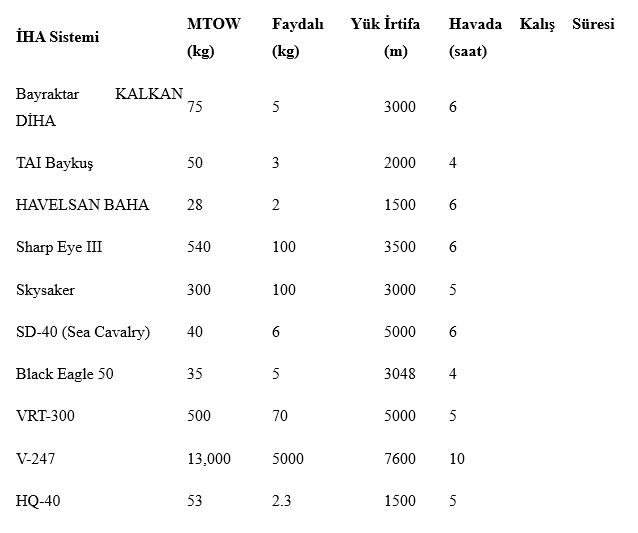
The Bayraktar KALKAN UAV belongs to the category of lightweight and middle class compact UAVs and is considered comparable to systems such as the SD-40 and Black Eagle 50 due to its compact dimensions and operational flexibility. Local production Its competitive advantage lies in its advanced autonomous flight capabilities and its integration with the BG-160 Electro-Optical system, developed indigenously by Baykar, positioning it favorably among national and international counterparts.
Baykar Technologies. "Bayraktar DİHA – Tanıtım Videosu." YouTube. Accessed December 5, 2024. https://www.youtube.com/watch?v=ie6boIMUFLw
Baykar Technologies. #BayraktarKALKAN DİHA | FPV Drone Atış Testi. YouTube video, 00:53. November 28, 2025. Accessed December 2, 2025. https://www.youtube.com/watch?v=-ljmfX8kSk4.
Baykar Teknoloji. "Bayraktar DİHA testi geçti." Accessed December 5, 2024. https://baykartech.com/tr/haberler/bayraktar-diha-testi-gecti/
Baykar Teknoloji. "Bayraktar Kalkan DİHA’nın uçuş testleri başarıyla sürüyor." Accessed December 5, 2024. https://baykartech.com/tr/haberler/bayraktar-kalkan-dihanin-ucus-testleri-basariyla-suruyor/
Baykar Teknoloji. *Bayraktar DİHA.* Baykar Teknoloji. Accessed December 5, 2024. https://www.baykartech.com/tr/uav/bayraktar-diha/
DonanımHaber. "Baykar’dan dikey iniş kalkışlı insansız hava aracı geliyor: Bayraktar DİHA." Accessed December 5, 2024. https://www.donanimhaber.com/baykar-dan-dikey-inis-kalkisli-insansiz-hava-araci-geliyor-bayraktar-diha--114492
NTV. "Bayraktar Kalkan DİHA 30’uncu testi başarıyla tamamladı." Accessed December 5, 2024. https://www.ntv.com.tr/galeri/turkiye/bayraktar-kalkan-diha-30uncu-testi-basariyla-tamamladi,tbr2KU1hAk6OcTI5C0bofA/sQTd7kZb3UC9O2lY2oGjKQ
Sabah. "Bayraktar DİHA geliyor: Baykar nefes kesen görüntüleri paylaştı, işte muhteşem özellikleri." Accessed December 5, 2024. https://www.sabah.com.tr/galeri/ekonomi/bayraktar-diha-geliyor-baykar-nefes-kesen-goruntuleri-paylasti-iste-muhtesem-ozellikleri/4
SavunmaTR. “Bayraktar DİHA TEKNOFEST 2021’de.” Accessed December 5, 2024. https://www.savunmatr.com/bayraktar-diha-teknofest-2021de/
TGRTHaber. "Bayraktar Kalkan DİHA’dan yeni başarı: 6 prototipi ilk uçuşunu gerçekleştirdi." Accessed December 5, 2024. https://www.tgrthaber.com/teknoloji/bayraktar-kalkan-dihadan-yeni-basari-6-prototipi-ilk-ucusunu-gerceklestirdi-2970002
TRT Haber. "Bayraktar Kalkan DİHA 40’ıncı uçuş testini başarıyla tamamladı." Accessed December 5, 2024. https://www.trthaber.com/haber/gundem/bayraktar-kalkan-diha-40-ucus-testini-basariyla-tamamladi-870384.html

Type(s) | Vertical Takeoff and Landing Unmanned Aerial Vehicle | ||||||||
|---|---|---|---|---|---|---|---|---|---|
National Origin | Türkiye | ||||||||
Developer(s) | Baykar Teknoloji | ||||||||
First Flight(s) | 19.04.2022 | ||||||||
No Discussion Added Yet
Start discussion for "Bayraktar KALKAN DİHA" article
Development Process
Development Timeline
Technical Specifications
Performance Characteristics
Sensors and Avionics Systems
Useful Loads and Missions
General Features
Vertical Takeoff and Landing Capability
Flexible Mission Profile
Advantages for Use on Floating Platforms
Civilian Mission Profile
Easy Transportability
Air-Launched UAV Deployment Capability
National and International Counterparts
National Counterparts
International Counterparts