
This article was automatically translated from the original Turkish version.
+1 More
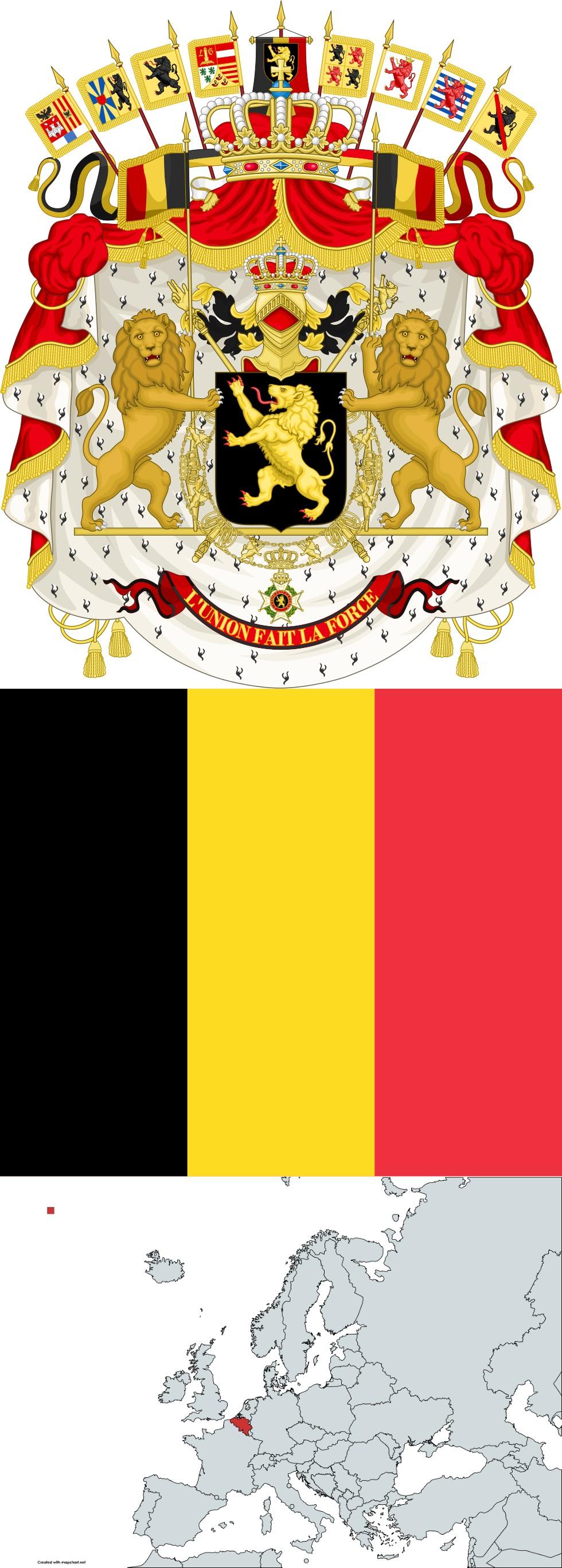
Kingdom of Belgium
Official Name | Kingdom of Belgium | ||||||||
|---|---|---|---|---|---|---|---|---|---|
Form of Government | Constitutional Monarchy – Federal Parliamentary Democracy | ||||||||
Date of Independence | 4 Ekim 1830 | ||||||||
Capital | Brussels | ||||||||
Head of State | Bart De Wever, King Philippe | ||||||||
Official Languages | Dutch, French, German | ||||||||
Common Languages | English | ||||||||
National Day | 21 July | ||||||||
Area | 30,528 km² | ||||||||
Total Population | 11.9 million | ||||||||
Climate | Temperate Oceanic Climate | ||||||||
GDP (Nominal) | 664.56 Billion US Dollars | ||||||||
GDP per Capita | 57,400 US Dollars | ||||||||
Ethnic Groups | German-Speaking Community (%1) Flemish (%60) Walloons (%39) Immigrant-Origin Population 17%: Moroccan Italian Turkish Polish Romanian | ||||||||
Telephone Code | +32 | ||||||||
Internet Domain Code | .be | ||||||||
Religious Structure | Muslim (%7) Catholic Christian (%57) Non-religious / Agnostic (%25) Protestant and Other Christian Denominations (%4) Other (%7) | ||||||||
Belgium, located in the center of Western Europe, has historically been at the intersection of European politics, industrialization, and cultural diversity. Despite its small area of only 30,688 km², its influence on continental history far exceeds its population and territorial size. The country is bordered by the Netherlands to the north, Germany to the east, Luxembourg to the southeast, France to the south and west, and the North Sea to the northwest. Its capital, Brussels, is not only the capital of Belgium but also the de facto diplomatic center of the European Union and NATO.
Belgium has a complex federal structure composed of three regions (Flanders, Wallonia, and Brussels) and three official languages (Dutch, French, and German). This multilingual and multicultural structure has made it a unique example in Europe, both in terms of cultural richness and administrative flexibility. The country stands out for its high standard of living, strong industrial infrastructure, advanced transportation network, and hosting of international organizations.
In the 21st century, Belgium continues to function as one of Europe’s political centers and remains an influential actor on the global stage in the fields of diplomacy, human rights, renewable energy, and peace policies.
Belgium’s national anthem is “La Brabançonne”. The lyrics were written in 1830 during the Belgian Revolution by Alexandre Dechet (Jenneval), and the music was composed by François Van Campenhout. The anthem is performed in all three official languages: French, Dutch, and German. The text glorifies the country’s struggle for independence, the ideal of freedom, and the unity of its people.
“La Brabançonne” is a symbol of Belgium’s post-revolutionary identity. Although different linguistic communities sing their own versions, the anthem’s core themes— independence, peace, and solidarity—have become the common foundation of Belgian national consciousness.
Belgian National Anthem (Youtube)
Human settlement in the territory of Belgium dates back to the Stone Age (around 4000 BC). Before Roman times, the region was inhabited by Celtic Belgae tribes, who gave the country its name. Following Julius Caesar’s Gallic Wars (57–50 BC), these tribes were incorporated into the Roman Empire and formed the province of “Gallia Belgica.” Throughout the Roman period, the region developed military roads, trade centers (Tongeren, Tournai, Arlon), and urban settlements.
In the 5th century, with the collapse of the Roman Empire, Frankish tribes gained dominance over the region. During this period, the territory of modern Belgium became one of the economic and administrative centers of Western Europe under the Merovingian and Carolingian dynasties of the Frankish Kingdom. During the reign of Charlemagne, the area now known as Belgium was part of the region called Lower Lorraine.
From the 10th century onward, Belgian territories were divided into autonomous duchies and counties such as Flanders, Brabant, Hainaut, and Namur. These regions became the heart of the European economy, particularly due to the wool trade and textile industry. Cities like Bruges, Ghent, and Ypres were among the major ports of the Hanseatic League during the Middle Ages.
In the 11th century, the House of Burgundy united Flanders and Brabant, creating political cohesion. In 1477, after the death of Duchess Mary of Burgundy, the region passed to the House of Habsburg. This era witnessed the rise of early Flemish masters in art; painters such as Jan van Eyck, Rogier van der Weyden and Hans Memling were pioneers of the Northern Renaissance.
In the 16th century, the Spanish Habsburgs governed the region as a Catholic stronghold. With the spread of Protestantism in the north during the Reformation, a religious and political divide emerged between what is now the Netherlands and Belgium. The Eighty Years’ War, which began in 1568, resulted in the independence of the northern Dutch Republic, while the southern territories of modern Belgium remained under Spanish rule as “Spanish Netherlands.”
In the 17th century, control passed to the Austrian Habsburgs. In 1794, the French Revolutionary Armies invaded the country; Belgium was annexed by France in 1795. After Napoleon’s defeat, the Congress of Vienna in 1815 united Belgium with the Kingdom of the Netherlands to form the “United Kingdom of the Netherlands.” However, differences in language, religion, and economy made this union unsustainable.

The Battle of Waterloo, Napoleon’s Final Battle, 18 June 1815 (Flickr)
A revolt that began in Brussels on 25 August 1830 quickly turned into a nationwide independence movement. On 4 October 1830, Belgium declared its independence; in 1831, Leopold I ascended the throne as the country’s first king. The new constitution was based on liberal principles, guaranteeing religious freedom and a parliamentary system.
Throughout the 19th century, Belgium rapidly industrialized and became one of Europe’s leaders in coal, iron, and textile production. However, this growth was also supported by colonialism: King Leopold II administered the Congo Free State as his personal possession from 1885; this period is recorded as one of the darkest episodes of colonial exploitation in human history.

Brussels Grand Place (Picryl)
Belgium was occupied in both World Wars. Germany’s invasion of neutral Belgium in World War I prompted Britain to enter the war. During World War II (1940–44), the country again fell under German control, but resistance movements remained strong.
After the war, Belgium played an active role in rebuilding Europe. In 1949, it became a founding member of NATO, and in 1951, one of the founding states of the European Coal and Steel Community (the precursor to the EU). Brussels today hosts the European Commission, the Council of the European Union and the European Parliament.

The European Commission Building in Brussels (Public Domain Pictures)
Belgium is located in the northwestern part of Western Europe, occupying a small but strategic position. With a total area of 30,688 km², its territory can be divided into three main regions: the Coastal Plain (La Plaine Côtière), the Central Plateau (Le Plateau Central), and the Ardennes Highlands (Les Ardennes). These three regions define the country’s character in terms of both natural environment and economic activity.
The coastal region consists of low sand dunes along the North Sea. This area is in constant interaction with the sea; polders protected by dikes are lands reclaimed from the sea, similar to those in the Netherlands. Central Belgium includes the capital Brussels and the city of Antwerp; it is the country’s industrial and commercial center, characterized by fertile soils and dense population. The Ardennes region in the south, with its dense forests, granite hills, and valley structures, maintains the country’s ecological balance.
Situated at the intersection of European climatic systems, Belgium has a temperate oceanic climate. This results in humid winters, cool summers, and consistent rainfall throughout the year. Average temperatures range from 3–5 °C in winter and 17–20 °C in summer. Annual precipitation varies between 750–1000 mm across the country.

Belgium National Borders (Picryl)
Belgium’s land borders total 1,297 km.
Belgium’s strategic location has made it a crossroads of Europe’s transportation, energy, and trade networks. Corridors running from east to west connect Amsterdam–Paris and Cologne–London. Brussels lies at the political center of this axis.
Belgium is generally a low-lying country with an average elevation of 181 meters. However, the Ardennes Mountain Region in the southeast forms the country’s highest area, with elevations ranging from 300 to 700 meters. The highest point is Signal de Botrange at 694 meters. This region, with its rich forest cover and granite terrain, serves as the country’s ecological balance zone.
The Ardennes have historically served as both a natural boundary and a military defense line. During both World Wars, this region was of great strategic importance as a transit corridor. Today, it is one of the country’s most valuable natural assets for hiking, cycling, and nature tourism.
The northern and central parts of Belgium consist of extensive alluvial plains and gently sloping plateaus. The Flemish Plain is the country’s most densely populated region in terms of agriculture and industry. The Central Belgian Plateau, surrounding Brussels and Leuven, has historically been the focal point of both agricultural production and urbanization.
Meuse (Maas) and Sambre valleys formed the foundation of the country’s industrial development. In the 19th century, the rise of coal and steel industries shaped these valleys. Today, these areas are centers of energy production and logistics networks.
Belgium is rich in water resources. Its main rivers are the Scheldt (Escaut), Meuse (Maas), Sambre, and Yser (Ijzer).
Natural lakes are rare in Belgium; however, artificial reservoirs such as Eupen, Gileppe, and Robertville are important for water storage and energy production.
Belgium has a temperate oceanic climate. Air masses from the Atlantic Ocean create balanced temperatures throughout the year. The average annual temperature in Brussels is around 10.5 °C.
Although the climate is favorable for agriculture, air quality has declined in recent decades due to increasing urbanization and industrialization. Since the 2020s, Belgium has increased its use of renewable energy sources in line with its carbon neutrality goals.
Belgium is one of Europe’s most economically dense countries relative to its size. It has a complex economic structure based on high-value-added production, advanced technology, logistics networks, and financial services. Belgium, one of the first countries in Europe to experience the Industrial Revolution in the 19th century, became the second industrialized nation after Britain and was known as “Europe’s Workshop” during that era.
Today, Belgium’s economy is defined by its open market structure and dependence on foreign trade. Approximately 85% of its gross domestic product (GDP) comes from export and import activities. Due to its central location in Europe, Belgium acts as a logistical bridge between Germany, France, the Netherlands, and the United Kingdom. Brussels is one of the most important regulatory centers of the European financial market; Antwerp is the world’s second-largest port and the heart of the global diamond trade.
Belgium’s economy has a balanced structure among its three main regions: the Flemish Region is the engine of industry and exports. The Wallonia Region is the center of heavy industry and energy production. The Brussels Capital Region is the hub of finance, services, and diplomacy.
As of 2025, Belgium’s economy is strong, stable, and high-income. The country’s nominal gross domestic product (GDP) stands at $689.36 billion. Its per capita national income of $58,256 is significantly above the European Union average. Its GDP adjusted for purchasing power parity reaches $889.83 billion. Despite global recessionary pressures in 2024, the economy showed real growth of 1.2%.
Inflation rate was measured at 3.2%, kept under control despite fluctuations in energy prices across Europe. The unemployment rate stands at 5.4%, with a dynamic labor market particularly in the service and technology sectors. The public debt-to-GDP ratio is at 105%, above the EU’s Maastricht criteria, but is considered sustainable due to Belgium’s fiscal discipline and high credit rating.
The country’s currency is the Euro (EUR), fully aligned with the monetary policies of the European Central Bank. Its most important trade partners are Germany, France, the Netherlands, the United States, and the United Kingdom. Belgium’s economic strength rests on its open trade model, advanced financial system, and export-oriented production structure.

Port of Antwerp, the Lifeline of Belgium’s Economy (Public Domain Images)
Industry: Belgium is among Europe’s leaders in chemicals, pharmaceuticals, food processing, machinery, metallurgy, and automotive sectors. Major multinational corporations such as Solvay, UCB, Umicore, and AB InBev are headquartered in Belgium. Historically, the areas around Liège and Charleroi were the cradle of heavy industry; in the 21st century, they have shifted toward advanced materials and energy technologies.
Service sector: Finance, logistics, law, and diplomacy dominate. Brussels, due to the presence of EU institutions, hosts over 120,000 diplomatic and international personnel. The banking system is among the most secure financial environments in the EU, with high regulatory standards.
Agriculture: Only 1.1% of total employment is in agriculture. Potatoes, sugar beet, wheat, and dairy products are prominent. The Flanders region represents a model of intensive technology and efficiency in agriculture.
Belgium has one of the world’s highest volumes of foreign trade relative to its GDP. In 2023, exports reached $549 billion and imports reached $520 billion.
The Port of Antwerp alone accounts for 15% of intra-EU trade. Belgium is also among the few European countries that export energy products to Germany and France.
Belgium ranks above the European average in the OECD’s 2023 Ease of Doing Business Index. The most attractive sectors for foreign investors are pharmaceuticals, biotechnology, chemicals, and information technology.
As of 2023, the country hosts over 45,000 foreign-capital companies. The stock of foreign direct investment stands at $595 billion.
The Belgian government provides incentives, tax breaks, and R&D support to investors through agencies such as Brussels Invest & Export and Flanders Investment & Trade. A transparent judicial system and strong intellectual property laws ensure a stable business environment.
Belgium’s energy infrastructure is among the most integrated in the EU. As of 2023, the country imports approximately 70% of its energy needs. Nuclear energy provides 45% of national electricity generation; the remainder comes from natural gas (30%), renewable energy (20%), and other non-coal sources.
By 2025, the gradual closure of the Doel and Tihange nuclear plants is planned, with accelerated investments in wind and offshore energy. Offshore wind farms in the North Sea with a total capacity of 2 GW are among Europe’s most concentrated energy corridors.
Transportation infrastructure is a fundamental pillar of the country’s economic strength. Brussels Airport leads in diplomatic air traffic within the EU. A network of 1,500 km of highways and 3,600 km of railways directly connects Belgium to Germany, France, and the Netherlands. The Port of Antwerp ranks among the world’s top 20 container ports, while the Zeebrugge port is the EU’s most important terminal for liquefied natural gas (LNG).
As of 2023, Belgium has a population of 11.7 million, making it one of Europe’s most densely populated countries. Population density is approximately 385 people per square kilometer, more than double the European average. The country’s population structure is highly complex, shaped by linguistic and regional identities. Approximately 58% of the population lives in the Flemish Region (north), 32% in the Wallonia Region (south), and 10% in the Brussels Capital Region.
Belgium has a balanced federal language system with three official languages: Dutch (Flemish), French, and German. Dutch is spoken in the north, French in the south, and German in small eastern cantons. This linguistic division is institutionally embedded across all areas of social life, from education to political representation.
98% of the population lives in urban areas, resulting in a very high urbanization rate. Cities such as Brussels, Antwerp, Ghent, Liège, and Bruges serve as the country’s cultural and economic centers. Brussels’ unique status as the seat of international institutions has led to approximately one-third of its resident population being of foreign origin.

Belgium Population Distribution (CIA World Factbook)
According to 2025 data, Belgium’s population growth rate is 0.5%, the fertility rate is 1.6 children per woman, and the average life expectancy is 83 years for women and 79 years for men. The literacy rate exceeds 99%. The immigrant population stands at 17%, significantly above the European average. The majority of immigrants originate from Morocco, Italy, France, Romania, and Türkiye.
97% of the population lives in urbanized areas. The Brussels Capital Region, together with EU institutions, NATO headquarters, and international organizations, forms a multinational settlement. Antwerp is the country’s economic engine; Ghent is a cultural center; Liège stands out as an industrial and university city. Rural areas have low population density, with agriculture, forestry, and rural tourism being common.
Belgium is not ethnically homogeneous, but its constitution defines distinctions based on linguistic communities rather than ethnicity. Flemings (approximately 60%) and Walloons (39%) form the country’s two major communities; a small German-speaking minority (1%) lives along the eastern border. Over the past two decades, growing migration flows have made communities from North Africa, the Middle East, and Eastern Europe significant components of the national population.
Secularism is constitutionally guaranteed in Belgium. Although there is no official religion, the majority of the population has historically been Catholic Christian. According to 2023 data, approximately 57% of the population identifies as Catholic, 25% as non-religious, 7% as Muslim, and the remainder belong to Protestant, Orthodox, or other faith groups. The Muslim population in Brussels approaches 20%.
Belgium’s education system is of high standard and managed at the regional level. Education is compulsory between ages 6 and 18 and is state-funded. The country ranks among the top five in Europe in per capita education spending. Higher education is internationally recognized through prestigious institutions such as KU Leuven, Ghent University, the Free University of Brussels (ULB), and the University of Liège.
The literacy rate is 99.5%. The language of instruction varies by region: Dutch in Flanders, French in Wallonia, and German in the Eupen region in the east. In Brussels, education is provided in both Dutch and French, with parents choosing the language of instruction. Bilingualism and cultural diversity in education are fundamental pillars of the federal structure.

Library of KU Leuven, Belgium’s Oldest University (Flickr)
Natural population growth is low; therefore, Belgium’s population increase is largely dependent on migration flows. Since 2020, migrant groups from Ukraine, Syria, and North Africa have settled in the country. The growth of the working-age population is crucial for the sustainability of the social security system. The government pursues policies encouraging skilled labor migration.
Aging populations are evident in rural areas. In eastern Wallonia, youth migration to urban centers has deepened regional development disparities. In contrast, the Flemish region maintains its demographic dynamism through higher fertility rates and successful immigrant integration.
Belgium is one of Europe’s countries distinguished by its cultural richness in tourism. Approximately 10 million tourists visit the country annually. Tourism revenue exceeded $17 billion in 2023. Tourism contributes 6% to the national economy and directly employs 200,000 people.
Belgium’s tourism structure is built around historic city centers, art museums, gastronomy, and cultural festivals. Brussels attracts year-round visitors due to international conferences and diplomatic events. Bruges, known as “the Venice of the North,” with its canals and medieval architecture, is on the UNESCO World Heritage List. Ghent and Antwerp stand out for their art galleries, universities, and diamond trade.
The Ardennes region in the east is known for nature tourism, hiking trails, and winter sports. The town of Spa is recognized as the birthplace of the modern concept of spa resorts. Leuven and Namur are notable for their cultural heritage, while Waterloo is the symbolic site of Napoleon’s battles.

One of Belgium’s Most Touristic Areas, Bruges and Its Canals (Pexels)
Belgium has a foreign policy tradition rooted in multilateral diplomacy, situated at the heart of the modern international system. Its historical position as a crossroads of European powers has shaped its political culture around a “policy of balance and dialogue.” Since the mid-20th century, Belgium has been described as a “small but influential actor in global diplomacy.”
Belgium’s foreign policy orientation has been built since World War II around European integration and transatlantic alliance. As one of the six founding members of the European Union, Belgium has played an active role in every stage of the integration process. Brussels is today the de facto capital of the EU, hosting institutions such as the European Commission, the Council of the European Union, and the European Parliament. This position grants the country not only diplomatic prestige but also significant economic and logistical advantages.
Belgium is an active member of multilateral organizations including the United Nations, the World Trade Organization (WTO), the OECD, the IMF, the Council of Europe, and the International Criminal Court. Its foreign policy priorities can be summarized as human rights, development aid, environmental policies, and peace missions. In Africa, particularly with the Democratic Republic of the Congo, it has elevated its historical ties to the level of economic partnership. Belgium also plays an active role in NATO’s operational planning and maintains a foreign policy based on international law.
Brussels’ identity as an international capital has placed Belgium at the center of EU and NATO decision-making mechanisms. This means Belgium largely bases its national security on collective defense systems. As a result, Belgium conducts its national security strategy primarily through multilateral security networks, intelligence sharing, and diplomatic mediation.

NATO Headquarters in Brussels (Flickr)
Belgium–Türkiye relations date back to the 1838 Ottoman–Belgian Treaty of Friendship. After the Cold War, bilateral relations acquired an institutional character within the frameworks of NATO and the EU. Brussels hosts both NATO headquarters and one of Türkiye’s most concentrated diplomatic networks in Europe.
Since the 2020s, two dimensions have come to the fore: economic cooperation and migration policies. Türkiye is a strategic partner for Belgium’s interests in the Middle East and Southern Europe energy corridors. Bilateral trade volume reached $10 billion in 2023. Turkish companies have a strong presence in Belgium, particularly in logistics, textiles, food, and construction sectors.
Additionally, the approximately 280,000-strong Turkish diaspora in Belgium forms the social foundation of bilateral relations. Turkish civil society organizations play active roles in Brussels and Ghent, conducting joint projects in education, culture, and business. Although there is no direct joint defense industry production, technical information sharing, cyber defense, and joint exercises continue within the NATO framework.

President of Türkiye Recep Tayyip Erdoğan with Charles Michel, President of the European Council, in Brussels (Anadolu Ajansı)
The Belgian Armed Forces (Belgische Defensie / La Défense belge) have a professional military structure. Conscription was abolished in 1994. As of 2023, the total active personnel strength is 25,000; approximately 14,000 serve in the Army, 2,500 in the Air Force, 1,500 in the Navy, and 7,000 in logistics and support units.
The Belgian military operates fully integrated within NATO’s command system. Consequently, its national defense policy is largely aligned with the alliance’s strategic priorities. In 2023, Belgium raised its defense budget to €7.2 billion and set a target of reaching 2% of GDP by 2030.
As part of its modernization process, the Army is integrating Franco-German joint armored vehicle systems (Scorpion Program) and U.S.-made F-35A Lightning II fighter jets. The Navy is modernizing under a joint project with the Netherlands for frigates and submarines.
Although its defense industry is small in scale, Belgium specializes in high technology, radar systems, munitions, unmanned aerial systems, and cybersecurity. Companies such as FN Herstal (weapons systems), Sonaca (aviation component manufacturing), and Sabca (space and aircraft technologies) are critical suppliers in NATO and EU projects.
The Belgian military is an active participant in international peacekeeping missions. It has deployed units in Kosovo, Mali, Niger, and the Baltic states. It also plays an active role in NATO’s “Enhanced Forward Presence” missions supporting the eastern flank.
In recent years, priority has been given to cyber defense and countering hybrid threats. The Cyber Command, established in 2021, works in coordination with NATO allies. Although Belgium limits its military power projection, its technological capabilities, intelligence capacity, and international cooperation networks enable it to maintain a disproportionately effective defense architecture.
Anadolu Ajansı. "Cumhurbaşkanı Erdoğan Belçika'da." Anadolu Ajansı, March 9, 2020. Accessed November 5, 2025.https://www.aa.com.tr/tr/pg/foto-galeri/cumhurbaskani-erdogan-belcikada-
Beata Makuch. "View of Canal and Brick Buildings in Bruges, Belgium." Pexels. Accessed November 5, 2025.https://www.pexels.com/photo/view-of-canal-and-brick-buildings-in-bruges-belgium-17352442/
Castanheira, M., Périlleux, G., Talukder, D., & Bandelow. 2024. *Belgium Report SGI 2024*. Bertelsmann Stiftung. Accessed November 12, 2025.https://www.sgi-network.org/docs/2024/country/SGI2024_Belgium.pdf.
Central Intelligence Agency. "Belgium." CIA. September 25, 2025. Accessed November 5, 2025.https://www.cia.gov/the-world-factbook/countries/belgium/
Central Intelligence Agency. "Belgium: People and Society." CIA. September 25, 2025. Accessed November 5, 2025.https://www.cia.gov/the-world-factbook/countries/belgium/#people-and-society
Dış Ekonomik İlişkiler Kurulu (DEİK). *Belçika Bilgi Notu.* DEİK. January 2025. Accessed November 12, 2025.https://www.deik.org.tr/uploads/belcika-bilgi-notu-ocak-2025.pdf
European Commission. "Economic Forecast for Belgium." European Commission, May 19, 2025. Accessed November 11, 2025.https://economy-finance.ec.europa.eu/economic-surveillance-eu-economies/belgium/economic-forecast-belgium_en.
European Commission. *2025 European Semester: Country Reports - Belgium.* Brussels: European Commission, Directorate-General for Economic and Financial Affairs, 2025. Accessed November 5, 2025.https://economy-finance.ec.europa.eu/publications/2025-european-semester-country-reports_en
Frans De Wit. "Short road trip to Belgium, and a long walk in the woods." Flickr. October 24, 2011. Accessed November 5, 2025.https://www.flickr.com/photos/fransdewit/6277229463/in/photostream/.
Ian Berwick. "National Anthem: Belgium - Brabançonne Trilingual." YouTube. October 14, 2015. Accessed November 5, 2025.https://www.youtube.com/watch?v=Cl8lBsmvYYU
International Monetary Fund (IMF). *Belgium: 2024 Article IV Consultation Report.* Washington, DC: IMF Publications, 2024. Accessed November 5, 2025.https://www.imf.org/en/countries/bel
NATO. "NATO's new headquarters in Brussels, Belgium." Flickr, March 19, 2018. Accessed November 5, 2025.https://www.flickr.com/photos/nato/27029507408
NATO. *Belgium and NATO*. NATO. Accessed November 5, 2025.https://www.nato.int/cps/en/natohq/declassified_162358.htm.
OECD. *Economic Surveys: Belgium 2024*. Paris: OECD Publishing, 2024. Accessed November 5, 2025.https://www.oecd.org/en/publications/oecd-economic-surveys-belgium-2024_c671124e-en.html
PERCEPTIONS. "Belgium: PERCEPTIONS Country Report 1.0." PERCEPTIONS. Accessed November 12, 2025.https://www.perceptions.eu/wp-content/uploads/2022/07/PERCEPTIONS-Country-Report-A4-Belgium-1.0.pdf.
Penn State University Libraries. "Centrale Bibliotheek: overview of front facade and tower from Monseigneur Ladeuzeplein." Flickr. Accessed November 5, 2025.https://www.flickr.com/photos/psulibscollections/19136645580/in/photostream/
Picryl. "Belgium. Historic Map. Library of Congress." Picryl, 1985. Accessed November 5, 2025.https://picryl.com/media/belgium
Picryl. "La Grande Place Brussels, Belgium." Accessed November 5, 2025.https://picryl.com/media/la-grande-place-brussels-belgium
Public Domain Pictures. "Berlaymont EU Building Brussels." Accessed November 5, 2025.https://www.publicdomainpictures.net/en/view-image.php?image=441310&picture=berlaymont-eu-building-brussels.
Public Domain Pictures. "Porto di Anversa." Accessed November 5, 2025.https://www.publicdomainpictures.net/it/view-image.php?image=96323&picture=porto-di-anversa&utm.
Royal Higher Institute for Defence. "Update of the Strategic Vision 2030: Recommendations." June 2021. Accessed November 12, 2025.https://www.defence-institute.be/wp-content/uploads/2021/06/200622-Strategic-Vision-2021-EN.pdf.
Statistics Belgium. *Population, Employment, and Urbanization Indicators 2024.* Brussels: Statbel, 2024. Accessed November 5, 2025.https://statbel.fgov.be/en
Swenden, W. 2003. *Belgian Federalism: Basic Institutional Features and Potential as a Model for the European Union*. London: Royal Institute of International Affairs (Chatham House). Accessed November 12, 2025.https://www.chathamhouse.org/sites/default/files/public/Research/Europe/swenden.pdf
World Bank. *Belgium Economic Update 2025*. Washington, DC: World Bank Group, 2025. Accessed November 5, 2025.https://data.worldbank.org/country/belgium

Kingdom of Belgium
Official Name | Kingdom of Belgium | ||||||||
|---|---|---|---|---|---|---|---|---|---|
Form of Government | Constitutional Monarchy – Federal Parliamentary Democracy | ||||||||
Date of Independence | 4 Ekim 1830 | ||||||||
Capital | Brussels | ||||||||
Head of State | Bart De Wever, King Philippe | ||||||||
Official Languages | Dutch, French, German | ||||||||
Common Languages | English | ||||||||
National Day | 21 July | ||||||||
Area | 30,528 km² | ||||||||
Total Population | 11.9 million | ||||||||
Climate | Temperate Oceanic Climate | ||||||||
GDP (Nominal) | 664.56 Billion US Dollars | ||||||||
GDP per Capita | 57,400 US Dollars | ||||||||
Ethnic Groups | German-Speaking Community (%1) Flemish (%60) Walloons (%39) Immigrant-Origin Population 17%: Moroccan Italian Turkish Polish Romanian | ||||||||
Telephone Code | +32 | ||||||||
Internet Domain Code | .be | ||||||||
Religious Structure | Muslim (%7) Catholic Christian (%57) Non-religious / Agnostic (%25) Protestant and Other Christian Denominations (%4) Other (%7) | ||||||||
National Anthem
History
Early Communities and Antiquity
Middle Ages and Feudal Period
Modern Period and the Struggle for Independence
The 1830 Revolution and the Modern Belgian State
The 20th Century and Today
Geography
Borders and Neighbors
Mountains
Plains and Valleys
Rivers and Lakes
Climate
Economy
Sectoral Distribution
Foreign Trade
Foreign Investment and Business Environment
Energy and Transportation Infrastructure
Demography, Education, and Culture
Key Demographic Indicators for 2025
Population Distribution and Urbanization
Ethnic Structure
Religious Distribution
Education and Literacy Rate
Migration and Population Decline
Tourism
Foreign Policy and Security
Relations with Türkiye
Military and Defense Industry